传统经济

Search documents
港股通50ETF(159712)涨超2%,多重驱动因素或支撑港股前景
Mei Ri Jing Ji Xin Wen· 2026-01-13 02:40
Core Viewpoint - The Hong Kong stock market is expected to experience three driving factors by 2026: international capital allocation, inflow of Chinese capital, and recovery of China's economic fundamentals [1] Group 1: International Capital - A weakening US dollar index is anticipated to drive capital inflow into the Hong Kong stock market [1] Group 2: Chinese Capital - The appreciation of the Renminbi is likely to attract Chinese capital that has been held overseas to invest in Hong Kong stocks, helping to avoid foreign exchange costs and benefit from asset recovery [1] Group 3: Economic Fundamentals - The expected rebound in CPI and PPI in 2026 may lead to a weak recovery in corporate profits, with potential for a strong recovery if combined with debt reduction policies [1] Group 4: Industry Insights - The Hang Seng Technology Index is expected to benefit from the "Davis Triple Play," with a high probability of success in AI application sectors [1] - The dividend yield of Hong Kong stocks, supported by tax advantages for insurance capital, is projected to continue outperforming that of A-shares [1] - The convergence of prices between innovative drugs in China and the US presents growth opportunities [1] - New consumption trends are expected to replicate the core asset bull market seen from 2019 to 2021 [1] Group 5: ETF Information - The Hong Kong Stock Connect 50 ETF (159712) tracks the Hong Kong Stock Connect 50 Index (930931), which selects the 50 largest listed companies within the Stock Connect framework, covering 18 industries including finance and information technology, reflecting the overall performance of large-cap leaders in both new and traditional economies, characterized by high growth and low valuation [1]
2026年A股市场策略展望:新老经济的平衡
Huafu Securities· 2025-12-12 12:58
Market Performance Review 2025 - The economic environment gradually stabilized under policy support, with PMI remaining below the growth line, indicating a "weak stabilization" trend [3][8] - PPI's year-on-year decline narrowed, while CPI showed an overall upward recovery, leading to a structural recovery in the economy, particularly in small-cap tech stocks driving a "fast bull" market [3][8] - The transition from "short on stocks, long on bonds" to "long on stocks, short on bonds" reflects a shift in trading logic, with the performance of equity assets improving significantly compared to bonds [9][31] Balance Between New and Traditional Economies - The contribution of the new economy to GDP remains limited, although it is steadily increasing, making it difficult to drive overall growth [3][20] - A style switch occurred post-August, with growth styles accelerating while value styles declined, indicating a divergence in returns between high and low valuation styles [3][20] - The valuation of the tech sector reached 3.95 times, higher than other sectors, suggesting that high valuation tech stocks may struggle to sustain market momentum [3][20] Market Outlook and Strategy for 2026 - The market is expected to be driven by value and quality styles in 2026, similar to the value bull market of 2016-2017, without necessarily requiring high trading volumes [3][19] - The investment logic for 2026 is characterized by "long on beta, short on volatility," with a focus on low-valuation value stocks to capture beta returns [3][19] - The market is entering a stable phase, with a gradual realization of low-valuation assets rather than a short-term surge in high-volatility assets [3][19] Fund Market Dynamics - The public fund market is characterized by a lack of incremental growth, maintaining a stock game due to the absence of new capital inflows [24][27] - Active equity funds show a significant bias towards sectors such as electronics, power equipment and new energy, pharmaceuticals, and communications [27][28] - The trend of excess savings has peaked and is now flowing into the equity market, indicating a shift in investor behavior [28][30]
宁德时代市值超越贵州茅台
Di Yi Cai Jing Zi Xun· 2025-09-25 13:20
Core Viewpoint - On September 25, CATL's market capitalization surpassed that of Kweichow Moutai, marking a significant shift in the market dynamics between traditional and new economy sectors [2][3][9]. Group 1: Market Performance - CATL's A and H shares experienced a strong rally, with A shares reaching a peak of 402.59 CNY and H shares hitting 535.5 HKD, resulting in a market cap exceeding 1.83 trillion CNY [3][4]. - In just nine trading days, CATL's market capitalization increased by approximately 310 billion CNY, highlighting its rapid growth compared to other companies in the A-share market [4][5]. - As of September 25, CATL's total market capitalization was about 1.8066 trillion CNY, slightly above Kweichow Moutai's 1.802 trillion CNY [3][4]. Group 2: Catalysts for Growth - The surge in CATL's stock price is attributed to a combination of market rumors, favorable policies, and solid performance metrics [5][6]. - Recent reports indicate a significant increase in orders for CATL, with a more than 50% month-on-month rise in September, driven by booming overseas energy storage demand [5][6]. - CATL's revenue for the first half of 2025 was reported at 178.89 billion CNY, a year-on-year increase of 7.27%, while net profit rose by 33.33% to 30.49 billion CNY [6]. Group 3: Industry Context - The competition between CATL and Kweichow Moutai symbolizes a broader transition from traditional consumption-driven sectors to new economy sectors focused on renewable energy and advanced technology [9][10]. - The rise of CATL reflects a global trend where technology companies dominate market valuations, as seen in the U.S. and Japan, indicating a potential shift in the A-share market as well [10][11]. - The Chinese technology sector is experiencing rapid advancements, particularly in key areas such as chips, artificial intelligence, and quantum technology, which are becoming crucial drivers of market growth [11].



宁德时代市值超越贵州茅台
第一财经· 2025-09-25 12:15
Core Viewpoint - The market capitalization of CATL has surpassed that of Kweichow Moutai, marking a significant shift in the capital landscape, indicating the rise of "new economy" forces centered around renewable energy and hard technology, challenging traditional consumption and manufacturing sectors [3][11]. Market Performance - On September 25, CATL's A and H shares surged, with A shares reaching a high of 402.59 CNY and H shares peaking at 535.5 HKD, leading to a market capitalization exceeding 1.83 trillion CNY, surpassing Kweichow Moutai's 1.8 trillion CNY [5][6]. - Over a span of nine trading days, CATL's market capitalization increased by approximately 310 billion CNY, with A shares rising over 20% from 325 CNY to above 392 CNY [5][6]. Industry Dynamics - Analysts attribute CATL's stock performance to a combination of market rumors, favorable policies, and solid financial results. Recent reports indicate a significant increase in orders, with a 50% month-on-month surge in September [6][8]. - The National Development and Reform Commission and the National Energy Administration have set ambitious targets for new energy storage installations, aiming for over 180 GW by 2027, primarily focusing on lithium-ion battery storage [7]. Financial Performance - In the first half of 2025, CATL reported revenues of 178.89 billion CNY, a year-on-year increase of 7.27%, and a net profit of 30.49 billion CNY, up 33.33% from the previous year [8]. - Institutional investors have shown strong interest, with 2,589 funds holding a total of 593 million shares, representing 13.47% of the circulating shares [8]. Market Transition - The competition between CATL and Kweichow Moutai reflects a broader economic paradigm shift, with traditional economic models represented by Moutai being challenged by new economic models led by CATL [11][12]. - The rise of technology-driven companies in the market is supported by both national policies and global economic transformations, indicating a potential long-term trend towards a tech-centric market structure [11][12].

宁德时代市值超越贵州茅台,9天猛增3100亿“涨出一个牧原股份”
Di Yi Cai Jing· 2025-09-25 11:09
Core Viewpoint - The market capitalization of CATL has surpassed that of Kweichow Moutai, marking a significant shift in the economic landscape from traditional consumption and manufacturing to new energy and hard technology sectors [1][7]. Group 1: Market Performance - On September 25, CATL's A and H shares surged, with A shares reaching a high of 402.59 CNY and H shares hitting 535.5 HKD, leading to a market cap exceeding 1.83 trillion CNY [2][3]. - In just nine trading days, CATL's market capitalization increased by approximately 310 billion CNY, reflecting a rise of over 20% from 325 CNY to above 392 CNY [2][3]. - As of September 25, CATL's total market capitalization was approximately 1.8066 trillion CNY, slightly above Kweichow Moutai's 1.802 trillion CNY [2]. Group 2: Catalysts for Growth - The strong performance of CATL's stock is attributed to a combination of market rumors, favorable policies, and solid financial results [3]. - Recent reports indicate a significant increase in orders for CATL, with a more than 50% month-on-month surge in September, and a projected net profit of 86 billion CNY by 2026 [3][4]. - Policy support includes the National Development and Reform Commission's plan to achieve a new energy storage capacity of over 180 GW by 2027, primarily using lithium-ion battery technology [4]. Group 3: Institutional Support - CATL is a popular stock among institutional investors, with 2,589 funds holding a total of 593 million shares, representing 13.47% of the circulating shares [5]. - The trend of increasing institutional holdings has been evident, with significant additions to the top shareholders list in 2023 [5]. Group 4: Economic Paradigm Shift - The competition between CATL and Kweichow Moutai symbolizes a broader transition from traditional to new economic paradigms, with CATL representing the new economy focused on technology and sustainability [7]. - The rise of technology-driven companies in the market reflects a global trend where tech firms dominate market capitalizations, as seen in the U.S. and Japan [7][8].
南向资金流出银行、新消费,三季度资金如何调仓?
Di Yi Cai Jing· 2025-07-16 12:52
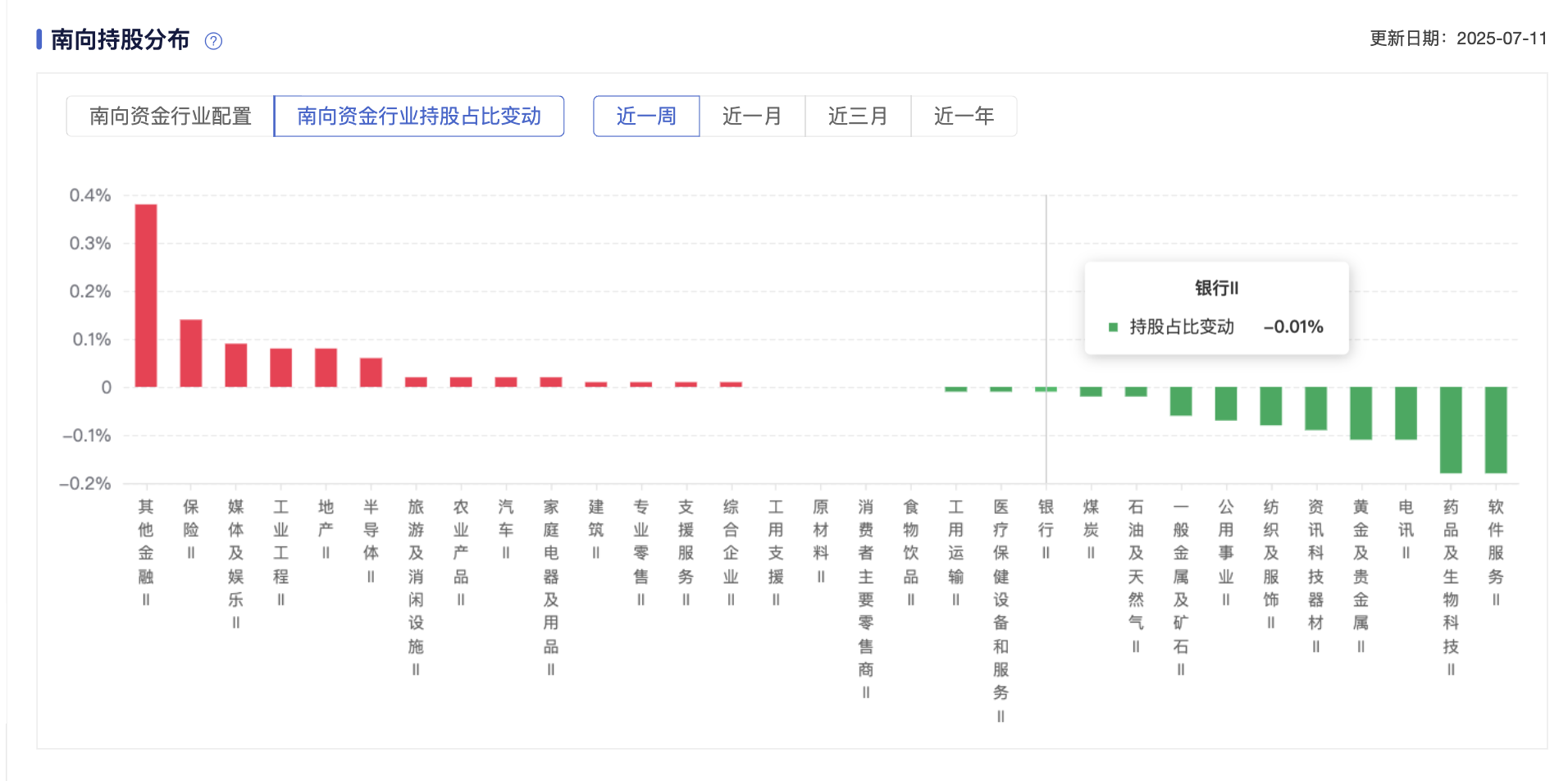
Group 1 - Recent southbound capital flows have shifted away from new consumption, biomedicine, and banking sectors, which were previously favored [1][3] - Despite a slight net outflow from foreign capital in Hong Kong and A-shares, there remains an overall optimistic outlook for the Chinese stock market among foreign investors [1][12] - The investment strategy is leaning towards a "barbell" approach, focusing on dividend-yielding assets and resource sectors while also targeting growth themes like innovative pharmaceuticals and technology [1][10] Group 2 - The banking sector has seen a notable shift to net outflows, contrasting with its previous strong performance, particularly within the CSI 300 index [3][4] - New consumption stocks, such as Pop Mart, have experienced significant valuation increases, but recent trends indicate a correction phase [4][9] - The outlook for the second half of the year suggests potential opportunities in the Hang Seng Technology sector and high-quality traditional enterprises, which are currently undervalued [10][11] Group 3 - Foreign capital remains under-allocated in the Chinese market, with ample room for increased investment, particularly in the context of a low-interest-rate environment [12][13] - The Hong Kong IPO market is witnessing a revival, with 51 companies having raised a total of HKD 124 billion so far this year, indicating strong market sentiment [12][13] - Active IPO activities are generally associated with improved market sentiment, which could positively impact related A-share and Hong Kong-listed companies [13]