供给侧结构性优化

Search documents
钢材、铁矿:供需双弱、重心下移
Xin Ji Yuan Qi Huo· 2025-12-22 10:57
1. Report Industry Investment Rating No information provided in the content. 2. Core Viewpoints of the Report - In 2025, the black industry chain was under pressure due to the pattern of "weak supply and demand", with the price center further moving down. In 2026, the pattern of "decreasing supply and weak demand" for steel is expected to continue, but the supply - demand gap may narrow marginally under policy guidance. The iron ore market is expected to enter a new stage of "continuous supply expansion and differentiated demand structure" [1][78][80]. - The "anti - involution" policy and supply - side structural optimization continued to exert force in 2025, accelerating supply contraction. In 2026, the policy direction of "controlling the total amount and optimizing the structure" remains unchanged for steel supply [1][78][80]. - The demand side shows significant differentiation and weakness. Real estate investment continued to decline, infrastructure investment growth slowed down significantly, and although steel exports provided some resilience, they were difficult to fully offset the decline in domestic demand [1][78]. 3. Summary According to Relevant Catalogs 3.1 Market Review: Weak Supply and Demand, Oscillating Downward - In 2025, black - series commodities continued the trend of oversupply and weak oscillation, with coking coal falling 5.94% and coke dropping 12.67%, iron ore's decline narrowing to 2.12%, and rebar falling 5.51%. The overall trend can be divided into four stages: oscillating upward from early January to late February, moving down from early March to late May, slowly rebounding from early June to early August, and oscillating downward from early August onwards [3][4]. 3.2 Steel Supply: Environmental Restrictions, Continuous Decline 3.2.1 Global Supply: Structurally Differentiated Economic Recovery, Production Expected to Continue Contracting - In the first 10 months of 2025, global crude steel production decreased year - on - year. China's crude steel production declined, while India's increased significantly, and the United States, Turkey and other countries also showed an upward trend. In 2026, global crude steel production is expected to continue a slight downward trend [10]. - In 2026, China's crude steel supply is expected to remain within 1 billion tons. India is expected to maintain an increasing trend, and the production of countries like Turkey is expected to continue growing, but it is difficult to fully make up for the reduction in China's production [1][13]. 3.2.2 Domestic Supply: Continuous Reduction due to Environmental Restrictions - Since 2021, China has implemented policies to control steel production capacity. In 2025, relevant policies further tightened the control of new production capacity. From January to October 2025, China's crude steel production was 817.41 million tons, a year - on - year decrease of 3.56%. It is expected that the annual production in 2025 will be in the range of 970 - 980 million tons, a decrease of about 2.5% - 3.5% compared with 2024 [16]. - In 2026, under the pressure of macro - policies and weak demand, China's crude steel production is expected to continue to contract [20]. 3.3 Steel Demand: Real Estate Continues to Weaken, Infrastructure Investment Growth Slows Down 3.3.1 Limited Support from Real Estate Policies, Difficult to Change the Weak Reality - In 2025, China introduced a series of real estate support policies, but the real estate market was still in a deep - adjustment period. From January to October, real estate development investment decreased by 14.77%, new housing construction area decreased by 19.87%, and the completion area decreased by 16.99%. In 2026, the real estate market will continue to be under pressure [25][30][32]. 3.3.2 Steel Exports Reach a New High in Total, but Structural Contradictions are Prominent - In 2025, China's steel exports maintained a high level in quantity, but the average export price continued to decline, and the product structure was continuously optimized. The exports to "Belt and Road" countries showed strong growth. Indirect exports of electromechanical products, automobiles (especially new - energy vehicles) were relatively optimistic, while home - appliance exports showed a downward trend [34][36][40]. 3.3.3 Investment: Manufacturing Remains Stable - In the first 10 months of 2025, China's fixed - asset investment was under pressure, but manufacturing investment remained resilient. In 2026, the manufacturing PMI is expected to improve marginally. Infrastructure investment growth slowed down in 2025, and in 2026, infrastructure construction investment will continue to follow the active fiscal policy orientation [42][46][53]. 3.4 Iron Ore: Loose Supply, Weakening Demand 3.4.1 Supply: Loose Overseas Ore Pattern, Limited Increment of Domestic Ore - In 2025, the production of the four major iron - ore mines increased slightly in the first three quarters. It is estimated that the annual production in 2025 will increase by more than 4% compared with 2024. The Simandou project started shipping, which will have a profound impact on the market pattern. In 2026, Vale and Rio Tinto plan to expand production capacity [57][61][62]. - In 2025, China's iron - ore production decreased year - on - year. From January to November, the import volume increased by 1.4%, and the port inventory reached a high level. In 2026, domestic production is expected to decline slightly, and the import dependence will remain high [69][71][72]. 3.4.2 Demand: Weak Domestic Demand, Weakening Export Support - In 2025, domestic demand for iron ore was weak, and the direct export growth of iron ore slowed down. In 2026, China's iron - ore demand is expected to continue the pattern of structural differentiation, with the overall pig - iron output slightly falling and steel exports being the core support [75]. - In 2026, the iron - ore market will enter a new stage of long - term supply relaxation. The price is expected to be under long - term downward pressure, and the market trading logic will shift from "quantity increase" to the game of "ore quality" and "production cost" [76]. 3.5 Summary and Outlook - In 2025, the black industry chain was under pressure, with supply contracting and demand weakening. The iron - ore market shifted from "tight balance" to "loose" [78][79]. - In 2026, the rebar price is expected to show an "M" - shaped oscillation, with the price center in the range of 3000 - 3500 yuan/ton. The iron - ore import price center is expected to be maintained in the range of 90 - 100 US dollars/ton [80][81].
磷化工板块震荡拉升,化工50ETF(516120)盘中走强,现涨2.47%!
Mei Ri Jing Ji Xin Wen· 2025-11-06 06:50
Core Viewpoint - The phosphorus chemical sector experienced significant market activity, leading to a 2.60% increase in the Chemical 50 ETF (516120), with over 90% of constituent stocks showing gains, driven by rising phosphorus prices and structural recovery in the industry [1] Group 1: Market Performance - The Chemical 50 ETF (516120) saw a rise of 2.60%, with a current increase of 2.47% at the time of reporting [1] - Major stocks such as Xin Fengming and Yuntianhua hit the 10% daily limit, while other constituents like Yangnong Chemical and Tongkun Co. also performed strongly [1] Group 2: Price Movements - The yellow phosphorus index increased by 4% on November 5, with a cumulative rise of over 7% in the past two weeks [1] - The price surge is attributed to the reduction in wet-process phosphoric acid production and the recovery in demand for downstream electrolyte raw materials [1] Group 3: Industry Outlook - Structural optimization is expected in the supply side of the basic chemical industry, supported by domestic "anti-involution" policies and rising overseas raw material costs [1] - The closure of European and American enterprises due to Asian capacity shocks allows China's chemical industry to fill international supply chain gaps, reshaping the global landscape [1] - In the medium to long term, demand recovery is anticipated under supportive policies, with significant growth potential in emerging fields such as semiconductors and new energy materials [1] Group 4: Sector Composition - The Chemical 50 ETF (516120) closely tracks the chemical sub-index (000813.CSI), with the top three sectors being chemical products (25.7%), agricultural chemicals (22.7%), and chemical raw materials (15%) [1] - The top ten weighted stocks include Wanhua Chemical, Salt Lake Co., Tianci Materials, Juhua Co., Cangge Mining, Jinfat Technology, Baofeng Energy, Hualu Hengsheng, Hengli Petrochemical, and Yuntianhua [1]
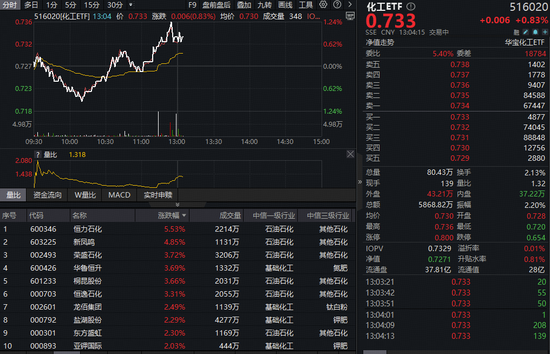
政策东风+数字化革命,化工板块逆市大涨!化工ETF(516020)盘中涨超1%,掘金低位布局正当时?
Xin Lang Ji Jin· 2025-10-23 05:15
Group 1 - The chemical sector showed resilience on October 23, with the chemical ETF (516020) rebounding after an initial dip, reaching a maximum intraday increase of 1.24% and closing up 0.83% [1][2] - Key stocks in the sector included Hengli Petrochemical, which surged over 5%, and several others like Xin Fengming and Rongsheng Petrochemical, which rose more than 3% [1][2] - The city of Linyi announced a focus on the fine chemical industry as one of its 13 key industrial chains, emphasizing new fertilizers and rubber materials [1][3] Group 2 - East China Securities noted a shift in the global chemical landscape, with Europe experiencing a decline in production capacity, leading to the closure of 21 major chemical plants and a loss of over 11 million tons of capacity [3] - China's chemical industry is filling gaps in the international supply chain due to its cost and technological advantages, potentially reshaping the global chemical landscape [3][4] - The chemical ETF (516020) is currently at a low valuation, with a price-to-book ratio of 2.23, indicating a favorable long-term investment opportunity [3][4] Group 3 - The outlook for the chemical sector suggests structural optimization on the supply side, with a focus on resilient and advantageous product segments [4][5] - The ETF tracks the CSI segmented chemical industry index, covering various sub-sectors, with nearly 50% of its holdings in leading stocks like Wanhua Chemical and Salt Lake Potash [5]


中国化工企业有望重塑化工产业格局,石化ETF(159731)逆势上行
Mei Ri Jing Ji Xin Wen· 2025-10-22 03:13
Core Viewpoint - The China Petroleum and Chemical Industry Index has shown a slight increase, with leading stocks such as Hengyi Petrochemical and China National Offshore Oil Corporation driving the gains. The structural optimization of supply is anticipated, with a focus on resilient and advantageous sectors [1] Group 1: Market Performance - On October 22, the China Petroleum and Chemical Industry Index opened lower but rose approximately 0.15% [1] - Key stocks leading the index include Hengyi Petrochemical, Rongsheng Petrochemical, Tongkun Co., and China National Offshore Oil Corporation [1] - The Petrochemical ETF (159731) has followed the index's upward trend, highlighting its value positioning [1] Group 2: Supply Side Dynamics - Domestic policies frequently emphasize the need for structural optimization on the supply side, particularly against excessive competition [1] - Rising raw material costs and capacity impacts from Asia have led to shutdowns and capacity exits among European and American chemical companies [1] - Short-term geopolitical tensions have increased uncertainty in overseas chemical supply [1] Group 3: Long-term Outlook - China's chemical industry chain possesses a clear competitive advantage, driven by significant cost benefits and ongoing technological advancements [1] - Chinese chemical companies are rapidly filling gaps in the international supply chain, potentially reshaping the chemical industry landscape [1] Group 4: ETF Composition - The Petrochemical ETF (159731) and its linked funds closely track the China Petroleum and Chemical Industry Index [1] - The basic chemical industry accounts for 61.93% of the index, while the petroleum and petrochemical industry represents 30.84% [1] - The top ten weighted stocks in the index include Wanhua Chemical, China Petroleum, and China National Offshore Oil Corporation, collectively accounting for 55.12% of the index [1]
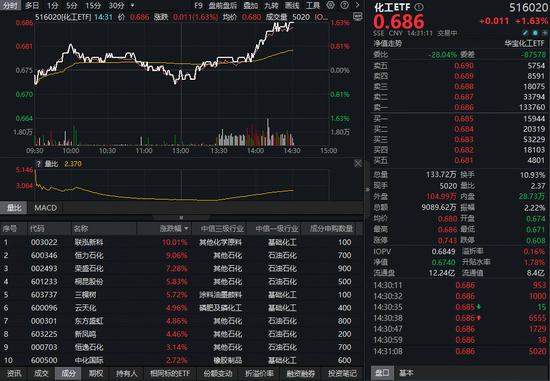
政策“反内卷”+海外产能退出,化工板块午后暴力拉升!联泓新科涨停,主力抢筹超44亿!
Xin Lang Ji Jin· 2025-08-20 06:43
Group 1 - The chemical sector experienced a significant surge on August 20, with the chemical ETF (516020) rising by 1.63% [1][2] - Key stocks in the sector saw substantial gains, including Lianhong Xinke reaching the daily limit, Hengli Petrochemical increasing over 9%, and Rongsheng Petrochemical rising over 7% [1][2] - The basic chemical sector attracted over 4.4 billion yuan in net inflows, ranking fifth among 30 sectors in terms of net capital inflow [1][3] Group 2 - Analysts suggest that supply-side structural optimization is expected, with domestic policies frequently addressing supply-side requirements [3] - The chemical industry in China is poised to fill gaps in the international supply chain due to its competitive advantages in cost and technology [3] - The valuation of the chemical ETF (516020) is at a low point, with a price-to-book ratio of 2.1, indicating a favorable long-term investment opportunity [4] Group 3 - Recommendations include identifying stocks with strong performance in Q2 and those benefiting from AI capital investments and U.S. tariff conflicts [5] - The chemical ETF (516020) provides a diversified investment approach, covering various sub-sectors and focusing on large-cap stocks [6]