
信用债套息策略

Search documents
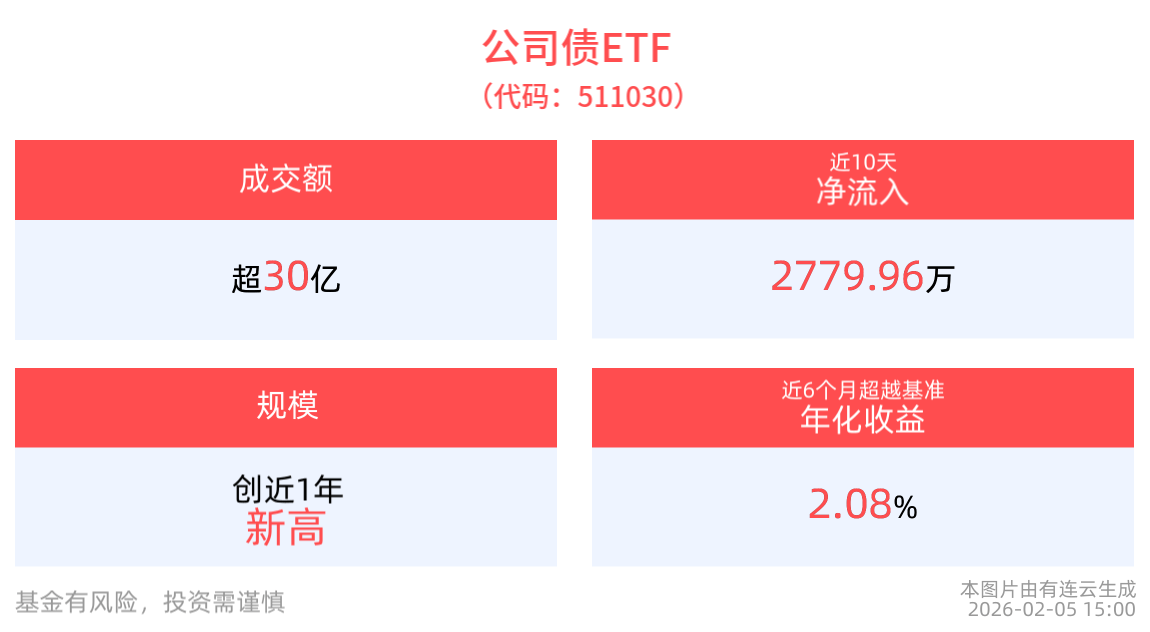
成交额超30亿元,公司债ETF(511030)近10个交易日净流入2779.96万元
Sou Hu Cai Jing· 2026-02-06 01:59
Group 1 - The credit bond carry strategy remains robust, but the safety cushion is narrowing, especially at the short end [9] - The current credit spread is at a relatively low level, suggesting attention to certain varieties and downgrading of coupon value [9] - The demand for amortized bond funds supports the logic that the public credit bond market has not yet significantly started but remains promising [9] Group 2 - The company bond ETF (511030) is experiencing a stalemate, with the latest quote at 106.94 yuan and a cumulative increase of 1.51% over the past year [3] - The trading volume of the company bond ETF is 8.85%, with a transaction value of 3.026 billion yuan, and an average daily transaction of 3.105 billion yuan over the past week [4] - The latest scale of the company bond ETF has reached 34.193 billion yuan, marking a new high in nearly a year [5] Group 3 - The company bond ETF has seen continuous net purchases of leveraged funds for five consecutive days, with the highest single-day net purchase reaching 19.1374 million yuan [5] - The maximum drawdown of the company bond ETF this year is 0.03%, with a recovery period of 7 days [5] - The management fee rate for the company bond ETF is 0.15%, and the custody fee rate is 0.05% [5] Group 4 - The tracking error of the company bond ETF this year is 0.006%, closely tracking the China Bond - High-Grade Corporate Bond Spread Factor Index [6] - The index serves as a performance benchmark for investing in high-grade corporate bonds, based on AAA-rated corporate bonds [6]

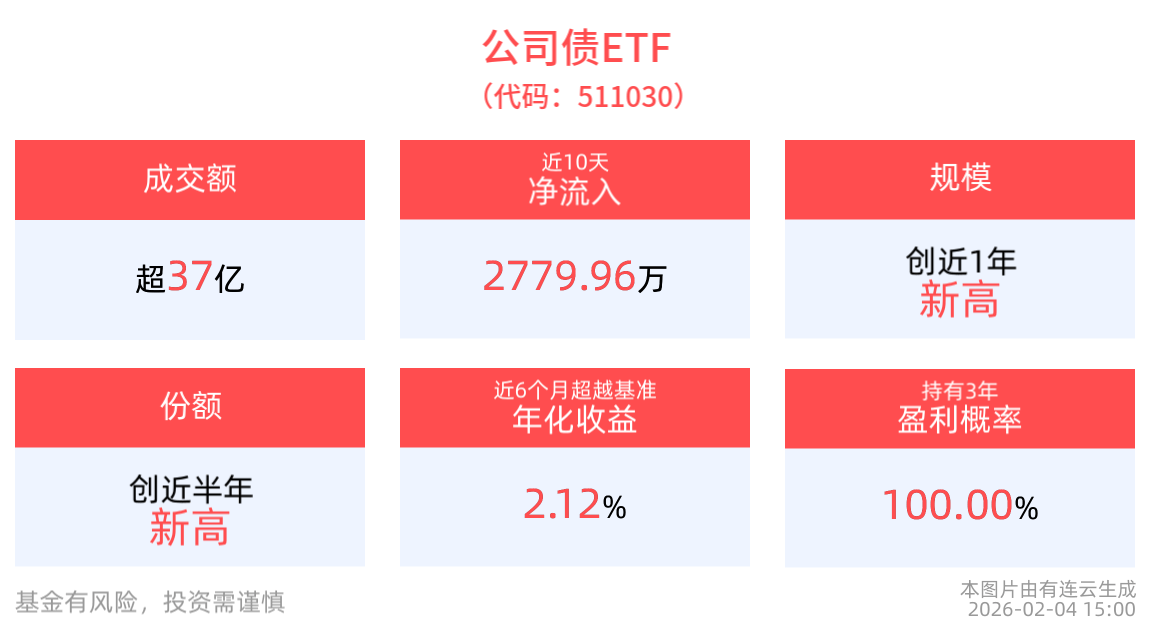
成交额超37亿元,公司债ETF(511030)近10个交易日净流入2779.96万元
Sou Hu Cai Jing· 2026-02-05 01:50
Group 1 - The credit bond market outlook for February 2026 suggests a moderate extension of duration to 3-5 years due to weak fundamentals and supportive liquidity, with a focus on high-grade credit bonds for interest rate arbitrage strategies [1] - Current credit spreads are at relatively low historical levels, indicating limited room for further compression; attention is recommended on specific varieties and lower-rated interest-bearing assets [1] - The company bond ETF (511030) has shown a 0.05% increase as of February 4, 2026, with a one-year cumulative increase of 1.56%, indicating a stable performance in the market [3] - The company bond ETF has reached a new high in scale at 341.92 billion yuan, with a recent net inflow of 320.67 million yuan, reflecting strong investor interest [3] - The average turnover rate for the company bond ETF is 11.09%, with a daily average transaction volume of 34.38 billion yuan over the past week, indicating active market trading [3] Group 2 - The management fee for the company bond ETF is set at 0.15%, while the custody fee is 0.05%, contributing to the overall cost structure of the fund [4] - The tracking error for the company bond ETF over the past month is 0.006%, demonstrating its effectiveness in closely following the underlying index [5] - The company bond ETF is designed to track the China Bond - High-Grade Corporate Bond Spread Factor Index, which serves as a benchmark for investment performance in high-grade corporate bonds [5]
2026年2月信用债市场展望:套息压舱,品种掘金
Shenwan Hongyuan Securities· 2026-02-04 05:45
Key Insights - The credit bond carry trade strategy remains robust, but the safety cushion is narrowing, especially at the short end [3][4] - Current credit spreads are at relatively low levels, with attention on certain varieties and the value of lower-rated coupons [3][4] - The performance of perpetual bonds has been strong since the beginning of the year, but the market may have reached a temporary peak [3][4] Market Overview - In January 2026, the issuance of traditional credit bonds increased slightly, with net financing rising significantly [11][13] - The total issuance of credit bonds reached 12,308 billion, with net financing at 4,997 billion, showing a substantial increase compared to previous months [11][13] - The performance of credit bonds in January was strong, with yields declining and credit spreads narrowing across various maturities [19][23] Investment Strategy - It is recommended to extend the duration of carry trades to 3-5 years while focusing on mid to short-term coupon assets [4][6] - The demand for certain credit bonds is expected to remain supported by the accumulation of amortized debt funds, although the market may not see the same level of activity as in Q4 of the previous year [4][6] - Attention should be given to high-quality central state-owned enterprise real estate bonds, lower-rated city investment bonds, and high-grade insurance subordinated bonds for potential investment opportunities [4][6]
固收专题:短端信用债的确定性或更强
Minsheng Securities· 2025-08-26 08:22
1. Report Industry Investment Rating No relevant content provided. 2. Core Viewpoints - The bond market is insensitive to fundamentals. In the volatile period, seizing periodic opportunities is more important than speculating on one - sided trends. The current approach to credit bonds is recommended to be defensive, with duration controlled at a low level. Short - term credit bonds may have stronger certainty [1][9]. - In a low - interest - rate environment, the adjustment pattern of credit bond yields has changed. Short - end yields are more resistant to decline compared to long - end varieties. It is advisable to focus on short - term credit bonds, especially those within 3 years [1][14]. - There are many disturbing factors in the bond market in the future. During the volatile period, short - and medium - term credit bond varieties are relatively stable. It is recommended to prioritize the carry trade strategy for credit bonds within 3 years [4][26]. 3. Summaries by Related Catalogs 3.1 Bond Market Trends and Overall Strategy - Recently, the bond market has been frequently adjusted, showing a weak and volatile trend. Positive factors such as negative credit growth in July, further slowing demand in economic data, and loose liquidity have not had a substantial positive impact on the bond market. The bond market is currently dominated by risk appetite. If there is negative feedback and continuous capital outflows, there may be a possibility of the bond market rising. Therefore, the overall credit bond strategy should be defensive, with low duration [1][9]. 3.2 Characteristics of Short - Term Credit Bonds - **Yield Resistance**: In a low - interest - rate environment, the adjustment pattern of credit bond yields has changed. When negative factors emerge, investors tend to sell long - term bonds and reduce duration to maintain liquidity. Since July this year, the yields of 1 - year and 3 - year AAA - medium - and short - term notes have increased by 3BP and 11BP respectively, while those of 10 - year and 15 - year AAA - medium - and short - term notes have increased by 14BP and 16BP respectively. Credit bonds within 3 years have stronger "resistance to decline" [1][14]. - **Price Performance**: From the weekly increase of the ChinaBond full - price index, since July, the bond market has been weak. Varieties within 1 year have shown stable performance, even with upward trends. Varieties within 5 years have relatively small declines, with weekly declines generally within 0.45% in the past two months. In contrast, the longer the term of varieties over 5 years, the greater the decline. On the week of August 15, the weekly decline of the full - price index of AAA credit bonds over 10 years was 0.67%, while that of 7 - 10 years and 5 - 7 years was 0.37% and 0.35% respectively. The decline of other short - term bonds of the same grade was within 0.20%, and the index of bonds within 1 year had a small increase of 0.10% [2][15]. - **Net Value Stability**: From the net value performance of AAA medium - and short - term notes of each term, medium - and long - term credit bonds have a higher upward amplitude in net value due to higher coupon advantages, but also have greater overall net value volatility. The shorter the duration of credit bond varieties, the smoother the net value curve. For example, during the negative feedback of wealth management redemptions in November 2022 and the significant bond market adjustment in March this year, short - term credit bonds showed stronger resistance to fluctuations [19]. 3.3 Fund Behavior and Credit Spreads - Since July, funds have reduced their holdings of long - term credit bonds and have been net - selling credit bonds over 7 years in the past two months. Instead, they have increased their holdings of shorter - term credit bond varieties. As of August 19, funds have net - bought approximately 70.3 billion yuan and 57.7 billion yuan of varieties within 1 year and 1 - 3 years respectively since July. Currently, the credit spreads of long - term credit bonds are still at a relatively high level since 2023, and there is a possibility of further widening. It is recommended to remain cautious about long - term credit bonds [3][23]. 3.4 Future Bond Market Outlook and Investment Suggestions - There are many disturbing factors in the bond market in the future. Although the current relatively loose liquidity provides room for carry trade with leverage, the possibility of further significant loosening of liquidity is low. Coupled with insufficient protection space for credit spreads of each variety, any negative factor may amplify market sentiment and lead to further market adjustments. - It is recommended to prioritize the carry trade strategy for credit bonds within 3 years. As of August 20, the maturity yields of various 2 - year credit bonds (including financial bonds) are basically above 1.85%. Institutions with high coupon requirements can appropriately lower their credit quality requirements [4][26].