停滞性通胀

Search documents
日元兑人民币汇率跌至4.48历史新低
Sou Hu Cai Jing· 2026-01-15 00:38
Exchange Rate Status and Market Reaction - The Japanese yen reached a historic low against the Chinese yuan at 4.48 on December 19, 2025, marking the lowest level on record; the yen also fell below 157 against the US dollar, despite a 25 basis point interest rate hike by the Bank of Japan, which failed to reverse the downward trend [1][2] Core Drivers of the Downward Trend - The conflict between monetary policies is evident as the Japanese government introduced a fiscal stimulus plan exceeding 21 trillion yen, raising debt concerns with a national debt-to-GDP ratio of 264%, while the central bank only made a minor interest rate increase; Prime Minister Fumio Kishida publicly opposed aggressive rate hikes, leading to a collapse in market confidence [3] - The widening interest rate differential between Japan and the US, with the US 10-year Treasury yield remaining above 4%, has driven continued selling of the yen through arbitrage trading [3] Economic and Social Impact - Input-driven inflation is eroding purchasing power, with rice prices soaring by 90% since the beginning of the year, and beef prices increasing by 150%-200% over the past 12 years, forcing consumers to cut back on food spending [6] - For every 1 yen depreciation, Japanese households face an annual increase in expenses of 6,000 yen, negating the benefits for exporting companies [7] - Small and medium-sized enterprises are facing survival crises due to skyrocketing import costs, with manufacturing profit growth declining by 2.1%, and tourism revenue sharply decreasing, further worsening the employment market [8] Intervention Challenges and Global Risks - The policy toolbox is nearing exhaustion, as government debt stands at 235% of GDP; if interest rates rise to 0.75%, annual debt servicing costs could surge by 8 trillion yen, potentially triggering a sovereign debt crisis [10] - Foreign exchange intervention is limited, with nearly half of the foreign reserves committed to US investments, leaving insufficient funds available; interventions in 2024 cost 5 trillion yen but only provided temporary stabilization [10] - There is a risk of a global financial chain reaction if approximately 20 trillion yen in arbitrage funds return en masse, which could impact liquidity in emerging markets and lead to competitive currency devaluations [10] - If the yen falls below the 160 mark, Japan may be forced to utilize foreign reserves for intervention, although the US has clearly opposed unilateral actions; without coordinated rate cuts from the Federal Reserve or G7 support, the yen could plunge towards 180:1 against the dollar [10]
最大经济体面临崩盘?大批资本逃离美国,美专家:更大危机在后面
Sou Hu Cai Jing· 2025-11-08 17:47
Core Viewpoint - The U.S. economy is facing significant challenges, including a sharp decline in foreign investment in U.S. Treasury bonds, rising inflation, and increasing national debt, leading to a potential economic downturn in 2025 [1][3][5]. Group 1: Economic Indicators - In July, China sold $25.7 billion in U.S. Treasury bonds, reducing its holdings to $730.7 billion, the lowest in 16 years [1]. - Foreign holdings of U.S. Treasury bonds decreased from $9 trillion to $8.8 trillion, indicating a significant capital withdrawal [3]. - The U.S. national debt surpassed $31 trillion in 2023, with interest payments reaching $1 trillion, equivalent to twice the defense budget [5]. Group 2: Inflation and Interest Rates - Inflation surged to 9.1% in June 2022, prompting the Federal Reserve to raise interest rates from near zero to 4.25%-4.5% by the end of 2022 [5]. - Despite a reduction in inflation to 3.1% in 2023, the high-interest rates have led to a decline in stock market value, with a loss of nearly $20 trillion in U.S. equities [5][10]. Group 3: Consumer Impact - The imposition of tariffs under the Trump administration has increased domestic consumer prices, costing American households over $5,000 annually [7]. - The effective tariff rate in the U.S. reached 25.1%, the highest since the Great Depression [7]. Group 4: Investment Trends - In 2024, foreign net inflows into the U.S. stock market fell below $100 billion, a 50% decrease from the previous year [8]. - By 2025, foreign capital outflows reached $15 billion, tightening market liquidity and making corporate financing more challenging [8]. Group 5: Structural Issues - The total federal debt exceeded $37.86 trillion in 2025, with interest payments consuming 17.1% of the budget, leading to cuts in essential services [12]. - The wealth gap in the U.S. has widened, with the top 0.1% of households holding 13.8% of total wealth, while the bottom 50% hold only 2.5% [12]. Group 6: Global Economic Shifts - As capital flows out of the U.S., China has reduced its U.S. Treasury holdings while increasing gold and euro assets, with gold reserves surpassing 2,000 tons [16]. - The share of the U.S. dollar in global foreign exchange reserves has declined from 60% to 58%, with predictions it may drop below 50% in five years [16].


全球国债遭遇抛售潮,黄金创历史新高
Sou Hu Cai Jing· 2025-09-03 15:27
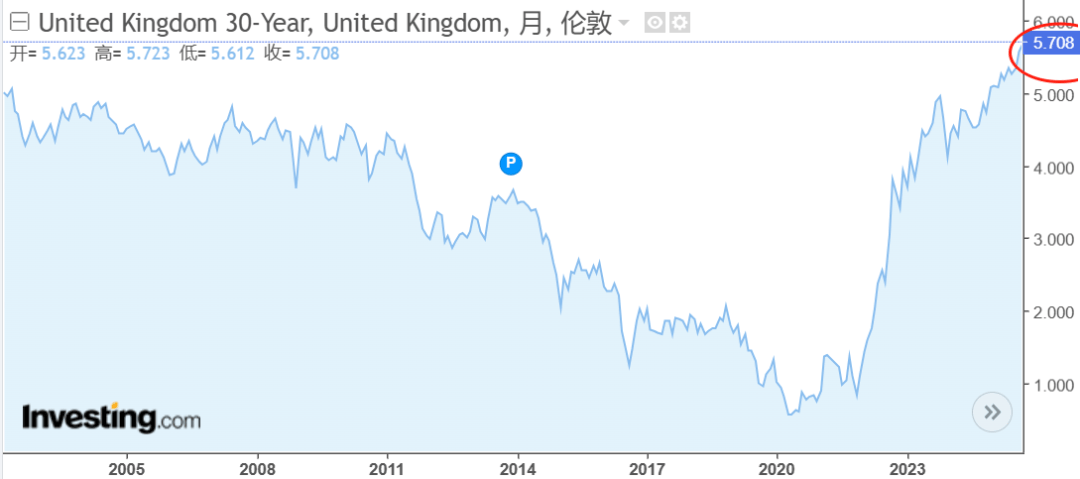
Core Viewpoint - A global sell-off of government bonds is occurring, leading to a unique bull market for gold, driven by a collective distrust in sovereign currencies like the US dollar [1][12]. Group 1: Gold and Silver Market - On September 2, spot gold surpassed $3,500 per ounce, reaching a historical high, while silver rose to $40.85 per ounce, marking a 14-year high [1]. - The surge in gold prices is not merely a traditional safe-haven response but reflects a broader skepticism towards government-issued currencies [1][14]. Group 2: Government Bond Market - The global bond market is experiencing a significant downturn, with the UK 30-year bond yield rising to 5.69%, the highest in over 20 years, and the US 30-year bond yield nearing 5%, a level not seen since 2006 [1][2]. - Other countries are also witnessing similar trends, with Japan's 30-year bond yield reaching its highest since 2006, and France's at 4.49%, the highest since 2009 [2][4]. - The rise in bond yields indicates a loss of confidence in government bonds, as investors sell off long-term bonds, reflecting concerns over rising government fiscal deficits [1][4]. Group 3: Fiscal Concerns - Many countries are seeing their fiscal spending as a percentage of GDP increase, with the UK projected to spend 60% of its GDP, while the US is expected to have a fiscal spending ratio of 40.5% in FY 2024 [8][9]. - The debt burden is escalating, with the US government leverage ratio at 114% and Japan exceeding 212%, both significantly above the internationally recognized warning threshold of 60% [9][11]. - Interest payments on government debt are consuming a growing portion of national budgets, with the US spending over $1 trillion annually on interest alone, surpassing defense and Medicare expenditures combined [12]. Group 4: Inflation and Economic Implications - Inflation is re-emerging as a significant concern, with the US core PCE exceeding 3% and the UK CPI rising to 3.8%, expected to breach 4% [12][13]. - The situation presents a dilemma for central banks: either allow inflation to rise, impacting living costs, or increase interest rates, which could stifle fragile economic recovery [12][13]. - The current environment has led to a paradox where central banks are cutting rates while bond yields are rising, indicating a deeper trust crisis in government bonds [13]. Group 5: Shift in Investment Sentiment - The ongoing crisis in government bonds and persistent inflation pressures are driving investors to seek alternative safe-haven assets, with gold and other precious metals experiencing significant price increases [12][14]. - The traditional role of bonds as a safe asset appears to be diminishing, prompting a systemic reassessment of the value of precious metals as a hedge against economic instability [13][14].
伊以临时停火可能避免了“停滞性通胀冲击”
财富FORTUNE· 2025-06-26 13:01
Core Viewpoint - The article discusses the potential impact of a temporary ceasefire announced by President Trump on global markets, particularly focusing on the implications of Iran's threat to close the Strait of Hormuz, a critical passage for global oil trade, which accounts for 20% of the world's oil supply [1][11]. Group 1: Market Reactions and Predictions - Analysts predict that if Iran closes the Strait of Hormuz, it could lead to a significant increase in oil prices, potentially causing a rise in overall inflation in the U.S. by 1% [2]. - In a more likely scenario where the Strait remains open but oil prices rise by 20% in Q3, U.S. inflation could increase by 0.5%, while the Eurozone and the UK could see increases of 0.4% and 0.3%, respectively [2]. - The Brent crude oil price fluctuated from $78.97 to around $70 per barrel, indicating market skepticism about Iran's ability to close the Strait [4]. Group 2: Economic Implications - The article highlights concerns that a rise in oil prices could affect the Federal Reserve's interest rate decisions, potentially preventing rate cuts that have been anticipated since December [4][5]. - Goldman Sachs analysts estimate a geopolitical risk premium of $12 per barrel, suggesting that if oil transport through the Strait is significantly disrupted, Brent prices could reach $110 per barrel [7]. - Historical context is provided, noting that oil price shocks have less impact on GDP now compared to past conflicts, with a $10 increase in oil prices resulting in only a 0.1% decline in GDP [6][5]. Group 3: Iran's Economic Situation - Iran's oil exports have drastically decreased from approximately 2.5 million barrels per day to just 150,000 barrels since the outbreak of conflict with Israel [9]. - Experts suggest that even if the Strait is closed, alternative transportation methods exist, although they pose risks to regional oil production facilities [10][11]. - The closure of the Strait would severely impact Iran's economy, as oil is its largest export product, indicating that such actions could be self-damaging for Iran [11][12].

美国关税宽限期即将结束 新台币续创逾三年高位
news flash· 2025-06-26 02:53
Core Viewpoint - The New Taiwan Dollar (TWD) has reached a three-year high against the US Dollar (USD) as the grace period for US tariffs is about to end, leading to concerns about stagnation and inflation, which has weakened the USD and strengthened the TWD [1] Group 1 - The TWD appreciated by 2.4 cents against the USD, with an intraday increase of 0.8% [1] - The market is worried about impending stagnation and inflation, contributing to the weakening of the USD [1] - The TWD has shown the strongest upward trend among Asian currencies, driven by foreign investment selling USD in the spot market [1] Group 2 - The one-month USD/TWD forward exchange rate has fallen below the 29 mark, indicating a bullish outlook for the TWD [1] - Traders expect the TWD to continue its upward trajectory as foreign investors remain optimistic [1]
中美贸易谈判后,美联储官员表态:降息更难!特朗普又要愤怒了?
Sou Hu Cai Jing· 2025-05-13 09:36
Core Viewpoint - The recent preliminary trade agreement between the U.S. and China may reduce the aggressive tariffs imposed on each other, but high tariffs will still impact the economy and make it more difficult for the Federal Reserve to lower interest rates [3][5]. Group 1: Trade Agreement Impact - The U.S. and China have reached a preliminary trade agreement that includes a significant reduction in tariffs, which may alleviate some of the trade war's negative effects [3]. - The current tariff rate on Chinese products is set at 30%, which remains high and is expected to lead to price increases and economic slowdown [3]. - The trade conflict could have long-term repercussions for the U.S., including damage to its reputation and potential shifts in supply chains as investors seek reliable partners elsewhere [5]. Group 2: Federal Reserve's Position - Federal Reserve official Adriana Kugler indicated that the likelihood of interest rate cuts has decreased due to the trade agreement, as the need for aggressive monetary policy tools may have changed [3]. - The economic data has been distorted by pre-tariff stockpiling, leading to a negative GDP growth in the first quarter, which is primarily attributed to a surge in imports [5]. - Chicago Fed President Austan Goolsbee echoed Kugler's sentiments, noting that while the agreement may reduce the immediate impact of tariffs, the elevated tariff rates will still contribute to stagflation and slow economic growth [6].