储能发展

Search documents
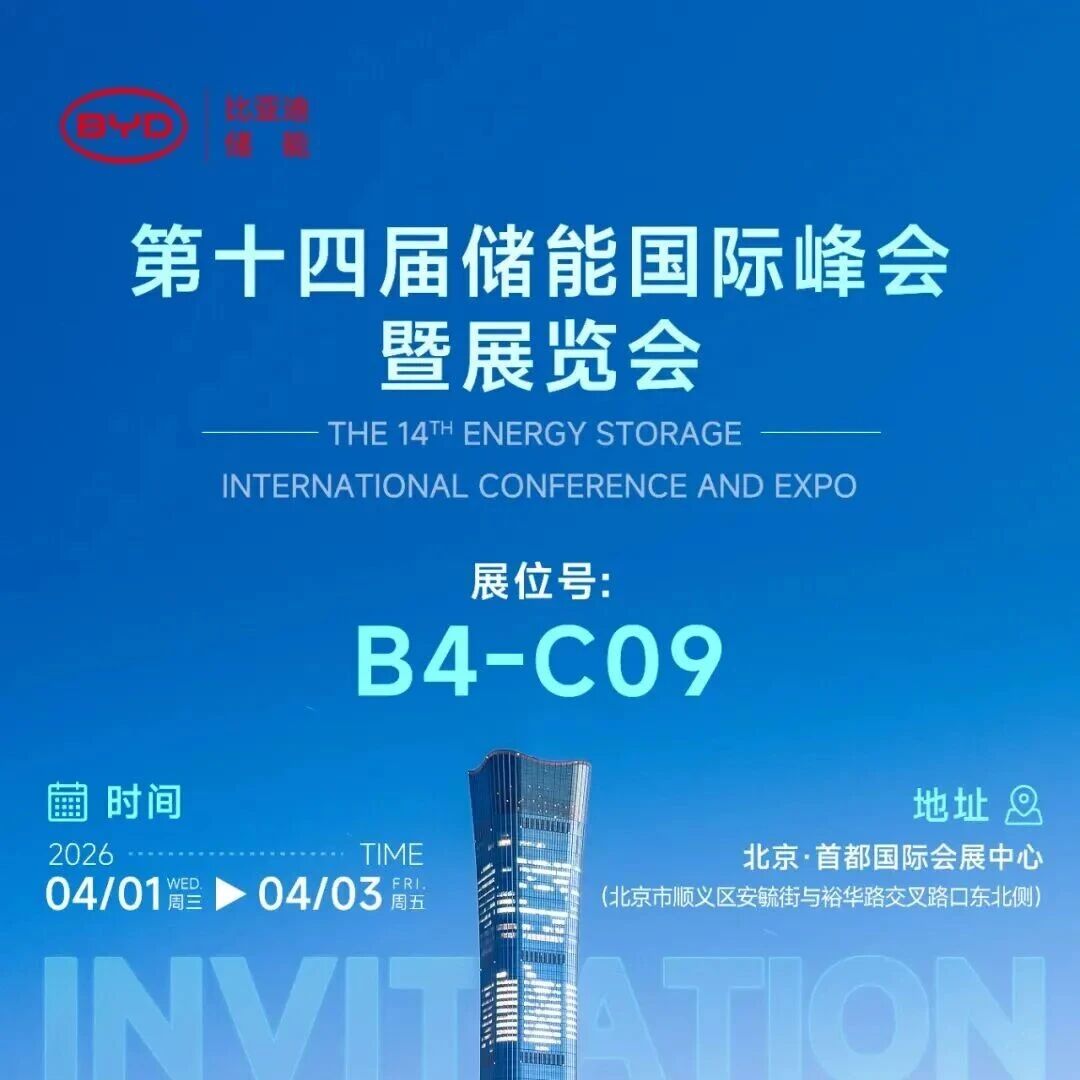
比亚迪储能邀您共聚第十四届储能国际峰会暨展览会ESIE 2026
中关村储能产业技术联盟· 2026-03-25 10:36
Core Viewpoint - The 14th International Energy Storage Summit and Exhibition (ESIE 2026) will be held in Beijing from March 31 to April 3, 2026, focusing on "Scenario Innovation, Value Reconstruction, and Global Win-Win" [3]. Group 1 - The exhibition will showcase the latest technological achievements and applications in energy storage, including breakthroughs in the "Haohan" system integration and comprehensive self-research solutions for grid construction [3]. - The event will feature an interactive experience called "Zero Carbon Ride," allowing attendees to engage with energy conversion processes [3]. - The exhibition will take place at the Capital International Exhibition Center in Beijing, with the exhibition running from April 1 to April 3, 2026, and the summit from March 31 to April 3, 2026 [3]. Group 2 - Major companies such as CRRC, Chuangneng New Energy, EVE Energy, and others are sponsoring the event, indicating strong industry support and participation [6]. - The event serves as a significant indicator of the development of China's energy storage industry, highlighting its importance in the global energy landscape [3]. - The exhibition aims to foster discussions on new opportunities for energy storage development during the 14th Five-Year Plan period [3].

碳酸锂下游需求“淡季不淡”
Qi Huo Ri Bao· 2026-01-14 23:56
Group 1 - The price of lithium carbonate futures has risen above 170,000 yuan per ton, indicating a comprehensive price increase throughout the lithium battery industry chain from upstream to downstream [1] - By 2025, China's high-quality lithium resources will undergo a strategic reassessment, highlighted by the discovery of a world-class lithium mineral belt spanning 2,800 kilometers across four provinces, significantly increasing China's lithium resource share from 6% to 16.5%, elevating its global ranking from sixth to second [1] - The lithium mineral belt has confirmed over 6.5 million tons of proven resources, with total potential exceeding 30 million tons, marking a significant breakthrough in national mining exploration efforts [1] Group 2 - The recycling of lithium from retired batteries is gaining momentum, with production expected to reach 10,010 tons by December 2025, accounting for 10.1% of total output, indicating a rapid commercialization and scaling of lithium resource recycling [2] - The demand for lithium carbonate is primarily driven by three sectors: electric vehicles, energy storage systems, and consumer electronics, with electric vehicle battery production projected to reach 1,245.5 GWh in 2025, a year-on-year increase of 41.9% [2] - The retail sales of new energy passenger vehicles are expected to reach 12.809 million units in 2025, reflecting a 17.6% year-on-year growth and a retail penetration rate of 54% [2] Group 3 - The energy storage battery industry in China is set for significant expansion, with production expected to reach 344 GWh and 529.43 GWh in 2024 and 2025, respectively, representing year-on-year growth of 83.8% and 53.9% [3] - The growth in energy storage demand is driven by the explosive growth of AIDC and photovoltaic storage, supported by policy measures aimed at enhancing the national electricity market system [3] Group 4 - Since early 2026, the lithium battery industry's downstream demand has remained strong, contributing to rising lithium carbonate prices, with export tax rebates for battery products set to decrease from 9% to 6% starting April 1, 2026 [4] - The adjustment of export tax rebate policies is expected to positively impact first-quarter export demand, although the release of pent-up demand may be limited compared to other industries like photovoltaics [4] - Companies in the lithium battery supply chain are advised to manage risks and seize opportunities for profit-taking while being cautious of inventory price fluctuations [4]
煤炭行业2026年度投资策略
2025-12-29 15:51
Summary of Coal Industry Conference Call Industry Overview - The conference call focuses on the coal industry, specifically discussing the market outlook for 2025 and 2026, as well as long-term supply constraints due to resource depletion [1][2][5]. Key Points and Arguments 2025 Market Performance - The coal industry experienced a downturn in 2025, with coal prices falling to their lowest levels in a decade. - The average price of thermal coal dropped from 850 RMB in 2024 to around 700 RMB, while coking coal prices fell from 2022 RMB to approximately 1500 RMB [2]. - The decline in prices is attributed to weak demand and increased supply, with residential electricity growth slowing and total electricity growth decreasing. The resurgence of production in Shanxi contributed to a 3% year-on-year increase in raw coal output [2]. 2026 Demand and Supply Forecast - Demand for coal is expected to improve in 2026, with a reduction in new wind and solar installations leading to an anticipated increase in thermal power generation [3][4]. - Total electricity consumption is projected to grow at a rate of 5%, equivalent to an increase of 500 billion kWh [4]. - Supply growth is expected to be limited, with a forecasted increase of only 0.6%, or 2.5 million tons, due to the potential exit of 80 million tons of illegal capacity [4]. Long-term Supply Constraints - Resource depletion is identified as a significant long-term supply constraint, with projections indicating that by 2040, the depletion rate could reach approximately 22% [5]. - Some groups may experience resource depletion rates of up to one-third of their total reserves within the next decade, highlighting severe resource over-extraction [5]. Impact of Energy Storage - Short-term impacts of energy storage on the competitiveness of thermal power are limited, but long-term projections suggest that if storage capacity reaches 30% with a 4-hour discharge time, it could correspond to an annualized power generation capacity of about 161 billion kWh [6]. - Economic viability of independent storage is constrained by diminishing price differentials as scale increases, alongside risks of subsidy reductions [6]. Investment Recommendations - Given the anticipated demand improvement and limited supply growth, the expected average price for thermal coal in 2026 is around 750 RMB, with coking coal priced between 1500-1600 RMB [3][7]. - Recommended stocks include Yancoal Energy, Power Development, and Shenhua, which are seen as having strong defensive and dividend characteristics [7][15]. Future Coal Power Demand - Coal power demand is expected to remain resilient over the next 5-10 years, despite rapid developments in wind and solar energy. The negative growth in thermal power in 2025 is attributed to short-term economic weakness rather than a long-term trend [8]. 2026 Consumption Predictions - A 1% increase in thermal coal consumption is anticipated for 2026, driven by increased coal usage in chemical processes and residential heating [9]. Global Supply Dynamics - Indonesia remains a primary source of coal imports for China, but future supply increases are limited due to rising export taxes and resource depletion issues. Other major suppliers like Australia and South Africa are also facing production plateauing [10][11]. Timing for Investment - The best time to invest in recommended companies is expected to be in the second quarter of the following year, particularly if spot prices fall below 700 RMB/ton, presenting a cost-effective opportunity [16]. Additional Important Insights - The focus on the steel industry and its demand for coking coal is crucial, as any slowdown in real estate investment could impact steel production negatively. Conversely, improvements in overseas economies could boost manufacturing and export, thereby increasing demand for steel and coking coal [13][14].
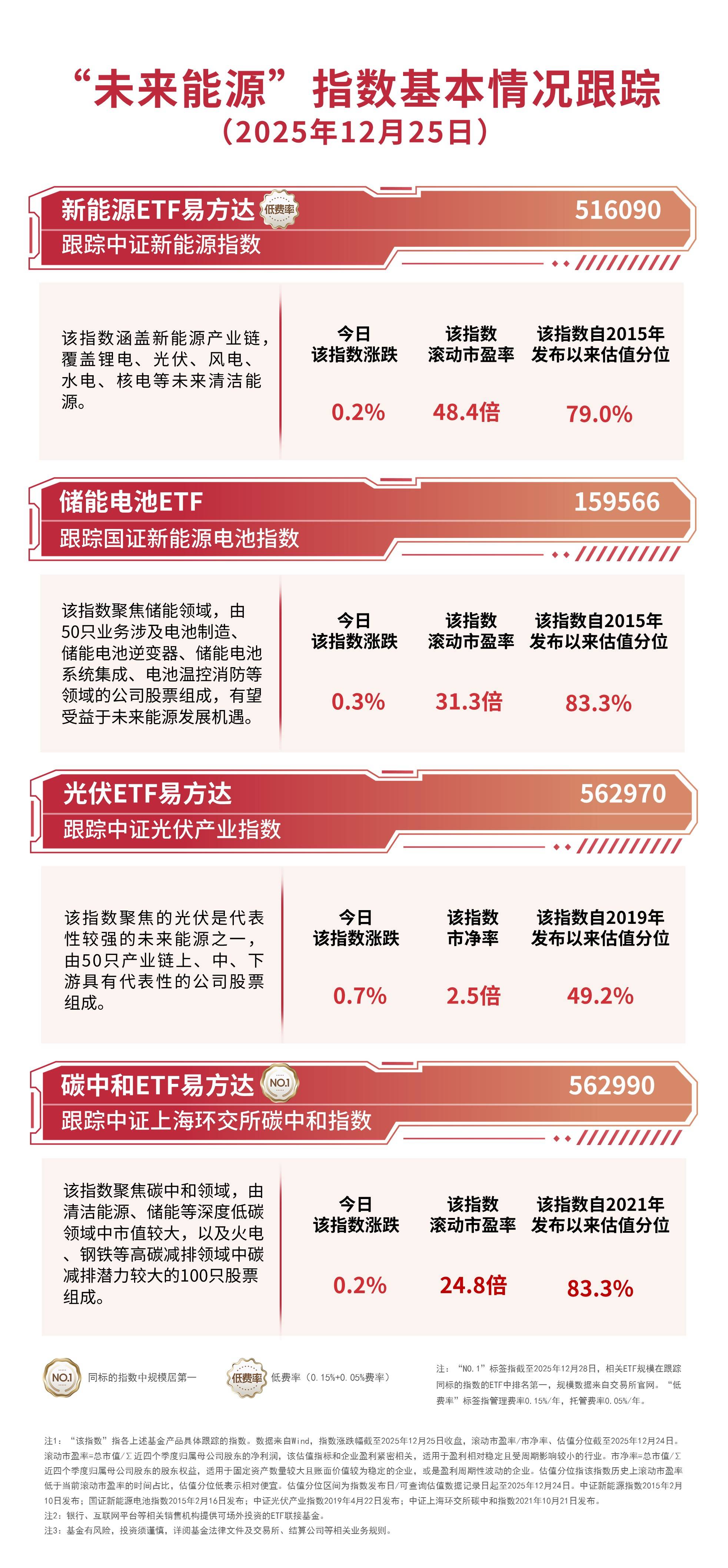
新能源板块午后回暖,储能电池ETF(159566)、新能源ETF易方达(516090)等受资金关注
Sou Hu Cai Jing· 2025-12-25 11:13
Group 1 - The renewable energy sector showed recovery in the afternoon, with the China Securities Photovoltaic Industry Index rising by 0.7%, and the National Securities New Energy Battery Index increasing by 0.3% [1] - The Storage Battery ETF (159566) saw a net subscription of nearly 30 million units throughout the day, indicating strong investor interest [1] - According to Wind data, the Storage Battery ETF (159566) and the E Fund New Energy ETF (516090) experienced net inflows of 610 million yuan and 220 million yuan respectively within the month [1] Group 2 - CITIC Securities research report indicates that by 2026, long-term electricity contracts will require time-segmented and curve-based signing, linking user-side time-based electricity prices to the spot market, marking a deepening of electricity market reforms [1] - The current electricity system capacity shortage is significant, approaching a critical point where capacity issues may accelerate, which is expected to support the long-term development of energy storage [1] Group 3 - The index focusing on energy storage consists of 50 companies involved in battery manufacturing, energy storage battery inverters, energy storage battery system integration, and battery temperature control and fire protection, which are expected to benefit from future energy development opportunities [3] - The photovoltaic ETF from E Fund tracks the China Securities Photovoltaic Industry Index, which is composed of 50 representative companies across the upstream, midstream, and downstream of the photovoltaic industry chain [5]
中信证券:预计2026年供需宽松和改革推动电价下行风险加大
Di Yi Cai Jing· 2025-12-11 04:11
Group 1 - The core viewpoint indicates that by 2026, the supply release will exacerbate the supply-demand imbalance in the electricity market [1] - It is projected that a new equilibrium point in the electricity market may emerge around 2028 [1] - The electricity system is facing a capacity shortage, approaching a critical point where the contradiction of insufficient capacity may accelerate [1] Group 2 - The development of energy storage is expected to receive long-term critical support due to these capacity issues [1] - By 2026, the risks of declining electricity prices are anticipated to increase due to supply-demand easing and reforms, with hydropower showing stronger resilience against cyclical downturns [1]

中信证券:电量市场新平衡拐点或在2028年出现
Xin Lang Cai Jing· 2025-12-11 01:21
Core Viewpoint - The electricity market is expected to face intensified supply-demand conflicts due to supply releases by 2026, with a new equilibrium point anticipated around 2028 [1] Group 1: Supply and Demand Dynamics - By 2026, the electricity market will experience increased risks of price declines driven by supply-demand easing and reforms, with hydropower showing stronger resilience against cyclical downturns [1] - The electricity system is approaching a critical point where capacity shortages will accelerate, highlighting the need for long-term support for energy storage development [1] Group 2: Market Predictions - The anticipated new balance in the electricity market is projected to emerge in 2028, indicating a significant shift in market dynamics [1]
亏损王瑞浦兰钧即将迎来业绩拐点?
Guo Ji Jin Rong Bao· 2025-10-17 03:37
Core Insights - The global energy storage demand is driving a new cycle in the sector, leading to significant growth for companies focused on energy storage [1][3] - Ruipu Lanjun (00666.HK) reported record shipments of over 23 GWh in Q3 2025, with a monthly high exceeding 8 GWh, marking the highest quarterly and monthly shipments in the company's history [1][4] - The company has reduced its losses significantly, with a 90.4% decrease in losses in H1 2025 compared to the previous year, indicating a potential turnaround [3][4] Company Performance - Ruipu Lanjun's revenue for H1 2025 reached 9.491 billion yuan, a year-on-year increase of 24.9%, with gross profit soaring by 177.8% to 829 million yuan [4] - The company's energy storage battery shipments in H1 2025 were 18.87 GWh, a year-on-year growth of approximately 119.3%, making energy storage the largest revenue source at 53.6% [4] - The company has established itself as a significant player in the energy storage market, ranking fifth globally in energy storage cell shipments and first in user energy storage cell shipments in H1 2025 [4] Strategic Developments - Ruipu Lanjun is focusing on both domestic and international markets, with strategic partnerships, including a memorandum of understanding with South Korea's Hyosung Heavy Industries for supplying 2.5 GWh of energy storage products [4][6] - The company is capitalizing on the new energy storage industry's growth, with expectations of reaching 300 million kilowatts of new energy storage capacity during the 14th Five-Year Plan period [6] - The company has signed supply agreements for over 20 GWh of energy storage cells with multiple enterprises, indicating strong demand and strategic positioning [7] Market Position - In the commercial vehicle market, Ruipu Lanjun ranked sixth in domestic installation volume in H1 2025, with a market share increase to 5.95% [8] - The company has achieved significant market shares in the new energy heavy truck and battery swap heavy truck sectors, reaching 7.5% and 18% respectively, ranking second nationally [8]
中国储能系统:专家电话会议要点:招标强劲与政策支持推动 V 型复苏-China ESS_ Expert call takes_ Tender strength and policy support to drive a V-shaped recovery
2025-09-25 05:58
Summary of Key Points from the Conference Call Industry Overview - **Industry**: Energy Storage Systems (ESS) in China - **Key Organization**: China Energy Storage Alliance (CNESA) Core Insights 1. **ESS Installation Trends**: - Post-May 2025, China experienced a significant drop in ESS installations from 26 GWh to 7-9 GWh between June and August due to a rush in solar installations and the cancellation of mandatory ESS policies [6][9][39] - Despite this decline, ESS tender volumes remained strong, with August 2025 reaching a record of over 40 GWh, and total tender volume for the first eight months of 2025 increased by over 200% year-on-year to 144 GWh [6][11] 2. **Government Support and Policy Changes**: - The National Development and Reform Commission (NDRC) set a new ESS installation target of 180 GW by 2027, up from 75 GW in 2024, indicating a strong policy direction to support ESS development [6][22] - More than 10 provinces are expected to roll out incentive programs to support ESS installations, with Inner Mongolia already providing Rmb 0.35/kWh for power discharged by ESS projects [6][37] 3. **V-Shaped Recovery Anticipated**: - A V-shaped recovery in ESS installations is expected as early as Q4 2025, driven by project developers securing projects ahead of provincial incentive programs [6][39][40] - The expert predicts that China's ESS installations could reach 130 GWh in 2025, with a further increase to 150 GWh in 2026 [50][54] 4. **Economic Viability of ESS Projects**: - The removal of mandatory ESS attachment may negatively impact demand, but the falling costs of ESS systems (from Rmb 1.5/Wh in 2024 to Rmb 1.0/Wh in 2025) and reduced financing costs for state-owned developers are expected to support project economics [12][39] - ESS projects in Inner Mongolia are projected to achieve an internal rate of return (IRR) of 13% over the next 10 years due to capacity compensation and peak-trough price arbitrage [16][37] 5. **Comparative Analysis with US Market**: - The expert noted that China's mandatory push for ESS is lagging behind the US merchant power market, where installations are driven by economic factors rather than mandates [41] - If China were to adopt similar attachment rates and battery durations as the US, cumulative ESS capacity could exceed 300 GWh by the end of 2024 [41][42] Additional Important Insights - **Investment Recommendations**: - J.P. Morgan has an "Overweight" rating on CATL-A/H and LGES, while maintaining a "Neutral" rating on Sungrow due to its stretched valuation despite potential benefits from ESS installations [7][39] - **Market Dynamics**: - The expert emphasized that the pace of ESS installation recovery in China will be critical for the global outlook, as China contributes over half of all global ESS installations [7][50] - **Provincial Policy Impacts**: - Local governments may source funds for capacity compensation from power generators or users, potentially increasing power generation costs [37][38] This summary encapsulates the key points discussed in the conference call regarding the current state and future outlook of the ESS industry in China, highlighting the impact of government policies, market dynamics, and investment opportunities.


20cm速递|外资看好中国储能发展,创业板新能源ETF华夏(159368)涨超2%,同类规模第一
Mei Ri Jing Ji Xin Wen· 2025-09-23 02:49
Group 1 - The core viewpoint of the news highlights the positive outlook for global energy storage systems (ESS), with Citigroup raising its demand forecast from 177.8 GWh in 2024 to an estimated 360.2 GWh by 2027, reflecting a compound annual growth rate of 26.5% over three years. The forecast for 2025 indicates a year-on-year growth of 37% to 243.7 GWh [1] - Foreign investment is optimistic about the development of energy storage in China, driven by increasing market demand, accelerated electricity needs in the U.S., a larger storage market in Europe, and deployment in emerging markets to address power shortages [1] Group 2 - The ChiNext New Energy ETF (159368) is the first ETF in the market tracking the ChiNext New Energy Index, covering various sectors including batteries and photovoltaics. It has the highest flexibility with a maximum increase of 20 cm, the lowest fee rate at a total of 0.2% for management and custody fees, and the largest scale with 770 million yuan as of September 22, 2025 [2] - The ETF has a significant storage component of 51% and solid-state battery content of 23.6%, aligning with current market trends [2]



新能源装机增长迎来拐点,储能发展道路明朗
Great Wall Securities· 2025-08-05 03:30
Investment Rating - The report maintains an "Outperform" rating for the industry, indicating expectations for the industry to perform better than the market in the next six months [4]. Core Insights - The report highlights a turning point in the growth of new energy installations, with a significant increase in installed capacity in the first half of 2025, totaling 293 million kilowatts, a year-on-year increase of 140.5 million kilowatts. Wind and solar power installations saw year-on-year growth of 98.9% and 107.1%, respectively, accounting for 64.4% and 76.6% of the total new installations in 2024 [1][9][10]. - The development of energy storage is becoming clearer, with 2025 identified as a year of value reconstruction for the storage industry, driven by both policy and market changes. The introduction of differentiated capacity pricing mechanisms in Gansu and Guangdong emphasizes the value of regulatory power sources [2][17][18]. Summary by Sections New Energy Installation Growth - The report notes that the new energy installation growth is at a critical juncture, with policies transitioning from reliance on government support to market-driven mechanisms. The "430" and "531" policies are pivotal in this shift, promoting a more mature electricity market and enhancing the capacity for energy consumption [1][13][14]. Energy Storage Development - The energy storage sector is projected to see a significant increase in installed capacity, reaching 73.76 million kilowatts by the end of 2024, a 130% increase from 2023. By mid-2025, this is expected to rise to 94.91 million kilowatts. The average utilization hours for energy storage are also expected to improve significantly, indicating a shift towards market competitiveness [2][20][24]. Regulatory Changes and Market Dynamics - The introduction of capacity pricing mechanisms in Gansu and Guangdong is a key development, allowing coal and gas power plants to have a more significant role in the energy market. This change is expected to enhance the operational flexibility of traditional power sources and support the integration of renewable energy [17][19][18]. - The report emphasizes that the energy sector is moving towards a collaborative model where new energy and regulatory power sources work together to meet the increasing demand for system flexibility as renewable energy penetration rises [25][27].