先进制程国产替代

Search documents
板块受大盘拖累,低位布局机遇凸显——半导体板块大跌点评
Sou Hu Cai Jing· 2026-02-02 08:39
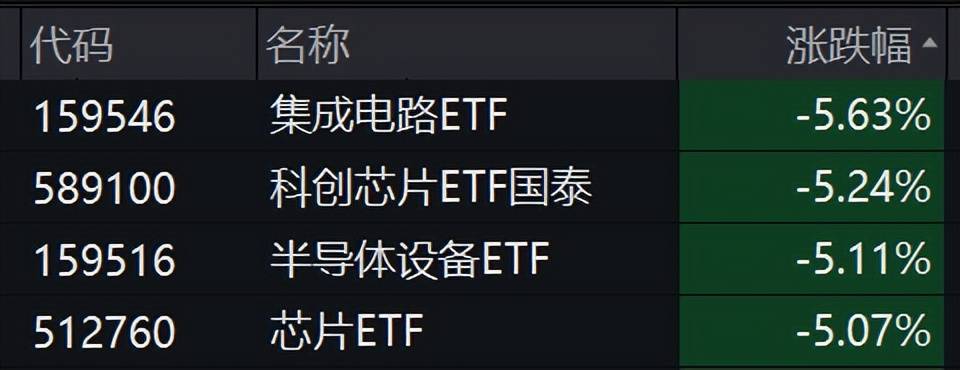
Market Performance - The market experienced fluctuations throughout the day, with the Shanghai Composite Index falling by 2.48%, the Shenzhen Component Index by 2.69%, and the ChiNext Index by 2.46%. The total trading volume in the Shanghai and Shenzhen markets reached 2.58 trillion yuan. The semiconductor sector saw significant declines, with various ETFs dropping over 5% [1][3]. Downward Factors Analysis - The decline in the semiconductor sector was influenced by the U.S. Federal Reserve's decisions and market reactions. The Fed maintained the benchmark interest rate at 3.50-3.75%, and the nomination of Warsh as the new Fed Chair raised market concerns due to his hawkish stance. This led to a pullback in the U.S. semiconductor sector, impacting A-shares [3]. - The overall market performance was weak, with a significant reduction in trading volume. The semiconductor sector had previously accumulated gains in early January, making it vulnerable to pressure in a declining market [3]. Future Outlook - There is strong demand for storage expansion, and the semiconductor equipment sector remains robust. ASML reported a record new order amount of 13.2 billion euros for Q4 2025, with 7.4 billion euros for EUV lithography machines. The backlog of orders at ASML extends to 2027, indicating strong growth potential in the storage sector [4]. - After recent corrections, the semiconductor equipment ETFs present an attractive investment opportunity. The high demand in the storage sector is expected to positively influence semiconductor equipment. The narrative of "storage expansion + advanced process domestic substitution" provides strong growth momentum [5]. - Concerns regarding the impact of H200 on domestic GPUs have largely subsided, and domestic GPU manufacturers are expected to gradually increase their shipment volumes, entering a phase of high growth. The Sci-Tech Innovation Chip ETF is also worth monitoring [5].

中信证券:26年台积电Capex指引超预期 先进制程国产替代开启国产设备成长大周期
Zhi Tong Cai Jing· 2026-01-17 07:33
Core Viewpoint - TSMC is expected to significantly increase its capital expenditure to $52-56 billion in 2026, exceeding market expectations, which indicates an early start to the 2nm process mass production cycle [1][3]. Group 1: Financial Performance - In 2025, TSMC is projected to achieve record revenue of $122 billion, a year-on-year increase of 35.9%, driven by strong demand in AI and HPC, with a gross margin nearing 60% [2]. - The revenue contribution from advanced processes (7nm and below) is expected to reach 77%, with 3nm and 5nm processes contributing 63% of wafer sales [2]. - TSMC's net profit attributable to the parent company is forecasted to reach NT$1.72 trillion, representing over a 30% year-on-year growth, marking a historical high [2]. Group 2: Capital Expenditure - TSMC's capital expenditure for 2025 is set at $40.9 billion, with a more aggressive guidance for 2026 at $52-56 billion, significantly above the previous market expectation of $45-48 billion [1][3]. - Approximately 70%-80% of the 2026 capital expenditure will be allocated to advanced processes, while 10%-20% will be directed towards advanced packaging, testing, and mask manufacturing [3]. Group 3: Market Demand and Supply - The global semiconductor market is projected to grow from $680 billion in 2025 to $1.741 trillion by 2035, with a CAGR of 9.9%, driven by demand from servers, data centers, and storage [4]. - Advanced logic capacity (7nm and below) is expected to grow at a CAGR of approximately 15% from 2025 to 2035, fueled by AI demand [5]. - The domestic semiconductor demand in China accounts for about 35% of the global market, while its production capacity for advanced logic processes is currently less than 5% [6]. Group 4: Domestic Market Dynamics - The domestic semiconductor industry is experiencing a dual drive of "high growth in AI computing power" and "domestic substitution of advanced processes," with a significant capacity gap of over 1 million wafers per month [6]. - The domestic semiconductor equipment localization rate is currently around 30%, with expectations to increase to 60%-70% in the future, indicating substantial growth potential [7]. Group 5: Investment Recommendations - The ongoing large-scale investments in China to fill the advanced capacity gap are expected to create a long-term growth period for domestic equipment manufacturers, independent of global semiconductor cycles [8]. - Focus is recommended on leading companies that have achieved technological breakthroughs in core equipment areas such as etching, thin film deposition, cleaning, and CMP, and have validated their capabilities with major clients [8].


中信证券:26年台积电(TSM.US)Capex指引超预期 先进制程国产替代开启国产设备成长大周期
智通财经网· 2026-01-17 07:32
Core Viewpoint - TSMC is expected to significantly increase its capital expenditure to $52-56 billion in 2026, exceeding market expectations, which indicates an early start to the 2nm process mass production cycle [1][3]. Group 1: Financial Performance - In 2025, TSMC is projected to achieve record revenue of $122 billion, a year-on-year increase of 35.9%, driven by strong demand in AI and HPC, with a gross margin nearing 60% [2]. - The revenue contribution from advanced processes (7nm and below) is expected to reach 77%, with 3nm and 5nm processes contributing 63% of wafer sales [2]. - The net profit attributable to the parent company is forecasted to reach NT$1.72 trillion, marking a growth of over 30% year-on-year, setting a historical high [2]. Group 2: Capital Expenditure Insights - TSMC's capital expenditure for 2025 is set at $40.9 billion, with a more aggressive guidance for 2026 at $52-56 billion, with 70%-80% allocated to advanced processes and 10%-20% for advanced packaging, testing, and mask manufacturing [3]. - This increased investment reflects TSMC's strategic commitment to expanding production capacity in response to the growing demand for AI computing chips [3]. Group 3: Semiconductor Market Trends - The global semiconductor market is projected to grow from $680 billion in 2025 to $1.741 trillion by 2035, with a CAGR of 9.9%, driven by demand from servers, data centers, and storage [4]. - Advanced logic capacity (7nm and below) is expected to grow at a CAGR of approximately 15% from 2025 to 2035, fueled by AI demand [5]. Group 4: Domestic Market Dynamics - China's semiconductor demand accounts for about 35% of the global market, while its production capacity for 7nm and below is less than 5%, indicating a significant potential for capacity expansion [6]. - The domestic semiconductor industry is expected to fill the capacity gap, leading to a market for equipment investments worth hundreds of billions of dollars [6]. Group 5: Equipment Supply Chain and Localization - Domestic wafer fabs are actively building a "non-US" equipment supply chain, providing a growth window for local equipment manufacturers [7]. - The localization rate of semiconductor equipment is expected to increase from 30% to 60%-70% in the coming years, driven by the domestic production of DRAM and 3D NAND [7]. Group 6: Investment Recommendations - The dual drivers of AI demand and domestic substitution are expected to lead to sustained large-scale investments in advanced capacity in China [8]. - Focus is recommended on leading companies that have achieved technological breakthroughs in core equipment areas such as etching, deposition, cleaning, and CMP, which have validated their capabilities with major clients [8].
中信证券:看好半导体设备的投资机遇 建议关注具备平台化能力的领军企业及高弹性细分龙头
Xin Lang Cai Jing· 2026-01-17 02:58
Core Viewpoint - TSMC's 2025 performance is expected to set a record, with a significant increase in capital expenditure for 2026, indicating ongoing benefits from AI computing power and advanced processes. The domestic wafer fabs are entering an expansion phase to address a million-unit capacity gap, creating a multi-billion dollar opportunity for the equipment market, with a potential doubling of domestic equipment localization rates [1][2][3]. Group 1: TSMC's Performance and Capital Expenditure - TSMC is projected to achieve a revenue of $122 billion in 2025, a year-on-year increase of 35.9%, with a gross margin nearing 60% [2][10]. - The company's capital expenditure for 2025 is set at $40.9 billion, with an aggressive forecast for 2026, estimating capital expenditure to rise to $52-56 billion, exceeding market expectations of $45-48 billion [2][10]. - 70-80% of the 2026 capital expenditure will be directed towards advanced processes, while 10-20% will be allocated for advanced packaging, testing, and mask manufacturing [2][10]. Group 2: Global Semiconductor Market Outlook - The global semiconductor sales are expected to grow from $68 billion in 2025 to $174.1 billion by 2035, with a CAGR of 9.9% [3][11]. - Demand for semiconductors in servers, data centers, and storage is projected to increase from $15.6 billion in 2025 to $82.6 billion by 2035, with a CAGR of 18.6% [3][11]. - Global semiconductor manufacturing capacity is anticipated to rise from 11.2 million wafers per month in 2025 to 19 million wafers per month by 2035, with a CAGR of 5.4% [3][11]. Group 3: Domestic Semiconductor Industry Dynamics - The domestic semiconductor industry is experiencing a dual drive of "high growth in AI computing power" and "advanced process localization," with a capacity gap exceeding one million wafers [4][12]. - Currently, domestic production of advanced logic processes (7nm and below) accounts for less than 5% of global capacity, while China's semiconductor demand represents about 35% of the global market [4][12]. - The localization rate of semiconductor equipment is currently around 30%, with expectations to double in the future, driven by increased domestic production and technological advancements [5][13]. Group 4: Investment Strategy - The ongoing AI wave and the push for localization are expected to lead to sustained, large-scale investments in China to fill the advanced capacity gap of over one million wafers [7][16]. - Focus is recommended on leading companies that have achieved technological breakthroughs in core equipment areas such as etching, thin film deposition, cleaning, and CMP, as well as those with flexible localization rates [7][16]. - Companies that can leverage this historical industry opportunity are likely to emerge as internationally competitive domestic manufacturers in the global semiconductor equipment market [7][16].