免费学前教育政策

Search documents
居民增收计划、养老金上涨、支持AI开源社区……45个关键词读懂2026政府工作报告
经济观察报· 2026-03-05 09:11
Economic Growth - The GDP growth target for 2026 is set at 4.5% to 5%, reflecting a pragmatic policy approach and considering both internal and external pressures on the economy [4][5] - The adjustment in the growth target aims to balance quality and reasonable growth, laying a foundation for high-quality economic development [5] Fiscal Policy - The proposed deficit rate for 2026 is around 4%, with a deficit scale of 5.89 trillion yuan, an increase of 230 billion yuan from the previous year [7] - Public budget expenditure is expected to reach 30 trillion yuan for the first time, with a focus on optimizing expenditure structure to support consumption and improve living standards [9][10] Tax and Financial Reforms - The government plans to advance tax and financial system reforms, including increasing the proportion of state-owned capital returns and enhancing local tax systems [12] - The emphasis on zero-based budgeting aims to optimize fund allocation and improve the efficiency of fiscal spending [12] Employment and Income - The urban survey unemployment rate target is set at around 5.5%, reflecting the need for policies to stabilize employment amid structural pressures [18] - The government aims to synchronize resident income growth with economic growth, emphasizing measures to increase income for low-income groups and improve social security systems [20][22] Environmental Goals - The target for reducing carbon dioxide emissions per unit of GDP is set at around 3.8%, aligning with the goal of achieving carbon peak by 2030 [26][27] - The shift from energy consumption control to carbon emission control reflects the need for a more precise approach to managing carbon emissions [27][28] State-Owned Enterprise Reforms - The government plans to implement a systematic approach to deepen state-owned enterprise reforms, focusing on optimizing the layout of state-owned capital and structural adjustments [29][30] - The emphasis on improving the modern enterprise system aims to enhance corporate governance and promote market-oriented reforms [31] Open Economy - The government intends to further expand high-level opening-up, focusing on service sector liberalization and enhancing international cooperation [35][36] - The approach aims to balance reform depth with security, promoting a competitive and fair business environment [36] Agricultural and Rural Development - The government is set to promote agricultural insurance development and enhance comprehensive disaster prevention capabilities in agriculture [59] - Policies will focus on improving rural elderly care services and implementing long-term care insurance systems to address the challenges of an aging population [45][47] Capital Market Stability - Measures to stabilize the stock market include comprehensive policies to enhance market confidence and promote active trading [54] - The government aims to improve the mechanism for long-term capital entering the market, ensuring a stable and healthy capital market [63] Innovation and Technology - The government plans to cultivate emerging and future industries, encouraging state-owned enterprises to lead in opening application scenarios for new technologies [69][70] - Support for artificial intelligence and open-source community development is expected to drive innovation and commercialization in various sectors [75]

财政部:研究建立适应学龄人口变化的教育经费分配新机制
Xin Hua Wang· 2025-12-28 04:15
Core Viewpoint - The Ministry of Finance emphasizes the importance of enhancing education funding and implementing policies to improve educational quality and accessibility in the upcoming year [1] Group 1: Education Funding - The government plans to increase financial support for education, focusing on a new funding distribution mechanism that adapts to changes in school-age population [1] - There will be a gradual implementation of free preschool education policies to ensure early childhood education is accessible [1] Group 2: Quality and Accessibility - The initiative aims to promote balanced development in compulsory education, ensuring that quality education is available to all [1] - Support will be provided to expand the supply of ordinary high school places and enhance the capabilities of vocational schools [1]
2025年秋季学期起广州免除公办幼儿园学前一年保教费
Nan Fang Ri Bao Wang Luo Ban· 2025-10-29 08:27
Core Points - Guangzhou will implement a free preschool education policy starting from the autumn semester of 2025, exempting childcare education fees for eligible children in public kindergartens [1] - The policy will cover all eligible children in the last year of preschool, including those in public and private kindergartens, urban and rural settings, as well as special education institutions [1] - The exemption standard will be based on the approved childcare education fee standards set by local government authorities [1] Summary by Category - **Policy Implementation** - The free childcare education fee policy will begin in the autumn semester of 2025 [1] - The current fee structure for preschool education (for small and medium classes) will remain in effect until then [1] - **Coverage of the Policy** - The exemption applies to all children in the last year of preschool, including those in public and private kindergartens, as well as various educational institutions [1] - This includes children in urban and rural kindergartens, primary school attached classes, special education schools, child welfare institutions, and rehabilitation centers for disabled children [1] - **Fee Structure** - The exemption standard will follow the childcare education fee standards approved by county-level or higher government and relevant education and pricing authorities [1] - While the exemption covers the basic childcare education fee, other fees such as meal fees, accommodation fees, and approved service charges will still be collected as per existing regulations [1] - Private kindergartens may charge families for any portion of the childcare education fee that exceeds the exemption level [1]
云南将逐步推行免费学前教育 公办幼儿园学前一年保教费全免
Jing Ji Guan Cha Bao· 2025-10-13 03:01
Core Viewpoint - Yunnan Province is implementing a gradual rollout of free preschool education, starting from the fall semester of 2025, which will eliminate the childcare education fees for children in public kindergartens for their final year before primary school [1][2]. Group 1: Implementation Details - The free preschool education policy will apply to children in public kindergartens, with similar fee reductions for those in approved private kindergartens based on local public kindergarten standards [1]. - The fee exemption will be based on the approved childcare education fee standards set by local governments, excluding costs for meals, accommodation, and miscellaneous fees [1]. - Existing free preschool education policies in specific regions, such as Diqing and Nujiang, will continue to be enforced [1]. Group 2: Financial Support Mechanism - To compensate for the loss of income due to the fee exemption, local financial and education departments will provide subsidies to kindergartens, considering the number of exempted children and the average fee levels [2]. - The financial burden of the subsidy will be shared between the central government and Yunnan Province at an 8:2 ratio, with varying levels of provincial support across different cities and counties [2]. - The provincial government will determine the average subsidy standards based on actual fee levels and will regularly evaluate the policy's implementation to adjust the subsidy standards as needed [2]. Group 3: Support for Special Groups - The implementation plan emphasizes the need to support economically disadvantaged families, orphans, and children with disabilities, ensuring that existing assistance policies remain in effect [3]. - The plan includes provisions for public kindergarten funding and teacher salaries to be included in the financial support framework [3]. - A mechanism for financial subsidies for inclusive private kindergartens will be established to promote equitable access to preschool education [3].
免费学前教育迈出第一步,意味着什么(读者点题·共同关注)
Ren Min Ri Bao· 2025-09-27 03:17
Core Viewpoint - The recent implementation of free preschool education and child-rearing subsidies reflects the government's commitment to alleviating the financial burden of raising children, particularly for low-income families and those in rural areas, thereby promoting educational equity and supporting population growth [1][3][5]. Policy Implementation - The free preschool education policy now covers all kindergarten classes, benefiting approximately 12 million children [2]. - The financial impact of this policy is significant, with an estimated increase in national fiscal expenditure of about 20 billion yuan for the current semester alone [3]. Financial Data - National fiscal expenditure on preschool education has increased from 86.2 billion yuan in 2013 to 315 billion yuan in 2023, representing an average annual growth rate of 13.8% [3]. - The gross enrollment rate for preschool education reached 92% in 2024, a 20 percentage point increase from 2013, aligning with the average level of high-income countries [3]. Future Considerations - The successful implementation of free preschool education requires careful planning regarding future birth rates, the demand for kindergarten spaces, and the economic capacity to sustain such policies [4]. - The series of supportive policies, including extended parental leave and increased childcare services, are interconnected and aim to create a favorable environment for child-rearing [4][5].
免费学前教育迈出第一步 意味着什么(读者点题·共同关注)
Ren Min Ri Bao· 2025-09-26 21:43
Core Viewpoint - The recent implementation of free preschool education policies in China aims to alleviate the financial burden on families, particularly benefiting low-income and rural households, while promoting educational equity [1][3][5]. Policy Impact - The free preschool education policy now covers all kindergarten classes, benefiting approximately 12 million children [2]. - Families can save significant amounts; for instance, one family reported saving nearly 5,000 yuan annually due to the policy [1]. Financial Implications - The policy is expected to reduce childcare costs for many families, with an estimated increase in national fiscal expenditure of about 20 billion yuan for the current semester [3]. - The national financial investment in preschool education has grown from 86.2 billion yuan in 2013 to 315 billion yuan in 2023, reflecting an annual growth rate of 13.8% [3]. Future Considerations - The successful implementation of free preschool education requires careful planning regarding future birth rates, the demand for kindergarten spaces, and the economic capacity to sustain such policies [4]. - The initiative is part of a broader strategy to create a supportive environment for young families, encouraging higher birth rates and improved child-rearing conditions [4][5].
广东省逐步推行免费学前教育政策有关问题解答
2 1 Shi Ji Jing Ji Bao Dao· 2025-08-30 09:21
Core Points - The implementation of free childcare education fees in the province will start from the autumn semester of 2025 [1] - The policy covers all eligible children in public and private kindergartens, including urban and rural areas [1] - The exemption applies to children in the last year of preschool (5 years old) [1] Group 1: Free Childcare Education Fee Policy - The exemption from childcare education fees applies to children in public kindergartens and eligible children in private kindergartens, based on the standards of local public kindergartens [1][3] - The standard for public kindergartens will be determined by the approved fee standards set by local government and education departments, excluding meal and accommodation fees [2] - Private kindergartens can charge the difference if their fees exceed the exemption level set by public kindergartens [3] Group 2: Financial Support and Regulation - Financial support will be provided to kindergartens to compensate for the loss of income due to the fee exemption, based on the number of exempted children and local fee levels [5] - The current fee policies for lower grades (small and middle classes) will remain unchanged [6] - Regulatory measures will be strengthened to ensure that for-profit private kindergartens adhere to fair and legal pricing practices [7] Group 3: Assistance for Economically Disadvantaged Families - The province will continue to implement assistance policies for economically disadvantaged children, with a current subsidy of 1,000 yuan per child per year [10] - The per-student funding policy for public and eligible private kindergartens will remain in effect, with a minimum funding standard of 600 yuan per child per year [10]
9月起,这些新规将影响你我生活!
中国基金报· 2025-08-29 07:20
Group 1 - The "Housing Rental Regulations" will be implemented starting September 15, 2025, requiring rental properties to meet safety and health standards, and prohibiting the separate rental of non-residential spaces for living purposes [3] - The regulations stipulate that landlords must specify the amount of deposit, return time, and conditions for deduction in the rental contract, and cannot unjustly withhold deposits [3] - All published rental information must be truthful, accurate, and complete, prohibiting misleading or false listings [3] Group 2 - The "Rural Road Regulations" will also take effect on September 15, 2025, focusing on improving road network quality and coordinating with national and provincial road construction [5] - New rural roads must meet technical standards, and existing roads that do not meet minimum standards must be upgraded [5] - The regulations encourage the use of existing roads for reconstruction or expansion to minimize land occupation [5] Group 3 - The Ministry of Finance and other authorities have introduced a personal consumption loan interest subsidy policy effective from September 1, 2025, for loans used for consumption [7] - The subsidy applies to personal consumption loans under 50,000 yuan and for significant purchases such as vehicles and education, with a cap on the subsidy amount [7] Group 4 - The new "Electric Bicycle Safety Technical Specifications" will be implemented on September 1, 2025, prohibiting the production and sale of electric bicycles that do not meet the new standards [12] - The new standards include requirements for battery packs, controllers, and speed limiters, as well as weight limits for lead-acid battery models [13] Group 5 - The "Artificial Intelligence Generated Content Identification Measures" will take effect on September 1, 2025, requiring explicit and implicit identification of AI-generated content [15] - Explicit identification must be clearly perceivable by users, while implicit identification involves technical measures embedded in the content data [15] Group 6 - The revised "Infectious Disease Prevention Law" will be implemented on September 1, 2025, categorizing infectious diseases into three classes based on their severity and impact [18] - The law emphasizes the protection of personal information and outlines penalties for violations related to personal data handling [18] Group 7 - The "Finished Oil Circulation Management Measures" will be effective from September 1, 2025, detailing regulations for wholesale and retail operations in the oil industry [20] - The measures include requirements for compliance, management systems, and data reporting for oil enterprises [21] Group 8 - The "Administrative Division Code Management Measures" will be implemented on September 1, 2025, clarifying the assignment of administrative division codes at various government levels [23] - The measures specify the conditions for creating and abolishing codes, ensuring consistency in administrative divisions [23] Group 9 - The revised "Land Allocation Directory" will take effect on September 1, 2025, imposing strict limitations on the allocation of state-owned construction land [26] - The directory requires government approval for land allocation and encourages the use of paid methods for land provision [26] Group 10 - The Ministry of Agriculture and Rural Affairs will implement new animal diagnosis management regulations starting September 1, 2025, introducing a new animal diagnosis license [28] - The regulations aim to standardize veterinary prescription practices and prohibit the use of substandard veterinary drugs [29]

财政部:免保育教育费政策主要遵循四个原则
Xin Hua Wang· 2025-08-12 06:05
Core Viewpoint - The Chinese government is gradually implementing a free preschool education policy, emphasizing the importance of universal access and government investment in early childhood education [1] Group 1: Policy Principles - The free preschool education policy is based on four main principles: enhancing universal accessibility, promoting a steady and orderly implementation, increasing government funding, and ensuring reasonable cost-sharing [1]
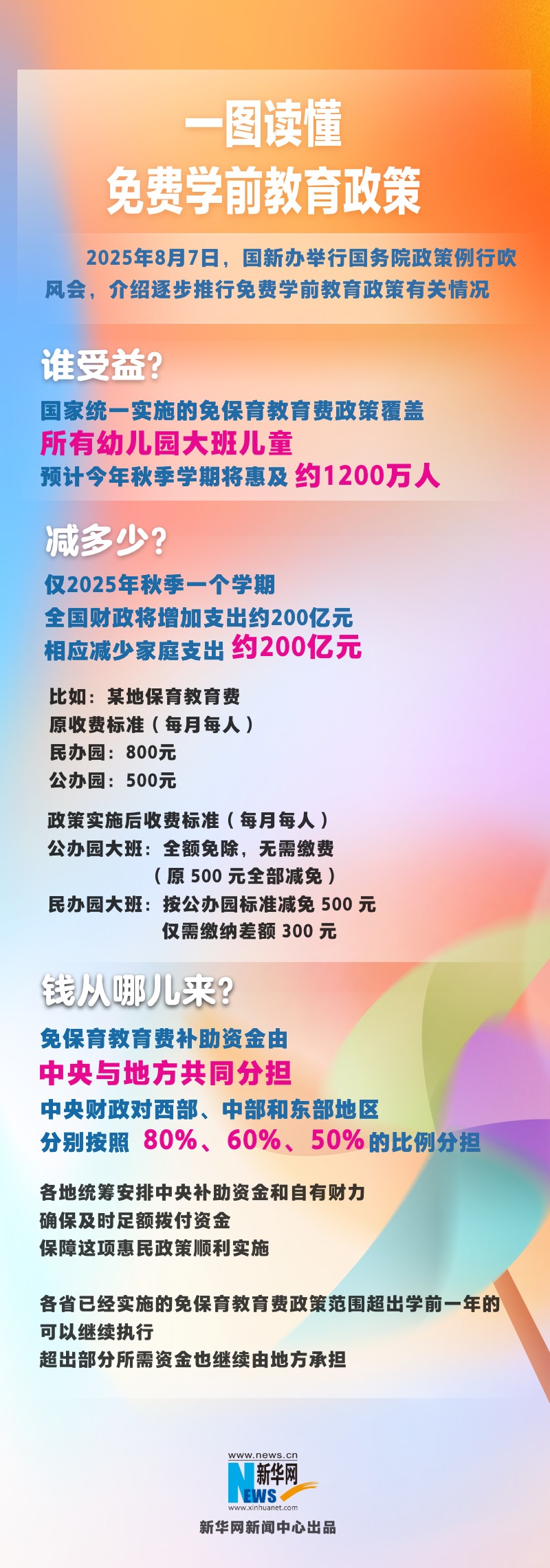
一图读懂免费学前教育政策
Xin Hua Wang· 2025-08-12 06:05
Group 1 - The core viewpoint of the article is the introduction of a nationwide free preschool education policy that aims to alleviate the financial burden on families and enhance access to early childhood education [1] - The policy will cover all kindergarten children in their final year, benefiting approximately 12 million children in the upcoming fall semester [1] - The national financial expenditure is expected to increase by about 20 billion yuan for just one semester, which will correspondingly reduce family expenses by the same amount [1] Group 2 - The previous fee structure for private kindergartens was around 800 yuan per month per child, while public kindergartens charged about 500 yuan per month [1]