
公积金政策优化

Search documents
地产行业周报:一线低总价二手房成交占比提升,关注议价空间及置换需求变化-20260329
Ping An Securities· 2026-03-29 10:09
Investment Rating - Industry investment rating: Real Estate Stronger than the Market (maintained) [2] Core Insights - Recent optimization of public housing fund policies and increased attractiveness of rental-to-sale ratios have led to a rise in the proportion of low-priced second-hand housing transactions in first-tier cities. For instance, in Shanghai, the proportion of second-hand homes priced below 3 million reached over 70% in March 2026, driven by enhanced public fund loan limits and rental yields [3][4] - The report draws parallels with the stabilization of the Hong Kong real estate market, suggesting that similar trends may occur in first-tier cities in mainland China. The focus is on monitoring the sustainability of second-hand housing transactions and the potential narrowing of negotiation space for low-priced homes [3][4] Summary by Sections Market Overview - The report notes a week-on-week increase in transaction volumes, with new home sales in 50 key cities rising by 19% to 23,000 units, while second-hand home sales in 20 key cities increased by 2.9% [3][9] - Inventory levels have decreased, with a total of 88.42 million square meters of inventory across 16 cities, reflecting a 0.91% decline and a 26-month de-stocking cycle [3][12] Capital Market Monitoring - The real estate sector saw a decline of 1.42% this week, underperforming the Shanghai and Shenzhen 300 index, which fell by 1.41%. The current price-to-earnings ratio (TTM) for the real estate sector stands at 68.29, significantly higher than the 13.91 for the broader index, indicating a high valuation relative to historical levels [3][23] - This week, the issuance of domestic real estate bonds totaled 9.23 billion, with a net financing of -5.95 billion, highlighting ongoing liquidity pressures in the sector [3][18] Key Company Insights - Recommended companies include those with strong fundamentals and low historical burdens, such as China Overseas Development and China Resources Land, which are expected to benefit from the stabilization of the housing market [3][5] - Companies with stable cash flow and dividends, such as China Resources Vientiane Life and Poly Property, are also highlighted as attractive investment opportunities [3][5]
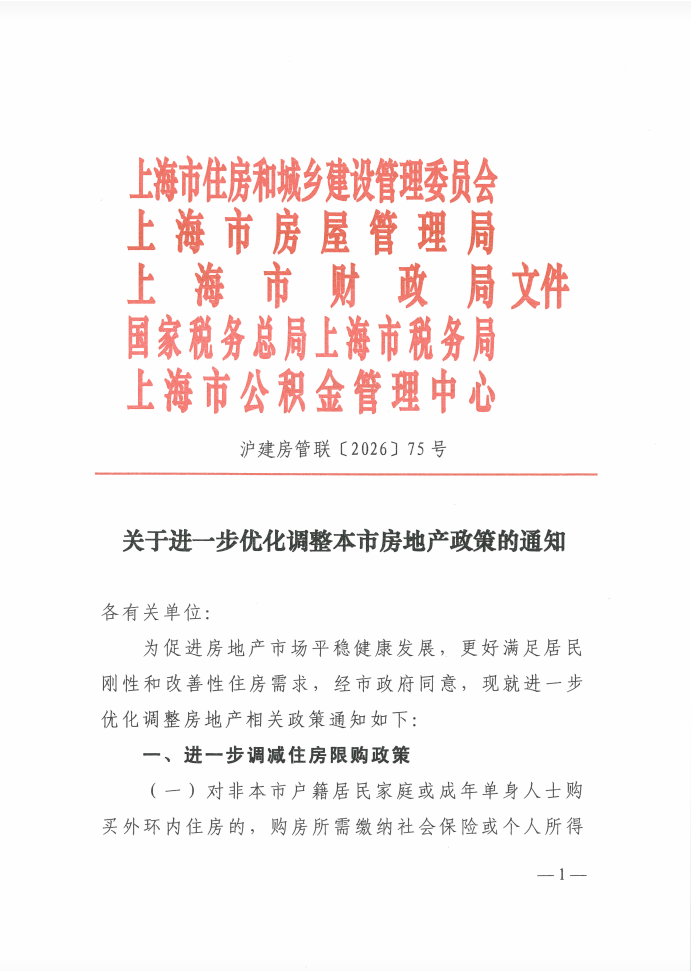
社保1年可买房!上海放出新春第一大礼包,非沪籍、新市民、改善族直接受益
Guo Ji Jin Rong Bao· 2026-02-25 10:57
Core Viewpoint - Shanghai has introduced new real estate policies aimed at stabilizing the housing market by reducing purchase restrictions, optimizing housing provident fund loans, and improving personal housing property tax regulations, with a focus on activating potential homebuyers from outside Shanghai [1][3]. Group 1: Housing Purchase Restrictions - The new policy will implement a "three-step" approach to further reduce housing purchase restrictions, including shortening the required social insurance or personal income tax payment period for non-local residents to one year [5][6]. - Non-local residents who have paid social insurance or personal income tax for three years or more can purchase an additional home in the outer ring of the city [5][6]. - Holders of the Shanghai residence permit for five years or more can purchase one home in the city without needing to provide proof of social insurance or tax payments [5][6]. Group 2: Housing Provident Fund Optimization - The maximum loan amount for first-time homebuyers using the housing provident fund has been increased from 160 million to 240 million yuan, with potential additional increases for families with multiple children and those purchasing green buildings [10][11]. - The policy also allows families who have previously used provident fund loans to apply for new loans if they currently own no more than one home and have settled their previous loans [11]. - The support for multi-child families has been expanded to include second home purchases, with a maximum loan amount increase of 20% [11][12]. Group 3: Support for Local Residents - The policy includes provisions for Shanghai residents, allowing adult children of local families to purchase homes without incurring personal housing property tax if the new home is their only residence [14][16]. - This tax exemption aims to stimulate demand among local families, particularly as the housing ownership rate among local residents is relatively high [14][16]. - The overall strategy is to tap into the potential housing demand from local families, especially as Shanghai's per capita disposable income has surpassed 90,000 yuan [14][16].

多地优化购房政策 能否释放住房消费潜力?
Xin Lang Cai Jing· 2026-02-03 20:49
Core Viewpoint - The recent policy adjustments in China's housing market aim to stimulate consumer demand by removing unreasonable restrictions on housing consumption, thereby enhancing the potential for housing consumption and revitalizing the real estate market [1][6]. Group 1: Policy Adjustments - Major cities have relaxed housing purchase restrictions, injecting vitality into housing consumption. For instance, Beijing allows multi-child families to purchase multiple homes within certain areas, while Shanghai has lifted restrictions on the number of homes that can be purchased in specific zones [2][4]. - Financial policies have been optimized, including lower mortgage rates and down payment ratios, which have reduced the barriers for consumers to purchase homes. For example, Beijing has unified mortgage rates for first and second homes, and the minimum down payment for second homes has been lowered to 25% [3][5]. Group 2: Market Response - Following the implementation of new policies, there has been a noticeable increase in market activity, with some cities experiencing a rebound in housing sales. For example, a project in Shanghai reported an average of 300 customer visits per day after the policy changes [4]. - The financial incentives provided through housing fund policies have directly alleviated the financial burden on consumers, with over 260 new policies introduced nationwide to enhance loan limits and simplify processes [5]. Group 3: Demand Release - The removal of unreasonable restrictions is expected to release three core demands: the rigid demand from new residents and talent, the improvement demand through lowered down payment ratios, and the reasonable cross-regional purchasing demand [6]. - There is still potential for further relaxation of policies, particularly regarding the use of housing funds and transaction processes, which could enhance market expectations and consumer confidence [7][8].
新华视点丨多地优化购房政策,能否释放住房消费潜力?
Xin Hua Wang· 2026-02-03 11:39
Core Viewpoint - Recent policy optimizations in various regions aim to stimulate housing consumption and release potential in the real estate market, aligning with national economic strategies to enhance consumer spending [1][2]. Group 1: Policy Adjustments - Many first-tier cities have relaxed purchase restrictions, injecting vitality into housing consumption. For instance, Beijing allows multi-child families to purchase multiple homes within certain areas, while Shanghai has lifted restrictions on the number of homes that can be bought in specific zones [2][3]. - Financial policies have also been adjusted, such as lowering mortgage rates and down payment ratios, which have reduced barriers for consumers. For example, Beijing has unified mortgage rates for first and second homes, and the minimum down payment for second homes has been reduced to 25% [3][4]. Group 2: Market Response - Following the implementation of new policies, there has been a noticeable increase in market activity and consumer sentiment. In Shanghai, for example, a specific project has seen an average of 300 customer visits per day since the policy changes [4][5]. - The financial benefits from policies, including lower mortgage rates and increased loan limits, have directly alleviated financial pressures on buyers, as evidenced by a case in Jinan where a buyer saved nearly 200,000 yuan due to reduced down payment requirements [5][6]. Group 3: Demand Release - The removal of unreasonable restrictions is expected to unlock three core demands: the rigid needs of new citizens and talent, improved housing conditions through reduced down payment ratios, and reasonable cross-regional purchasing demands [6][7]. - The ongoing adjustments in housing policies are seen as crucial for the recovery of the real estate market, with a focus on enhancing the accessibility of housing for various demographics [6][8]. Group 4: Future Policy Considerations - There remains potential for further policy relaxation, particularly regarding the use of housing provident funds and transaction processes, which could enhance market expectations and consumer confidence [7][8]. - Experts suggest that housing provident funds could be utilized for a broader range of housing-related expenses, such as property fees and renovations, to further stimulate housing consumption [7][8].
2025年公积金新政已经实施!相当于变相涨工资?请大家相互转告
Sou Hu Cai Jing· 2025-12-17 18:05
Core Viewpoint - The recent changes in the housing provident fund policy are significant and have various implications for ordinary workers, effectively acting as a form of indirect salary increase [1][7][12]. Group 1: Loan Rate Changes - The interest rate for existing personal housing provident fund loans will be reduced by 0.25 percentage points starting January 1, 2025, leading to lower monthly repayments for borrowers [1][3]. - For first-time homebuyers, the interest rates are set at 2.35% for loans under 5 years and 2.85% for loans over 5 years, which are relatively low compared to commercial loan rates [3]. Group 2: Loan Amount Adjustments - Many cities are increasing the maximum loan amounts for provident fund loans, with Shenzhen raising the individual limit from 500,000 to 600,000 and the family limit from 900,000 to 1,100,000 [3]. - Additional increases are available for first-time homebuyers and families with multiple children, allowing for potential maximum loans of 1,260,000 for individuals and 2,310,000 for families [3]. Group 3: Loan Term Extensions - The maximum loan term has been extended from 20 years to 30 years in many cities, reducing monthly repayment amounts and easing financial pressure on young professionals [3][11]. Group 4: Withdrawal Policy Relaxation - The conditions for withdrawing from the provident fund have been relaxed, with many regions removing residency restrictions and expanding the range of eligible expenses [4][8]. - Families with multiple children in Shenzhen can benefit from first-time homebuyer policies when purchasing a second home, maintaining lower interest rates and higher loan amounts [4]. Group 5: Interest Subsidies and Digitalization - Interest subsidies on provident fund accounts have been increased, with Shenzhen raising the subsidy rate for those who have contributed for less than 5 years from 5% to 10%, and for those over 10 years from 12% to 20% [4]. - Many regions are optimizing the process for handling provident fund transactions, reducing paperwork and processing times, and promoting digital solutions for easier access [5]. Group 6: Market Context and Implications - The policy changes are a response to the need for stimulating the real estate market, which has faced challenges such as declining prices and low transaction volumes [7]. - The adjustments aim to enhance the competitiveness of provident fund loans in light of decreasing commercial loan rates, ensuring that the fund continues to serve its purpose of aiding ordinary workers in housing matters [7][12]. Group 7: Targeted Beneficiaries - The primary beneficiaries of these policies are those with provident fund accounts who are planning to buy or have already purchased homes, while the impact on freelancers and those without provident funds is limited [8][12]. - The policies particularly benefit young people and families with multiple children, facilitating easier access to housing and supporting government initiatives to encourage childbirth [11].
公积金新政实施!深圳楼市年末“价跌量涨”
Huan Qiu Wang· 2025-12-16 02:17
Core Insights - Shenzhen has introduced a new regulation for housing provident fund withdrawals, allowing for down payment and tax payment withdrawals, effective from December 15 [1][4] - The Shenzhen real estate market is experiencing a "price drop, volume increase" trend, with a notable rise in transaction volumes despite ongoing price adjustments [1][5] Group 1: Policy Changes - The new regulation allows employees and their family members to withdraw housing provident funds for down payments before full payment is made [4] - The regulation also permits withdrawals for paying taxes related to the purchase of the first or second home, marking a significant policy shift in supporting housing consumption [4] Group 2: Market Trends - In the first 11 months of the year, both new and second-hand housing transactions in Shenzhen increased by 12% year-on-year, reaching a total of 111,519 units, the highest in five years [5] - The market is currently characterized by a trend of "price for volume," where price reductions by sellers are driving demand, particularly for first-time buyers [5] Group 3: Consumer Behavior - There has been a noticeable increase in inquiries and applications for housing provident fund loans, indicating heightened interest from potential buyers [4] - Recent market rumors regarding potential policy changes, such as interest subsidies for new personal housing loans and reduced transaction taxes, have further stimulated buyer interest [5][6] Group 4: Future Outlook - Experts suggest that the central government's focus on stabilizing the real estate market will require more robust policies to be effective by 2026, addressing both supply and demand dynamics [6] - The emphasis on local policies to manage inventory and promote affordable housing indicates ongoing adjustments in the market to stabilize prices [6]
公积金新政今起实施,深圳楼市年末“价跌量涨”
Zheng Quan Shi Bao· 2025-12-15 13:57
Core Viewpoint - Shenzhen has introduced a new regulation for housing provident fund withdrawals, which includes measures for down payment withdrawals, tax payment withdrawals, and support for simultaneous withdrawals and loans, effective from December 15 [1] Group 1: Housing Market Trends - The Shenzhen housing market is experiencing a "price drop and volume increase" trend, with a recovery in transaction volume amid ongoing price adjustments [1][9] - In the first 11 months of this year, both new and second-hand housing transactions in Shenzhen increased, with a total of 111,519 transactions, marking a 12% year-on-year growth and the highest in five years [9] - The market is currently characterized by a "price for volume" strategy, where price reductions by sellers are driving demand from first-time buyers [9] Group 2: Impact of New Policies - The new housing provident fund regulations allow employees and their family members to withdraw funds for down payments and tax payments when purchasing homes in Shenzhen [6][7] - The introduction of these measures is expected to boost enthusiasm among first-time homebuyers, although the luxury market remains active [4][6] - There is a growing expectation among market participants regarding further policy optimizations, which is influencing buyer behavior and accelerating decision-making [8][9] Group 3: Market Sentiment and Future Outlook - Recent increases in inquiries and applications for housing provident fund loans indicate heightened interest from potential buyers [6] - Industry experts suggest that the current policy environment may provide room for further adjustments, particularly in reducing housing transaction taxes [10] - Looking ahead to 2026, there is an emphasis on stabilizing the real estate market, with policies aimed at controlling supply and demand dynamics to address current price instability [10]
公积金新政今起实施!深圳楼市年末“价跌量涨”
Zheng Quan Shi Bao· 2025-12-15 13:43
Core Viewpoint - Shenzhen has introduced a new regulation for housing provident fund withdrawals, effective from December 15, which includes measures for down payment withdrawals, tax payment withdrawals, and support for "both withdrawal and loan" [1][3] Group 1: Housing Market Trends - The Shenzhen housing market is experiencing a "price drop and volume increase" trend towards the end of the year, driven by a series of market optimization measures [1] - In the first 11 months of this year, both new and second-hand housing transaction volumes in Shenzhen increased, with a total of 111,519 transactions, marking a 12% year-on-year growth and the highest in nearly five years [4] - The current market logic is characterized by "price for volume," where price adjustments are the main driver for demand release among first-time buyers [4] Group 2: Impact of New Policies - The new regulation allows employees and their family members to withdraw housing provident funds for down payments and to pay taxes related to home purchases, which is expected to boost enthusiasm among first-time buyers [3] - There has been a noticeable increase in inquiries and applications for housing provident fund loans, indicating heightened interest from potential buyers in response to the new policy [2][3] Group 3: Market Sentiment and Future Outlook - Market expectations for policy optimization are rising, with recent rumors about potential further easing measures, such as interest subsidies on new personal housing loans and tax reductions on housing transactions [4][5] - Industry experts suggest that the current focus on stabilizing the real estate market will require intensified policy efforts to achieve effective results by 2026, addressing issues related to new housing inventory and second-hand housing listings [5][6]
公积金新政今起实施!深圳楼市年末“价跌量涨”
证券时报· 2025-12-15 13:33
Core Viewpoint - Shenzhen has introduced a new regulation for housing provident fund withdrawals, which includes measures for down payment withdrawals, tax payment withdrawals, and support for simultaneous withdrawals and loans, effective from December 15 [1]. Group 1: Housing Market Trends - The Shenzhen housing market is experiencing a "price drop and volume increase" trend, with a recovery in transaction volume amid a backdrop of various market optimization measures [1]. - The market is currently characterized by a "price for volume" strategy, where price adjustments are driving demand, particularly among first-time buyers [9]. - In the first 11 months of this year, both new and second-hand housing transactions in Shenzhen increased, with a total of 111,519 units sold, marking a 12% year-on-year growth and the highest in five years [9]. Group 2: Impact of New Policies - The new housing provident fund regulations allow employees and their family members to withdraw funds for down payments and to pay housing taxes, which is expected to boost enthusiasm among first-time buyers [7][4]. - There has been a noticeable increase in inquiries and applications for housing provident fund loans, indicating heightened interest from potential buyers [5]. - The introduction of these policies is seen as a significant step in supporting housing consumption and improving living standards, with Shenzhen being the first city to explicitly allow provident fund withdrawals for tax payments [7]. Group 3: Market Sentiment and Future Outlook - Market expectations regarding policy optimizations are rising, encouraging previously hesitant buyers to make purchasing decisions, thus amplifying year-end transaction activity [9][8]. - Industry experts suggest that the current policy environment is conducive to stabilizing the real estate market, with a focus on maintaining stable prices and addressing inventory issues [10].
行业周报:新房成交面积环比增长,支持城市存量设施更新改造-20251130
KAIYUAN SECURITIES· 2025-11-30 11:42
Investment Rating - The industry investment rating is "Positive" (maintained) [1] Core Viewpoints - The new housing transaction area has increased month-on-month, supporting the renovation and upgrading of existing urban facilities. The overall real estate market in China is moving towards stabilization, with potential for slight fluctuations in housing prices during this process. The expectation is for further stabilization of the real estate market under the influence of various supportive policies [5][64]. Summary by Sections 1. Support for Urban Facility Upgrades - The National Development and Reform Commission will support cities in enhancing parking facility planning and upgrading existing facilities, as well as improving the charging infrastructure network [6][14]. 2. Sales Performance - In the 48th week of 2025, the transaction area of new homes in 68 major cities reached 2.43 million square meters, a year-on-year decrease of 49% but a month-on-month increase of 5%. Cumulatively, the transaction area from the beginning of the year to date is 10.829 million square meters, down 16% year-on-year [19][29]. - The transaction area of second-hand homes in 20 cities was 1.88 million square meters, with a year-on-year growth rate of -19% [37]. 3. Investment Performance - In the 48th week of 2025, the planned land area for sale in 100 major cities was 94.7 million square meters, with a transaction area of 40.72 million square meters, down 3% year-on-year. The transaction premium rate was 0.9% [43][46]. 4. Financing Performance - In the 48th week of 2025, the issuance of credit bonds was 17.84 billion yuan, an increase of 27% year-on-year and 279% month-on-month. The cumulative issuance of credit bonds reached 379.47 billion yuan, up 2% year-on-year [51][55]. 5. Weekly Market Review - The real estate index rose by 0.72%, underperforming the CSI 300 index, which increased by 1.64%. The real estate sector ranked 23rd among 28 sectors in terms of performance [56][58].