楼市松绑

Search documents
社保1年可买房!上海放出新春第一大礼包,非沪籍、新市民、改善族直接受益
Guo Ji Jin Rong Bao· 2026-02-25 10:57
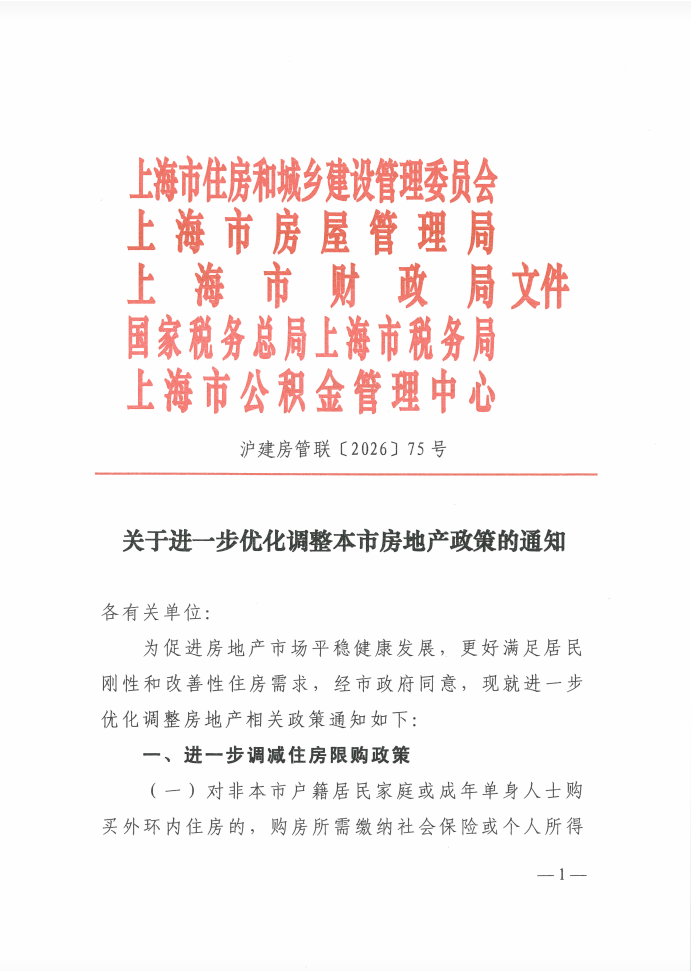
Core Viewpoint - Shanghai has introduced new real estate policies aimed at stabilizing the housing market by reducing purchase restrictions, optimizing housing provident fund loans, and improving personal housing property tax regulations, with a focus on activating potential homebuyers from outside Shanghai [1][3]. Group 1: Housing Purchase Restrictions - The new policy will implement a "three-step" approach to further reduce housing purchase restrictions, including shortening the required social insurance or personal income tax payment period for non-local residents to one year [5][6]. - Non-local residents who have paid social insurance or personal income tax for three years or more can purchase an additional home in the outer ring of the city [5][6]. - Holders of the Shanghai residence permit for five years or more can purchase one home in the city without needing to provide proof of social insurance or tax payments [5][6]. Group 2: Housing Provident Fund Optimization - The maximum loan amount for first-time homebuyers using the housing provident fund has been increased from 160 million to 240 million yuan, with potential additional increases for families with multiple children and those purchasing green buildings [10][11]. - The policy also allows families who have previously used provident fund loans to apply for new loans if they currently own no more than one home and have settled their previous loans [11]. - The support for multi-child families has been expanded to include second home purchases, with a maximum loan amount increase of 20% [11][12]. Group 3: Support for Local Residents - The policy includes provisions for Shanghai residents, allowing adult children of local families to purchase homes without incurring personal housing property tax if the new home is their only residence [14][16]. - This tax exemption aims to stimulate demand among local families, particularly as the housing ownership rate among local residents is relatively high [14][16]. - The overall strategy is to tap into the potential housing demand from local families, especially as Shanghai's per capita disposable income has surpassed 90,000 yuan [14][16].

商务部回应美国加征100%关税,9月进出口增速超预期 | 财经日日评
吴晓波频道· 2025-10-14 00:30
Group 1: Trade Relations and Policies - The Chinese Ministry of Commerce responded to the U.S. announcement of a 100% tariff increase, labeling it as a typical "double standard" and emphasizing that China does not wish to engage in a trade war but is not afraid to do so if necessary [2] - Recent measures by China to tighten export controls on rare earths are seen as a retaliatory action against the U.S., indicating a potential escalation in trade tensions [2][3] - The uncertainty in U.S.-China trade policies is affecting global multinational companies, leading to diminished business confidence [3] Group 2: Trade Data and Economic Indicators - In September, China's exports grew by 8.3% year-on-year, reaching a six-month high, while imports increased by 7.4%, the highest in 17 months, indicating resilience in trade performance [4] - The total value of China's goods trade in the first three quarters reached 33.61 trillion yuan, a year-on-year increase of 4%, with exports maintaining growth for eight consecutive quarters [4] - Despite the positive trade data, challenges remain, including the impact of U.S. tariffs on re-exported goods and a shift towards processing trade, which may continue to pressure China's export outlook [5] Group 3: Real Estate Market Trends - Major cities like Beijing, Shanghai, and Shenzhen have seen an increase in real estate transaction volumes, with September data showing significant growth in both new and second-hand housing sales [6] - The overall real estate market remains under pressure, with limited recovery in supply-demand dynamics, indicating a buyer's market [7] Group 4: Corporate Developments - The Dutch government has imposed restrictions on China's Wingtech Technology's subsidiary, Anshi Semiconductor, leading to asset freezes and management changes, highlighting the political risks faced by Chinese companies abroad [8] - Vanke's chairman, Xin Jie, resigned for personal reasons, raising concerns about the company's stability amid liquidity challenges [9][10] Group 5: Aviation and Tourism Industry - Post-holiday, air ticket prices have significantly dropped, with some routes seeing reductions of up to 80%, reflecting a decrease in travel demand following the peak holiday season [13][14] - The entire tourism industry is facing profitability challenges, with airlines struggling to maintain margins as ticket prices align with or fall below high-speed rail costs [14] Group 6: Market Performance - On October 13, the stock market experienced fluctuations, with the Shanghai Composite Index closing down 0.19%, amid ongoing trade tensions between the U.S. and China [15][16] - The market's response to trade policy changes indicates a reduction in panic compared to previous instances, although overall trading volume has decreased, reflecting a cautious investor sentiment [15][16]



深圳楼市大松绑!政策组合拳如何激活“金九银十”?
Sou Hu Cai Jing· 2025-09-16 01:55
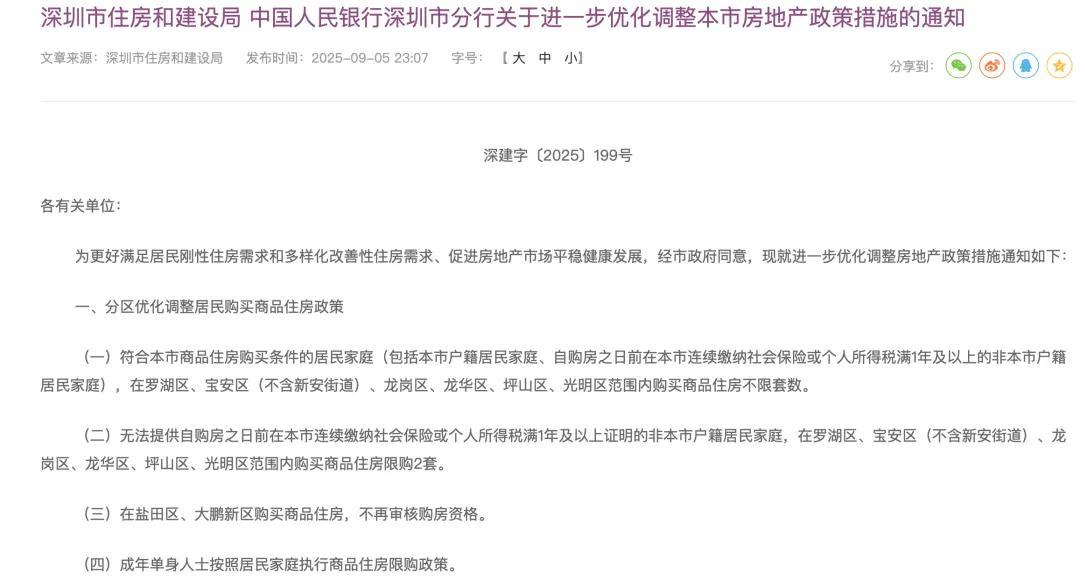
Core Insights - Shenzhen has introduced significant policy changes to its real estate market, including lowering purchase thresholds, easing corporate buying restrictions, and adjusting mortgage rates, aiming to stimulate demand during the traditional peak season of "Golden September and Silver October" [1][2][3] Policy Changes - The purchase restrictions in Shenzhen have been significantly relaxed, with core areas now limited to three districts, while non-core areas have removed previous limits on the number of properties that can be purchased [2] - For corporate purchases, conditions have been eased, allowing companies to buy properties in core areas under certain conditions and completely removing restrictions in non-core areas [2] - Mortgage rates have been adjusted, with no differentiation between first and second homes, potentially lowering rates by approximately 40 basis points for second homes, providing tangible financial relief for buyers [2] Market Response - Following the announcement of the new policies, there has been a notable increase in buyer activity in Shenzhen, with a reported 10% rise in property visits and immediate purchases by some buyers [3] - Other major cities like Beijing and Shanghai have also implemented similar easing measures, indicating a trend towards more lenient housing policies across first-tier cities [3][4] Market Performance - In Beijing, the new policies have led to a significant increase in market activity, with over 2,800 new residential transactions in August, marking a 2.3% month-on-month increase, and a 4.1% rise in second-hand home transactions [4] - Shanghai's second-hand market has also seen a surge, with daily transactions reaching over 500 units post-policy announcement, indicating sustained demand [4] Broader Implications - The collective actions of major cities signal a shift towards "loosening and activating demand," aimed at providing more opportunities for both first-time and upgrading homebuyers, which is expected to enhance market activity and alleviate price pressures [4][5] - Other cities across the country are likely to follow suit with similar policy adjustments, contributing to a more optimistic outlook for the real estate market during the peak buying season [5]

高频|一线城市二手房回暖,猪肉价格小幅上行
Sou Hu Cai Jing· 2025-09-13 23:35
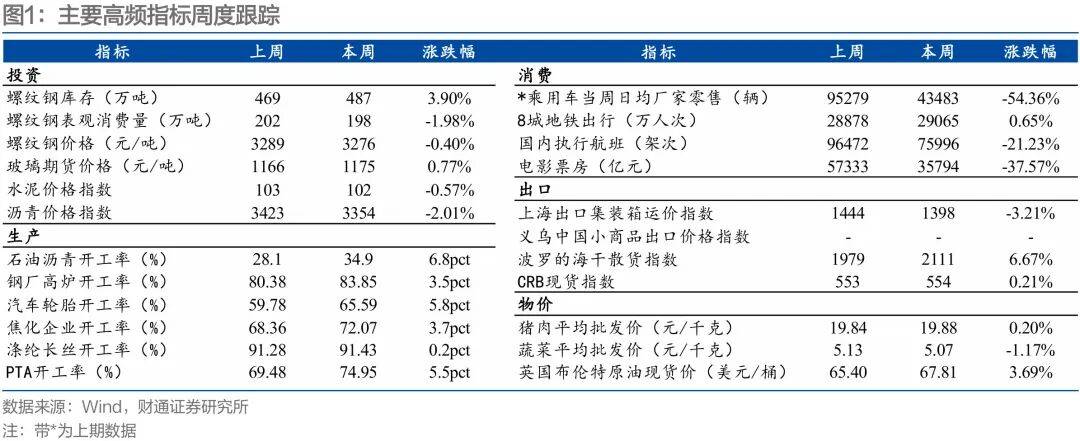
Group 1: Real Estate Sales - The real estate market in first and second-tier cities shows signs of marginal recovery, with new home sales experiencing a year-on-year decline that has narrowed to 3.58% [5][10] - In first-tier cities, the year-on-year decline in new home sales has significantly narrowed to 3.66%, while second-tier cities have seen a positive year-on-year change [5][19] - Second-hand home sales in major cities have generally increased compared to the previous period and last year, with notable growth in most cities [19] Group 2: Investment and Commodity Prices - Commodity prices are generally on a downward trend, with slight decreases in rebar and cement prices, while glass futures prices have seen a small increase [23][49] - The price index for asphalt has decreased, indicating ongoing weak market demand [23] Group 3: Production and Operating Rates - The operating rates for various industries, including steel mills and asphalt production, have generally increased, indicating a positive trend in production activity [34] - The operating rate for oil asphalt has seen a significant increase from 28.1% to 34.9% [3] Group 4: Consumer Activity - Consumer activity shows strong momentum, with subway ridership exceeding seasonal expectations, while automotive consumption and domestic flight operations align with seasonal trends [39] Group 5: Export Trends - The SCFI index has declined, indicating a decrease in container shipping rates, while the BDI index has increased, suggesting a rise in dry bulk shipping rates [43] Group 6: Price Trends - Pork prices have seen a slight increase, while vegetable prices have decreased, and oil prices have risen, reflecting mixed trends in consumer prices [49]
深圳楼市新政力度超过京沪,将“吸引外地人群购房”
Mei Ri Jing Ji Xin Wen· 2025-09-07 16:21
Core Viewpoint - Shenzhen's real estate market is experiencing significant policy relaxation aimed at stimulating demand and attracting buyers, particularly from outside the city [2][6]. Policy Changes - The new regulations, effective from September 6, include relaxed purchasing qualifications, reduced restrictions for corporate buyers, and adjustments to mortgage interest rates [2][5]. - Non-residents can now purchase up to two homes in certain districts without needing to meet the one-year social security or tax payment requirement [5][7]. - Saltian and Dapeng New Districts have completely removed purchase qualification checks, allowing anyone to buy property regardless of residency or social security status [7][8]. Impact on Buyers - The policy introduces differentiated purchasing limits based on district, with core areas maintaining stricter controls while peripheral areas see significant relaxations [7][8]. - Single adults will now be subject to the same purchasing limits as families, eliminating previous disparities [8]. Corporate Buying Regulations - Companies can now purchase residential properties across the city, with conditions in core areas and no restrictions in non-core areas [10][12]. - The requirements for corporate purchases in core areas include a minimum one-year establishment, tax payments of at least 1 million yuan, and a workforce of at least 10 employees [11][12]. Mortgage Rate Adjustments - Banks will no longer differentiate between first and second home loans, allowing for more flexible interest rate setting based on market conditions [14]. - The mortgage interest rate for first-time buyers is expected to decrease from 3.45% to 3.05%, resulting in lower total repayment amounts and monthly payments [15]. Market Outlook - The new policies are anticipated to significantly boost transaction volumes in peripheral areas, with expectations of over 40% growth in the upcoming months [9][15]. - The adjustments are seen as a means to stabilize the market and encourage both individual and corporate investments in Shenzhen's real estate sector [9][14].
苏州楼市再松绑,一夜甩卖三千套房,新房卖不动成谜
Sou Hu Cai Jing· 2025-08-31 10:50
Core Viewpoint - Suzhou has lifted its last housing market restriction, indicating a significant downturn in the real estate market, with new home sales plummeting by 70% in July compared to the previous month [1][4]. Group 1: Policy Changes - On August 26, Suzhou announced the cancellation of new home sales restrictions, leading to an immediate increase of over 3,000 second-hand homes listed online [1]. - Since 2022, Suzhou has gradually relaxed housing policies, starting with easing restrictions on second-hand home transactions [1][4]. - Other cities, such as Nanjing, are expected to follow Suzhou's lead in lifting sales restrictions, reflecting a broader trend across second and third-tier cities [4]. Group 2: Market Dynamics - The most significant price drops are observed in new homes, as the previous sales restrictions had been protecting their prices [3]. - The influx of second-hand homes into the market has led to aggressive price competition, with some listings seeing price cuts of up to 50% [3]. - The current market is characterized by urgent sales, with real estate agents reporting a surge in properties being sold at discounted prices [3]. Group 3: Economic Implications - The situation in Suzhou, as a major economic city, suggests that other cities may face even greater challenges in their real estate markets [4][6]. - The lifting of restrictions indicates that local governments are struggling to manage declining tax revenues from property transactions, leading to a reliance on market self-adjustment [6]. - The overall sentiment in the market is that property values are unlikely to rise in the near future, shifting the focus to genuine housing needs rather than speculative investments [4][6].

怎么看825上海新政?富人抄底,房东跑路,普通人看戏!
Sou Hu Cai Jing· 2025-08-27 21:20
Core Viewpoint - The "8·25 New Policy" in Shanghai is designed to benefit wealthy individuals and landlords, rather than the general public, by stimulating high-net-worth purchasing power and providing a way for landlords in outer ring areas to exit the market gracefully [1][9]. Group 1: Policy Changes - The most significant change is the removal of purchase restrictions for properties outside the outer ring, allowing individuals with Shanghai purchase qualifications to buy any number of properties [2]. - Single individuals now have equal purchasing rights as families, enabling them to buy multiple properties, which primarily benefits financially independent wealthy singles [4][5]. - The policy allows for the extraction of public housing funds for down payments without affecting loan limits, but this is limited to new homes and ties future income to real estate [5][7]. Group 2: Beneficiaries - The primary beneficiaries are middle-class individuals who own properties in the city, allowing them to upgrade to better housing in outer areas [4]. - Wealthy individuals, including successful entrepreneurs and affluent young people, are expected to purchase properties aggressively in high-demand areas [4][5]. - Landlords in outer ring areas gain an advantage as they can now buy city properties without needing to sell their existing ones first, avoiding significant losses [8]. Group 3: Financial Implications - The cancellation of the interest rate distinction between first and second homes is aimed at reducing monthly payment burdens, effectively inviting investors back into the market [7]. - The exemption of property tax for non-local buyers purchasing their first home serves as a corrective measure to encourage purchases in the context of the new policy [7][9]. - The overall design of the policy focuses on facilitating financial flow and stimulating the market, primarily benefiting wealthier individuals and landlords [9].
现在下决心降价卖房,已经晚了
Sou Hu Cai Jing· 2025-07-09 17:06
Core Viewpoint - The recent real estate market is experiencing significant declines in housing prices, particularly in the second-hand housing market, raising concerns among potential buyers and investors [1][3]. Group 1: Overall Market Situation - In June, the average price of second-hand residential properties in 100 cities was 13,691 yuan per square meter, reflecting a month-on-month decline of 0.75%, which is an increase in the decline rate by 0.4 percentage points compared to May [3]. - Year-on-year, the price dropped by 7.26%, with the decline rate also widening by 0.02 percentage points from the previous month [3]. - The continuous decline in housing prices, particularly when the month-on-month drop exceeds 0.7%, indicates a significant market contraction that can lead to a cumulative annual decline of around 10% [3]. Group 2: City-Level Analysis - First-tier cities saw a month-on-month price drop of 0.56%, while second-tier and third/fourth-tier cities experienced declines of 0.81% and 0.76%, respectively [3]. - Although first-tier cities have the smallest decline, the acceleration in the drop from 0.36% in May to 0.56% in June suggests a concerning trend [3][4]. Group 3: Market Dynamics - The easing of restrictions in the real estate market since September last year initially alleviated pressure on first-tier cities, but the effects appear to have diminished as demand has been largely consumed [5]. - The increasing number of listings indicates a shift in market dynamics, favoring buyers as sellers are compelled to lower prices to attract buyers [6]. - The rise in listings, particularly in first-tier cities, suggests a supply-demand imbalance, leading to further price reductions [6]. Group 4: Future Outlook - The potential for a new wave of selling could emerge if market expectations are not met, particularly if further policy relaxations do not stabilize the market [9]. - The company advises sellers to capitalize on potential market rebounds in 2025, as this period may coincide with policy-driven demand surges [10].
格林大华期货钢材早盘提示-20250703
Ge Lin Qi Huo· 2025-07-03 02:51
1. Report's Industry Investment Rating - The investment rating for the black building materials (steel) sector is short - term oscillatory and bullish [1] 2. Report's Core View - The black building materials (steel) market showed significant price increases on Wednesday and night trading. Although the macro and news aspects are favorable, the fundamental situation has not improved significantly, so the upside potential should be viewed with caution, and the short - term trend is oscillatory and bullish [1] 3. Summary According to the Catalog 3.1 Market Review - On Wednesday, rebar and hot - rolled coils rose significantly, and the night trading closed higher [1] 3.2 Important Information - The National Development and Reform Commission recently allocated over 300 billion yuan to support the third - batch of "two major" construction projects in 2025, and the 800 - billion - yuan "two major" construction project list for this year has been fully issued [1] - As of June 30, 27 cities introduced 34 real - estate market relaxation policies, with many areas optimizing housing provident fund policies, and some cities extending relevant relaxation policy periods [1] - Vice - Premier Zhang Guoqing recently investigated the transformation and upgrading and innovation development of the manufacturing industry in Hubei, emphasizing the focus on the real economy and promoting high - end, intelligent, and green development of the manufacturing industry [1] 3.3 Market Logic - On Wednesday, the spot prices of rebar and hot - rolled coils generally increased with good trading volume. Futures prices also rose significantly. In the industrial aspect, due to the decline in raw material prices such as coke, scrap steel, and iron ore, the profit of building materials improved, with a profit of about 100 yuan per ton of steel. Some blast furnaces resumed production but not at full capacity. Electric furnaces continued to suffer deep losses, with a loss of 100 - 150 yuan per ton during off - peak hours, and production continued to decline. The total actual steel supply only increased slightly. The emission reduction and production restriction in Tangshan from July 4 - 15 are beneficial to the market but have little impact on overall production. On the demand side, due to hot and rainy weather, demand continued to show off - season characteristics. The recent central meeting may briefly support the market. The upper resistance level of the rebar main contract moved up to 3100 after breaking through 3050, with an important support level at 2912. The support level of hot - rolled coils is 3026, with a resistance level of 3282 after breaking through 3200. The support level of stainless steel is 12300, and the resistance level is 13000 [1] 3.4 Trading Strategy - With the positive macro and news factors already reflected in the market, and without obvious improvement in the fundamentals, the upside potential should be viewed with caution, and the short - term trend is oscillatory and bullish [1]
杭州楼市:买房人开始懵了,买房的逻辑又变了?
Sou Hu Cai Jing· 2025-05-01 23:24
Group 1 - New housing prices increased by 0.5% month-on-month, while second-hand housing prices rose by 1%, ranking first in the country [1] - New commodity housing transactions reached 7,049 units, a month-on-month growth of 184%; second-hand housing transactions totaled 12,413 units, with a month-on-month increase of 108% and a year-on-year growth of 45%, marking the highest transaction volume in nearly 8 years [1][3] - Recent policy adjustments in Hangzhou aim to reduce transaction taxes, lowering the deed tax from 3% to 1% for multiple home purchases, effectively reducing the tax burden for buyers [3] Group 2 - The acceleration of policy relaxation in Hangzhou is attributed to a decline in market heat observed in April, with reports of reduced property viewings and lower transaction expectations [6] - A recent meeting led by the Premier emphasized the need for more proactive macro policies to stimulate demand, indicating potential for further supportive measures in the real estate market [8] - The changing logic of home buying is influenced by broader economic signals and income expectations, suggesting that market sentiment may remain cautious despite policy support [10]