
关税报复

Search documents
英国政府警告称,如果美国撕毁贸易协议英国将采取关税报复措施
Shang Wu Bu Wang Zhan· 2026-02-26 11:01
Core Viewpoint - The UK government warns of retaliatory measures if the US violates the previously agreed 10% tariff deal and imposes a new 15% tariff, which could significantly impact UK businesses [1] Group 1: Tariff Implications - The proposed US global uniform tax rate of 15% is expected to be most detrimental to the UK, which previously imposed a 10% tariff on many goods, leading to an average tariff rate increase of 2.1 percentage points [1] - UK businesses express concerns over the new tariff system, with the British Chamber of Commerce president Andy Haldane stating that allied countries with preferential agreements are now at a disadvantage [1] Group 2: Business Impact - The executive chairman of clothing brand Sunspel, Nicholas Brooke, highlights that the changes not only increase costs directly but also create uncertainty in investment confidence in the US due to rapidly changing rules [1] Group 3: Trade Agreements - UK officials assert that the proposed 15% new tariff will not affect the industry trade agreements signed separately with the US, which operate under different legal frameworks [1] - UK officials also indicate that the country is expected to continue benefiting once the US concludes its "Section 301" investigations related to semiconductors and other digital trade areas [1]
美国商务部长:预计美国一季度增速将超过5% 警告欧洲不要落实关税报复行动
Jin Rong Jie· 2026-01-20 17:44
Core Viewpoint - The U.S. Secretary of Commerce, Howard Lutnick, anticipates that the U.S. GDP growth rate will exceed 5% in the first quarter of 2026, while cautioning the EU against retaliatory tariffs related to President Trump's threats concerning Greenland [1] Group 1 - The expected U.S. GDP growth rate for Q1 2026 is projected to be over 5% [1] - Lutnick warns that if the EU implements retaliatory tariffs, it could lead to a renewed cycle of tariff escalations [1]
美国再度以“巨额关税”威胁印度
Huan Qiu Shi Bao· 2025-10-20 22:57
Group 1 - The core point of the article is that President Trump claims Indian Prime Minister Modi assured him that India would stop purchasing Russian oil, warning of "huge" tariffs if India does not comply [1][2] - Trump indicated that the issue of Russian oil purchases has been a significant point of contention in long-term trade negotiations with India, with tariffs imposed as a form of retaliation [1] - Following the Ukraine conflict, India emerged as a major buyer of discounted Russian oil, despite Western sanctions aimed at reducing Russia's oil revenue [1] Group 2 - The Indian government has denied any knowledge of a conversation between Modi and Trump regarding the cessation of Russian oil purchases, while U.S. officials claim that India has halved its purchases [2] - Despite claims of reduced purchases, sources indicate that there has been no observable decline in India's Russian oil imports, with any potential reductions likely to be reflected in future data [2] - The textile industry in India, which is significantly impacted by U.S. tariffs, accounts for approximately 2.3% of India's GDP and employs over 45 million people [2]
美国拿加拿大祭旗,谁敢学中国反抗,等于打美国的脸,决不轻饶
Sou Hu Cai Jing· 2025-08-09 12:36
Core Viewpoint - The U.S. has increased tariffs on Canada from 25% to 35% as a response to Canada's retaliation against U.S. tariffs, marking a significant shift in U.S.-Canada relations [3][5][9] Group 1: U.S.-Canada Relations - Canada, traditionally a close ally of the U.S., is facing unprecedented tariff increases, which has caused shock domestically and among other Western nations [3] - The U.S. perceives Canada's retaliation as a direct challenge, contrasting with other allies who have accepted U.S. tariffs without response [9] Group 2: U.S. Trade Policy - The U.S. Trade Representative, Jamison Greer, indicated that the U.S. must maintain the integrity of its tariff actions, hence the increase in tariffs on Canada serves as a warning to other nations [7] - The U.S. has been unable to effectively counter China's retaliatory measures, leading to a unique situation where China is treated differently compared to Canada [7][10] Group 3: Strategic Implications - The U.S. aims to deter other countries from following Canada's example of retaliation, emphasizing the need for strict enforcement of its global tariff policy [7][9] - The situation reflects broader concerns within the U.S. regarding maintaining control over its trade relationships, especially as other countries like Brazil and India begin to challenge U.S. policies [10]

高盛(GS.N):巴西的关税报复措施将对经济活动和通货膨胀产生更大的负面影响。
news flash· 2025-07-30 22:44
Core Viewpoint - Goldman Sachs (GS.N) indicates that Brazil's retaliatory tariff measures will have a more significant negative impact on economic activity and inflation [1] Economic Impact - The retaliatory tariffs are expected to dampen economic growth in Brazil, leading to a slowdown in various sectors [1] - Increased tariffs may result in higher consumer prices, contributing to inflationary pressures within the economy [1] Inflation Concerns - The measures are likely to exacerbate existing inflation issues, making it more challenging for policymakers to manage price stability [1] - Goldman Sachs highlights that the inflationary impact could lead to adjustments in monetary policy [1]
据CNN Brasil:巴西工业界请求政府不要对美国关税采取报复措施。
news flash· 2025-07-15 15:17
Core Viewpoint - The Brazilian industrial sector is urging the government not to retaliate against U.S. tariffs [1] Group 1 - The Brazilian industry is concerned that retaliatory measures could harm local businesses and the economy [1] - Industry representatives emphasize the importance of maintaining a stable trade relationship with the U.S. [1] - The call for restraint reflects a desire to avoid escalating trade tensions that could negatively impact Brazil's economic growth [1]
巴西财政部官员梅洛:特朗普宣布关税后,有与美国谈判的空间。巴西对进口征收关税可能成为一种报复措施,但这一措施尚未确定。
news flash· 2025-07-11 13:07
Core Viewpoint - Brazilian Finance Ministry official Melo indicated that there is room for negotiation with the United States following Trump's announcement of tariffs, suggesting potential diplomatic engagement despite the tensions [1] Group 1 - Brazil may consider imposing tariffs on imports as a retaliatory measure, although this action has not yet been confirmed [1]
印尼经济部发言人:美国已告知印度尼西亚,华盛顿不希望印度尼西亚以关税进行报复。
news flash· 2025-07-09 06:58
Group 1 - The U.S. has informed Indonesia that it does not wish for Indonesia to retaliate with tariffs [1]
950亿欧元?欧盟对美“翻脸”了,局势生变,中方通告全球!
Sou Hu Cai Jing· 2025-06-30 11:48
Core Viewpoint - The European Union (EU) is preparing to implement retaliatory tariffs against the United States, targeting $95 billion worth of American goods, in response to ongoing trade tensions and to secure a better trade agreement [1][3]. Group 1: EU's Trade Strategy - The EU is coordinating its stance internally to prepare for potential retaliatory measures against the U.S. before the July 9 deadline for trade negotiations [1]. - The proposed tariff list includes items such as Boeing aircraft, automobiles, and bourbon whiskey, aimed at countering Trump's "reciprocal tariffs" [3]. - EU officials express that a passive approach is politically unfeasible, indicating a shift towards a more aggressive trade strategy [3]. Group 2: Global Trade Implications - The ongoing trade war between the U.S. and EU could lead to significant global economic repercussions, including a potential loss of $6.75 trillion in global GDP if the tariff conflict escalates [5]. - The trade dispute is seen as a precursor to a broader restructuring of global economic order, with the U.S. high tariff policies negatively impacting both its own growth and European economies [7]. - China's position as a stable and cooperative market is highlighted as a counterbalance to the uncertainties created by U.S.-EU trade tensions [7].

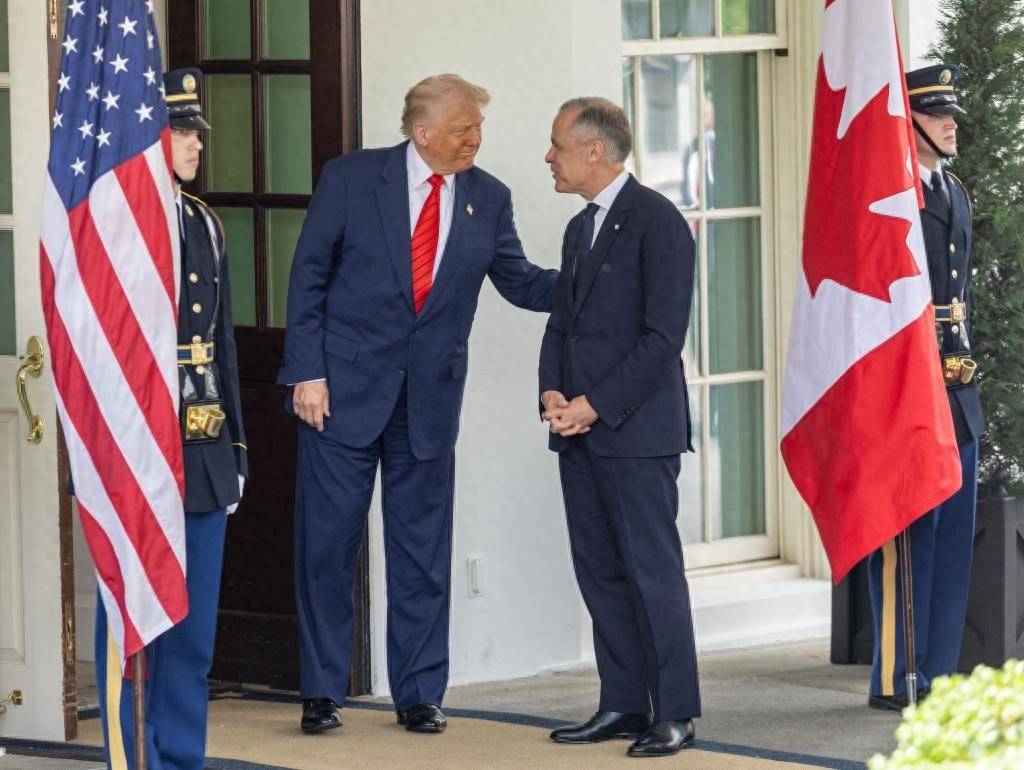
加拿大总理卡尼:保留对美国关税进行报复的灵活性。
news flash· 2025-06-18 00:39
Core Viewpoint - Canadian Prime Minister Carney emphasizes the importance of maintaining flexibility in retaliating against U.S. tariffs [1] Group 1 - The Canadian government is considering various options to respond to U.S. tariffs [1] - There is a focus on protecting Canadian industries from the impact of these tariffs [1] - The Prime Minister's statement indicates a strategic approach to trade relations with the U.S. [1]