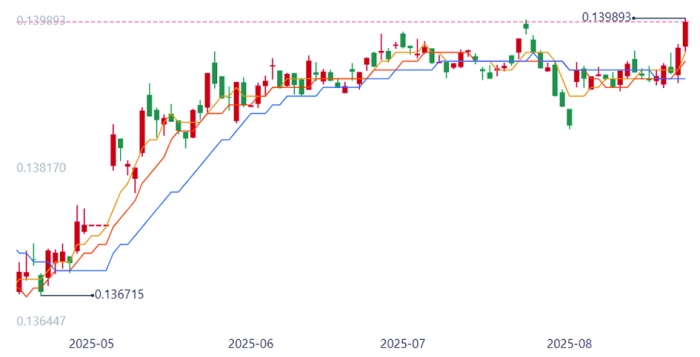
双向波动

Search documents
人民币暴涨5600点!美元未跌,人民币却单独升值,谁在疯狂买入?
Sou Hu Cai Jing· 2026-02-27 06:07
Core Viewpoint - The Chinese yuan has experienced a significant appreciation from 7.4 to 6.83 against the US dollar over a span of ten months, marking a strong independent performance amidst a backdrop of stagnation in other major currencies [1][3][8]. Group 1: Currency Performance - The yuan's rise to 6.83 on February 26, 2026, stands out as it occurred while other major currencies remained stagnant, with the US dollar index fluctuating between 96.5 and 98.5 [3][5]. - The yuan's appreciation was characterized by a cumulative increase of over 5600 basis points, transitioning from 7.4 to 6.83 [8][12]. - Key milestones in this appreciation included breaking through the 7.1 mark in September 2025 and surpassing the psychologically significant 7.0 level by the end of December 2025 [10][12]. Group 2: Economic Drivers - The appreciation of the yuan is supported by substantial inflows of capital, including a record foreign exchange surplus of $999 billion in December 2025 and $887.6 billion in January 2026, totaling nearly $2 trillion in two months [6][16]. - Foreign investment in the Chinese stock market reached approximately $260 billion in January 2026, driven by a recovery in the Chinese economy and the attractiveness of yuan-denominated assets [18]. - The IPO fundraising in Hong Kong surged to ten times the previous year's levels in early 2026, indicating a strong market vitality and foreign interest in Chinese assets [20][22]. Group 3: Regulatory Environment - The Chinese regulatory authorities have maintained a cautious approach to the yuan's rapid appreciation, ensuring that it does not lead to excessive volatility while keeping foreign exchange reserves stable at over $3.39 trillion [24][26]. - The regulatory strategy aims to balance growth and risk prevention, avoiding both panic devaluation and uncontrolled appreciation [30][40]. - The maturity of the foreign exchange market is reflected in the rational behavior of market participants, who are increasingly using hedging tools to manage currency risk [32]. Group 4: Market Implications - The yuan's strength presents both opportunities and challenges; for instance, companies reliant on imported goods benefit from reduced costs, while small exporters may face profit pressures due to increased foreign currency prices [34][36]. - The appreciation signals international confidence in the Chinese economy, highlighting its resilience and potential [34][42]. - The future trajectory of the yuan will depend on maintaining economic fundamentals and enhancing industrial competitiveness, ensuring its role as a significant player in the global currency system [46].


人民币走强!专家:双向波动仍是趋势
Zhong Guo Zheng Quan Bao· 2026-02-22 15:13
Core Viewpoint - The Chinese yuan has been appreciating against the US dollar since 2026, with both onshore and offshore yuan breaking the 6.9 yuan mark before the Spring Festival, indicating a trend of strengthening supported by various factors [1][3]. Group 1: Exchange Rate Trends - The offshore yuan appreciated by 0.06% against the US dollar during the Spring Festival holiday from February 16 to 20 [3]. - The recent rise in the yuan's exchange rate is significantly driven by increased corporate demand for currency settlement, particularly at the end of the year [3]. - The foreign exchange reserves increased by $41.2 billion from the end of December 2025 to the end of January 2026, indicating a strengthening of market confidence in cross-border capital flow stability [3]. Group 2: Expert Predictions - Experts predict that the yuan will likely continue to exhibit a pattern of mild appreciation and two-way fluctuations throughout the year [5]. - The first quarter of 2026 is expected to see sustained growth in exports, with corporate settlement demand likely to continue releasing [5]. - The yuan's exchange rate is projected to fluctuate between 6.8 and 7.1 yuan against the US dollar, reflecting a stable upward trend amid manageable external risks [5].
人民币汇率创15个月新高 双向波动或成常态
Sou Hu Cai Jing· 2025-12-25 17:38
Core Viewpoint - The offshore RMB has broken the "7" threshold against the USD for the first time since October 2024, reaching a high of 6.9985, while the onshore RMB also strengthened, nearing the "7" mark at 7.0066, marking a new high since September 2024 [1] Group 1: Factors Driving RMB Strength - The recent appreciation of the RMB is primarily driven by a weakening USD, with the dollar index dropping from above 100 to below 98 since November [2] - China's robust economic fundamentals, including a trade surplus of $1.0758 trillion for the first 11 months of 2025, have bolstered market confidence in the RMB [2] - Increased demand for currency settlement by enterprises at year-end has contributed to the seasonal strengthening of the RMB, although this "settlement wave" is not the main driver of the current appreciation [2][3] Group 2: Outlook on RMB Exchange Rate - Experts caution against expecting a new cycle of sustained RMB appreciation, predicting that the exchange rate will likely exhibit two-way fluctuations rather than a unilateral trend [4][9] - A continuous appreciation of the RMB requires two conditions: a sustained decline in the USD index and strong domestic economic support [4] - Uncertainties regarding the USD's future trajectory and potential economic changes in the U.S. could impact the RMB's appreciation momentum [5] Group 3: Regulatory and Market Responses - The central economic work conference emphasizes maintaining the RMB exchange rate's stability, reflecting a policy approach to prevent excessive appreciation or depreciation [7] - Regulatory authorities have actively managed market expectations to mitigate one-sided behaviors, indicating a potential intention to adjust the exchange rate amid rapid RMB appreciation [8] Group 4: Implications for Enterprises - The RMB's appreciation presents mixed impacts for businesses, benefiting capital markets and importers while posing challenges for exporters [10] - Exporters face pressures from reduced international price competitiveness and slower order rhythms due to the rapid appreciation of the RMB [11] - Despite the challenges, historical data suggests that RMB appreciation has not significantly suppressed exports, and may even coincide with increased export growth in certain contexts [11]
多项因素推动本轮人民币升值 “双向波动”或是未来常态
Sou Hu Cai Jing· 2025-12-02 14:43
Core Viewpoint - The recent fluctuations in the RMB exchange rate against the USD have garnered significant market attention, with the RMB appreciating to a high not seen in over a year, driven by both internal and external factors [1][2]. Group 1: Exchange Rate Trends - On December 1, the RMB to USD central parity rate was reported at 7.0759, an increase of 30 basis points from the previous day's rate of 7.0789, marking a significant high [1]. - The RMB's appreciation is supported by the People's Bank of China's (PBOC) stable exchange rate policy and seasonal demand for currency conversion as year-end approaches [2][3]. - The RMB is expected to experience moderate appreciation towards the end of the year and into 2026, influenced by seasonal factors and the anticipated easing of US monetary policy [3][5]. Group 2: Contributing Factors - A weaker USD, driven by the Federal Reserve's shift towards potential interest rate cuts, has created a favorable environment for non-USD currencies, including the RMB [2]. - The attractiveness of domestic assets has increased due to strong performance in China's A-shares, leading to higher foreign capital inflows and demand for RMB [2]. - The PBOC's gradual adjustments to the RMB's central parity rate signal a commitment to maintaining a stable exchange rate, which has encouraged market confidence [2][4]. Group 3: Future Outlook - The RMB's long-term appreciation is supported by expected improvements in China's economic fundamentals, contrasting with a projected downturn in the US financial cycle [3]. - The ongoing structural adjustments in the Chinese economy and the internationalization of the RMB are expected to foster a positive cycle of appreciation and demand for RMB assets [3]. - The PBOC aims to maintain a stable RMB exchange rate while preventing excessive fluctuations, indicating a preference for orderly market conditions rather than rapid appreciation [4].
廖市无双:双向波动后,主升3浪还能延续吗?
2025-09-01 02:01
Summary of Key Points from Conference Call Records Industry Overview - The market is currently experiencing a phase of **bidirectional volatility**, with the potential for the main upward wave (third wave) to continue, targeting mid-term levels of **3,806 points** and **4,130 points** [1][2][14] - The **A-share market** is expected to outperform the **H-share market**, influenced by the anticipated appreciation of the **RMB** and the impact of subsidy policies on major technology stocks [1][8] Core Insights and Arguments - The market has shown unusual adjustments and rebounds this year, with global capital driving stock prices higher even without clear reasons [3][4] - The **current market dynamics** are driven by emotions and funds, making it difficult to predict market tops [6][14] - The **RMB appreciation** is a significant factor for A-shares, indicating a potential phase of a bull market, with confidence in reaching **4,130 points** on the Shanghai Composite Index [1][12][15] Trading Strategies - Investors are advised to maintain positions and avoid making quick trades or reducing holdings during this volatile phase [5][21] - For medium-term positions, holding until **4,100 points** is recommended, while short-term positions should be approached with caution [18][21] - A balanced industry allocation is suggested, with investments in large financials and broad technology sectors [21] Market Performance and Trends - Recent performance of major indices includes: - **CSI 300**: up **2.7%** - **CSI 500**: up **3%** - **ChiNext Index**: up **7.74%** - **STAR 50**: up **7.49%** [9] - The **communication and electronics sectors** have shown significant gains, while small-cap stocks have underperformed, indicating institutional control over pricing [11][9] Important but Overlooked Content - The **North China 50** index was the only one to decline this week, down **1.6%**, highlighting a shift in investor focus towards undervalued sectors [9] - The **technical pressures** on the STAR 50 and ChiNext indices suggest caution, as they face potential resistance levels [17] - The **current market style** is leaning towards large-cap growth, influenced by expectations of overseas interest rate cuts and advancements in the AI sector [23] Investment Themes and Opportunities - Investors should consider **中字头 stocks** and the real estate sector, which may benefit from recent policy changes despite past performance concerns [20] - Emerging industries such as **solid-state batteries** and related fields are noted for their rebound potential, alongside stable consumer-related indices [25] Conclusion - The market outlook remains optimistic despite increased volatility, with a focus on maintaining a balanced portfolio and being prepared for potential market corrections [19][14]
多重因素驱动人民币走强 “双向波动”仍是主基调
Shang Hai Zheng Quan Bao· 2025-08-25 20:09
Core Viewpoint - The onshore RMB against the USD strengthened significantly on August 25, closing at 7.1517, an increase of 288 basis points from the previous trading day, driven by multiple factors including a weaker USD index, a substantial adjustment in the central parity rate, and improved capital market sentiment [2][3]. Group 1: Factors Supporting RMB Strength - The RMB/USD exchange rate surged, breaking through multiple key levels, with a closing price of 7.1517, marking a new high since November 2024 [3]. - The weakening of the USD index, influenced by rising expectations of a Federal Reserve rate cut, provided upward momentum for the RMB. The USD index fell below 98, decreasing by 0.94% on August 22 [3]. - The central parity rate for RMB against USD was significantly raised by 160 points to 7.1161, the highest since November of the previous year, which positively impacted both domestic and foreign trading prices [4]. Group 2: Future Outlook for RMB Exchange Rate - The RMB exchange rate is expected to exhibit a dual-directional fluctuation, influenced by both internal and external factors. The future trajectory of the USD index remains a critical variable for the global forex market [5]. - The potential for further USD weakness due to Fed rate cuts could benefit the RMB, but uncertainties regarding the continuity of rate cuts may affect the USD's performance [5]. - Domestic economic trends play a crucial role in determining the RMB exchange rate, with the possibility of increased foreign capital inflows contributing to RMB appreciation [6].