商办市场去库存

Search documents
商业用房最低首付比下调至30% 直指商办市场去库存难题
Shang Hai Zheng Quan Bao· 2026-01-18 18:15
Group 1 - The adjustment of the minimum down payment ratio for commercial property loans to no less than 30% is expected to positively impact the real estate market and corporate structure [2][3] - This policy aims to support the de-inventory of the commercial real estate market, which includes shops, office buildings, hotels, and commercial complexes [4][5] - The previous down payment requirements for commercial properties were generally around 50%, with some banks increasing it to 60% or more, which suppressed the purchasing willingness of small investors and enterprises [3][4] Group 2 - The new policy is seen as a tool to stimulate market activity and accelerate the de-inventory process for real estate companies, which have been facing cash flow pressures due to slow sales [5][6] - The adjustment is expected to facilitate the transformation of commercial properties into long-term rental apartments and hotel-style apartments, thereby activating demand for such investments [6] - The reduction in the down payment requirement aligns with the recovery of the consumption market and the service industry, indicating a positive response from the policy side to economic recovery [6]


周末重磅!央行、金融监管总局下调商业用房购房贷款最低首付款比例
Jin Rong Shi Bao· 2026-01-18 02:41
Core Viewpoint - The People's Bank of China and the National Financial Regulatory Administration have announced a policy adjustment to reduce the minimum down payment ratio for commercial property loans to 30%, aimed at stimulating the commercial real estate market and reducing inventory levels [3][4]. Group 1: Policy Changes - The minimum down payment ratio for commercial property loans, including "commercial-residential mixed-use properties," has been adjusted to no less than 30% from the previous 50% [3]. - Local branches of the People's Bank of China and the National Financial Regulatory Administration will determine the minimum down payment ratio based on local government regulations, adhering to the principle of "differentiated policies" [3]. Group 2: Market Context - As of November 2025, there are 52.34 million square meters of unsold office space and 141.05 million square meters of unsold commercial properties in China [3]. - The commercial property market, which includes shops, office buildings, hotels, and commercial complexes, has been experiencing a slower inventory reduction compared to the residential market [4]. Group 3: Expert Opinions - Experts believe that lowering the down payment ratio will significantly reduce the initial financial burden on buyers, particularly benefiting small and medium-sized enterprises and startups [4]. - The adjustment is seen as a coordinated effort with residential market policies and a targeted response to structural issues in the commercial real estate sector [4]. Group 4: Additional Support Measures - Various cities are providing subsidies for purchasing commercial properties, such as a 50% rebate on deed tax in Wuhan and a 10,000 yuan subsidy for purchases over 100 square meters in Nanning [5]. - The short-term effect of the policy is expected to stimulate demand in active commercial areas, while the long-term recovery of the commercial property market will depend on sustained growth in consumption and the service sector [5].
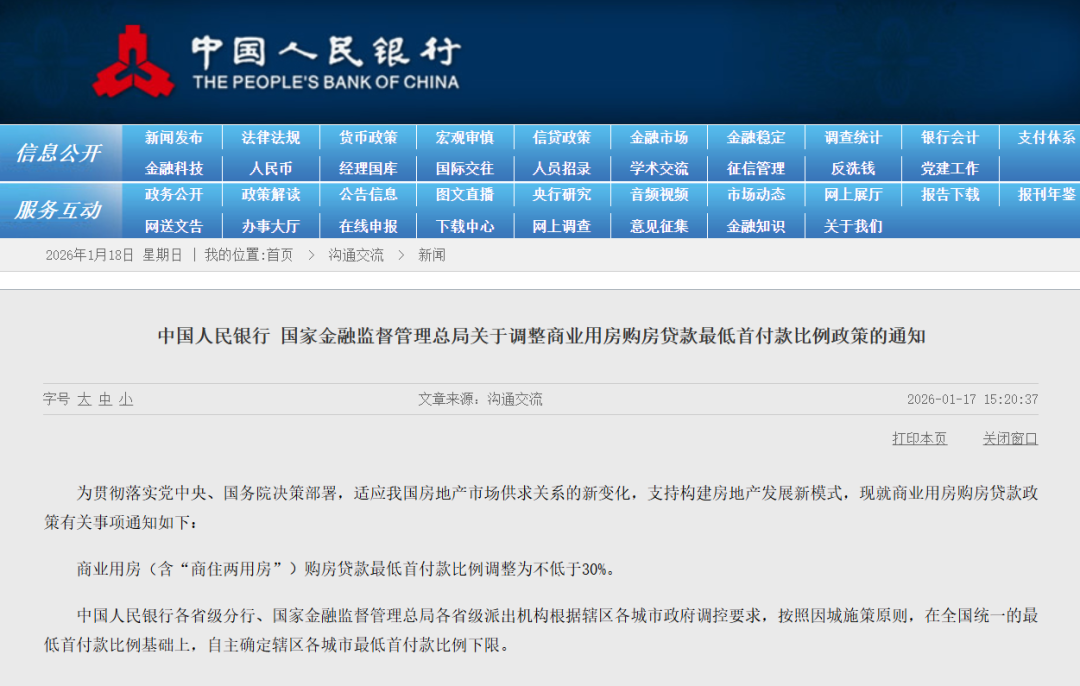
利好来了!两部门联合发布
Zhong Guo Ji Jin Bao· 2026-01-17 09:28
Core Viewpoint - The People's Bank of China has announced a reduction in the minimum down payment ratio for commercial property loans to 30%, aimed at stimulating the commercial real estate market and addressing inventory issues [1][3]. Group 1: Policy Changes - The minimum down payment ratio for commercial property loans, including "commercial-residential mixed-use properties," has been adjusted to no less than 30% [3]. - Previously, the minimum down payment ratio was set at 50%, with some banks requiring even higher ratios, making it difficult for buyers to enter the market [3]. - The adjustment is expected to lower the financial burden on buyers, particularly benefiting young individuals in first-tier cities [3]. Group 2: Market Context - The commercial real estate sector is facing significant inventory challenges, with approximately 52.34 million square meters of office space and 14 million square meters of commercial property available for sale, totaling nearly 200 million square meters [4]. - The central government and regulatory bodies are increasingly focused on reducing inventory in the commercial property sector, as evidenced by various supportive policies being implemented in different cities [4]. Group 3: Future Expectations - More cities are anticipated to implement policies aimed at reducing inventory in the commercial property market, which may include optimizing purchase restrictions to promote transaction activity [5]. - The reduction in the minimum down payment ratio is expected to stimulate demand from buyers with actual operational needs or long-term investment intentions, marking a significant national-level credit support for the commercial property market [5].
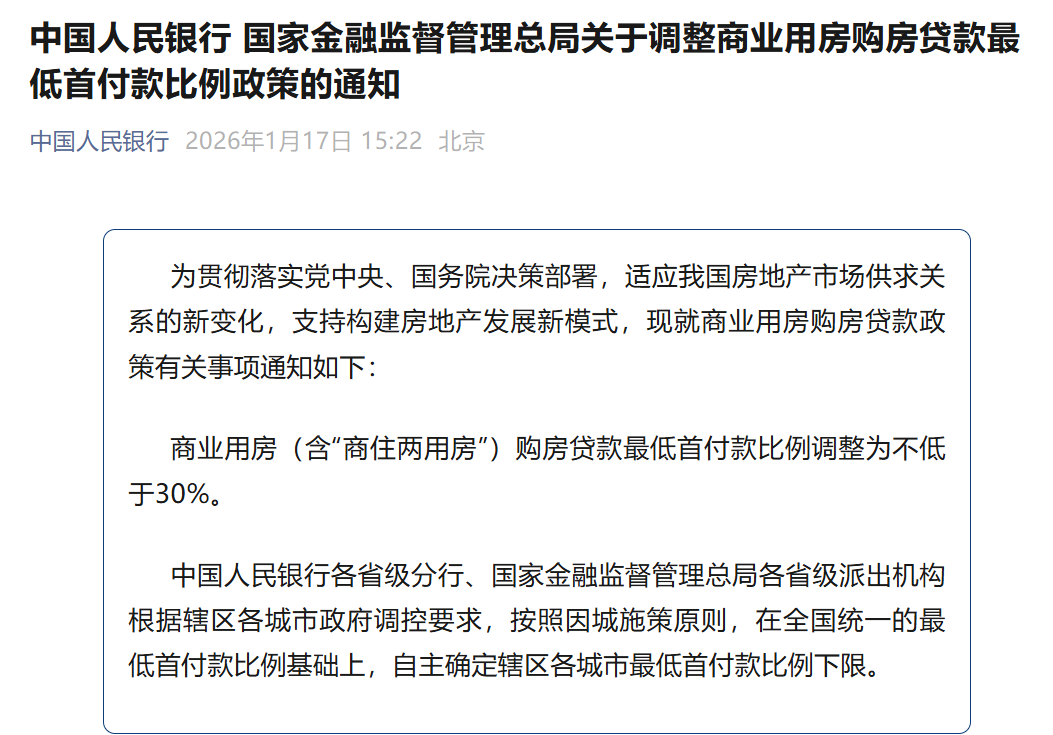
刚刚,利好来了!两部门联合发布
Zhong Guo Ji Jin Bao· 2026-01-17 09:00
Core Viewpoint - The People's Bank of China and the National Financial Regulatory Administration have announced a reduction in the minimum down payment ratio for commercial property loans to no less than 30%, aimed at stimulating the commercial real estate market and addressing inventory issues [1][2]. Group 1: Policy Changes - The minimum down payment ratio for commercial properties, including mixed-use properties, has been adjusted from 50% to 30%, significantly lowering the entry barrier for buyers [2]. - This policy allows local financial institutions to set their own minimum down payment ratios based on local government regulations, promoting a tailored approach to real estate market conditions [1][2]. Group 2: Market Impact - The reduction in down payment requirements is expected to enhance market activity in the commercial real estate sector, which has been facing significant inventory challenges, with approximately 52.34 million square meters of office space and 14 million square meters of commercial property unsold as of November 2025 [2][3]. - The adjustment is seen as a direct effort to support inventory reduction in the commercial property market, reflecting the central government's increasing focus on addressing these challenges [2][3]. Group 3: Regional Initiatives - Various cities are implementing supportive policies to promote the conversion of existing commercial properties into rental housing and other uses, indicating a broader strategy to revitalize the commercial real estate market [3]. - Examples include Shanghai's "zoning and classification compatibility" strategy and Wuhan's tax incentives for new commercial property purchases, showcasing localized efforts to stimulate the market [3].
商业用房首付比例从50%降至30%,央行表示降准降息仍有空间,业内:将带动商办去化
Hua Xia Shi Bao· 2026-01-16 04:57
Core Viewpoint - The Chinese government is implementing policies to support the commercial real estate market by lowering the minimum down payment for commercial property loans to 30%, aiming to reduce inventory and improve the financial situation of real estate companies [2][3]. Group 1: Policy Changes - The minimum down payment for commercial property loans has been significantly reduced from 50% to 30%, which is expected to stimulate demand in the commercial real estate market [3]. - Various cities are introducing supportive policies to promote the operation of commercial projects, including allowing the conversion of existing commercial properties into rental housing [3]. Group 2: Market Conditions - The commercial real estate market has been experiencing high inventory levels, with a consensus among industry experts that the market's inventory reduction has lagged behind the residential market [3]. - In major cities like Beijing, Shanghai, and Shenzhen, the commercial market is facing declining rents and challenges in reducing vacancy rates, indicating a need for policy intervention [4]. Group 3: Impact on Demand - The new policy is expected to lower the initial financial burden on buyers, thereby releasing pent-up demand, particularly benefiting small businesses and startups [5]. - The reduction in down payment requirements is anticipated to enhance the liquidity of the commercial real estate market and improve cash flow for real estate companies [6]. Group 4: Future Outlook - The long-term recovery of the commercial real estate market will depend on sustained growth in consumption and services, as well as stability in the employment market [7]. - The central bank has indicated that there is still room for further reductions in interest rates, which could lower mortgage costs and stimulate housing demand [7].