
商铺

Search documents
新房与二手房成交环比增加,金茂新增南京、苏州地块
Huachuang Securities· 2026-03-31 04:28
Investment Rating - The report maintains a "Recommend" rating for the real estate sector [2] Core Insights - New and second-hand housing transactions have increased on a month-on-month basis, indicating a potential recovery in the market [2] - The real estate index fell by 1.4%, ranking 22nd among 31 sectors, reflecting ongoing challenges in the industry [8] - The report highlights various local government policies aimed at stimulating housing demand and improving market conditions [15] Summary by Sections Industry Basic Data - The total number of listed companies in the real estate sector is 107, with a total market capitalization of 1,144.406 billion yuan and a circulating market capitalization of 1,097.122 billion yuan [2] Sales Performance - In the 13th week, new housing transaction volume increased by 35% month-on-month but decreased by 17% year-on-year, with a total transaction area of 3.09 million square meters [21] - The average daily transaction area for new housing was 442,000 square meters [23] - For second-hand housing, the transaction area in 11 cities decreased by 6% year-on-year, totaling 2.52 million square meters in the 13th week [27] Policy News - Local policies include adjustments to housing fund withdrawal regulations in Hainan and various subsidy programs in Hangzhou to stimulate housing consumption [15][17] - A new housing fund interest subsidy policy for young talents was announced in Suzhou, effective from April 1, 2026 [15][17] Investment Strategy - The report suggests focusing on developers with high land acquisition precision to ensure asset yield, recommending companies like Greentown China, China Resources Land, and China Jinmao [35] - It also highlights the stability of top shopping centers and suggests investing in leading real estate intermediaries like Beike-W for efficient transaction systems [35]
16套商铺过户遇阻,法院护航解企忧!
Yang Zi Wan Bao Wang· 2026-02-26 12:58
Core Viewpoint - The case illustrates the resolution of a debt dispute between two companies, where one company successfully navigates tax issues to facilitate the transfer of property as debt repayment [1][2][3]. Group 1: Debt Dispute and Agreements - In 2016, Company A (天天公司) entered into a financing lease agreement with Company B (春来公司) for equipment rental, totaling over 20 million yuan [1]. - Due to financial difficulties, Company B was unable to repay the lease, leading to a new agreement where Company B would use its 101 properties, including 16 shops, to settle the debt [1][2]. Group 2: Legal Proceedings and Tax Issues - When Company A requested the transfer of the 16 shops, it faced delays due to Company B's unpaid taxes, preventing the completion of the property transfer [2]. - The court examined the validity of the agreements and found no legal obstacles to the transfer, while also recognizing Company B's agreement to the request [2]. Group 3: Resolution and Follow-Up - The judge facilitated communication with tax authorities and encouraged Company A to cover the tax payments temporarily to resolve the issue [2]. - Following the court's ruling, the property transfer was successfully completed, allowing Company A to unlock its previously frozen assets [3].
希慎兴业(00014)发布年度业绩,营业额34.64亿港元 同比增加1.6%
智通财经网· 2026-02-26 04:12
Core Viewpoint - The company reported a slight increase in revenue but a decrease in recurring profit, with a significant rise in basic profit driven by property sales [1] Group 1: Financial Performance - The company achieved a revenue of HKD 3.464 billion, representing a year-on-year increase of 1.6% [1] - Recurring basic profit decreased by 1.9% to HKD 1.918 billion [1] - Basic profit increased by 28.3% to HKD 2.51 billion, attributed to fair value gains from the sale of residential units [1] - Basic earnings per share stood at HKD 0.31 [1] Group 2: Business Segments - The retail business revenue grew by 2.6%, benefiting from the entry and expansion of luxury brand flagship stores, with tenant sales recording double-digit year-on-year growth in the second half of 2025 [1] - The office leasing business revenue remained stable, with the occupancy rate in Hong Kong increasing from 90% to 94%, mitigating downward pressure on renewal rental levels [1] Group 3: Capital Management - The company initiated an HKD 8 billion five-year capital recycling plan to enhance financial health and long-term value [1] - As of 2025, 26% of the capital recycling target has been achieved, with HKD 2.1 billion received [1]

最低降至30%!河北下调公寓、商铺等商业用房首付款比例
Xin Lang Cai Jing· 2026-02-05 06:58
Core Viewpoint - The minimum down payment ratio for commercial properties in Hebei Province has been reduced to 30%, effective from February 4, 2026, as part of a broader effort to stimulate the commercial real estate market and support economic development [1][3]. Summary by Category Policy Changes - The People's Bank of China, Hebei Branch, announced a new policy that lowers the minimum down payment for commercial property loans from 50% to 30% for various types of commercial real estate, including shops, apartments, office buildings, and hotels [2][4]. - The adjustment is part of a strategy to implement city-specific measures based on local government requirements and aims to facilitate the reduction of inventory in the commercial real estate market [2][4]. Market Impact - The reduction in the down payment requirement is expected to lower the barriers for purchasing commercial properties, thereby attracting more potential investors to the commercial real estate sector [2][4]. - This policy change is seen as a specific measure to promote economic growth by directing resources towards more efficient sectors and projects [2][4].
中国三迪(00910.HK)2024年度总收益约20.78亿元 同比减少约37.1%
Ge Long Hui· 2026-01-28 14:18
Group 1 - The core viewpoint of the article indicates that China Sandi (00910.HK) reported a significant decline in total revenue for the fiscal year ending December 31, 2024, amounting to approximately RMB 2.078 billion, which represents a year-on-year decrease of about 37.1% [1] - The company recorded a substantial loss attributable to shareholders of approximately RMB 4.052 billion, compared to a loss of about RMB 465 million for the fiscal year ending December 31, 2023 [1] - Basic loss per share was reported at RMB 0.7963, a significant increase from RMB 0.0913 in the previous year [1] Group 2 - As of December 31, 2024, the company has nine developing property projects located in various cities across China, with key cities including Shanghai, Fuzhou, Xi'an, and Baoji [1] - The company primarily focuses on the development of residential properties, as well as residential and commercial mixed-use properties, with product categories including apartments, offices, shops, and villas [1]
首付最低三成!买公寓、商铺压力小了多少?
Sou Hu Cai Jing· 2026-01-26 10:55
Core Viewpoint - The adjustment of the minimum down payment ratio for commercial property loans in Hunan Province to no less than 30% significantly lowers the financial barrier for investors, benefiting small businesses and entrepreneurs [1][3] Group 1: Policy Changes - Starting from January 22, the minimum down payment ratio for purchasing commercial properties (including mixed-use properties) in Hunan Province has been adjusted to no less than 30% [1] - This change applies uniformly across 14 cities and states that banks can determine specific down payment ratios based on their operational and customer risk conditions [1][3] Group 2: Impact on Investors and Businesses - The reduction in the down payment from 50% to 30% for a commercial property priced at 1 million yuan decreases the upfront financial burden by 200,000 yuan [3] - This adjustment allows startup owners and individual entrepreneurs to allocate saved funds towards business operations, renovations, or working capital, facilitating a "light asset entry" into the market [3] - The lowered threshold may attract small investors who were previously hesitant due to high entry costs, particularly for properties with stable rental returns, such as those near subway lines or industrial parks [3] Group 3: Considerations and Risks - The decrease in down payment means an increase in loan amounts, which could lead to higher monthly repayment pressures, necessitating careful evaluation of cash flow and repayment capacity by buyers [4] - Commercial properties typically incur higher holding costs, including property fees and utility costs, compared to residential properties, and have a land use period of 40 years, which may affect liquidity and resale value [4] - Buyers are advised to be cautious and focus on long-term rental yield and the future development potential of locations rather than being solely attracted by lower down payments [4]


首付比例下调!事关西安商业用房购买!
Sou Hu Cai Jing· 2026-01-25 19:11
Core Viewpoint - The People's Bank of China has introduced a new financial policy that lowers the minimum down payment ratio for commercial property loans to 30%, which is expected to stimulate the market by reducing the purchasing threshold for commercial properties [1][2]. Group 1: Policy Implementation - The new down payment ratio has been implemented in Shaanxi Province, effective from January 23, 2026, reducing the previous minimum from 50% to 30% for commercial properties, including "commercial-residential mixed-use properties" [2]. - This policy is seen as a significant benefit for currently available commercial properties, as it lowers the entry barrier for potential buyers [3]. Group 2: Market Dynamics - Despite the reduction in down payment, the overall cost of purchasing commercial properties remains high due to elevated loan interest rates and other associated costs, which may limit its attractiveness to investors [5][7]. - The demand for residential properties is generally larger compared to commercial properties, which tend to have stable prices and rely more on rental income for returns, making them less appealing in comparison to residential investments [6]. Group 3: Investment Considerations - The current investment environment has shifted from capital appreciation to rental yield, making prime commercial properties in core urban areas more attractive [6]. - The reduction in down payment alone may not be sufficient to attract investors; further adjustments in loan terms, interest rates, and holding costs are necessary to enhance the appeal of commercial properties [7]. Group 4: Types of Commercial Properties - Commercial properties encompass a wide range of types, including shops, office buildings, apartments, and luxury residences, each with distinct market dynamics and investment potential [8][11][15][18]. - Community shops are considered lower risk due to their stable consumer base, while office buildings in Xi'an face high vacancy rates, making them less attractive for investment [9][12]. - The luxury segment, particularly in core urban areas, may benefit the most from the down payment reduction, as it allows business owners to allocate funds more effectively for higher returns [21][22].

首付降至三成!商铺投资回报率到底香不香?
3 6 Ke· 2026-01-19 02:42
Core Insights - The People's Bank of China and the National Financial Regulatory Administration announced a reduction in the minimum down payment ratio for commercial property loans to 30%, down from 50%, which is expected to stimulate the commercial real estate market [2][12] - Commercial properties, including shops, offices, and apartments, are becoming focal points for investors, especially given the higher rental yields compared to residential properties [2][4] Group 1: Market Dynamics - In Shenzhen, commercial properties are reported to have rental yields ranging from 4% to 6%, with some properties claiming yields as high as 8%, contrasting sharply with the residential rental yield of approximately 1.7% [2][4] - The price of commercial properties has significantly declined since the peak investment period of 2016-2017, with some properties selling for a fraction of their previous prices [7][9] Group 2: Investment Considerations - Despite attractive rental yields, potential investors face higher holding costs, including taxes and maintenance fees, which can reduce actual returns to below 3% [8][11] - The investment in commercial properties requires substantial financial capability, as the loan terms are shorter and the interest rates are higher compared to residential loans [9][11] - The current market sentiment indicates a cautious approach among investors, with many preferring to hold properties for longer periods to realize returns, often requiring 10 to 20 years to break even [11][12]
商业用房首付降至30%!业内:对商业地产去化有一定促进作用
Mei Ri Jing Ji Xin Wen· 2026-01-18 14:44
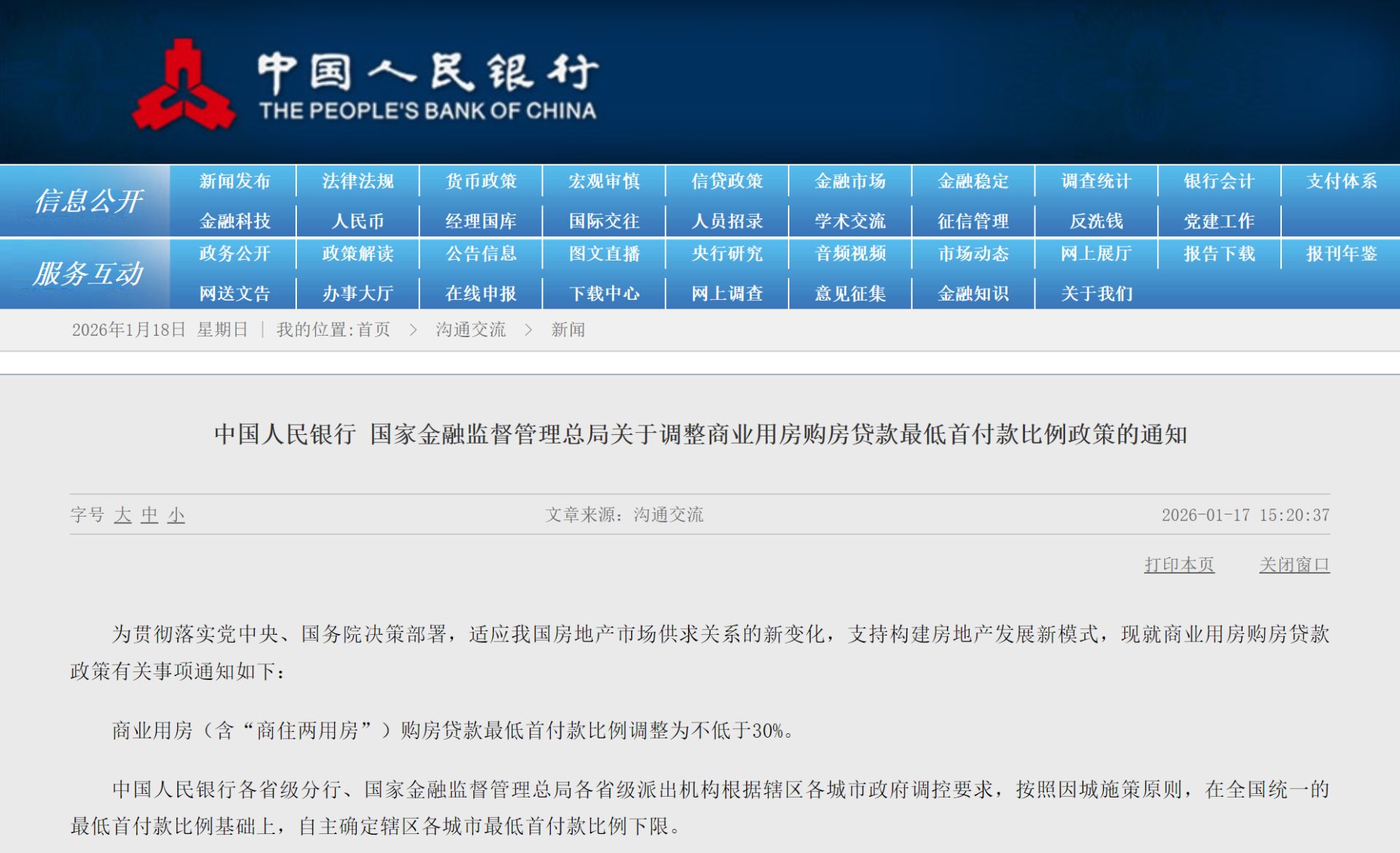
Core Viewpoint - The People's Bank of China and the National Financial Regulatory Administration announced a reduction in the minimum down payment ratio for commercial property loans to no less than 30%, which is expected to stimulate the commercial real estate market in 2026 [1][5][19]. Summary by Relevant Sections Policy Changes - The minimum down payment for commercial properties, including "commercial-residential mixed-use properties," has been reduced from 50% to 30% [1][5]. - This policy aims to promote the de-inventory of commercial properties rather than directly increase the investment value of commercial properties [19]. Market Reactions - The reduction in down payment has made commercial properties, particularly shops, a focal point for investors, with reported rental yields ranging from 4% to 6%, and some properties claiming yields as high as 8% [5][19]. - In Shenzhen, the rental yield for residential properties is significantly lower at approximately 1.7%, highlighting the attractiveness of commercial properties [5]. Investment Considerations - Despite the lower entry barrier, potential investors express caution, indicating that the core challenge lies in managing long-term risks rather than just meeting the down payment [5][15]. - Investors face higher holding costs, including taxes and maintenance fees, which can significantly reduce actual returns [15][16]. - The average loan term for commercial properties is shorter than for residential properties, which may require investors to have stable cash flow to support long-term holdings [16][17]. Market Trends - There has been a notable price correction in commercial property values compared to the peak investment period of 2016-2017, with some properties selling for significantly less than their previous purchase prices [14][19]. - The current market shows a high rate of unsold properties, indicating a cautious investor sentiment [15]. Expert Insights - Industry experts suggest that while the rental yield for commercial properties appears attractive, it is essential to account for various costs that can diminish actual returns [18]. - The overall sentiment in the market is that investors should approach commercial property investments with a long-term perspective, as quick returns are unlikely [17].
首付比例大降至最低30%,商业用房去库存新政落地
Di Yi Cai Jing Zi Xun· 2026-01-17 12:33
Core Viewpoint - The People's Bank of China and the National Financial Regulatory Administration have announced a nationwide adjustment to the minimum down payment ratio for commercial property loans, lowering it to no less than 30% to support a new model of real estate development and promote the destocking of commercial real estate [1][3]. Group 1: Policy Changes - The minimum down payment ratio for commercial property loans has been adjusted to 30%, significantly lowering the barrier for purchasing commercial properties [3][5]. - Prior to this adjustment, most cities had a minimum down payment requirement of 50%, with some banks setting it as high as 60% or more [3]. - The adjustment is seen as a direct response to the high inventory levels in the commercial real estate market, with a focus on enhancing market activity [3][4]. Group 2: Market Conditions - As of November 2025, there is an estimated 141 million square meters of commercial real estate available for sale nationwide, with 52 million square meters of office space included in this figure, indicating a significant oversupply [2]. - The average time for inventory turnover is reported to be around 30 months, with some areas experiencing turnover periods of 50 to 70 months, highlighting the urgency of destocking [4]. Group 3: Industry Expectations - There is a consensus in the industry regarding the need for further policy relaxation to address the high inventory levels and the challenges in selling existing commercial properties [4][6]. - Various cities are implementing supportive policies, such as allowing the conversion of existing commercial properties into rental housing and other uses, to stimulate market activity [4]. - The demand for loans related to long-term rental apartments and other commercial property investments is expected to increase as a result of the lowered down payment requirement [5].