国潮联名

Search documents
老凤祥(600612):3Q25收入增速环比提升,净增门店与高端化布局稳步推进
海通国际· 2025-10-31 08:50
Investment Rating - The report assigns an "Outperform" rating for Lao Feng Xiang, indicating an expected total return exceeding the relevant market benchmark over the next 12-18 months [18]. Core Insights - In Q3 2025, Lao Feng Xiang experienced a sequential revenue growth acceleration, with a 16.0% year-on-year increase in revenue, reaching RMB 14.646 billion, compared to a 10.5% increase in Q2 2025 [2][8]. - The company is focusing on optimizing its product mix and pricing strategy in response to high gold prices, resulting in a gross margin increase of 0.49 percentage points year-on-year to 7.01% in Q3 2025 [2][8]. - The company is expanding its store network, with a total of 5,625 stores as of Q3 2025, including a net increase of 76 franchised stores [3][9]. - A strategic partnership with Maybach Luxury Asia Pacific aims to enhance the brand's image and market presence in the luxury segment, targeting mid-to-high-end consumers [4][10]. Summary by Sections Financial Performance - For the first three quarters of 2025, Lao Feng Xiang reported operating revenue of RMB 48.001 billion, down 8.71% year-on-year. The revenue breakdown includes RMB 37.965 billion from jewelry and accessories, RMB 9.727 billion from gold trading, and smaller contributions from other segments [2][8]. - The attributable net profit for the first nine months was RMB 1.438 billion, a decline of 19.05% year-on-year, with Q3 2025 net profit at RMB 217 million, down 41.6% year-on-year [2][8]. Store Expansion and Optimization - The company is actively optimizing its store structure, focusing on themed stores such as "Cang Bao Jin" and "Feng Xiang Wedding," with a total of 5,625 stores as of Q3 2025 [3][9]. - The domestic sales revenue for the first nine months was RMB 47.373 billion, down 8.91% year-on-year, but showing improvement in Q3 2025 with revenue of RMB 14.50 billion [3][9]. Strategic Initiatives - The partnership with Maybach involves a USD 24 million investment for a 20% stake in Maybach Luxury Asia Pacific, aiming to enhance Lao Feng Xiang's brand value and market share in luxury goods [4][10]. - The company is also focusing on cultural storytelling and collaborations with popular IPs to attract younger consumers, launching new collections that resonate with contemporary trends [4][10].

百年老店的时代岔路口:广州酒家2025年上半年增收不增利、传承中的创新困局
Xin Lang Zheng Quan· 2025-09-18 09:53
Core Insights - Guangzhou Restaurant is experiencing a disconnect between traditional offerings and modern consumer preferences, leading to stagnant profits despite a slight revenue increase [1][2][4] - The company reported a revenue of 1.991 billion yuan in the first half of 2025, a year-on-year increase of 4.16%, while net profit decreased by 33.11% to 39.1 million yuan [1] Group 1: Traditional vs. Modern Consumer Preferences - The signature products of Guangzhou Restaurant, such as lotus seed mooncakes and preserved meat gift boxes, are not resonating with the new generation of consumers who prefer low-sugar and trendy options [2] - The dining experience at Guangzhou Restaurant is struggling to adapt to the experience economy, where competitors are integrating cultural performances and workshops into their offerings [2] Group 2: Online Presence and Market Identity - The company's online sales efforts are cautious, lacking viral products that can generate significant social media buzz, contrasting with competitors who engage audiences through interactive content [3] - Communication with customers remains formal and restrained, missing opportunities for engaging interactions that resonate with modern consumers [3] Group 3: Cultural Relevance and Future Directions - Guangzhou Restaurant is not facing a survival crisis but must navigate the challenge of remaining a cultural symbol in a rapidly changing market [4] - The company needs to adjust its offerings to appeal to younger consumers who seek new culinary experiences rather than merely nostalgic visits [4]

“男人的衣柜”快装不下了,关店283家,金融出身二代急着“续命”
3 6 Ke· 2025-09-17 08:53
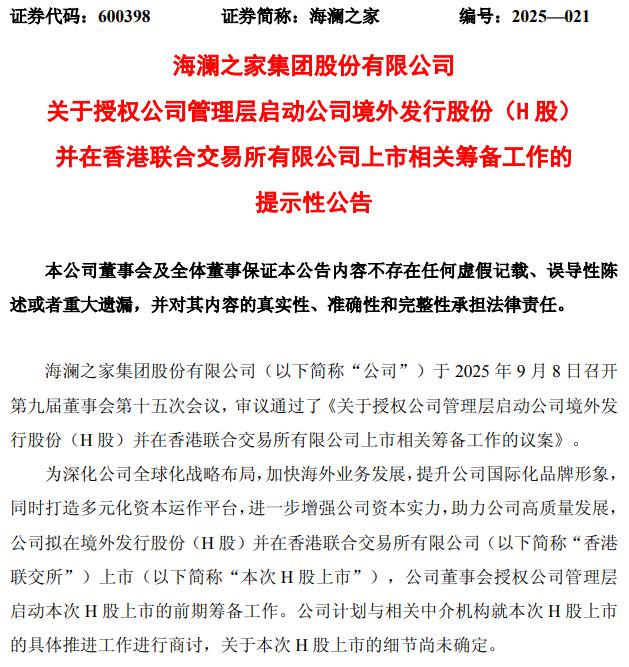
Core Viewpoint - Haier's Home, known as "the men's wardrobe," is planning to go public in Hong Kong after closing 283 stores in two years and experiencing stagnant growth, with the new chairman, Xiao Zhou, aiming to expand internationally to revitalize the company's performance [1][3][11]. Group 1: Company Overview - Haier's Home, a leading player in China's menswear industry, was established in 1988 and went public in 2014. The company has recently attempted to diversify its brand offerings beyond menswear to include younger menswear, women's wear, and children's wear [4][7]. - As of the first half of 2025, the company reported a revenue of 11.566 billion yuan, a year-on-year increase of 1.73%, while net profit decreased by 3.42% to 1.58 billion yuan. Total assets reached 33.422 billion yuan, with over 15,000 employees [7][8]. Group 2: Store Closures and Strategy - The number of stores peaked at 6,006 in mid-2023 but has since declined to 5,723, marking a closure of 283 stores over two years. However, this closure rate is relatively low compared to other fashion brands [8][10]. - The company aims to focus on "precise layout, high quality, and strong experience" for future store openings, emphasizing flagship and premium malls while enhancing operational efficiency through digital tools [10]. Group 3: International Expansion Plans - The primary goal of the Hong Kong listing is to deepen the company's global strategy, accelerate overseas business development, and enhance its international brand image. The company has already established a presence in Southeast Asia and plans to enter Central Asia, the Middle East, and Africa [12][13]. - As of the first half of 2025, Haier's Home had 111 overseas stores, with overseas revenue reaching 206 million yuan, a year-on-year increase of 27.42% [13]. Group 4: Leadership Transition and New Strategies - Founder Zhou Jianping has retired, passing leadership to his son Zhou Licheng, who has initiated a transformation strategy focusing on multi-brand, full-category, and group-oriented approaches, alongside a significant push into e-commerce and live-streaming sales [22][35]. - Zhou Licheng's strategies include updating marketing campaigns, collaborating with cultural institutions, and implementing a "new thousand-store plan" to close inefficient franchise stores and increase direct management [32][35].