
国际关系民主化

Search documents
俄外长表示俄中协作为全球注入稳定性
Xin Lang Cai Jing· 2026-02-03 21:52
Core Viewpoint - Russia and China are strengthening their collaboration on the international stage, contributing stability to an increasingly tense global situation [1] Group 1: Russia-China Relations - Russian Foreign Minister Lavrov emphasized the historical mission of Russia and China as responsible major powers in a turbulent global environment [1] - The two countries are commemorating the 80th anniversaries of the Soviet Union's victory in the Great Patriotic War and China's victory in the War of Resistance Against Japan, marking their significant contributions to addressing new global security threats and improving international relations [1] - Coordination of foreign policies between Russia and China is a priority in their comprehensive strategic partnership, serving as an important stabilizing factor in international affairs [1] Group 2: Multilateral Cooperation - Russia and China are enhancing cooperation within multilateral frameworks such as the United Nations, Shanghai Cooperation Organization, BRICS, G20, and APEC [1]
学习手记|“大历史观”的长远眼光
Xin Hua She· 2026-02-02 14:53
Core Viewpoint - The concept of "big historical perspective" is emphasized as a guiding principle for China-UK relations and international cooperation, advocating for mutual respect and understanding in the face of global challenges [3][4]. Group 1: Historical Perspective - The "big historical perspective" encourages a broader and long-term view of world history, recognizing the overarching trends in human social development [3]. - Xi Jinping has previously called for the establishment of a "big historical perspective" within the Communist Party, focusing on analyzing historical evolution and proposing strategic responses [3][4]. Group 2: Peaceful Development - The article highlights that Chinese civilization is characterized by peace, and China's modernization is rooted in peaceful development, which benefits the world [3]. - Xi Jinping has reiterated that China will never seek hegemony or expansion, regardless of its development stage, positioning China as an opportunity for the world [3][4]. Group 3: International Relations - The current global landscape is marked by significant changes and challenges, but history shows that it progresses according to its own laws, and no force can halt this progress [4]. - Recent interactions between Western leaders and China signify a shift in international relations, with countries looking towards China for cooperation amidst global turmoil [4][5]. Group 4: Future Development - China aims to inject stability into a turbulent world through high-quality development and responsible engagement, offering opportunities for mutual growth [5]. - The article reflects on the need for Western countries to reassess their policies towards China, recognizing the importance of engaging with China as a rising power [5].


中国代表敦促坚定维护国际法治的权威
Xin Hua She· 2026-01-27 07:46
Core Viewpoint - The speech emphasizes the importance of upholding the principles and purposes of the United Nations Charter and maintaining the authority of international law [1][2] Group 1: Importance of International Law - The United Nations Charter is fundamental for international relations and a key pillar for global order stability [1] - Countries should treat each other equally, respect sovereignty and territorial integrity, and resolve disputes peacefully while opposing the use or threat of force [1] - International law should apply equally to all nations without exceptions, rejecting the notion of any country acting as an international police force or judge [1] Group 2: Role of Major Powers and Global Governance - Major powers should lead by example, avoiding double standards and the imposition of their will on others [1] - The trend towards a multipolar world and democratization of international relations is irreversible, with global destiny and rules needing to be jointly determined by all countries [1] Group 3: Significance of the United Nations - The United Nations is the most universal, representative, and authoritative intergovernmental organization, especially crucial in complex international situations [1] - The Security Council has an irreplaceable role in maintaining international peace and security, and its authority should not be undermined [1] Group 4: China's Commitment - China is a staunch defender of international law and aims to work with other countries to promote a community with a shared future for humanity, contributing to international law and global peace and development [2]
“非凡2025”系列年终报道:听国际人士共话全球治理倡议
Huan Qiu Shi Bao· 2025-12-05 23:27
Core Viewpoint - The articles discuss China's global governance initiative, emphasizing its role in promoting a more equitable international order and addressing global challenges through multilateralism and respect for sovereignty [2][3][4][6]. Group 1: Global Governance Initiative - The global governance initiative is presented as a systematic public product aimed at revitalizing and updating the post-1945 international order, responding to profound changes and turmoil in the current international landscape [6]. - It emphasizes the importance of sovereign equality and aims to democratize international relations, ensuring that all countries have the right to participate in and benefit from international decision-making processes [4][6]. - The initiative seeks to enhance the representation and voice of the Global South in international governance, addressing their diplomatic policy agendas and calling for reforms to adapt the international order to contemporary needs [6][10]. Group 2: Core Principles of the Initiative - One core principle is adherence to international law, which aims to establish a stable and reliable set of rules applicable to all nations, countering the double standards often seen in international relations [8][10]. - The initiative promotes multilateralism, focusing on collective governance to address global challenges such as climate change, pandemics, and economic crises, which cannot be solved by individual nations alone [10][12]. - It advocates a people-centered approach, aiming to enhance the well-being of people globally and ensure that the benefits of globalization are shared equitably among all nations [12][14]. Group 3: Action-Oriented Approach - The initiative emphasizes an action-oriented approach, focusing on measurable outcomes and the establishment of a fairer world order as prerequisites for peace and development [14][15]. - China's efforts in renewable energy capacity and AI research collaborations are highlighted as concrete examples of this action-oriented principle [14][15]. - The initiative addresses urgent issues faced by developing countries, such as climate change and financial inequality, through practical reforms and investments [15][16].
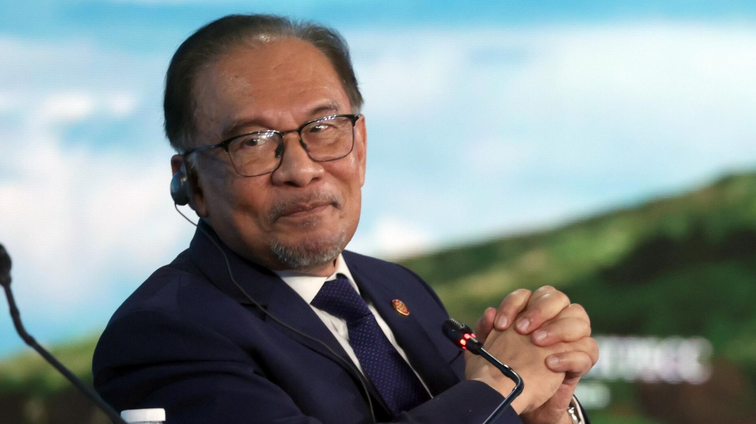
马来西亚总理:愿意加入金砖,“如果明天接受我们,我们明天就加入”
Huan Qiu Wang· 2025-10-28 11:23
Core Viewpoint - Malaysia's Prime Minister Anwar expressed the country's readiness to join BRICS immediately if accepted, highlighting Malaysia's interest in becoming a formal member of the group [1][3]. Group 1: Malaysia's Interest in BRICS - Anwar stated that Malaysia is willing to join BRICS "tomorrow" if the group accepts the application [3]. - The Prime Minister's comments were made during an interview at the ASEAN summit, indicating a proactive stance towards international collaboration [3]. Group 2: Support from Other Nations - Brazilian President Lula expressed support for Malaysia's membership in BRICS during his visit to Kuala Lumpur [3]. - China's Foreign Ministry spokesperson acknowledged the importance of BRICS as a platform for emerging markets and developing countries, welcoming Malaysia's interest in joining [3].
外交部:欢迎志同道合的伙伴参与到金砖合作中
Yang Shi Xin Wen Ke Hu Duan· 2025-09-26 09:30
Core Viewpoint - The BRICS nations serve as a significant platform for cooperation among developing and emerging market countries, promoting a multipolar world and democratization of international relations, which has gained widespread recognition among Southern countries [1]. Group 1 - The BRICS countries are recognized as an important platform for collaboration among developing and emerging market nations [1]. - The initiative is seen as injecting strong momentum into the development of a multipolar world and the democratization of international relations [1]. - There is an open invitation for like-minded partners to join BRICS cooperation to promote a more just and reasonable international order [1].
中方是否支持巴勒斯坦加入金砖国家?外交部回应
Huan Qiu Wang· 2025-09-26 07:40
Core Viewpoint - The Chinese government expresses support for the inclusion of Palestine in the BRICS group, emphasizing the importance of BRICS as a platform for cooperation among developing and emerging market countries [1] Group 1 - The BRICS group is recognized as a significant platform for cooperation among developing countries and emerging markets, contributing to the multipolarity of the world and the democratization of international relations [1] - The Chinese government welcomes like-minded partners to participate in BRICS cooperation, aiming to promote a more just and reasonable international order [1]
追忆峥嵘岁月,谱写合作新篇(大使随笔·以史为鉴 共护和平)
Ren Min Wang· 2025-09-06 21:55
Group 1 - The core viewpoint emphasizes the historical significance of the anti-fascist struggle shared by China and Kyrgyzstan, highlighting their joint efforts during World War II to defeat fascism and the deep friendship formed through this struggle [1][2]. - Both countries have maintained a commitment to uphold the results of World War II, supporting the international order based on the United Nations and international law, with a specific focus on the One China principle [2][3]. - The strategic partnership between China and Kyrgyzstan has been elevated to a new level, with China being the largest trade partner, import source, and investment source for Kyrgyzstan, indicating strong economic ties [3]. Group 2 - The construction of the China-Kyrgyzstan-Uzbekistan railway project is highlighted as a significant development that will enhance connectivity and economic cooperation between the two nations [3]. - Both countries share similar positions on major international and regional issues, advocating for an open world economy and a multilateral trade system centered around the World Trade Organization [3]. - The partnership aims to continue the legacy of World War II victories, fostering a closer community of shared destiny between the two nations for a better future for their peoples [3].
古巴政府表态支持全球治理倡议
Xin Hua She· 2025-09-02 07:57
Core Viewpoint - Cuba supports President Xi Jinping's global governance initiative proposed at the "Shanghai Cooperation Organization+" meeting, believing it will promote reforms in the global governance system and contribute to building a community with a shared future for mankind [1] Group 1: Government Statements - Cuban President Díaz-Canel expressed support for the global governance initiative, highlighting its potential to advance global governance reforms [1] - Cuban Foreign Minister Rodríguez emphasized the significance of the global governance initiative, stating it reflects the common aspirations of the Global South and promotes the democratization of international relations [1] Group 2: Media Coverage - The Cuban newspaper Granma reported on the main contents of the global governance initiative, noting that the Shanghai Cooperation Organization aims to establish a more just and multipolar international order based on international law [1] - The report highlighted the importance of the Tianjin summit in strengthening solidarity among the Global South and consolidating its position on the global stage [1]
马朝旭:构建人类命运共同体重大理念连续8年写入联大决议
Xin Jing Bao· 2025-08-29 04:20
Core Viewpoint - The concept of building a community with a shared future for mankind has been recognized as a significant international public good, influencing global peace and development [1][7]. Group 1: Historical Context and Development - The victory of the Chinese people in the Anti-Japanese War marked a historical turning point for the Chinese nation, contributing significantly to the global anti-fascist war and the pursuit of world peace [2]. - Since the founding of New China, the country has adhered to an independent and peaceful foreign policy, advocating for the principles of peaceful coexistence and contributing to global peace and development [2]. Group 2: Conceptual Framework - The concept emphasizes that humanity is a community where the fate of each nation is interconnected, advocating for collective efforts to build a harmonious world [3]. - In 2023, a comprehensive framework for building a community with a shared future was outlined, focusing on goals such as lasting peace, universal security, and common prosperity [4]. Group 3: Global Consensus and Implementation - The idea has evolved from a Chinese initiative to an international consensus, transforming from a vision into practical applications and establishing a scientific system for global governance [5][6]. - The concept transcends selfishness and protectionism, promoting cooperation among nations and reflecting a unique perspective on human development [6].