地方债供给

Search documents
【申万固收|地方债周报】下周供给保持高位,二季度已披露计划发行15827亿元——地方债周度跟踪20260320
申万宏源证券上海北京西路营业部· 2026-03-25 02:44
Core Viewpoint - The article discusses the high supply of local government bonds in the upcoming week, with a total issuance plan of 15,827 billion yuan disclosed for the second quarter [2] Group 1: Supply and Issuance - The supply of local government bonds is expected to remain high in the coming week [2] - A total of 15,827 billion yuan in local government bonds has been planned for issuance in the second quarter [2]


【申万固收|地方债周报】30Y减国债利差大幅收窄,下期供给明显回升——地方债周度跟踪20260313
申万宏源证券上海北京西路营业部· 2026-03-19 02:32
Core Viewpoint - The article discusses the significant narrowing of the yield spread between 30-year local government bonds and national treasury bonds, indicating a shift in the bond market dynamics and a notable increase in upcoming supply of local government bonds [2] Group 1: Yield Spread Analysis - The yield spread between 30-year local government bonds and national treasury bonds has narrowed significantly, reflecting changing investor sentiment and market conditions [2] - This narrowing spread suggests a potential increase in demand for local government bonds as investors reassess risk and return profiles [2] Group 2: Supply Dynamics - There is a clear indication that the supply of local government bonds is set to increase in the upcoming period, which may impact pricing and investor strategies [2] - The anticipated rise in supply could lead to adjustments in market liquidity and interest rates, influencing overall bond market performance [2]

1月PMI数据点评:制造业PMI超季节性回落,价格指数抬升
Western Securities· 2026-02-01 13:06
1. Report's Investment Rating for the Industry - No information provided regarding the industry investment rating in the report. 2. Core Viewpoints of the Report - In January 2026, the manufacturing PMI declined more than seasonally with supply - demand converging and enterprise - scale differentiation intensifying, while price indices rose. The service industry PMI slightly dropped and the construction industry's prosperity significantly declined, thus more efforts are needed to promote economic - stabilizing policies [1][10][34]. - In January, the shock of sentiment was gradually digested, and the bond market recovered after adjustment. However, there were still some constraints for a smooth short - term decline. The 10Y Treasury bond yield may return to the central part of the oscillation range in February. Two structural investment opportunities are recommended: the allocation opportunities of 5Y government - financial bonds and 3 - 5Y general - credit bonds, and the spread - compression opportunities such as 10Y CDB - 10Y Treasury bonds [4][34][35]. 3. Summary According to the Directory 3.1 1 - month PMI Data Overview - Manufacturing PMI declined by 0.8 percentage points to 49.3% in January, returning to the contraction range and being weaker than the seasonal average. The production index expansion slowed, demand was under pressure, price indices rose, and enterprises replenished inventory passively with a decline in purchasing willingness [10]. - In the non - manufacturing sector, the service industry PMI slightly decreased by 0.2 percentage points to 49.5%, and the construction industry's business activity index dropped by 4.0 percentage points to 48.8%, both showing different degrees of deviation from seasonal performance [11][14]. 3.2 Manufacturing: Demand - side Operation Under Pressure, Both Price Indices Rising - **Production**: The manufacturing PMI production index was 50.6% in January, down 1.1 percentage points month - on - month, weaker than the seasonal level. The slowdown was due to factors like cold weather and approaching Spring Festival, especially the over 4 - percentage - point decline in the consumer goods manufacturing production index [17]. - **Demand**: The new order index and new export order index of manufacturing PMI decreased by 1.6 and 1.2 percentage points respectively. The "new order - new export order" index dropped to 1.4%. Seasonal factors and external policy changes affected demand, but the proportion of manufacturing enterprises reporting insufficient market demand decreased [19]. - **Enterprise Scale and New Kinetic Energy**: The PMI of large, medium, and small enterprises decreased by 0.5, 1.1, and 1.2 percentage points respectively. New kinetic energy industries continued to lead, while traditional industries' prosperity declined [20]. - **Price**: Affected by multiple factors, the main raw material purchase price index and ex - factory price index were 56.1% and 50.6% respectively, up 3.0 and 1.7 percentage points month - on - month. The index difference reached 5.5 percentage points, compressing the profit space of mid - and downstream enterprises [23]. - **Inventory**: The raw material inventory index decreased by 0.4 percentage points, and the finished - product inventory increased by 0.4 percentage points. The economic kinetic energy index decreased by 2.0 percentage points, and the purchasing volume index dropped to 48.7%. The start of the replenishment cycle depends on the recovery of market demand [24]. 3.3 Non - manufacturing: Slight Decline in Service Industry PMI, Significant Decline in Construction Industry - **Service Industry**: In January, the service industry PMI slightly declined. The strong support from the financial industry, the stable development of new kinetic energy, and the good performance of some consumption - related service industries maintained its stability. However, the real - estate industry's business activity index fell below 40.0%, and Spring Festival consumption may boost the consumption - related service industries [29]. - **Construction Industry**: Due to cold weather and the approaching Spring Festival, the construction industry's business activity index decreased by 4.0 percentage points to 48.8% in January. Both housing construction and civil engineering construction activities slowed down, and the off - season characteristics may continue in February [32]. 3.4 Impact on the Bond Market - In January, after the shock of sentiment was digested, the bond market recovered. The 10Y Treasury bond yield dropped to the lower limit of the 1.8% - 1.9% oscillation range. With insufficient broad - money expectations and increased local - bond supply in February, the 10Y Treasury bond yield may return to the central part of the oscillation range. Two parts of structural investment opportunities are recommended [4][34][35].
如何定价地方债?
Sou Hu Cai Jing· 2026-01-16 03:20
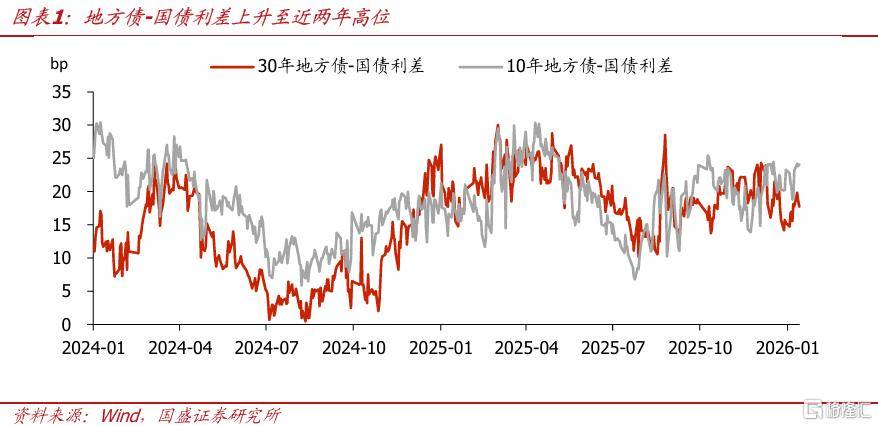
Core Viewpoint - Recent fluctuations in 30-year government bonds have been significant, while local government bonds remain stable, raising market concerns about the future trajectory of local bonds [1][5]. Group 1: Factors Influencing Local Government Bonds - The local government bond and government bond yield spread is influenced by multiple factors, including the risk-free interest rate anchor, funding costs, institutional behavior, risk appetite, local bond supply, and trading liquidity [2][8]. - The risk-free interest rate anchor reflects the macro interest rate environment and directly affects the valuation of interest rate bonds, with a negative correlation between the risk-free rate and the local bond-government bond spread [8]. - Short-term funding costs, indicated by the rise in DR007, lead to increased marginal costs for institutions, causing a preference for more liquid government bonds and widening the local bond-government bond spread [10]. Group 2: Market Dynamics and Predictions - The model indicates that the current 10-year local bond-government bond spread is close to its fitted value, while the 30-year spread is significantly above it, suggesting that the long-end local bonds are undervalued with limited upward space [3][30]. - Predictions for 2026 suggest that the average spreads for 10-year and 30-year local bonds will be lower than current levels, at approximately 14.3bps and 14.9bps respectively, indicating limited risk for further increases in spreads [31]. - The current market environment presents both challenges and opportunities for local bonds, with rising bond yields improving relative value, and a shift in supply dynamics observed in the issuance schedule [34].