埃尔多安经济学

Search documents
土耳其计划2026年小幅加税 力争压燃料价格来抗击通胀
Zhi Tong Cai Jing· 2025-12-26 13:00
Group 1 - The Turkish government plans to implement slight tax increases on key goods and services, including fuel, by 2026 to help the central bank control inflation, aiming for a target of 16% by the end of next year [1] - Fuel tax increases will be moderated to align with the central bank's inflation target, indicating a commitment from the government to support the central bank's efforts [1][2] - The special consumption tax on gasoline and diesel is typically adjusted twice a year, with the upcoming adjustments expected to be lower than the legal thresholds, reflecting the government's attempt to mitigate price pressures [1][3] Group 2 - The Turkish Finance and Treasury Minister stated that some tax increases will be based on the target inflation rate rather than the 25.5% revaluation rate, which aligns with producer price inflation [2] - Economists predict that consumer price inflation in Turkey could reach around 30% by the end of the year, significantly above the central bank's target of 24% for 2025 [2] - The central bank is currently in a disinflation process, having recently lowered the one-week repo policy rate from 39.5% to 38% [2] Group 3 - High inflation in Turkey, approximately 31.1% year-on-year as of November 2025, is attributed to the depreciation of the lira, sticky inflation expectations, and administrative price adjustments [3] - The legacy of previous economic policies, characterized by interest rate cuts and credit expansion in a high inflation environment, has contributed to the current inflationary spiral, often referred to as "Erdoganomics" [3]
土耳其国别研究专题系列报告:土耳其深度洞察:埃尔多安经济学的破局与转型
国泰海通· 2025-12-20 08:15
Economic Overview - Turkey's economy is currently influenced by "Erdoganomics," facing high inflation and structural contradictions[38] - The nominal GDP reached approximately $860 billion in 2015, nearly doubling from $440 billion in 2003, with a CPI growth rate below 12% for over a decade[39] - Turkey's energy import dependency is high, with 77.5% of energy products imported as of 2023, down from a peak of 85% in 2015[19] Geopolitical Position - Turkey serves as a strategic hub connecting Europe, Asia, and Africa, historically a key node on the Silk Road[5] - The Turkish Straits are crucial for maritime trade, controlling the only passage from the Black Sea to the Mediterranean, impacting regional geopolitical dynamics[10] - Turkey's diplomatic strategy has shifted from a Western-centric approach to a multi-faceted alliance, emphasizing relations with Middle Eastern and non-Western countries[28] Industrial and Investment Insights - Turkey has a strong industrial base, particularly in automotive and textiles, but faces challenges from high inflation and weak domestic and external demand[5] - The country is actively seeking to upgrade its industrial structure and attract foreign investment to improve its current account balance and reserve levels[5] - Recent collaborations between China and Turkey focus on clean energy, electric vehicles, and high-tech industries, aligning with China's Belt and Road Initiative[5] Risks and Challenges - Potential risks include rising oil prices leading to inflation and currency depreciation, improper capital controls causing reserve depletion, and escalating regional conflicts affecting diplomatic relations[5]
虎嗅【作·嗅之星】周榜第276期
Hu Xiu· 2025-08-26 06:00
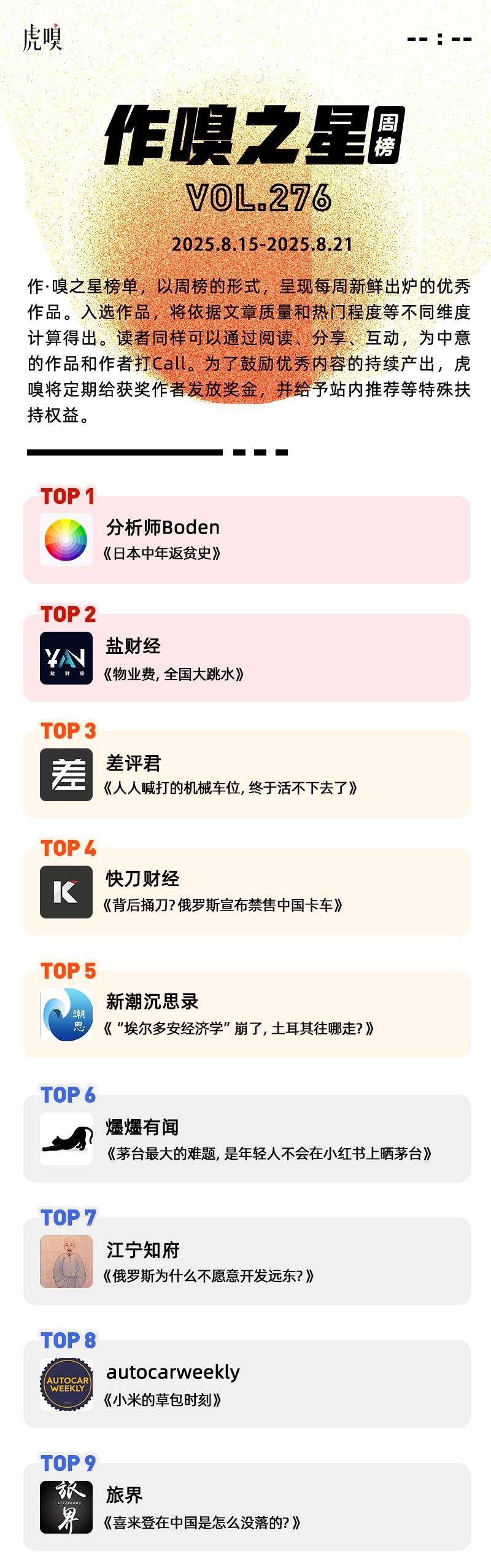
Core Insights - The article presents the weekly ranking of outstanding works titled "作·嗅之星" for the period from August 15 to August 21, 2025, highlighting the top articles and their authors [1][10]. Ranking Summary - TOP 1: "The History of Middle-Aged Poverty in Japan" by Analyst Boden [4][6] - TOP 2: "Property Fees, Nationwide Plunge" by Yan Finance [4][7] - TOP 3: "The Mechanical Parking Spaces Everyone is Against are Finally Fading" by Cha Ping Jun [4][7] - TOP 4: "Backstab? Russia Announces Ban on Chinese Trucks" by Fast Knife Finance [4][7] - TOP 5: "The Collapse of 'Erdogan Economics', Where is Turkey Headed?" by New Trend Think Tank [4][7] - TOP 6: "The Biggest Challenge for Moutai is Young People Not Posting Moutai on Xiaohongshu" by Zhuo Zhuo You Wen [4][7] - TOP 7: "Why Russia is Reluctant to Develop the Far East?" by Jiang Ning Zhi Fu [4][7] - TOP 8: "Xiaomi's Moment of Weakness" by Autocar Weekly [4][7] - TOP 9: "How Sheraton Declined in China?" by Travel Industry [4][7] Support for Authors - The platform will regularly provide bonuses and special support rights to the awarded authors to encourage the continuous production of quality content [9].

“埃尔多安经济学”崩了,土耳其往哪走?
Hu Xiu· 2025-08-17 01:27
Group 1 - Erdogan has successfully suppressed opposition and resolved the PKK issue, marking a significant political achievement for his nationalist and Islamist agenda [1][4][12] - Turkey is seen as an ideal diplomatic venue for international negotiations, enhancing its geopolitical influence in regions like the Caucasus and Syria [2][19] - The Turkish economy faces structural issues, including high deficits, unemployment, and low labor participation, despite temporary stabilization efforts post-2023 elections [4][22][43] Group 2 - Erdogan's political future is uncertain, with challenges in modifying the constitution to extend his presidency and declining public support [5][51][53] - The PKK's disarmament in May 2025 is a significant domestic political victory for Erdogan, potentially aiding his coalition's efforts to secure the necessary parliamentary votes for constitutional amendments [12][14][15] - Erdogan's foreign policy strategy, characterized by "strategic ambiguity," allows Turkey to navigate complex geopolitical landscapes and expand its influence [16][18][19] Group 3 - The economic policies under Erdogan, particularly the "Erdoganomics" approach, have led to soaring inflation rates, peaking at 85.5% in November 2022, and significant currency depreciation [25][28][33] - The recent shift back to orthodox economic policies, including a substantial interest rate hike from 8.5% to 50%, aims to stabilize the Turkish lira and attract foreign investment [33][34] - Turkey's reliance on short-term external financing to address its ongoing current account deficit poses significant vulnerabilities to economic stability [43][44][46] Group 4 - The geopolitical landscape presents both opportunities and risks for Turkey, with ongoing regional conflicts and the potential for increased Russian influence post-Ukraine war [47][49][50] - Erdogan's lack of a clear political successor raises concerns about the future stability of his administration and Turkey's geopolitical position [54][55][56] - The interplay between Turkey's economic challenges and geopolitical ambitions will determine its future trajectory, as Erdogan's leadership faces increasing scrutiny [56][57]