城市安全

Search documents
海州启用智慧安防OPC创业社区
Xin Hua Ri Bao· 2026-01-26 21:51
Core Viewpoint - The "Huaguoshan Smart Security OPC Community" in Lianyungang City has officially launched, serving as an incubator for entrepreneurs in the security sector, utilizing an innovative model of "individual + AI as a company" [1] Group 1: Community Structure and Support - The community is built around four empowering systems: technology, tasks, capital, and industrial ecology [1] - Partnerships with companies like Rui'an Technology provide computational power and compliance data, enabling the rapid formation of digital intelligent teams [1] - A dedicated venture capital fund of 50 million yuan is established to connect with investment institutions in the Yangtze River Delta [1] Group 2: Entrepreneurial Policies and Benefits - The "Worry-Free Maker" policy package is introduced to lower the barriers for entrepreneurs, including free rent for the first year and comprehensive gigabit broadband coverage [1] - Entrepreneurs can access shared meeting and roadshow spaces, allowing for a "move-in ready" experience [1] - Free access to three months of professional large model usage and 1 billion Tokens of computational power is provided [1] Group 3: Focus Areas and Services - The community targets four cutting-edge tracks: AI Vision Pioneers, Police Intelligent Agents, Urban Safety Guardians, and Data Compliance Experts, covering core areas of smart security [1] - Dedicated "entrepreneurial housekeepers" are assigned to provide full-process assistance and services [1]


用心用情为居民做好事办实事
Xin Lang Cai Jing· 2026-01-10 08:11
Group 1 - The meeting focused on gathering opinions and suggestions from grassroots representatives regarding the 2026 Government Work Report and government operations [1] - Suggestions included improving the structure of beds in elderly care institutions, enhancing community-based elderly services, and encouraging more social participation [1] - Other recommendations involved optimizing land use and housing repair policies in rural areas to enhance farmers' sense of gain and promote economic and ecological value [1] Group 2 - The mayor emphasized the importance of grassroots work in promoting high-quality development and addressing the urgent needs of urban and rural residents [2] - There is a commitment to strengthen support for grassroots governance, reduce burdens on grassroots workers, and enhance resource allocation and management [2] - The government aims to create a new path for grassroots work that aligns with the characteristics and rules of a megacity [2]
龚正主持召开街镇基层干部代表座谈会,就《政府工作报告》听取基层代表意见建议
Di Yi Cai Jing· 2026-01-09 15:01
Core Viewpoint - The Shanghai government is focusing on strengthening support for grassroots cadres and enhancing their welfare while soliciting opinions for the 2026 Government Work Report from grassroots representatives [1][2]. Group 1: Government Initiatives - The government aims to support the adjustment and improvement of bed structures in elderly care institutions and deepen community-based elderly care services, encouraging more social participation [1]. - There is a push to optimize policies related to land use and housing repairs in rural areas to enhance farmers' sense of gain and unlock economic and ecological value in rural regions [1]. - The government plans to promote the renovation and quality improvement of old residential communities and establish a maintenance guarantee mechanism for high-rise building facades to ensure urban safety [1]. Group 2: Grassroots Cadre Engagement - The Shanghai government emphasizes the importance of grassroots cadres in driving high-quality development and addressing urgent issues faced by urban and rural residents [2]. - There is a commitment to reducing burdens on grassroots levels, ensuring resources, management, and services are directed towards them, and enhancing support for grassroots innovation and exploration [2]. - The government recognizes grassroots governance as the foundation for managing a megacity like Shanghai and aims to develop a new approach to grassroots work that aligns with the city's characteristics and regulations [2].
上海市委常委会研究巡视整改,部署岁末年初城市安全工作
Xin Lang Cai Jing· 2025-12-19 14:22
Core Viewpoint - The Shanghai Municipal Committee emphasizes the importance of implementing Xi Jinping's directives regarding safety production and the rectification of issues raised in the central inspection feedback, aiming to enhance urban safety and social stability as the year ends [1][2]. Group 1: Implementation of Directives - The meeting highlighted the need to adhere to Xi Jinping's important instructions as the fundamental guideline for rectification, ensuring political clarity and loyalty throughout the process [1]. - There is a focus on tightening the responsibility chain and enhancing supervision and management, with a commitment to addressing issues through a comprehensive approach [1]. Group 2: Safety and Risk Management - The meeting stressed the importance of recognizing the end-of-year peak periods for production, celebrations, and transportation, urging vigilance in safety measures [2]. - It called for rigorous risk assessment and remediation, ensuring no blind spots remain, and emphasized the need for practical drills to improve emergency response efficiency [2]. - The necessity of early intervention and source governance was highlighted, leveraging technology and public service platforms to address community concerns and resolve conflicts [2].
上海市委常委会学习贯彻习近平总书记重要讲话和重要指示精神,研究巡视整改、城市安全等工作
Di Yi Cai Jing· 2025-12-19 14:12
Core Viewpoint - The meeting emphasizes the importance of implementing Xi Jinping's directives on risk prevention, safety assurance, and stability maintenance, particularly during the busy end-of-year period [1][2]. Group 1: Risk Prevention and Safety Measures - The meeting highlights the need for a strong sense of responsibility and proactive action to ensure safety and stability, especially during peak periods of construction and holiday activities [2]. - It stresses the importance of maintaining vigilance against complacency and the necessity of thorough risk assessments and rectifications without leaving any blind spots [2]. - The meeting calls for enhanced practical drills to improve emergency response efficiency and emphasizes early intervention and source governance [2]. Group 2: Accountability and Governance - The meeting underscores the need to tighten responsibility chains and strengthen supervision and management, aligning with the problem, task, and responsibility lists for effective rectification [1]. - It advocates for integrating the results of rectification into long-term institutional norms to promote high-quality development across the city [1]. - The meeting insists on the principle that safety must be managed alongside industry, business, and production operations, urging strict adherence to safety protocols [2].
杨正武:统筹现代化人民城市的建设与治理
Jing Ji Ri Bao· 2025-12-10 00:07
Core Viewpoint - The construction of modern people-oriented cities is essential for promoting high-quality development and improving the quality of life in China, emphasizing a people-centered approach in urban modernization [1][2]. Group 1: Urban Modernization Goals - The "14th Five-Year Plan" suggests strategic deployment around building innovative, livable, beautiful, resilient, civilized, and smart modern people-oriented cities [1]. - Urban modernization should focus on optimizing urban structure, transforming development momentum, enhancing quality, promoting green transitions, and ensuring effective governance to achieve the goal of "making cities better for living" [1][2]. Group 2: Challenges in Urban Development - Current challenges include gaps between public service supply and the growing needs of citizens, the need for improved systematic and refined urban planning, and the modernization of urban governance systems [2][3]. - Balancing historical preservation with urban renewal and strengthening the resilience of urban infrastructure are also critical issues that need to be addressed [2]. Group 3: Transition to Quality Improvement - By the end of 2024, China's urbanization rate is expected to reach 67%, with 940 million people living and working in urban areas, indicating a shift from large-scale expansion to quality enhancement in urban development [3]. - This transition requires a focus on improving urban quality through optimizing industrial layout and urban functions, promoting urban-rural integration, and enhancing overall operational efficiency and sustainability [3]. Group 4: Systematic Approach to Urban Modernization - The historical achievements in urban modernization stem from treating cities as organic entities and systematically planning urban development dimensions and goals [4]. - The expansion of urban development goals from "livable, resilient, smart" to "innovative, livable, beautiful, resilient, civilized, smart" reflects the guiding role of new development concepts and emphasizes the coordination of material and spiritual civilization [4]. Group 5: Strategic Focus Areas - Urban renewal should be a key focus, emphasizing high quality through comprehensive and systematic measures to enhance urban economic, social, and cultural development [5]. - Urban governance should prioritize high standards, addressing the complexities of urban ecosystems through improved legal frameworks, scientific planning, and digital technology integration [6]. - Ensuring urban safety as a baseline is crucial, with a focus on risk identification, infrastructure resilience, and innovative social governance models to create a collaborative urban governance community [6].
统筹现代化人民城市的建设与治理
Jing Ji Ri Bao· 2025-12-09 23:02
Core Viewpoint - The construction of modern people-oriented cities is essential for promoting high-quality development and improving the quality of life in China, emphasizing a people-centered approach in urban modernization [1][2]. Group 1: Urban Modernization Goals - The "14th Five-Year Plan" suggests strategic deployment around building innovative, livable, beautiful, resilient, civilized, and smart modern people-oriented cities [1]. - Urban modernization should focus on optimizing urban structure, transforming development dynamics, enhancing quality, promoting green transitions, and ensuring cultural continuity [1][2]. Group 2: Challenges in Urban Development - Current urban construction faces challenges such as gaps in public service supply, the need for improved systematic and refined urban planning, and the necessity for modernized urban governance capabilities [2][3]. - Balancing historical context preservation with urban renewal and enhancing urban resilience are critical issues that need addressing [2]. Group 3: Transition to Quality Improvement - By the end of 2024, China's urbanization rate is projected to reach 67%, with 940 million people living and working in urban areas, indicating a shift from large-scale expansion to quality enhancement in urban development [3]. - Urban development should focus on quality improvement through optimizing industrial layout and urban functions, promoting urban-rural integration, and enhancing overall urban living standards [3]. Group 4: Systematic Approach to Urban Modernization - The historical achievements in urban modernization stem from treating cities as organic entities and systematically planning urban development dimensions and goals [4]. - The expansion of urban development goals reflects the guiding role of new development concepts, emphasizing the coordination of material and spiritual civilization [4]. Group 5: Strategic Focus Areas - Urban renewal should be a key focus, emphasizing high quality through the transformation of urban spaces and functions to meet current and future needs [5]. - Urban governance must prioritize high standards, addressing the complexities of urban ecosystems through improved legal frameworks, scientific planning, and refined service models [6]. - Ensuring urban safety is crucial, with a focus on building resilient cities that prioritize safety and reliability, enhancing risk assessment mechanisms, and fostering community participation in governance [6].
Salesforce CEO faces pushback over support for potential National Guard deployment in San Francisco
Youtube· 2025-10-17 21:00
Core Viewpoint - Salesforce CEO Mark Benioff is facing backlash in Silicon Valley for his support of National Guard deployment in San Francisco, with notable figures like Ron Conway resigning from the Salesforce Foundation board and Lorine Powell Jobs criticizing Benioff's stance in an op-ed [1][4]. Group 1: Safety and Community Support - Benioff emphasizes the importance of safety for all individuals in San Francisco, stating that hundreds of additional police have been brought in to ensure this [2]. - He has consistently advocated for safety in the city and has been recognized as one of the largest philanthropists and job creators in San Francisco, contributing to affordable housing initiatives [4][5]. - The political climate has made discussions around safety increasingly divisive, with opposition to National Guard deployment in blue states being notable [5][8]. Group 2: Public Perception and Criticism - Benioff's comments have sparked controversy, with some perceiving his support for safety measures as a shift towards a more conservative stance [3][7]. - Despite his philanthropic efforts, he faces criticism from within his own foundation, highlighting the challenges of navigating public opinion in a politically charged environment [8]. - The perception of Benioff's alignment with political figures, including past collaborations with the Trump administration, has led to mixed reactions regarding his advocacy for safety [7].



城市建设要“面子”更要“里子”(记者手记)
Ren Min Ri Bao· 2025-09-18 22:12
Core Viewpoint - The article emphasizes the importance of focusing on the "substance" of urban construction, which includes safety and ecological considerations, rather than just the "facade" or aesthetic aspects of cities [1][4]. Group 1: Urban Development and Safety - Urban development should prioritize both ecological and safety aspects, as highlighted by Xi Jinping's emphasis on building resilient cities [1]. - The current urbanization phase in China requires a shift from superficial construction to addressing underlying infrastructure issues, particularly in aging facilities that are underperforming [1][2]. Group 2: Systematic Approach - A systematic approach is necessary for urban safety, involving coordination among various departments such as meteorology, water management, and emergency services to effectively manage flood risks [2]. - Integrating both above-ground and underground planning is crucial for enhancing the overall integrity and systematization of urban infrastructure [2]. Group 3: Technological Empowerment - The use of technology, such as IoT and big data, is essential for improving urban safety and operational efficiency, moving from reactive to proactive risk management [2][3]. - By the end of 2024, China plans to update and renovate 165,000 kilometers of aging gas pipelines and enhance urban drainage systems, significantly improving urban resilience [3]. Group 4: Quality of Life - A solid "substance" in urban infrastructure leads to a more attractive "facade," ensuring that citizens can live with peace of mind and security [4].
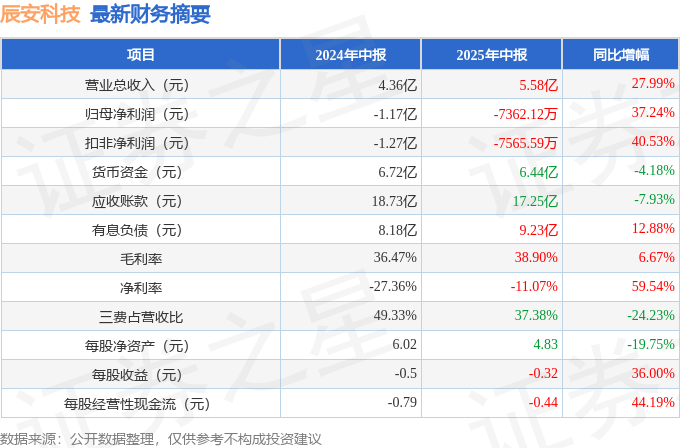
辰安科技2025年中报简析:营收上升亏损收窄,盈利能力上升
Zheng Quan Zhi Xing· 2025-08-29 22:42
Core Viewpoint - The recent financial report of Chen'an Technology (300523) shows a significant increase in revenue and a reduction in net loss, indicating an improvement in the company's profitability metrics despite ongoing challenges [1]. Financial Performance - As of the reporting period, the total revenue reached 558 million yuan, a year-on-year increase of 27.99% [1]. - The net profit attributable to the parent company was -73.62 million yuan, showing a year-on-year improvement of 37.24% [1]. - In Q2, total revenue was 357 million yuan, up 16.34% year-on-year, while the net profit attributable to the parent company was -39.72 million yuan, an increase of 33.28% year-on-year [1]. - The gross margin increased by 6.67% to 38.9%, and the net margin improved by 59.54% to -11.07% [1]. - Total sales, management, and financial expenses amounted to 208 million yuan, accounting for 37.38% of revenue, a decrease of 24.23% year-on-year [1]. - The earnings per share were -0.32 yuan, reflecting a year-on-year increase of 36.0% [1]. Business Model and Market Position - The company's business model relies heavily on marketing-driven strategies, which necessitates a thorough examination of the underlying factors driving this approach [2]. - Historical data indicates that the company's median Return on Invested Capital (ROIC) since its listing is 13.31%, with a notably poor ROIC of -13.14% in 2024 [2]. - The company has experienced two years of losses since its listing, suggesting a fragile business model [2]. Operational Developments - In 2024, the company signed contracts worth nearly 40% more than the previous year, driven by opportunities in national policies related to urban safety, emergency management, and infrastructure projects [3]. - The company has expanded its market presence in urban safety and emergency management, successfully winning significant projects, including a central enterprise emergency rescue platform [3]. - The AIoT public safety service platform has become one of the largest online monitoring platforms in China, indicating strong consumer engagement [3]. - The company has also made strides in international markets, achieving breakthroughs in the Middle East and expanding services in regions such as Singapore and Africa [3].