
城市竞争力

Search documents
杭州的“耐心陪跑”:包容十年不鸣,静待一鸣惊人
Zhong Guo Xin Wen Wang· 2026-01-23 17:25
Core Viewpoint - Hangzhou's approach to innovation emphasizes patience and support, encapsulated in the phrase "ten years of silence, waiting for a stunning performance," highlighting the city's commitment to fostering a nurturing environment for innovation and entrepreneurship [1][10]. Group 1: Institutional Support - The Hangzhou government is committed to creating a friendly environment for employment and entrepreneurship, as articulated by the Human Resources and Social Security Bureau [3]. - A clear institutional framework is in place to support innovation, focusing on technology and advanced manufacturing, including the launch of the seventh round of the "Three-Year Action Plan for College Student Innovation and Entrepreneurship" [4]. - Initiatives include the establishment of the Hangzhou Entrepreneurship Talent Academy and various supportive policies aimed at assisting all entrepreneurs [5]. Group 2: Physical Space for Innovation - The Central Innovation District (CID) is being developed in Hangzhou, providing free entrepreneurial spaces and financial support to startups, which is crucial for many entrepreneurs [7]. - The "Honghu Hui" entrepreneurial community has attracted over 800 projects and more than 30 companies since its launch, demonstrating the effectiveness of providing supportive environments for young entrepreneurs [7]. - In 2025, thousands of square meters of free innovation space were made available to qualified tech companies, with up to three years of free usage rights and hardware support [7]. Group 3: Long-term Service Commitment - Hangzhou's commitment to the animation industry has been consistent since 2004, leading to a robust talent system and industry foundation over two decades [8]. - The government has proactively supported companies like the one behind "Black Myth: Wukong" even before they gained recognition, showcasing a long-term vision rather than a focus on immediate results [9]. - The overarching strategy is to create an environment conducive to innovation, where the government plays a supportive role rather than pushing for quick successes [9].
把“一时爆款” 变为“长久繁荣”
Xin Lang Cai Jing· 2026-01-04 17:59
Core Insights - The city of Quzhou has successfully hosted the New Year's Eve concert for three consecutive years, significantly enhancing its profile as a cultural destination [1][3] - The "concert economy" initiated in 2023 has led to a remarkable increase in tourism, with 519,800 visitors during the 2024 New Year holiday, representing a 46.71% year-on-year growth [1] - Quzhou has invested over 10 billion yuan in upgrading its infrastructure, including the renovation of 33 venues, achieving full coverage of "one venue, two halls" across its districts [1] Infrastructure Development - The city has upgraded its sports center from a 30,000-seat stadium to a multi-venue facility, optimizing traffic flow to accommodate large-scale performances [1] - Additional infrastructure improvements include the establishment of a fan lounge at the airport, the replacement of temporary stalls with a shopping outlet, and the introduction of 1,000 shared electric bikes and free shuttle buses [1] Service System Enhancement - Quzhou has developed a comprehensive service system, including a "one-stop" approval mechanism and thoughtful amenities such as free ginger tea and 26,500 warm packs for attendees [1] - The city aims to extend its service model to the broader cultural and tourism sector, ensuring that the warm hospitality experienced during concerts becomes a standard for visitors [2] Cultural and Economic Sustainability - The city is focused on transforming the resources and experiences gained from the concerts into sustainable competitive advantages, rather than treating them as one-time assets [2] - Plans include utilizing the sports venues for various events such as youth sports training, music festivals, and industry conferences, aiming to keep the venues active year-round [2] Long-term Vision - Quzhou is positioning itself as a cultural magnet, leveraging its geographical advantages and cultural heritage to attract more visitors and create a lasting impact on its economy [3] - The goal is to convert short-term gains from events into long-term benefits, ensuring that Quzhou evolves from a temporary hotspot to a thriving cultural destination [3]
2025年科尔尼行业系列回顾|经济与政策
科尔尼管理咨询· 2025-12-30 01:06
Group 1 - The global economic uncertainty is significantly increasing due to the interplay of geopolitical factors, tariff adjustments, and technological changes, which are reshaping growth and capital flows for the next five years [1][2]. - Companies and cities must enhance their competitiveness by gaining insights into structural trends and maintaining resilience and decisive decision-making in a volatile environment [1][2]. Group 2 - The next five years will see five major variables, including geopolitical dynamics, technological breakthroughs, and institutional evolution, profoundly reshaping the global operational logic, necessitating companies to identify long-term trends rather than being swayed by short-term fluctuations [2][3]. - Commodity prices are expected to be highly differentiated and volatile, requiring companies to adopt data-driven procurement and pricing systems to improve their ability to respond to cyclical and structural changes [4]. Group 3 - Adjustments in tariff policies are altering foreign direct investment expectations, presenting Asian economies with critical challenges in capital reallocation and industrial layout decisions [7]. - In the context of increasing global uncertainty, urban competitiveness is shifting from historical advantages to innovation capabilities, digital infrastructure, and talent aggregation effects [10]. Group 4 - The global economic outlook indicates a coexistence of recovery and downward risks, with regional growth becoming differentiated, where Asia emerges as a primary growth engine despite ongoing trade slowdowns and fragmentation pressures [13]. - CEOs are shifting their focus from mere efficiency and growth to resilience, trust, and organizational adaptability to navigate the ongoing global turbulence [14].


新观察:场景经济或将重塑城市竞争力格局
Sou Hu Cai Jing· 2025-12-18 10:38
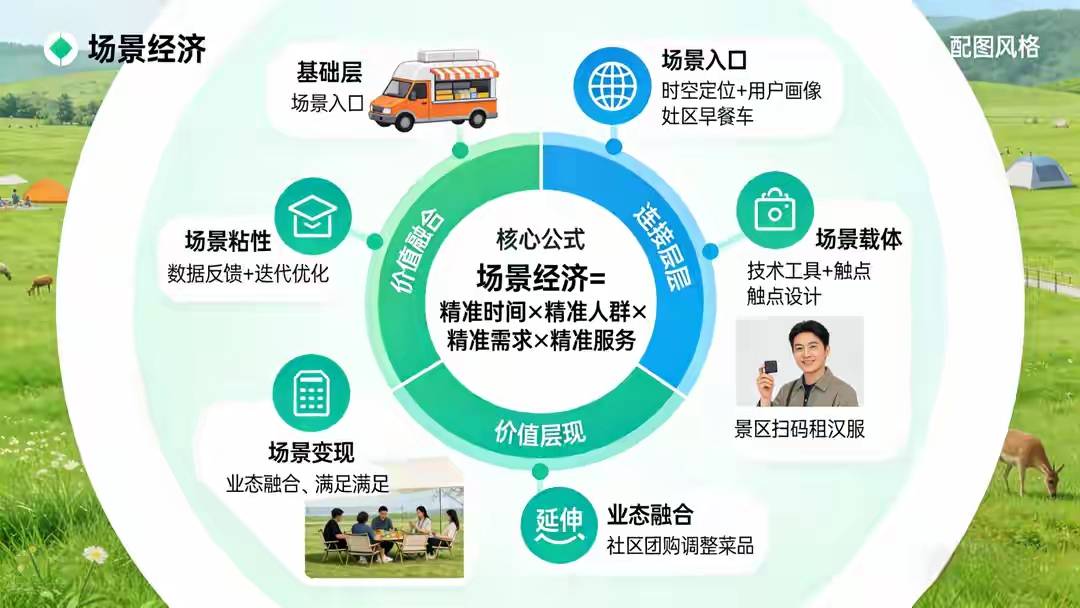
Core Viewpoint - The "scenario economy" is emerging as a new competitive arena for cities, driven by specific application needs that promote technological implementation and industrial transformation [1] Group 1: Definition and Concept - The scenario economy focuses on connecting cutting-edge technology with market demand through real and specific application scenarios, differing from mere technology development or product promotion [3] - It serves as a "bridge" linking technological innovation in laboratories with industrial upgrades on production lines, and as a "melting pot" refining new products and business models from complex real-world demands [3] Group 2: Pathways to Empower New Productive Forces - Top-level design should elevate scenarios to a strategic ecological content, making them a core part of urban innovation strategies [5][6] - A balanced approach to supply and demand is essential, systematically identifying and opening "opportunity scenarios" while showcasing local "capability scenarios" to seek external collaboration [7] - Establishing a regular platform for scenario supply and demand cooperation is crucial to break down information barriers and facilitate face-to-face interactions among technology providers, enterprises, capital, and government [7] Group 3: Goals and High-Quality Development - The exploration of the scenario economy ultimately aims to develop new productive forces and achieve "leapfrog development," embedding scenario innovation into the overall layout of innovation entities, talent aggregation, and platform building [8] Group 4: Future Outlook - Future urban competition will hinge not only on policies, costs, or single technologies but also on the ability to cultivate a "fertile innovation soil," precisely defining key scenarios and facilitating cross-border integration [10] - By deeply engaging in the scenario economy, cities can transform into dynamic, open "innovation laboratories," where technology meets market needs and creativity finds a platform, driving high-quality development [10]
济南第5、广州第7?15万人口增量、3.2万亿GDP,广州用实力证明
Sou Hu Cai Jing· 2025-10-30 15:04
Core Viewpoint - The ranking that places Jinan above Guangzhou is misleading and lacks a fair comparison, as it selectively uses data to create an illusion of Jinan's superiority over Guangzhou [1] Group 1: Livability Scores - The livability score for Guangzhou is 82.1, only 2 points lower than Jinan, yet the ranking exaggerates Jinan's advantage [3] - The population decline in Guangzhou is attributed to "low living cost," which is misleading as 65% of the decline is due to short-term issues like pandemic-related disruptions [3][5] Group 2: Population Growth - In 2024, Guangzhou's population increased by 151,000, while Jinan's grew by 78,000, making Guangzhou's actual increase 1.7 times that of Jinan [9] - Jinan's population growth is significant within a declining provincial context, but Guangzhou's growth reflects its national appeal and stronger economic fundamentals [9] Group 3: Transportation Infrastructure - Guangzhou has a well-developed metro system with 705 kilometers of track, while Jinan has only 205 kilometers, leading to a higher density of metro coverage in Guangzhou [11] - The extensive metro network in Guangzhou facilitates easier commuting for its growing population, unlike Jinan, which may face congestion issues due to limited coverage [13] Group 4: Economic Performance - In 2024, Guangzhou's GDP reached 3.23 trillion, significantly higher than Jinan's 1.35 trillion, indicating that Guangzhou's economy is approximately 2.4 times larger [15] - Guangzhou's third sector accounts for 72% of its economy, creating ample job opportunities, while Jinan's economy is more reliant on secondary industries, which may limit job flexibility [15] Group 5: Education and Healthcare - Guangzhou has 83 universities with 1.568 million students, compared to Jinan's 52 universities and 740,000 students, indicating a much larger educational capacity [17] - In healthcare, Guangzhou has 67 top-tier hospitals and 10.4 million beds, while Jinan has only 24 top-tier hospitals and 3.4 million beds, showcasing a significant disparity in healthcare resources [19] Group 6: Foreign Trade - In 2024, Guangzhou's export volume was 651.8 billion, significantly higher than Jinan's 73.4 billion, with Guangzhou's exports supporting a larger employment base [21] - The scale of Guangzhou's foreign trade operations provides a robust economic foundation, while Jinan's smaller export volume limits its job creation potential [21] Group 7: Overall City Competitiveness - True city competitiveness is determined not just by attracting people but by retaining them through job availability, transportation, education, and healthcare [23] - The controversial ranking fails to consider the comprehensive strengths of Guangzhou, focusing instead on short-term population fluctuations without acknowledging long-term systemic advantages [23]
用好知识产权提升城市竞争力
Jing Ji Ri Bao· 2025-05-09 22:09
Group 1 - The core viewpoint of the article emphasizes the importance of utilizing the intellectual property (IP) system to enhance urban innovation capabilities and overall strength, as highlighted in the "China Urban Intellectual Property Index Report 2025" [1][2] - In 2024, the National Intellectual Property Administration will complete various tasks related to the innovation pilot of the business environment, with 34 cities participating in the standardization of IP public services and the establishment of 28 key industry patent databases, significantly boosting urban competitiveness [1][2] - There has been a notable increase in IP creation capabilities, with improvements in IP output levels and conversion efficiency, driven by increased R&D investment and supportive policies in representative cities like Beijing [1][2] Group 2 - The business environment for intellectual property has improved significantly, supported by strong administrative and judicial enforcement, with 16 specific measures outlined to enhance policy support and service guarantees for business entities [2][3] - The urban IP development index reveals disparities between cities and regions, with Beijing, Shenzhen, and Shanghai leading the rankings, while Northeast and Northwest regions lag behind, indicating a correlation between economic development and IP maturity [2][3] - To enhance urban core competitiveness through the IP system, a multi-faceted approach is recommended, focusing on strategic emerging industries, establishing coordination mechanisms for knowledge sharing and IP protection, and improving regional IP strategies [3]