
城投企业市场化转型

Search documents
从政府报告看江苏化债:阶段性成效显著,重点关注经营性债务化解与长效债务管理机制构建
Lian He Zi Xin· 2026-03-11 11:05
Group 1: Report Industry Investment Rating - No information provided Group 2: Core Viewpoints of the Report - Since 2024, Jiangsu Province has made significant phased achievements in debt reduction, including large - scale clearance of financing platforms, zeroing out of implicit debts in many places, significant cost reduction, and innovation in building a debt management system, providing a replicable "Jiangsu Plan" for national local government debt risk prevention and control [4] - The central government's deployment in 2026 signals an overall expansion of the debt reduction scope, a shift in governance logic towards marketization and long - term effectiveness, and an acceleration of platform transformation. Jiangsu's debt risk prevention and resolution work is transitioning from phased "attack and zero - clearing" to normalized "long - term governance" [10] - While Jiangsu has achieved remarkable results in debt reduction, it still faces deep - seated problems such as the need to refine post - clearance management of financing platforms, strengthen the control of new implicit debt sources, improve the efficiency of non - operating asset revitalization, and pay attention to the market risks in the transformation of urban investment enterprises and the construction of long - term debt management mechanisms [16] Group 3: Summary by Relevant Catalogs 1. Jiangsu Province's Debt Reduction Achievements - **Policy implementation and quota acquisition**: Jiangsu strictly implemented the "6 + 4+ 2" incremental debt reduction measures, obtaining an implicit debt replacement quota of 753.3 billion yuan, accounting for 12.56% of the national total, ranking first in the country. Many places achieved significant results in implicit debt reduction, such as Xuzhou achieving zero implicit debt in 2024 and Lianyungang's implicit debt balance decreasing by 31.5% in 2025 compared to 2024 [4] - **Cost reduction and platform clearance**: Through measures such as bank loan replacement of high - interest non - standard debts and expansion of government - supported financing guarantee coverage, the comprehensive financing cost was continuously reduced. As of January 2026, 984 financing platforms had been withdrawn in the province, with over 300 withdrawn in 2025 alone, leading the country [5] - **Asset inventory and platform transformation**: A comprehensive inventory of state - owned assets was carried out, with assets of 488 trillion yuan inventoried and earnings of 115 billion yuan obtained. Various forms were adopted to promote the market - oriented transformation of urban investment enterprises and enhance their self - hematopoietic function [5] - **System innovation and mechanism improvement**: Jiangsu built a "1315" debt management system, implemented closed - loop management of debt "borrowing, use, management, and repayment", and promoted "one - policy - for - one - household" precise governance, providing a solid institutional support for debt reduction [6] 2. Next - Stage Work Priorities - **Addressing operating debt risks and promoting market - oriented transformation**: Jiangsu has formed a full - scale debt reduction plan covering government debts, implicit debts, and operating debts of financing platforms since 2024. In the next stage, urban investment enterprises will take on more functions related to investment promotion and industrial development, and use market - based financing tools to revitalize assets and achieve market - oriented transformation [11] - **Building a long - term government debt management mechanism and strengthening source control**: In 2026, debt reduction work will focus on mechanism improvement and source control, shifting from scale reduction to structure optimization and from phased tasks to normalized system building. The 13 cities in Jiangsu have different work focuses in line with regional characteristics [12][15] 3. Key Areas of Future Attention - Although Jiangsu has achieved significant results in debt reduction, it still needs to address deep - seated issues such as the follow - up management of assets, debts, and personnel after the clearance of financing platforms, strict control of new implicit debts, improvement of non - operating asset revitalization efficiency, and attention to market risks in the transformation of urban investment enterprises and the construction of long - term debt management mechanisms [16]
浙江省发债城投企业财务表现观察:化债与发展并举,再融资能力强劲
Lian He Zi Xin· 2025-12-04 11:01
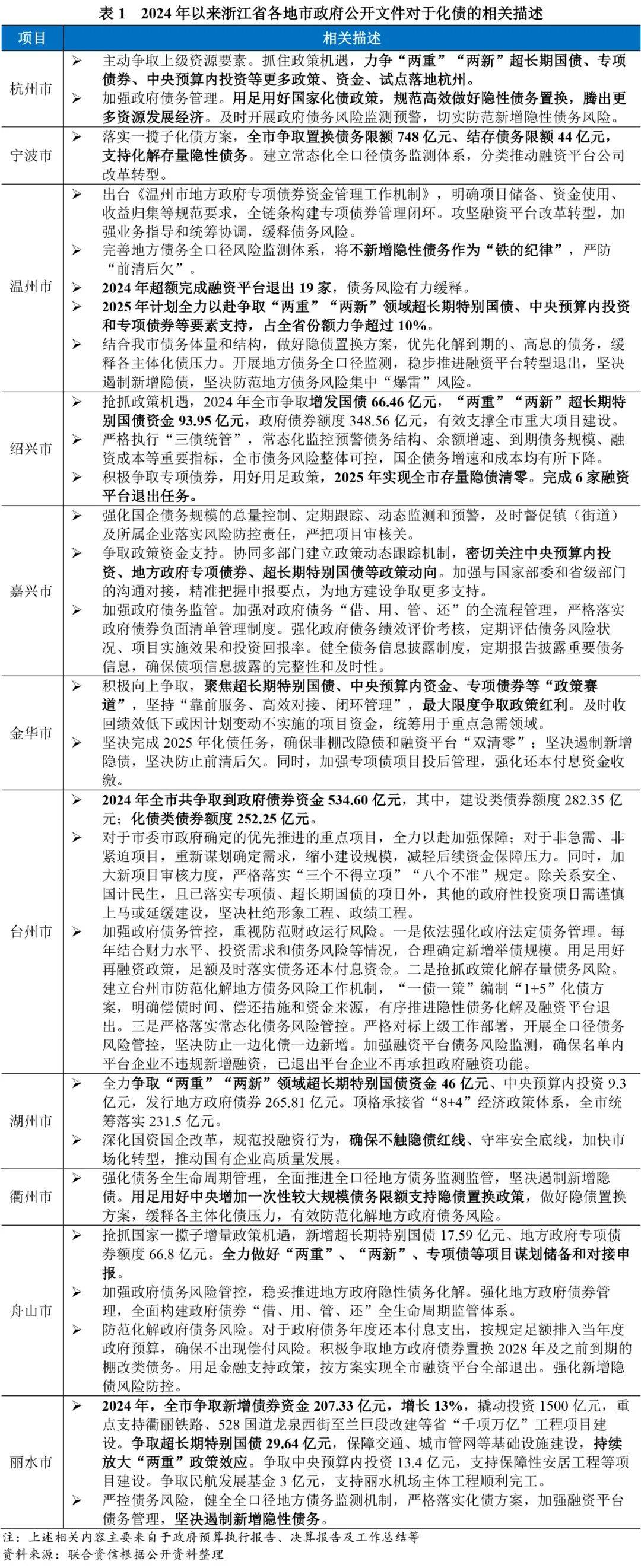
1. Report Industry Investment Rating No relevant content provided. 2. Core Viewpoints of the Report - Zhejiang Province has made phased achievements in debt resolution through multiple measures such as seeking superior funds, issuing special refinancing bonds, and controlling project investments. The province's 11 prefecture - level cities have formed a pattern of "full - scale promotion and gradient clearance" around debt reduction goals, with some regions achieving zero implicit debt and "dual zero" goals. At the same time, Zhejiang's urban investment enterprises' debt scale continues to grow but at a slower pace, with an optimized financing structure, and the short - term debt ratio has slightly increased. However, challenges remain, including regional differentiation, continued growth in accounts receivable in some areas, slowdown in investment growth, and insufficient self - hematopoietic ability in some urban investment enterprises. Therefore, it's necessary to plan for debt resolution and market - oriented transformation of urban investment enterprises simultaneously to improve their operational efficiency and risk - resistance ability [3][9][34]. 3. Summary by Relevant Catalogs 3.1 Zhejiang Province's Debt Control Situation - **Seeking Superior Funds**: In 2024, Zhejiang obtained 69.764 billion yuan in ultra - long - term special treasury bonds and 327.9 billion yuan in new special bonds, with 290.1 billion yuan used for project construction, accounting for 9.1% of the national total, and 37.8 billion yuan for the completion of existing government investment projects [5]. - **Implicit Debt Replacement**: In 2024, the Ministry of Finance allocated a local government debt limit of 244.2 billion yuan to Zhejiang in three - year installments (81.4 billion yuan per year from 2024 - 2026). In 2024 and 2025, Zhejiang (including Ningbo) fully used the "special bonds for implicit debt replacement" quota of 81.4 billion yuan each year. The issuance of special refinancing bonds in 2025 was faster than the national average, which lowered the average financing cost of urban investment enterprises [5]. - **Controlling Project Investment**: Cities like Jiaxing and Taizhou proposed to control project investment to prevent new debt. They sorted out and reviewed existing government investment projects, strengthened support for key projects, and carefully considered or postponed non - urgent projects. They also tightened the review of new projects and coordinated the connection between the fiscal budget and the government investment plan [6]. - **Regional Achievements**: As of the end of September 2025, some regions in Zhejiang, such as Lin'an District and Chun'an County in Hangzhou, Zhoushan City, etc., achieved zero implicit debt, and some areas completed the "dual zero" goals of implicit debt resolution and platform exit. More than 600 urban investment platforms in Zhejiang have exited, accounting for half of the national total during the same period [9]. 3.2 Changes in Financial Indicators of Zhejiang's Urban Investment Enterprises 3.2.1 Investment - **Overall Situation in Zhejiang**: From 2022 to June 2025, the investment scale of urban - construction assets, self - operated assets, and equity and fund investments of Zhejiang's urban investment enterprises continued to grow, but the growth rate of urban - construction assets and equity and fund investments slowed down. By the end of June 2025, the growth rates of these three types of assets further decreased. The proportion of urban - construction assets decreased to 69.90% but remained the main asset component [13]. - **Regional Differences**: Most cities' total investment and urban - construction asset investment increased. The growth rates of Wenzhou, Shaoxing, Huzhou, and Zhoushan were below 10%, while the other seven cities exceeded 10%. In 2024, the growth rate of urban - construction assets in all cities slowed down, and the growth rates of self - operated assets in most cities increased. The growth rate of equity and fund investments decreased in half of the regions [14]. 3.2.2 Receivables - **Overall Situation in Zhejiang**: From 2022 to June 2025, the accounts receivable of Zhejiang's urban investment enterprises continued to grow, but the growth rate decreased in 2024 and June 2025. In 2024, the cash income ratio was relatively good, which may be affected by multiple factors such as the slowdown of project settlement and the change in the business structure [16]. - **Regional Differences**: At the end of 2024, the accounts receivable of urban investment enterprises in Hangzhou, Ningbo, and Huzhou exceeded 50 billion yuan, while those in Quzhou, Lishui, and Zhoushan were below 20 billion yuan. Except for Jinhua, the growth rate of accounts receivable in other cities exceeded 10% [18]. 3.2.3 Financing - **Overall Situation in Zhejiang**: From 2022 to 2024, the cash inflow and outflow of financing activities of Zhejiang's urban investment enterprises increased year by year, with a net inflow that fluctuated and decreased, mainly due to policy restrictions on new financing in 2024. The financing structure was optimized, with bank borrowing as the main channel and an increasing proportion of bank financing [20][25]. - **Regional Differences**: In 2024, the cash inflow of financing activities in Hangzhou, Shaoxing, Ningbo, and Huzhou exceeded 500 billion yuan. The net inflow of financing activities was positive in all cities, with significant regional differences. The net inflow in Zhoushan was only 6 billion yuan, while those in Hangzhou, Ningbo, and Jiaxing exceeded 100 billion yuan [20][23]. 3.2.4 Interest - Bearing Debt - **Overall Situation in Zhejiang**: By the end of June 2025, the debt scale of Zhejiang's urban investment enterprises continued to grow, but the growth rate slowed down from 22.55% in 2023 to 8.53%. The debt was mainly long - term, with a slightly increased proportion of short - term debt. The financing structure was optimized, with bank borrowing accounting for nearly 70% [25][26]. - **Regional Differences**: The debt scale of urban investment enterprises in Hangzhou, Shaoxing, Ningbo, and Huzhou ranked among the top, exceeding 1 trillion yuan in total. In 2024, the debt growth rates of urban investment enterprises in Jiaxing, Quzhou, Taizhou, and Lishui exceeded 15%. The proportion of short - term debt in some regions increased [26]. 3.2.5 Debt - Servicing Ability - **Overall Situation in Zhejiang**: From 2022 to June 2025, the overall debt burden of Zhejiang's urban investment enterprises continued to rise, and the cash - to - short - term - debt ratio fluctuated and decreased. Since 2025, with increased debt resolution efforts and support from financial institutions, the short - term debt - servicing ability has improved [29][33]. - **Regional Differences**: The debt burdens of urban investment enterprises in Shaoxing, Taizhou, Jinhua, Hangzhou, and Jiaxing were relatively heavy. The cash - to - short - term - debt ratio of cities in Zhejiang ranged from 0.3 to 0.5 times, with Lishui having the highest ratio. In 2025, the short - term debt - servicing ability of all cities improved to some extent [33].
【债市研究】化债与发展并举,再融资能力强劲——浙江省发债城投企业财务表现观察
Sou Hu Cai Jing· 2025-12-04 10:29
Core Viewpoint - Zhejiang Province is actively advancing local debt resolution through various methods, achieving phased results, including a significant reduction in platform numbers and some regions reaching dual clearance of debts [1][5]. Group 1: Debt Management in Zhejiang Province - Zhejiang Province is utilizing strategies such as securing higher-level funding, issuing special refinancing bonds, and controlling project investments to enhance debt management and has seen initial success [2]. - In 2024, Zhejiang secured 69.764 billion yuan in special long-term bonds and 327.9 billion yuan in new special bonds, with 290.1 billion yuan allocated for project construction, accounting for 9.1% of the national total [2]. - The provincial government is gradually implementing plans for replacing hidden debts, with a total debt limit of 244.2 billion yuan set for 2024, distributed over three years [2]. Group 2: Investment Control Measures - Several cities in Zhejiang, including Jiaxing and Taizhou, have publicly committed to controlling project investments to manage new debt risks [3]. - The focus is on prioritizing essential projects while re-evaluating non-urgent projects to reduce future funding pressures [3]. - New project approvals are being scrutinized, with a strong emphasis on avoiding non-essential projects and ensuring alignment with fiscal budgets [3]. Group 3: Financial Indicators of Urban Investment Enterprises - The debt scale of urban investment enterprises in Zhejiang continues to grow, but the growth rate has slowed, with long-term debt remaining predominant [23]. - As of June 2025, the debt growth rate decreased from 22.55% in 2023 to 8.53% [23]. - The financing structure has improved, with bank loans becoming the primary source of financing, accounting for nearly 70% of total financing by June 2025 [26]. Group 4: Cash Flow and Receivables - Urban investment enterprises in Zhejiang have maintained a net inflow of cash from financing activities, with significant inflows reported in cities like Hangzhou, Ningbo, and Jiaxing [16][20]. - However, the growth rate of accounts receivable has been increasing, indicating ongoing challenges in cash collection [12][15]. - The cash income ratio for urban investment enterprises has shown positive performance, reflecting better cash collection from certain business segments despite overall project settlement delays [14]. Group 5: Challenges and Future Outlook - Zhejiang Province faces significant regional disparities in debt management, with some areas continuing to experience increased accounts receivable and cash flow pressures [5][34]. - The investment growth rate is slowing, particularly in infrastructure projects, which, combined with cash collection challenges, indicates that the internal debt repayment capacity of urban investment enterprises has not improved substantially [34]. - As a major economic province, Zhejiang must balance the hard task of debt resolution with the new requirements for high-quality development, necessitating a comprehensive approach to enhance operational efficiency and risk resilience in urban investment enterprises [34].

地方政府债与城投行业监测周报2022年第9期:国有林场资源被禁止无偿划拨至城投,吉林融资平台数量已压降超七成-20251202
Zhong Cheng Xin Guo Ji· 2025-12-02 05:17
1. Report Industry Investment Rating - No relevant content provided 2. Core Viewpoints of the Report - The high - pressure situation of implicit debt supervision remains unchanged, and emphasis is placed on preventing "the risk of risk disposal". The prohibition of free allocation of state - owned forest farm resources to urban investment platforms and the progress of some regions in exiting the list of key debt - risk provinces are significant events that will impact the local government debt and urban investment industry [3][6]. 3. Summary According to Relevant Catalogs 3.1. News Review - The "Document No. 1343 of Fagai Nongjing" prohibits the free allocation of state - owned forest farm resources to local state - owned investment and financing platforms and provides a market - oriented participation path. This not only ensures the safe and reasonable use of forest farm resources but also provides a model for local government asset allocation to urban investment enterprises, preventing local debt risks and guiding the market - oriented transformation of urban investment enterprises. It also encourages urban investment enterprises to participate in the development and operation of forest farm resources through market - based cooperation [6][9][11]. - Jilin Province has met the conditions to exit the list of key debt - risk provinces, and Anhui Province has taken multiple measures to prevent local debt risks. After Jilin exits the list, there will be both opportunities and risks for local investment and financing. Anhui has proposed five countermeasures to address local debt issues [6][12][13]. - Five urban investment enterprises declared to become market - oriented business entities or exit the financing platform list this week, mainly at the district - county and municipal levels with AA - level ratings. Jilin has become the third province to publicly state that it meets the conditions to exit the list of key debt - risk provinces [6][15]. - Seventeen urban investment enterprises prepaid bond principal and interest this week, involving 21 bonds with a total scale of 2.803 billion yuan [6][20]. - Two urban investment bonds were cancelled this week. As of November 23, 94 urban investment bonds have been postponed or cancelled this year, with a total scale of 60.658 billion yuan [6][21]. 3.2. Issuance of Local Government Bonds and Urban Investment Enterprise Bonds - This week, the issuance and net financing scale of local government bonds decreased. The issuance progress of new bonds exceeded 90% (excluding the activation of the remaining quota). There is still 357.6 million yuan left in this year's 2 - trillion - yuan replacement quota, and only Henan Province has not completed the issuance. The weighted average issuance term of local government bonds was 14.30 years, and the weighted average issuance interest rate increased to 2.07% [6][22][23]. - This week, the issuance and net financing scale of urban investment bonds increased, the issuance interest rate decreased, and the spread narrowed. A total of 146 urban investment bonds were issued, with a total scale of 98.416 billion yuan. The weighted average issuance term was 3.44 years. Four overseas urban investment bonds were issued, with a total scale of 2.308 billion yuan [6][29]. 3.3. Trading of Local Government Bonds and Urban Investment Enterprise Bonds - This week, the central bank conducted 1.676 trillion yuan in reverse repurchase operations, with a net investment of 434 billion yuan. Short - term capital interest rates fluctuated. There were no adjustments to urban investment ratings or credit risk events this week [35]. - The trading volume of local government bond cash bonds increased by 14.00% to 45.5755 billion yuan, and the maturity yield decreased by an average of 2.89BP. The trading volume of urban investment bonds decreased by 1.31% to 27.7139 billion yuan, and the maturity yield fluctuated. The spreads of 1 - year and 3 - year AA+ urban investment bonds widened, while the spread of 5 - year AA+ urban investment bonds narrowed [35]. - Nine urban investment bonds of nine urban investment entities had 11 abnormal trades, with the number of entities, bonds, and abnormal trades decreasing compared to last week [36]. 3.4. Important Announcements of Urban Investment Enterprises - Eighty urban investment enterprises issued announcements regarding changes in senior management, legal representatives, directors, supervisors, etc., changes in controlling shareholders and actual controllers, equity/asset transfers, changes in the use of raised funds, and name changes [41].
2025年三季度城投债市场分析与展望:以化债促发展,城投债融资边际改善
Lian He Zi Xin· 2025-11-18 14:19
1. Report's Industry Investment Rating No relevant content provided. 2. Core Viewpoints of the Report - The "package debt resolution plan" advanced its efforts, with two "500 billion" injections in succession, highlighting the policy approach of balancing debt resolution and development. The intensified proactive fiscal policy is expected to ease the liquidity pressure on local governments and urban investment enterprises [4][5]. - In Q3 2025, the issuance scale of urban investment bonds increased both year - on - year and quarter - on - quarter, and the net repayment scale narrowed significantly. The financing situation of key provinces improved marginally, and provincial and park - level urban investment entities turned into net inflows [4][8][9]. - In Q4, the maturity and repayment scale of urban investment bonds will decline, but considering the large total debt of urban investment enterprises, the interest payment pressure remains severe, and the repayment pressure on urban investment bonds in Q4 will not decrease. Attention should be paid to the liquidity pressure in regions with high concentrated repayment pressure and district - county - level urban investment enterprises [4][33]. - The powerful incremental debt resolution plan has achieved phased results, significantly reducing costs and accelerating the transformation of urban investment enterprises. Urban investment enterprises have entered a critical transition period from "debt resolution" to "transformation and quality improvement" [4][37]. 3. Summary by Relevant Catalogs Policy Environment - The "package debt resolution plan" advanced its efforts, with two "500 billion" injections, highlighting the policy approach of balancing debt resolution and development. The proactive fiscal policy was intensified, and the liquidity pressure on local governments and urban investment enterprises is expected to ease. The Ministry of Finance increased support for implicit debt resolution by using the debt resolution quota in advance. As of the end of October 2025, the special refinancing bonds for replacing implicit debt had a cumulative issuance of 1.993 trillion yuan, with a issuance progress of 99.67%. The issuance of special new special bonds accelerated significantly since May, with a cumulative issuance of 738.1 billion yuan in Q3, and the total issuance exceeded 1.2 trillion yuan by the end of September, exceeding the annual issuance target of 800 billion yuan [5]. - A new policy - based financial instrument of 500 billion yuan was established, which was fully used to supplement the capital of major projects. As of the end of October, all the funds had been invested, supporting more than 2,300 projects with a total investment of about 7 trillion yuan, mainly in digital economy, artificial intelligence, and other fields. It can relieve the project capital bottleneck caused by tight local finances and help some urban investment companies relieve capital pressure and expand financing channels [6]. - The central government allocated 500 billion yuan from the local government debt balance limit to local governments, an increase of 100 billion yuan compared with the previous year, and the scope was expanded. In addition to supplementing local government comprehensive financial resources and supporting debt resolution, it was also used for project construction in eligible economic provinces to support effective investment [7]. Review of the Urban Investment Bond Market Issuance Overview - In Q3, the issuance scale of urban investment bonds increased both year - on - year and quarter - on - quarter, and the net repayment scale narrowed significantly. The issuance of private placement bonds and ABS increased significantly, while the issuance of ultra - short - term financing bills and medium - term notes decreased significantly. The net repayment scale of inter - bank and exchange - traded products decreased significantly year - on - year. The issuance scale of urban investment bonds in Q3 was 1.26 trillion yuan, a year - on - year increase of 0.42% and a quarter - on - quarter increase of 17.38%, with a net repayment of 2.6007 billion yuan. The issuance scale of urban investment bonds of entities that declared themselves as market - oriented business entities accounted for 33.99%, and they achieved a net financing of 3.444 billion yuan. The early repayment scale of urban investment bonds in Q3 was about 453.6 billion yuan, with year - on - year and quarter - on - quarter increases of 3.65% and 4.10% respectively [8][9]. - In terms of issuance varieties, the issuance scale of exchange - traded products increased both year - on - year and quarter - on - quarter, mainly private placement bonds, with significant increases in private placement bonds and ABS. The issuance scale of inter - bank products decreased year - on - year, with significant declines in ultra - short - term financing bills and general medium - term notes of over 10%. The net repayment scale of the inter - bank and exchange markets decreased significantly year - on - year, with a decline of over 80% [11]. - Regionally, the issuance scale of non - key provinces increased both year - on - year and quarter - on - quarter, with a quarter - on - quarter increase of about 16%. The issuance scale of key provinces decreased year - on - year but increased significantly quarter - on - quarter, with a quarter - on - quarter increase of about 26%. The net repayment scale of both key and non - key provinces narrowed significantly. In non - key provinces, Zhejiang, Shanghai, and Guangdong had large net inflows, while Jiangsu had the largest net repayment scale of 45.09 billion yuan. In key provinces, except for Tianjin, Liaoning, Qinghai, and Inner Mongolia, other provinces had net repayments, and Chongqing had the largest net repayment scale of 9.293 billion yuan [13][15]. - In terms of credit ratings, the issuance of urban investment bonds was still dominated by AA + and AAA - rated entities, with high - level entities accounting for over 77%. The AAA - rated entities maintained a net inflow, and provincial and park - level entities turned into net inflows, while the net repayment scale of municipal and district - county - level entities narrowed [17][19]. - The issuance scale of ultra - long - term urban investment bonds further increased and was concentrated in high - quality entities in more economically developed regions. In key provinces, the issuance term structure of Guizhou and Yunnan improved. The issuance term of urban investment bonds was still mainly medium - and long - term, with bonds over 3 years accounting for over 55%. The issuance of ultra - long - term (10 years and above) urban investment bonds was 128 issues with a scale of 84.028 billion yuan, increasing both year - on - year and quarter - on - quarter. Non - key provinces were the main issuers of ultra - long - term urban investment bonds, with the issuers mainly in Shandong, Jiangsu, Zhejiang, and other economically developed provinces [20]. - In Q3, the issuance interest rate and spread of urban investment bonds fluctuated upward, but the spread center decreased quarter - on - quarter. The issuance spreads of some key provinces decreased significantly, but the spreads of Guizhou, Yunnan, and Guangxi remained high. Among non - key provinces, the spreads of Shandong, Xinjiang, and Henan were higher than the national average, and the credit differentiation intensified [23]. New Issuance Situation - In Q3, driven by the policy of balancing debt resolution and development, the number of issues and scale of newly issued bonds of urban investment entities increased both year - on - year and quarter - on - quarter. The newly issued entities showed the characteristic of "concentration on high - quality entities", mainly high - level entities in regions with strong economic and fiscal strength and industrial advantages such as Guangdong, Shanghai, and Zhejiang. The newly issued bonds were mainly invested in rural revitalization, green industries, and other fields. A total of 68 urban investment entities newly issued bonds, with 89 issues and a scale of 53.591 billion yuan [28][29]. Outlook - In Q4, the maturity and repayment scale of urban investment bonds will decline, but considering the large total debt of urban investment enterprises, the interest payment pressure remains severe, and the repayment pressure on urban investment bonds in Q4 will not decrease. Attention should be paid to the liquidity pressure in regions with high concentrated repayment pressure and district - county - level urban investment enterprises. The scale of outstanding urban investment bonds at the end of Q3 was about 13.36 trillion yuan. Assuming that all callable bonds are exercised, the maturity scale of urban investment bonds in Q4 2025 is 1.2 trillion yuan, a decrease of about 15% compared with Q4 2024 [33][35]. - The powerful incremental debt resolution plan has achieved phased results, significantly reducing costs and accelerating the transformation of urban investment enterprises. Urban investment enterprises have entered a critical transition period from "debt resolution" to "transformation and quality improvement". After the replacement of implicit debt with local government debt, the average interest cost of debt decreased by over 2.5 percentage points, saving over 450 billion yuan in interest payments. As of the end of June 2025, over 60% of financing platforms had exited. In the future, urban investment enterprises will be classified and disposed of in an orderly manner, and some financing platforms may be forced to accelerate their market - oriented transformation. Urban investment enterprises should explore substantial transformation paths based on their own conditions and regional resource endowments [37][38].
地方政府债与城投行业监测周报2025年第25期:中央城市工作会议强调存量提质增效吉林重启中小银行专项债发行-20250723
Zhong Cheng Xin Guo Ji· 2025-07-23 08:58
Report Investment Rating No investment rating information is provided in the report. Core Viewpoints - The Central Urban Work Conference points out a new direction for urban development. Special bond support areas may be further tilted towards urban renewal, green - low - carbon, safety - resilience, and smart governance. Urban investment enterprises can participate in urban renewal and smart city operations to accelerate market - oriented transformation [7][9]. - Jilin plans to issue 26 billion yuan of special bonds for small and medium - sized banks to support the establishment of a provincial rural commercial bank. In the future, more provinces may issue relevant bonds to support small and medium - sized banks and explore the feasibility of supporting other local small and medium - sized financial institutions [11]. - This week, the issuance and net financing of local government bonds and urban investment bonds both increased, with different trends in issuance costs and structures [16][20]. Summary by Directory 1. News Review - **Central Urban Work Conference**: Held from July 14th to 15th, it emphasizes "five transformations" and "seven key tasks". Special bond support areas may be tilted towards urban renewal, etc., and urban investment enterprises can accelerate transformation [7][8][9]. - **Jilin's Special Bond Issuance**: Jilin plans to issue 26 billion yuan of special bonds for small and medium - sized banks on July 22nd. More provinces may follow suit to support small and medium - sized banks and explore supporting other local small and medium - sized financial institutions [11][12]. - **Early Redemption of Urban Investment Bonds**: 18 urban investment enterprises redeemed bond principal and interest in advance this week, involving 20 bonds with a total scale of 2.704 billion yuan [14][15]. - **Cancellation or Postponement of Urban Investment Bond Issuance**: No urban investment bonds were cancelled or postponed this week [16]. 2. Issuance of Local Government Bonds and Urban Investment Enterprise Bonds - **Local Government Bonds**: 45 local bonds were issued this week, with a scale of 231.79 billion yuan, a net financing of 110.229 billion yuan. The issuance of new special bonds exceeded half of the annual quota. The weighted average issuance interest rate rose to 1.80%, and the spread widened to 10.35BP [16]. - **Urban Investment Bonds**: 135 urban investment bonds were issued this week, with a scale of 88.943 billion yuan, and the net financing was - 3.301 billion yuan. The overall issuance interest rate was 2.13%, and the spread was 66.47BP. Four overseas urban investment bonds were issued, with a total scale of 4.467 billion yuan [20]. 3. Trading of Local Government Bonds and Urban Investment Enterprise Bonds - **Funds and Credit Rating Adjustment**: The central bank net - withdrew 22.65 billion yuan this week. On July 9th, 2025, Zhongzheng Pengyuan downgraded the rating of "22 Shenshan Investment MTN001" of Guangdong Shenshan Investment Holding Group Co., Ltd. from AAA to AA+ [23][24]. - **Trading Volume and Yield**: The trading volume of local government bonds was 390.614 billion yuan, a decrease of 30.89%. The trading volume of urban investment bonds was 284.91 billion yuan, a decrease of 2.16%. The yields of both mostly increased [24]. - **Abnormal Trading of Urban Investment Bonds**: 18 urban investment entities had 22 abnormal bond trades, with an increase in the number of entities, bonds, and trades [25]. 4. Important Announcements of Urban Investment Enterprises 86 urban investment enterprises issued announcements on changes in senior management, legal representatives, etc., including changes in executives, legal representatives, directors, and supervisors; changes in controlling shareholders and actual controllers; equity/asset transfers; changes in fund use; cumulative new borrowings; and external guarantees [29].
“退平台”对城投企业信用水平的影响
Lian He Zi Xin· 2025-03-11 05:17
Investment Rating - The report does not explicitly state an investment rating for the industry or companies involved in the "retirement from platform" initiative [3]. Core Insights - The "retirement from platform" initiative is driven by policy changes aimed at decoupling local government financing from city investment companies, mitigating hidden debt risks, and promoting market-oriented transformations [3][4]. - From 2021 to 2023, entities undergoing retirement from platforms have shown improvements in business transformation, with a notable increase in the proportion of non-city investment business revenue [3][13]. - The credit ratings of the retiring platform entities predominantly fall within the AA and AA+ categories, with a significant concentration of these entities at the county level [13][22]. Summary by Sections 1. Policy Overview - The retirement from platform initiative has undergone three main phases, including exits from the CBRC and the Ministry of Finance's city investment platform lists, driven by the need to break financing constraints and seize development opportunities [6][9]. - The initiative is a response to the central government's push to address hidden debt risks and facilitate the market-oriented transformation of city investment companies [6][12]. 2. Characteristics of Retiring Entities - Between August 2023 and February 2025, a total of 749 companies announced their retirement from platforms, with 572 being bond-issuing entities [14]. - The revenue structure of these entities has diversified, with the share of city investment business revenue decreasing from 31.69% in 2021 to 28.23% in 2023, indicating a shift towards more market-oriented operations [14][15]. 3. Regional Distribution - The majority of retiring entities are located in non-key provinces, with significant numbers in Jiangsu and Zhejiang, while key provinces like Chongqing have also seen notable retirements [16][19]. 4. Impact on Government-Enterprise Relations - The relationship between retiring entities and local governments is expected to weaken gradually, although actual adjustments will depend on various factors including ownership structures and transformation progress [25][26]. - Despite the nominal separation, the influence of local governments on these entities remains significant in the short term [25][26]. 5. Credit Risk Implications - In the short term, the overall debt risk for retiring entities is manageable, but attention is needed for potential defaults among weaker entities [28][29]. - Long-term debt risks may vary regionally, with entities that successfully transition to market-oriented operations likely to see improved risk profiles [29]. 6. Future Development Directions - Retiring entities must establish modern corporate governance, achieve business transformation, and enhance cash flow independence to thrive post-retirement [30][31]. - The ability to issue new bonds and secure financing will depend on the successful implementation of market-oriented strategies and the reduction of reliance on government support [32].