基金溢价率

Search documents
罕见!单日净值跌幅超过30%,国投瑞银白银LOF溢价率飙升至109%
Xin Lang Cai Jing· 2026-02-02 15:55
Core Viewpoint - The significant drop in the net asset value (NAV) of Guotai Junan Silver LOF is attributed to extreme fluctuations in the international silver market and the fund's adjustment of its valuation method, leading to a drastic decline in its NAV and a high premium in the secondary market [1][2]. Group 1: Fund Performance and Valuation - On February 2, 2026, Guotai Junan Silver LOF resumed trading after a suspension, experiencing a "limit down" with a closing price of 4.722 yuan, while its NAV plummeted from 3.2838 yuan to 2.2494 yuan, marking a daily decline of 31.5% [1]. - The fund's NAV drop is one of the rare occurrences in the industry, with the last similar case being a 37.51% drop in another fund in April 2020, which was caused by large redemptions rather than external market factors [1]. - The fund's management implemented a special valuation method due to the extreme volatility in the international silver market, which involved referencing the afternoon prices of major international markets for revaluation [2]. Group 2: Market Dynamics and Investor Implications - The significant discrepancy between the NAV and the secondary market price, with a premium rate of 109.92%, indicates a need for the secondary market price to adjust downward to align with the true NAV [2]. - The market sentiment reflects a consensus that the secondary market price will decline to reconcile with the NAV, with discussions of potential "5 limit downs" illustrating the pressure for this adjustment [3]. - The situation serves as a cautionary lesson for investors, highlighting that when the trading price of a fund significantly deviates from its NAV, it can transform from a simple investment tool into a speculative risk [3].
溢价率居高不下!白银主题基金场内价格为何难回归净值
Bei Jing Shang Bao· 2026-01-08 12:45
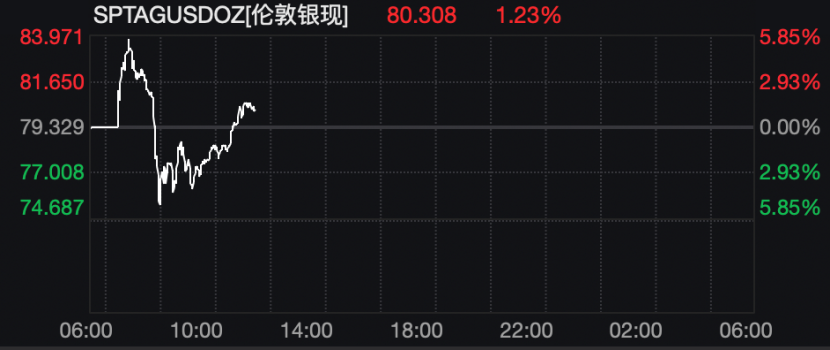
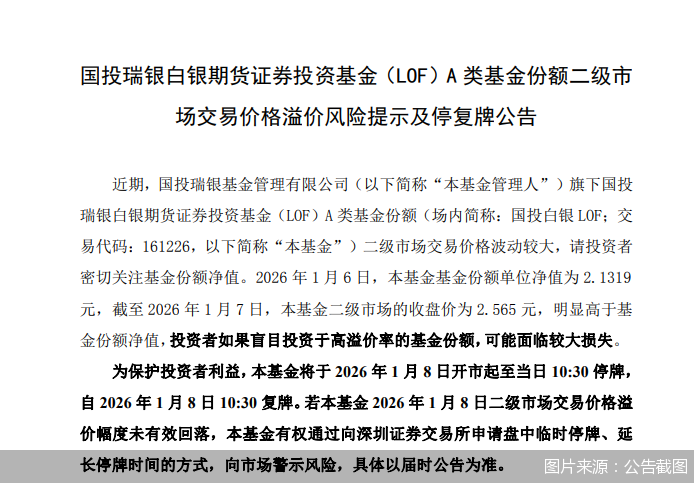
Core Viewpoint - Precious metal prices, particularly silver and gold, have experienced significant volatility, with silver prices recently declining after reaching new highs. The market is influenced by speculative trading and geopolitical uncertainties, leading to high premium rates for silver-themed funds [1][3][7]. Group 1: Silver Market Dynamics - As of January 8, silver prices fell by 3.13% to $75.93 per ounce, following a peak of $83.97 per ounce on December 29, 2025, representing a cumulative increase of over 34% since December 2025 [1][3]. - The only silver-themed public fund in the domestic market, Guotou Ruijin Silver Futures (LOF), reported a premium rate of approximately 16% as of January 7, 2026, with the fund's market price significantly exceeding its net asset value [3][4]. - The fund has issued multiple warnings regarding premium risks and has suspended trading several times due to high volatility and speculative trading behavior [3][5]. Group 2: Gold Market Trends - Gold prices have also reached historical highs, with COMEX gold hitting $4,584 per ounce on December 26, 2025, and London gold reaching $4,550.52 per ounce on December 29, 2025. As of January 8, 2026, gold prices have slightly decreased to $4,434.54 per ounce [7][8]. - Analysts suggest that despite the recent price corrections, the long-term upward trend for both gold and silver remains intact, with no clear price ceiling in sight [7][8]. - The market dynamics are influenced by factors such as geopolitical uncertainties, technical trading aspects, and expectations of U.S. monetary policy, which continue to support the fundamental demand for precious metals [8][9]. Group 3: Regulatory and Market Responses - In response to the volatility in silver futures, the Shanghai Futures Exchange has implemented stricter risk control measures, including adjustments to trading fees and position limits for various contracts starting January 9, 2026 [6]. - The fund management has also reduced the subscription limits for the Guotou Ruijin Silver Futures fund, indicating a cautious approach to managing investor exposure amid high premium risks [5].

投资进化论丨ETF、LOF的溢价率变高了,还能入场吗?
Jin Rong Jie· 2025-12-30 10:10
Core Viewpoint - Recent increases in trading prices of certain ETFs and LOFs in the secondary market have led to rising premium rates, prompting questions about the feasibility of entering the market at this time [1] Group 1: Causes of Premium - Premium arises primarily from the supply and demand dynamics in the secondary market, applicable only to funds like ETFs and LOFs that can be traded on exchanges [2] - These funds have two prices: the net asset value (NAV) calculated daily by the fund company, representing the true intrinsic value, and the market trading price determined by investor supply and demand [2] - When demand for a fund significantly exceeds supply, its trading price can rise above its NAV, resulting in a premium [2] - Premium rates can vary; for instance, a fund with a unit NAV of 1 yuan trading at 1.1 yuan has a premium of 0.1 yuan, equating to a premium rate of 10% [2] - Historical data shows that premiums are not uncommon, especially in QDII ETFs, with rates typically ranging from 2% to 5%, and extreme cases reaching over 43% [2] Group 2: Risks of High Premiums - Investing in high-premium ETFs or LOFs carries two main risks: value regression risk and NAV decline risk [3] - Value regression risk indicates that market prices will eventually align with NAV, and high premiums may lead to losses if market sentiment cools [3] - NAV decline risk suggests that entering the market at high premiums exposes investors to both emotional premiums and potential declines in NAV, leading to compounded losses [3] Group 3: Perspective on Premium Phenomenon - High premiums reflect market sentiment and short-term supply-demand imbalances, with potential for rapid price corrections if sentiment shifts [4] - The emergence of premiums also indicates growing investor interest in overseas and commodity assets, suggesting a diversification in asset allocation strategies [4] - ETFs and LOFs serve as convenient asset allocation tools, with their trading rules differing from traditional funds, leading to greater volatility and rapid premium adjustments [4] - Investors are advised to remain calm and assess value and risk rationally when premiums deviate significantly from normal ranges [4]
国投白银LOF剧烈波动:振幅接近20%
Zheng Quan Shi Bao· 2025-12-29 06:24
Core Viewpoint - Guotou Silver LOF has attracted significant market attention due to its volatile trading performance, with a notable increase in both price and trading volume in recent days [1][2]. Group 1: Fund Performance - Guotou Silver LOF experienced a dramatic price fluctuation, opening at the limit down price and then quickly rebounding, achieving a maximum intraday increase of over 9%, closing up 8.8% at midday [1]. - The fund has seen a cumulative increase of over 200% this year, with an accelerated rise of nearly 80% in December alone [1]. - As of December 25, 2025, the fund's net asset value per share was 1.9469 yuan, while the closing price on December 26 was 2.524 yuan, indicating a significant premium over the net asset value [1]. Group 2: Trading and Risk Management - To protect investor interests, the fund announced a temporary suspension of trading from December 29, 2025, until 10:30 AM, with the possibility of further suspensions if the premium remains high [2]. - The fund management has stated that the A-class fund shares have a subscription limit of 100.00 yuan, with plans to adjust this limit in response to market conditions [3]. - The fund's trading prices are subject to fluctuations not only from net asset value changes but also from market supply and demand, systemic risks, and liquidity risks [4]. Group 3: Market Context - The international precious metals market has also experienced significant volatility, with silver spot prices initially rising over 5% before dropping and then recovering to a gain of approximately 1.2% [4]. - Silver futures displayed similar trends, initially increasing over 7% before experiencing a drop and then rising again to a gain of about 3.8% [6].