
黄金相关ETF

Search documents
金价上演“过山车”,资金大分歧,此刻进场是“馅饼”还是“陷阱”?
市值风云· 2026-03-27 10:16
Core Viewpoint - The long-term logic for precious metals, particularly gold, remains intact despite recent volatility in prices and market sentiment [1] Group 1: Market Dynamics - The recent fluctuations in gold prices have led to a significant divergence in investor sentiment, with many questioning whether to hold gold as a long-term asset or to sell [5] - As of March 26, the total scale of gold-related ETFs reached 313.1 billion, with a notable decline in total assets from 3,660.06 billion on March 18, representing a 14.4% decrease [6][9] - The trading volume of gold ETFs has increased significantly, with a total transaction amount of 1,593.6 billion from March 19 to the present, indicating a shift in market dynamics [10][11] Group 2: Investment Sentiment - Despite some net redemptions in gold-related ETFs, the overall market has not seen a massive outflow of funds, suggesting a mixed sentiment among investors [9] - The current geopolitical tensions and rising inflation risks have led to a stronger dollar and higher nominal interest rates, which have negatively impacted gold prices [12] - Long-term factors such as the evolving geopolitical landscape, weakening dollar credit, and continued central bank purchases of gold support the case for gold as a valuable asset [15] Group 3: Strategic Considerations - The traditional stock-bond allocation strategy is under pressure, as the correlation between U.S. bonds and stocks has turned positive, diminishing bonds' role as a safe haven [18] - While short-term risks remain due to ongoing geopolitical conflicts and high energy prices, the long-term investment logic for gold has not been fundamentally broken, suggesting potential opportunities for accumulation at lower prices [18]

A股别样开门红:油气狂欢、机器人缺席、影视扑街
Xin Lang Cai Jing· 2026-02-24 10:49
Core Viewpoint - The A-share market experienced a strong performance on the first trading day of the Year of the Horse, with all three major indices closing higher, driven by resource sectors and policy expectations as the Two Sessions approach [3][15]. Market Performance - On February 24, the Shanghai Composite Index rose by 0.87% to 4117 points, the Shenzhen Component increased by 1.36% to 14291 points, and the ChiNext Index gained 0.99% to 3308 points [3][15]. - The total trading volume for the day reached 2.2 trillion yuan, an increase of 219.2 billion yuan compared to the previous trading day, indicating heightened market activity [3][15]. Sector Analysis - Resource sectors, particularly oil and gas, led the market rally, with multiple oil and gas ETFs hitting the daily limit [4][16]. - In contrast, the film and media sector saw significant declines, with related ETFs dropping over 7% due to disappointing box office performance during the Spring Festival [4][17]. ETF Market Insights - Oil and gas ETFs showed remarkable performance, with several reaching the daily limit and an average increase of around 10% [5][18]. - The Standard & Poor's Oil and Gas ETF recorded a trading volume of 1.117 billion yuan and a turnover rate of 152.76%, reflecting strong market interest in this sector [5][18]. Investment Themes - Analysts suggest that resource products and technology sectors may become the main themes for the spring market, driven by policy expectations and industry trends [3][11]. - The focus on stable growth policies ahead of the Two Sessions is expected to benefit infrastructure and resource sectors [11][24]. Market Sentiment - Despite the overall market rally, there is a notable divergence in sector performance, with technology stocks experiencing mixed results [21][23]. - Southbound capital flows showed a "buy the dip" strategy, with net purchases of 3.131 billion Hong Kong dollars on February 24, indicating continued interest in the market despite fluctuations [22][24].


金银价继续大跌,商品黄金相关ETF早盘跌停开盘
Sou Hu Cai Jing· 2026-02-02 01:38
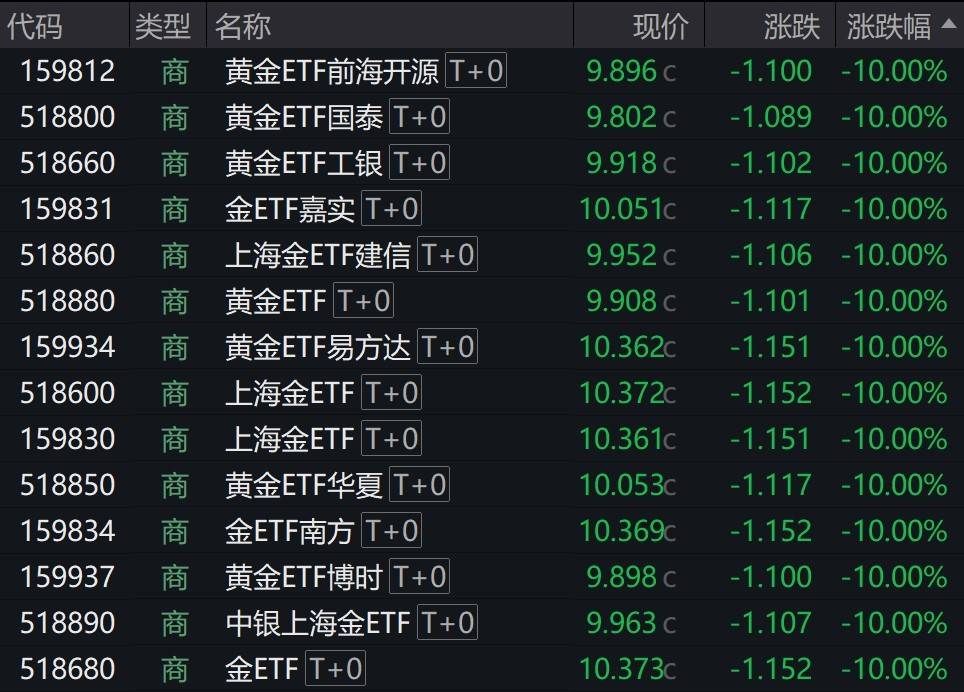
Core Viewpoint - Gold and silver prices continue to decline sharply following the nomination of Kevin Warsh as the Federal Reserve Chairman by President Trump, triggering hawkish market expectations and panic selling of precious metals [1]. Group 1: Market Impact - Gold-related ETFs opened with a limit down, reflecting the negative market sentiment [1]. - All listed gold ETFs experienced a decline of 10% in their prices, indicating a significant market reaction to the news [2]. Group 2: Investment Insights - Analysts suggest that the primary function of gold is not to generate profit but to serve as a store of value and a hedge against risks, closely tied to geopolitical uncertainties, U.S. monetary policy, and global economic conditions [2]. - Investors are advised against blindly trying to buy the dip in gold prices, emphasizing the need for a cautious approach [2].
这些方向,资金大幅流入
Zhong Guo Zheng Quan Bao· 2026-02-01 23:17
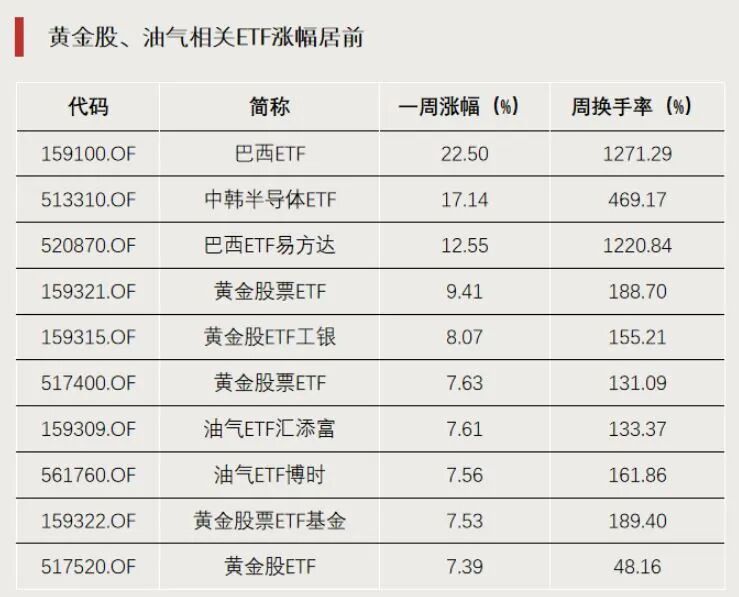
Group 1 - The core viewpoint of the article highlights the significant fluctuations in the ETF market, particularly the strong performance of gold and oil-related ETFs, followed by a sharp decline in gold stock ETFs on January 30 [1][3][6] - During the week of January 26 to January 30, the overall ETF market experienced a net outflow of 298.22 billion yuan, with gold and non-ferrous metal ETFs being the main beneficiaries of capital inflow [1][9] - Gold ETFs, particularly those linked to the Shanghai Gold Exchange Au99.99 spot contracts, saw a net inflow exceeding 20 billion yuan, while ETFs tracking the SSH gold stock index had a net inflow of 7.525 billion yuan [1][9] Group 2 - The trading volume for ETFs tracking major indices such as the CSI 300 and CSI 500 remained active, with the A500 ETF from E Fund exceeding a trading volume of 220 billion yuan [2][11] - A total of 541 ETFs recorded positive returns, with gold and oil-related ETFs leading the gains, some exceeding 7% [3][6] - The Brazilian ETF (159100) had the highest weekly gain at 22.5%, while several gold stock ETFs also showed significant increases [3][4] Group 3 - Year-to-date, gold stock ETFs have shown remarkable performance, with the gold stock ETF (159321) increasing over 40%, and others like the gold stock ETF from ICBC and (517520) rising over 30% [6][7] - The semiconductor-related ETFs and Brazilian ETFs also ranked among the top performers year-to-date [7][8] - The net inflow for the gold stock ETF (517520) was notably high at 3.228 billion yuan, indicating strong investor interest [8] Group 4 - The article notes that the overall market sentiment is shifting towards focusing on economic trends rather than speculative trading, with an emphasis on cyclical resources and AI-related sectors [14] - Analysts suggest a balanced investment strategy that includes high-growth sectors like technology while also considering undervalued dividend assets to mitigate potential market volatility [14]
1165亿元!宽基ETF成交再放量
Sou Hu Cai Jing· 2026-01-28 09:59
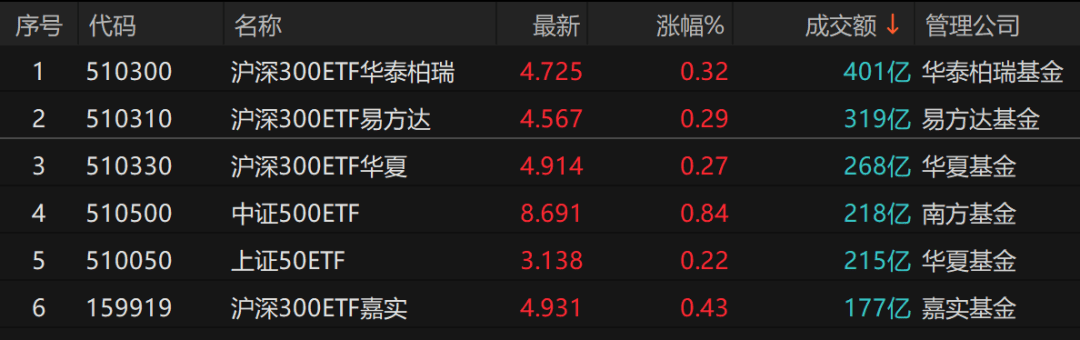
Group 1 - On January 28, the trading volume of broad-based ETFs surged, with four major CSI 300 ETFs achieving record trading amounts since their inception, including Huatai-PB CSI 300 ETF surpassing 40 billion yuan for the first time [1][2][3] - The total trading volume of the four leading CSI 300 ETFs reached 116.5 billion yuan, with E Fund CSI 300 ETF at 31.9 billion yuan, Huaxia CSI 300 ETF at 26.8 billion yuan, and Harvest CSI 300 ETF at 17.7 billion yuan, all setting new records [3][4] Group 2 - Despite the record trading volumes, the market indices showed resilience, with the CSI 300 Index up 0.22% and the Shanghai Composite Index up 0.27%, while the ChiNext Index fell by 0.57% [8] - On January 27, broad-based ETFs experienced significant net outflows of 47.48 billion yuan, with major ETFs like Huatai-PB CSI 300 ETF, Huaxia CSI 300 ETF, E Fund CSI 300 ETF, and Harvest CSI 300 ETF collectively seeing net outflows of 43.65 billion yuan [9] Group 3 - The net outflow from broad-based ETFs from January 14 to 27 totaled 766.32 billion yuan, with the leading ETFs experiencing over 440 billion yuan in outflows [9] - As a result of the continuous outflows, the sizes of major ETFs have significantly decreased, with Huatai-PB CSI 300 ETF's size dropping from 422.26 billion yuan at the end of last year to 271.19 billion yuan, and E Fund CSI 300 ETF's size decreasing from 300.22 billion yuan to 187.95 billion yuan [9] Group 4 - On January 28, several industry-themed ETFs, particularly in the precious metals sector, saw strong inflows, with the Huaxia Nonferrous Metals ETF gaining 1.657 billion yuan and other related ETFs also attracting over 500 million yuan [10][12] - The scale of domestic gold-related ETFs reached 314.14 billion yuan as of January 27, a significant increase from 70.44 billion yuan at the beginning of 2025 [11][12] Group 5 - The leading gold ETF, Huaan Gold ETF, reached a size of 120.57 billion yuan, while Bosera Gold ETF and E Fund Gold ETF had sizes of 52.18 billion yuan and 45.09 billion yuan, respectively [12] - The continuous net purchases of gold by the People's Bank of China for 14 consecutive months reflect a global trend among central banks to optimize reserve asset structures and hedge against geopolitical and dollar credit risks [12]
这些方向,出现大量集中卖单
Zhong Guo Zheng Quan Bao· 2026-01-27 12:12
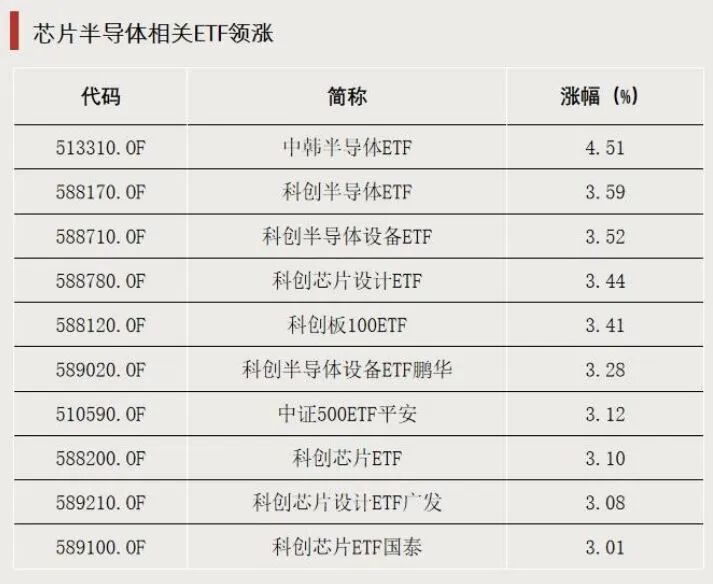
Group 1 - The market showed a rebound on January 27, with all three major indices turning positive, driven by the semiconductor industry chain, leading to a rise in semiconductor-related ETFs, with many increasing by over 3% [1][4] - The top ten ETFs by net inflow on January 26 included three gold-related ETFs, which collectively attracted nearly 3.5 billion yuan [3][8] - The semiconductor-related ETFs dominated the market, with nine out of the top ten ETFs by growth being semiconductor-related, supported by rising expectations for memory chip price increases and ongoing demand for AI computing power [4][5] Group 2 - The total trading volume of ETFs reached 538.918 billion yuan on January 27, with ten ETFs exceeding 10 billion yuan in trading volume, although there was a decrease in trading volume compared to the previous day [6][7] - The gold-related ETFs continued to attract significant capital, with three gold ETFs among the top ten by net inflow, indicating strong investor interest in this sector [8][10] - The market is expected to shift towards emphasizing industry trends and profit certainty, with a focus on sectors like semiconductor storage, overseas computing power chains, and innovative pharmaceuticals, as earnings reports begin to be released [11]
黄金相关ETF表现强劲 科技成长类ETF获资金净流入
Sou Hu Cai Jing· 2026-01-25 10:31
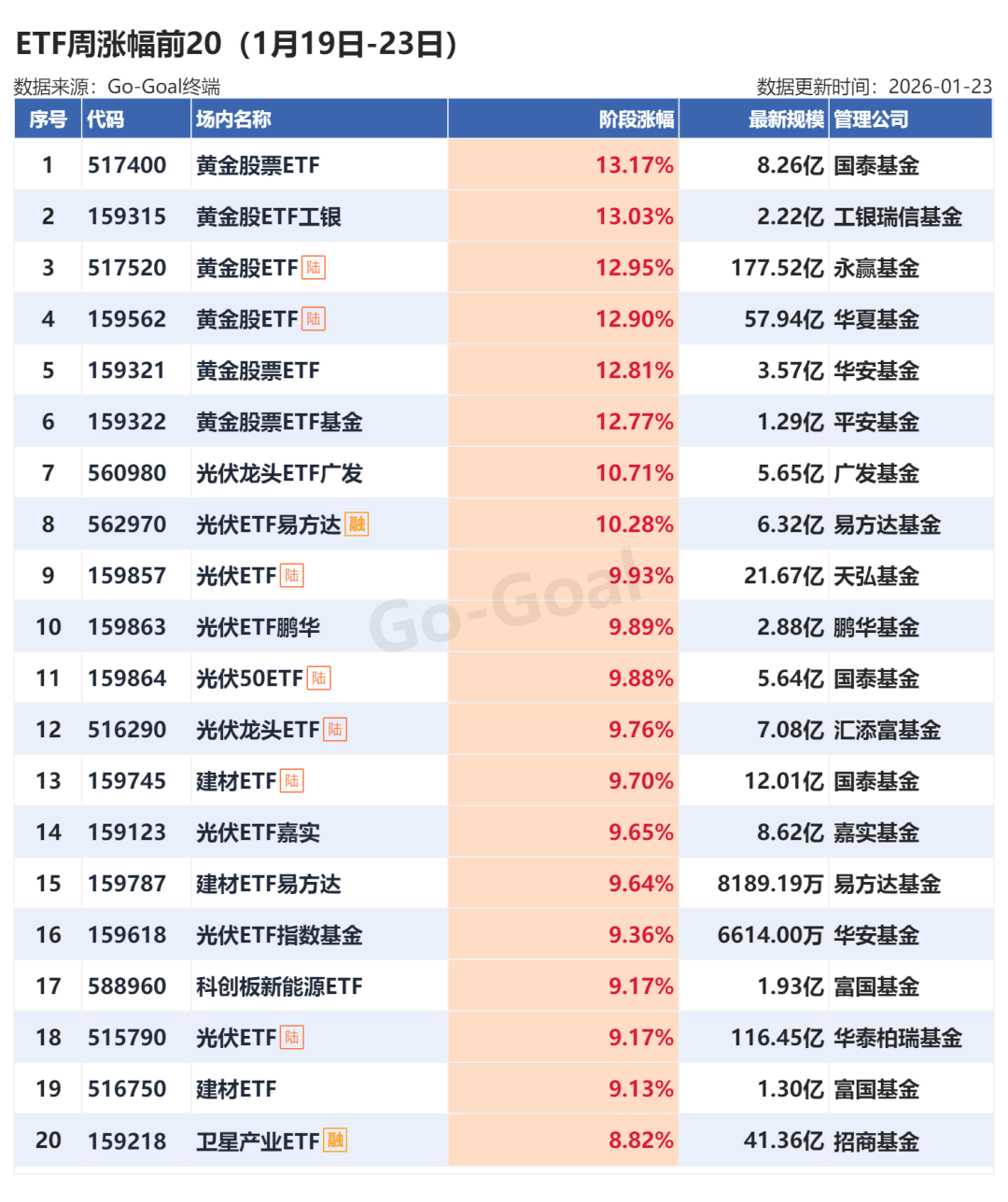
Market Overview - The A-share market exhibited a fluctuating upward trend this week, with major broad-based indices showing mixed performance and significant market style differentiation [1] - International gold prices recently reached a new historical high, leading to strong performance in related ETFs, with gold stock ETFs rising by 13.17%, the highest among all [1][2] - Other sectors such as photovoltaic and building materials ETFs also saw substantial gains, while Hong Kong innovative drug-related ETFs experienced slight adjustments [1] Fund Flow Analysis - Overall, ETF funds experienced a net outflow of 696.39 billion, with broad-based ETFs facing a net outflow of 873.01 billion, while industry ETFs saw a net inflow of 143.04 billion and commodity ETFs a net inflow of 32.91 billion [3] - Funds have not exited the market but have shifted towards more elastic sectors, with significant net inflows into TMT (Technology, Media, Telecommunications) and cyclical sectors like non-ferrous metals, indicating active funds' preference for technology growth themes [2][3] ETF Performance - The top-performing gold stock ETFs included: - 517400 Gold Stock ETF with a 13.17% increase and a latest scale of 826 million [2] - 159315 Gold Stock ETF from ICBC with a 13.03% increase and a scale of 222 million [2] - 517520 Gold Stock ETF from Yongying with a 12.95% increase and a scale of 177.52 billion [2] - Photovoltaic ETFs also performed well, with the top performer being 560980 Photovoltaic Leader ETF from GF with a 10.71% increase and a scale of 565 million [2] Upcoming ETF Listings - Next week, four new ETFs are set to be listed, including: - 589190 Sci-Tech Chip ETF from Huabao, with subscription starting on December 30, 2025 [5] - 159158 Power ETF from Invesco, with subscription starting on January 7, 2026 [5] - 589220 Sci-Tech 200 ETF from Guotai, with subscription starting on January 5, 2026 [5]
避险情绪高涨,黄金相关ETF早盘涨超2%
Sou Hu Cai Jing· 2026-01-21 01:55
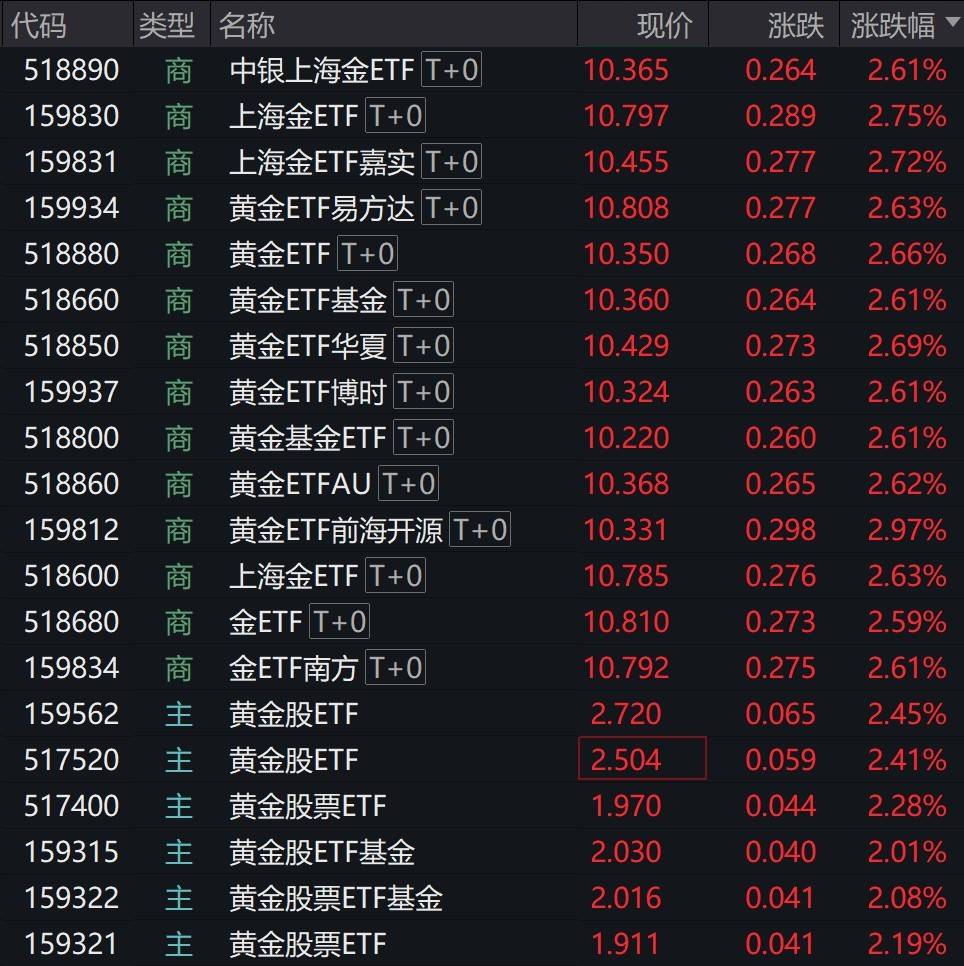
Core Viewpoint - The U.S. stock market declined overnight due to tariffs and geopolitical tensions, leading to increased safe-haven sentiment, which resulted in gold and silver reaching new highs [1] Group 1: Market Impact - The COMEX gold futures surpassed $4800 per ounce during the trading session [1] - Gold-related ETFs saw an early morning increase of over 2% due to market conditions [1] Group 2: ETF Performance - Various gold ETFs experienced notable price increases, with the following highlights: - Zhongyin Shanghai Gold ETF T+0 rose by 2.61% to a price of 10.365 [2] - Shanghai Gold ETF T+0 increased by 2.75% to a price of 10.797 [2] - Shanghai Gold ETF Required T+0 saw a rise of 2.72% to a price of 10.455 [2] - E Fund Gold ETF T+0 gained 2.63% to a price of 10.808 [2] - Other gold ETFs also reported similar increases, generally around 2.6% to 2.97% [2]
贵金属的转折点?风浪越大鱼越贵!
格隆汇APP· 2025-12-25 09:41
Core Viewpoint - The current precious metals market is experiencing significant volatility, with extreme bullish sentiment on one side and sudden bearish movements on the other, indicating a potential turning point for precious metals [5][10]. Short-term Disturbances - Investors should avoid acting as "purchasers" during the upcoming passive fund rebalancing, which is expected to exert selling pressure on silver (9%) and gold (3%) [16][18]. - Active funds are likely to preemptively reduce their holdings to lock in profits, suggesting that the current bullish trend in precious metals may soon end [20][21]. - It is advised to reduce positions in non-ferrous stocks to navigate this turbulent period [22]. Long-term Support for Gold Bull Market - The long-term bullish trend for gold is supported by four key factors: 1. Central banks have been net buyers of gold for three consecutive years, with purchases exceeding 1,000 tons annually, and are projected to reach 1,086 tons in 2024 [31]. 2. The Federal Reserve's interest rate cuts are expected to support gold prices, with three cuts anticipated by 2025 [36][37]. 3. The global debt crisis, particularly in the U.S., has created a demand for safe-haven assets like gold, as debt levels exceed $36 trillion [42][45]. 4. Retail investors currently have a low allocation to gold, with U.S. gold ETFs comprising only 0.17% of private investment portfolios, indicating significant room for growth [49]. Market Trends and Predictions - Historical data shows that gold has consistently outperformed U.S. equities over the past 25 years, with a 20-year return rate of 761% compared to the S&P 500's 673% [64]. - The current gold price has surpassed $4,500, with a total market capitalization of $31.5 trillion, suggesting a strong valuation relative to historical peaks [66]. - Analysts predict that gold could reach $5,000 per ounce by 2026, with some forecasts suggesting a potential rise to $10,000 per ounce by 2029, driven by multiple factors including the Fed's interest rate policies and global de-dollarization [69][72]. Investment Strategy - Short-term strategies should focus on defensive measures, such as reducing positions to avoid passive selling pressure, while long-term strategies should involve buying on dips as market volatility stabilizes [83][88]. - Investors are encouraged to consider gold-related ETFs for a straightforward investment approach that aligns with gold price movements [92].

11月社融数据解读
2025-12-15 01:55
Summary of Conference Call Notes Industry Overview - The conference call discusses the financial data and economic conditions in China, particularly focusing on the banking sector and macroeconomic indicators [1][2][3]. Key Points and Arguments 1. **Loan Growth and Economic Trends** - In January, new loans amounted to 5.1 trillion yuan, indicating a typical credit peak season, but a slight decrease in loan growth is expected in the coming months, aligning with nominal economic growth trends [1][9]. - The demand for household credit remains weak due to multiple factors including a sluggish real estate market, stock market volatility, and declining consumer data [1][10]. 2. **Monetary Supply and Policy Environment** - M1 money supply growth has decreased to 4.9% year-on-year, while M2 growth remains stable at 8%, reflecting a relatively stable policy environment with no urgent need for adjustments [1][4]. - The central bank's financial data shows a year-on-year growth in social financing scale of 8.5%, with loan growth at 6.3%, indicating a stable overall performance but with some discrepancies from market expectations [2]. 3. **ETF Fund Flows and Market Sentiment** - Dividend ETFs continue to attract funds for low-positioning, while the technology sector shows weak liquidity. The CSI 500 ETF saw a net inflow close to 10 billion yuan, while tech-themed ETFs like AI, military, and semiconductors experienced significant net outflows [1][5][6]. - The banking sector is experiencing a daily net outflow of about 500 million yuan, but its fundamental improvement is considered highly certain, suggesting potential investment value [6]. 4. **Future Market Expectations** - An interest rate hike is anticipated around mid-2026 to address potential economic downturn risks. The banking sector's fundamentals are improving, but the overall upward potential is limited to about one or two percentage points [7][8]. - The consumer sector remains a market highlight, and the performance of innovative pharmaceutical stocks in Hong Kong is also noted [8]. 5. **Investment Policy and Economic Recovery** - Attention is required on the implementation of policies from the Central Economic Work Conference, particularly regarding "investment stabilization." Current market reactions are relatively muted, and there is a lack of new directions to boost investment growth [11]. - The potential for large-scale infrastructure projects or new monetary tools to support the economy is acknowledged, but the effectiveness may not match past initiatives like the 4 trillion yuan stimulus plan [11]. 6. **Market Dynamics and Risks** - The overall economic activity is showing signs of weakening, which is viewed as a healthy adjustment. The stock market requires strong policy signals to break out of its current stagnation [12]. - The impact of US-China competition is discussed, indicating that China is not at a disadvantage, which supports the RMB exchange rate and foreign capital allocation [13]. Additional Important Insights - The early loan disbursement by banks in October rather than December may influence corporate project growth [3]. - The current financial data suggests that without unexpected policy support, the stock market may struggle to maintain upward momentum [12]. - The debt market may see recovery opportunities following the Central Financial Conference, as high interest rates currently hinder fiscal debt issuance costs [12].