学术诚信

Search documents
本科生1年40篇论文可笑吗?
Xin Lang Cai Jing· 2025-12-25 09:08
Core Viewpoint - The case of a Wenzhou Medical University undergraduate publishing over 40 papers in a year raises significant concerns about academic integrity and the potential for a "paper factory" phenomenon in research [1] Group 1: Publication Output - The student has published 50 articles since July 2024, with over 30 as the first author, achieving an average of one paper every 9 days, which is far beyond the typical output of peers and even seasoned professors [1] - The total citation count for the student's articles has reached 259, with the highest individual citation at 51 [1] Group 2: Research Methodology - Experts suggest that the student's research heavily relies on public databases and fixed analytical methods, indicating a lack of innovation and experimental validation, which may point to a "production line" approach to research [1] - The rapid publication rate raises questions about the authenticity of the research process, with concerns that the student may be leveraging their advisor's team or outsourcing work [1] Group 3: Ethical Concerns - There are suspicions that AI may have been used to assist in writing the papers, as the structural similarities and writing efficiency appear beyond human capability, which would violate research ethics if true [1] - The university has not provided a timely response to public concerns, merely stating that they are "handling" the situation, which could undermine academic credibility if a third-party investigation is not conducted [1] Group 4: Implications for Academic Integrity - The incident highlights the dangers of a culture that prioritizes quantity over quality in academic publishing, which could stifle genuine innovation and erode public trust in scientific research [1] - A call for institutional reform, technological empowerment, and ethical reconstruction is emphasized to ensure that research returns to its foundational principles of diligence and truth-seeking [1]
撤稿之后还须彻查(纵横)
Ren Min Ri Bao· 2025-12-08 22:10
Core Viewpoint - The Ministry of Science and Technology, along with relevant departments, has initiated a special rectification action against academic misconduct, focusing on retracted papers by Chinese scholars in international journals, emphasizing a zero-tolerance attitude towards academic fraud [1][2]. Group 1: Academic Misconduct and Retraction - The action targets behaviors such as plagiarism, data fabrication, paper trading, and the fabrication of peer review experts and opinions, with a commitment to serious investigation and handling of these issues [1]. - Retraction is described as a conventional self-correction mechanism within the academic community, where some authors voluntarily retract papers due to content issues, reflecting a responsible attitude towards academia [1]. - However, some retractions are attempts to cover up academic misconduct, which can lead to misallocation of research resources and tarnish the reputation of scientific research [1]. Group 2: Consequences and Systemic Issues - The special rectification action will incorporate serious misconduct into a database linked to project applications, academic awards, and other evaluations, aiming to increase the cost of dishonesty [2]. - The initiative is seen as a necessary "surgical operation" to combat academic misconduct and to hold accountable those who conceal or tolerate such behaviors within their institutions [2]. - The underlying issue of evaluation criteria is highlighted, where some institutions prioritize quantity over quality, allowing for gray areas that enable opportunistic behaviors among researchers [2]. Group 3: Reform and Ethical Education - The rectification is viewed as a means to return to the original intent of research, which is to explore truth and benefit society, emphasizing the need for ethical education and improved supervision mechanisms [2]. - Reforming the evaluation system to focus on innovation, quality, effectiveness, and contribution is deemed essential for fostering a healthier research environment [2]. - The process of rectification, while painful, is necessary for the revitalization of Chinese research and achieving global recognition through genuine innovation [2].
科技部打击国际期刊造假,撤稿不是终点
Xin Jing Bao· 2025-11-27 08:31
Core Viewpoint - The Ministry of Science and Technology of China has initiated a special rectification action to address academic misconduct, focusing on retracted papers by Chinese scholars in international journals, with a strong emphasis on investigating and handling serious violations such as plagiarism, data fabrication, and fraudulent peer reviews [1][2]. Group 1: Academic Misconduct Rectification - The special action targets various forms of academic misconduct, including plagiarism, data fabrication, and the sale of papers, with a commitment to serious investigation and handling of these issues [1][2]. - The initiative aims to establish a long-term governance mechanism for retracted papers and enhance monitoring of institutions frequently involved in academic misconduct [2][3]. - There is a recognition that some academic institutions have been lax in addressing misconduct, often ignoring or downplaying issues due to a lack of external pressure [2][3]. Group 2: Consequences and Institutional Responsibility - Institutions are expected to take serious actions against authors involved in academic misconduct, ensuring accountability and maintaining academic integrity [2][3]. - Despite previous warnings from authorities, some institutions have not effectively acted against academic misconduct, allowing individuals to continue their careers without facing consequences [3]. - The rise of international academic engagement necessitates a robust monitoring mechanism to prevent misconduct and protect the integrity of Chinese academic research on the global stage [3].
再三宽纵投稿抄袭,学术公信还请三思
Nan Fang Du Shi Bao· 2025-10-28 04:49
Core Viewpoint - The article discusses the repeated incidents of plagiarism in submissions to the journal "Tsinghua Journal of Western Philosophy," emphasizing the need for stricter measures against academic misconduct and the importance of maintaining academic integrity in research environments [1][2][3]. Group 1: Journal's Response to Plagiarism - The journal has issued a statement regarding a recent plagiarism incident, indicating that this is the third occurrence, and warns that future serious academic misconduct will lead to severe consequences, including public criticism [1]. - The journal, founded in 2015, aims to promote the professionalization and internationalization of Western philosophy research in China and has been recognized as a high-impact academic journal [1]. Group 2: Concerns Over Inconsistent Treatment - There are concerns about the journal's inconsistent handling of plagiarism cases, particularly if the same author repeatedly submits plagiarized work while receiving leniency, which raises questions about fairness and the integrity of the academic process [2]. - The article argues that all authors should be treated equally in cases of academic misconduct, and that leniency towards early offenders undermines the principles of academic integrity [2]. Group 3: Need for Collaborative Action - The investigation and handling of academic misconduct should involve collaboration among various academic institutions and timely information sharing, rather than secrecy or selective disclosure [2][3]. - The article highlights the responsibility of academic journals to disclose misconduct involving affiliated individuals and the potential consequences of failing to do so, which can damage the academic environment [3].
斩断论文代写“灰产链条”
Zhong Guo Jing Ji Wang· 2025-10-16 13:55
Core Points - The article highlights the emergence of a gray market for paid essay writing services, where companies offer to produce fake articles and papers for clients, facilitated by AI technology [1] - The use of AI in essay writing has lowered the barriers to entry, with some advertisements claiming that "ghostwriters" can produce up to 30 papers in a single day [1] - The article emphasizes the importance of academic integrity and warns against the dangers of relying on AI-generated content as a substitute for original work [1] Industry Summary - The practice of hiring ghostwriters for academic papers is identified as a violation of social ethics and disrupts the healthy development of the academic ecosystem [2] - The Ministry of Education has classified this behavior as "academic misconduct" and is taking strict measures against students involved in purchasing or commissioning papers, including expulsion or revocation of degrees [2] - Educational institutions and faculty members are adopting a "zero tolerance" policy towards AI-generated papers, reinforcing the need for students to focus on improving their academic skills rather than resorting to unethical practices [2]
标价95万,评欧洲科学院院士怎么成了一门生意
Xin Jing Bao· 2025-10-16 13:34
Core Viewpoint - The article discusses the commercialization of academic titles, particularly focusing on the European Academy's foreign member application process, which has been linked to paid consulting services, raising concerns about the integrity of academic honors [1][2]. Group 1: Commercialization of Academic Titles - The European Academy, despite being a prestigious organization, is now associated with a consulting service that charges up to 950,000 yuan for assistance in obtaining membership, leading to questions about the commodification of academic honors [1][2]. - The emergence of such services reflects a demand gap in the academic evaluation system, where titles are often seen as core indicators of academic achievement, resulting in "title anxiety" among scholars [1][2]. Group 2: Impact on Academic Integrity - The operation of these consulting services shifts the focus of academic evaluation from capability to resource availability, creating a mature market for such services that can undermine the fairness of academic recognition [2][3]. - The article highlights the irony that while the European Academy emphasizes "sustained academic excellence" in its selection criteria, the involvement of intermediaries seeking financial gain threatens the integrity of the evaluation process [2][3]. Group 3: Regulatory and Ethical Concerns - The commercialization of academic titles exposes weaknesses in regulatory mechanisms and academic integrity, with potential legal implications for scholars using public research funds to purchase these services [3]. - The article warns of a vicious cycle where diligent researchers may be discouraged by those who seek shortcuts to academic titles, ultimately harming the environment for academic innovation [3].
香港多所高校曝假学历申请:港大、港中大各发现数百宗伪造案!此前,28岁环球小姐李思萱伪造美国哥大学历入读港大,被判入狱240天
Mei Ri Jing Ji Xin Wen· 2025-10-16 07:43
Core Viewpoint - Multiple universities in Hong Kong have reported a significant increase in cases of applicants using false academic credentials, prompting enhanced verification measures and stricter penalties for fraudulent applications [1][2][5]. Group 1: University Responses - The Hong Kong University and the Chinese University of Hong Kong have intercepted hundreds of applications suspected of using false academic credentials, with the number of cases at the Chinese University rising dramatically from ten last year to hundreds this year [2]. - The Hong Kong University of Science and Technology has implemented a comprehensive approach to address fraudulent applications, including improved coordination among departments and the introduction of a reporting system for suspicious cases [1][6]. - The Hong Kong Polytechnic University has also reported similar cases and has canceled the applications of approximately ten non-local students suspected of using false credentials [6]. Group 2: Government and Legal Actions - The Hong Kong Education Bureau has adopted a "zero tolerance" policy towards false academic credentials, emphasizing the serious impact on the reputation of local universities and the potential for severe legal consequences, including up to 14 years of imprisonment for those found guilty [5]. - Recent cases have highlighted the legal ramifications of submitting false credentials, with individuals facing imprisonment for obtaining degrees under false pretenses [3]. Group 3: Enhanced Verification Measures - Universities are upgrading their admission verification systems, with the Chinese University implementing a new application and approval system to enhance the verification of PDF documents and images [7]. - The Hong Kong Polytechnic University has introduced a cross-border data verification platform utilizing blockchain and encryption technology to validate academic credentials [7].


香港多所高校披露发现假学历申请 港科大:伪造材料获录取者将被取消资格并转至执法部门
Mei Ri Jing Ji Xin Wen· 2025-10-16 03:40
Core Viewpoint - Multiple universities in Hong Kong have reported cases of applicants submitting false academic credentials, leading to increased scrutiny and enhanced verification processes in admissions [1][3][4]. Group 1: University Responses - Hong Kong universities, including the University of Hong Kong and Chinese University of Hong Kong, have intercepted hundreds of suspected fraudulent applications, with the number significantly increasing compared to previous years [1][2]. - The Hong Kong University of Science and Technology has implemented new procedures and a reporting system to handle fraudulent applications, emphasizing strict verification of academic documents before enrollment [1][3]. - The Education Bureau of the Hong Kong government has adopted a "zero tolerance" policy towards false credentials, enhancing admission review mechanisms and introducing third-party verification [3][4]. Group 2: Specific Cases and Incidents - A notable case involved a former Miss Universe contestant who was sentenced to imprisonment for providing false academic credentials to gain admission to the University of Hong Kong [3]. - Between January 2022 and December 2024, 25 individuals have been arrested for submitting false academic documents to local colleges, with some receiving prison sentences [2]. Group 3: Technological Enhancements - Universities are increasingly utilizing advanced technologies, such as artificial intelligence and blockchain, to improve the verification of academic credentials and combat fraud [6]. - The Chinese University of Hong Kong has upgraded its admission system to enhance the verification of PDF documents and images [6].
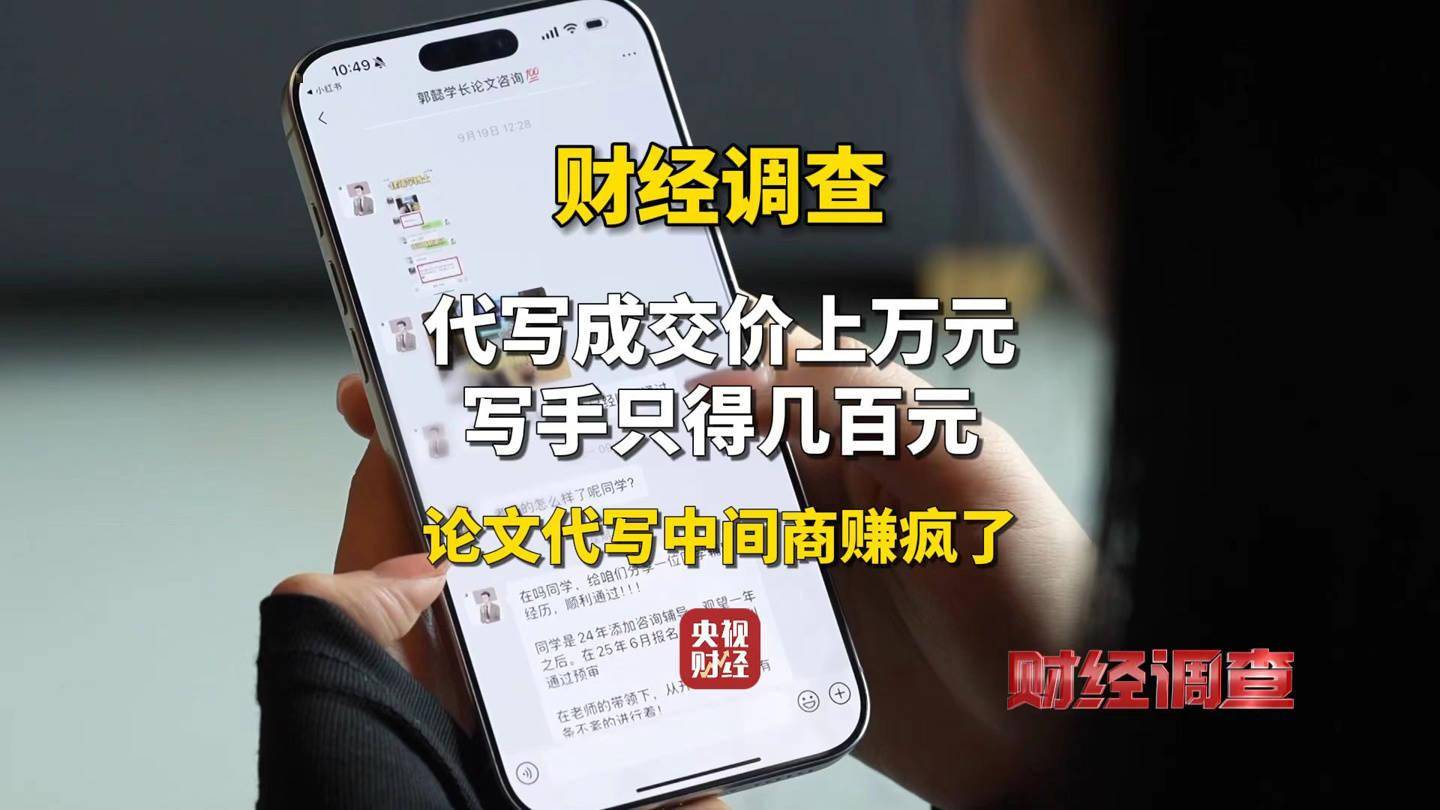
AI 一天 30 篇:央视曝光论文代写造假“流水线”与廉价写手
Sou Hu Cai Jing· 2025-10-12 13:51
Core Insights - A complete chain of academic paper fraud has formed, involving online stores, social media, AI workflows, and cross-border outsourcing, with low-cost writers producing papers that are sold for thousands of yuan [1][12] Group 1: Industry Overview - The investigation revealed a thriving gray industry of academic paper ghostwriting, which operates on the edge of legality and generates significant profits [1][12] - The industry utilizes AI tools to automate the writing process, allowing non-experts to produce papers across various disciplines quickly [7][12] Group 2: Business Operations - A company named Wuhan Zhiyu Culture Co., Ltd. disguises its ghostwriting services as "plagiarism check" products on e-commerce platforms, with a customer service representative admitting to avoiding sensitive terms in conversations [6][12] - The annual sales volume of one store exceeds 40,000 orders, and a writing group has over 1,300 members, with writers earning up to 8,000 yuan per month [5][12] Group 3: Technology Utilization - Companies employ an industrialized model of fraud, where employees fill in templates and use AI to quickly generate papers, regardless of their academic background [7][12] - AI tools can produce initial drafts in as little as five minutes, significantly increasing the efficiency of paper production [7][12] Group 4: Market Dynamics - The gray market for academic writing is expanding, with social media platforms like Xiaohongshu hosting accounts that covertly sell ghostwriting services under the guise of tutoring [9][12] - Ghostwriting services are offered at high prices, with quotes for publishing in academic journals reaching up to 30,000 yuan, promising publication without the author's involvement [10][12] Group 5: Ethical Implications - This gray industry undermines academic integrity and highlights regulatory gaps, as e-commerce platforms and social media evade scrutiny by presenting their services under misleading labels [12]
2025年大学生学术研究洞察报告
艾瑞咨询· 2025-10-06 00:06
Core Insights - Over 40% of university students plan to pursue further studies after graduation, demonstrating a strong academic enthusiasm with 92.2% seeking academic progress [1][9] - The topic of academic integrity and plagiarism detection has gained significant public attention, with discussions reaching billions of views on social media platforms [4] Academic Attitude - 69.3% of students prioritize their major courses, while 64.0% consider completing their thesis as one of the most important tasks during university [6] - 92.2% of students set academic KPIs for themselves, with 33.8% pursuing academic innovation [9] Academic Tools - More than half of the students experience anxiety related to plagiarism checks, often using multiple tools for a single paper [2][3] - 59.2% of students utilize AI tools, and 56.2% use plagiarism detection tools, indicating a reliance on technology for academic efficiency [19] Plagiarism Detection Experience - 68.6% of students rely on AI for assistance, while 62.9% consult AI when facing difficulties in writing [17][24] - 50.4% of students encounter inconsistencies in results from different plagiarism detection tools, leading to confusion [32] Academic Spending - 69.8% of students consider academic papers their primary expenditure in academic pursuits, with a higher willingness to pay for plagiarism checks among graduate students [38][40] - 86.6% believe that purchasing academic-related products or services enhances research efficiency [38] Expectations for Tools - 53.5% of students expect plagiarism detection tools to evolve with AIGC detection capabilities, and 50.4% desire document format conversion features [34] - Students are looking for comprehensive solutions that can assist in various aspects of academic writing [34]