
实物资产投资

Search documents
3 ETFs Quietly Rallying Through Market Uncertainty
ZACKS· 2026-03-30 18:45
Core Insights - The S&P 500 has declined approximately 6% year-to-date, while certain ETFs focused on real assets and tangible commodities are experiencing strong gains amidst market uncertainty [1][2] Group 1: Investment Landscape - The Iran conflict has significantly disrupted energy supply chains, leading to surging commodity prices and a renewed interest in funds that focus on physical scarcity rather than mere market expansion [2][6] - The Global X Lithium & Battery Tech ETF (LIT), Schwab US Dividend Equity ETF (SCHD), and Invesco Optimum Yield Diversified Commodity Strategy ETF (PDBC) have outperformed the market this year due to favorable market conditions [3][21] Group 2: LIT ETF Analysis - LIT ETF, which tracks the Solactive Global Lithium Index, has gained traction as consumers consider electric vehicles (EVs) due to rising fuel costs, making EVs a more attractive option [4][5] - Demand for lithium is projected to reach 3.6 million metric tonnes by 2030, more than double the levels expected in 2025, driven by policy support and supply constraints [6][7] Group 3: SCHD ETF Analysis - SCHD ETF focuses on companies with a strong history of dividend payments, primarily in energy, consumer staples, and healthcare sectors, making it a defensive investment during market volatility [9][10] - The fund has a 3.47% yield and has shown a 9.4% annualized return over the last 20 years, indicating its appeal as a rotation destination amid a flight from growth stocks [12] Group 4: PDBC ETF Analysis - PDBC ETF has risen over 30% year-to-date, actively investing in futures contracts across 14 commodities, benefiting from supply-side constraints and strong global growth [15][16] - The energy component of PDBC's portfolio has been particularly strong, with crude oil prices surging past $100 per barrel, contributing to the fund's performance [17][18] Group 5: Market Trends - The current market trend indicates a shift from intangible assets to tangible ones, as high-multiple growth stocks struggle in an environment of rising energy costs and supply disruptions [21][22] - The future trajectory of this trend will depend on the developments in the Iran conflict and its broader geopolitical implications [22]


金银大跌后摩根大通分析师坚定看多:别慌!年底黄金仍看至6300美元
Hua Er Jie Jian Wen· 2026-02-03 01:15
Core Viewpoint - The global precious metals market experienced a historic crash last Friday, with silver plunging nearly 30% in a single day and gold also seeing significant declines. Analysts attribute this to a technical liquidation caused by overcrowded positions and margin increases rather than a fundamental shift in market logic [1][4]. Group 1: Market Reaction and Data - iShares Silver Trust fell 28.5% to $75.44, marking the largest single-day drop in history, while SPDR Gold Shares dropped 10.3% to $444.95 [1]. - Silver's volatility surged to extreme levels not seen since the global financial crisis and COVID-19 lockdowns, with ETF nominal trading volume exceeding $32 billion [1]. - The Chicago Mercantile Exchange (CME) raised margin requirements, which forced many leveraged positions to liquidate before the weekend, accelerating the price drop [3]. Group 2: Institutional Analysis and Predictions - Morgan Stanley maintains a bullish outlook on gold, predicting prices could reach $6,300 per ounce by the end of 2026, driven by central bank purchases and investor demand [2]. - The bank forecasts that central bank gold purchases will reach 800 tons by 2026, as the trend of diversifying foreign exchange reserves continues [2]. - In contrast, Morgan Stanley is more cautious about silver, noting the lack of clear structural buyers like central banks, which may lead to deeper corrections compared to gold [2]. Group 3: Technical Adjustments and Market Dynamics - Goldman Sachs emphasizes that the recent sell-off should not be over-interpreted, viewing it as a technical adjustment due to overcrowded positions [4][5]. - The total exposure in the market was at an extreme level, with systematic quantitative strategies showing significant overcrowding [5]. - Despite the volatility, core trends in the market remain strong, with other asset classes like rare earths and nuclear stocks showing positive performance [5]. Group 4: Future Outlook - The macro environment is still favorable for physical assets, with Goldman Sachs highlighting the importance of the new Federal Reserve chair's appointment as a key event [6]. - Yardeni Research notes that the fundamental environment should continue to support precious metals, especially in light of recent economic indicators [6]. - Both firms agree that while short-term volatility needs to be digested, gold and silver remain effective hedges against currency devaluation and geopolitical tensions [6].


“新债王”冈拉克:美元进入长期贬值周期,将持续押注黄金及实物资产
Hua Er Jie Jian Wen· 2026-01-29 13:40
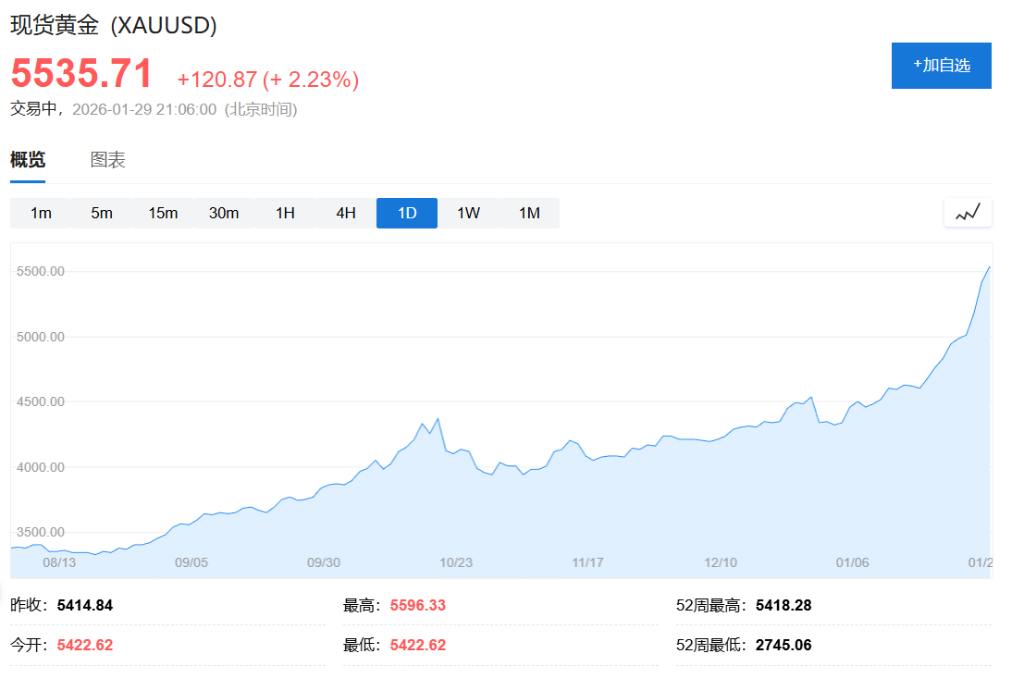
Core Viewpoint - The "New Bond King," Jeffrey Gundlach, suggests that investors should continue to bet on precious metals and a weakening dollar, believing this theme will persist in the future [1][4]. Group 1: Dollar Weakness - Gundlach has positioned his investment portfolio around the idea of structural dollar weakness for about two years, stating that even if the economy weakens, the dollar will remain weak due to long-term debt concerns [4]. - The ICE Dollar Index recently fell to a four-year low, down 2% this year and over 10% in the past year [1]. Group 2: Investment Strategy - Gundlach recommends allocating 30% to 40% of stock investments to non-dollar markets, expecting this strategy to continue yielding returns [1][4]. - Emerging market stocks and bonds have performed particularly well, providing currency conversion benefits for dollar-denominated investors during dollar weakness [4]. Group 3: Federal Reserve Policy and Inflation - Following the Federal Reserve's decision to maintain interest rates, Gundlach believes there will be no rate cuts during Chairman Powell's term, which ends in May [5]. - He emphasizes that Powell's focus on inflation and stable unemployment supports the notion that the economic outlook is not as dire as previously thought [5]. Group 4: Preference for Physical Assets - Gundlach has increased his personal investment in gold mining stocks and land, highlighting the importance of physical assets in protecting against currency fluctuations [6]. - Gold has risen 90% over the past 12 months, contrasting with the decline of Bitcoin, indicating a shift in investor interest towards tangible assets [6].
有色金属行业2026年投资策略报告:实物资产的时代:把握工业金属投资机会-20251222
CHINA DRAGON SECURITIES· 2025-12-22 10:30
Group 1 - The report maintains a "recommended" rating for the non-ferrous metals industry, highlighting the sustained improvement in metal prices amid geopolitical tensions and economic uncertainties [8][12]. - In the first eleven months of 2025, the average price of gold increased by 40.75% compared to the full year of 2024, while silver rose by 33.69%, copper by 7.25%, and aluminum by 7.96% [8][15][17]. - The non-ferrous metals industry achieved a revenue of 2.82 trillion yuan in the first three quarters of 2025, representing a year-on-year growth of 9.3%, with a net profit of 151.29 billion yuan, up 41.55% [8][20]. Group 2 - Gold is expected to continue its upward trend, driven by investment demand, as the negative correlation with long-term U.S. Treasury yields weakens, indicating a shift in gold's pricing logic [8][31]. - The demand for gold is primarily driven by jewelry, technology, investment (including ETFs), and central bank purchases, with central banks being a significant source of demand growth [38][41]. - In 2025, global gold ETFs saw inflows of 712.64 tons, the highest since 2020, indicating a shift in demand dynamics where ETF investments are becoming a major driver of gold prices [49][50]. Group 3 - The copper market is facing a supply-demand mismatch, with expectations of tightening supply due to declining ore grades and geopolitical factors disrupting supply chains [8][53]. - The International Copper Study Group (ICSG) has revised its forecast, predicting a shortage of refined copper in 2025 and 2026, indicating a shift from previous expectations of surplus [59][71]. - The anticipated recovery in demand, particularly from the U.S. and China, is expected to provide upward price elasticity for copper, with projections of a 2%-3% growth in refined copper demand in China for 2026 [71]. Group 4 - The report suggests focusing on specific companies within the gold sector, such as Zijin Mining (601899.SH), Shandong Gold (600547.SH), and Zhongjin Gold (600489.SH), due to their strong performance and growth potential [8][75]. - For copper, companies like Zijin Mining (601899.SH), Luoyang Molybdenum (603993.SH), and Western Mining (601168.SH) are recommended as they are expected to benefit from the tightening supply and recovering demand [8][75].