市场共识

Search documents
龙迅股份赴港上市,芯片股的机会在哪里?
Sou Hu Cai Jing· 2025-12-23 13:52
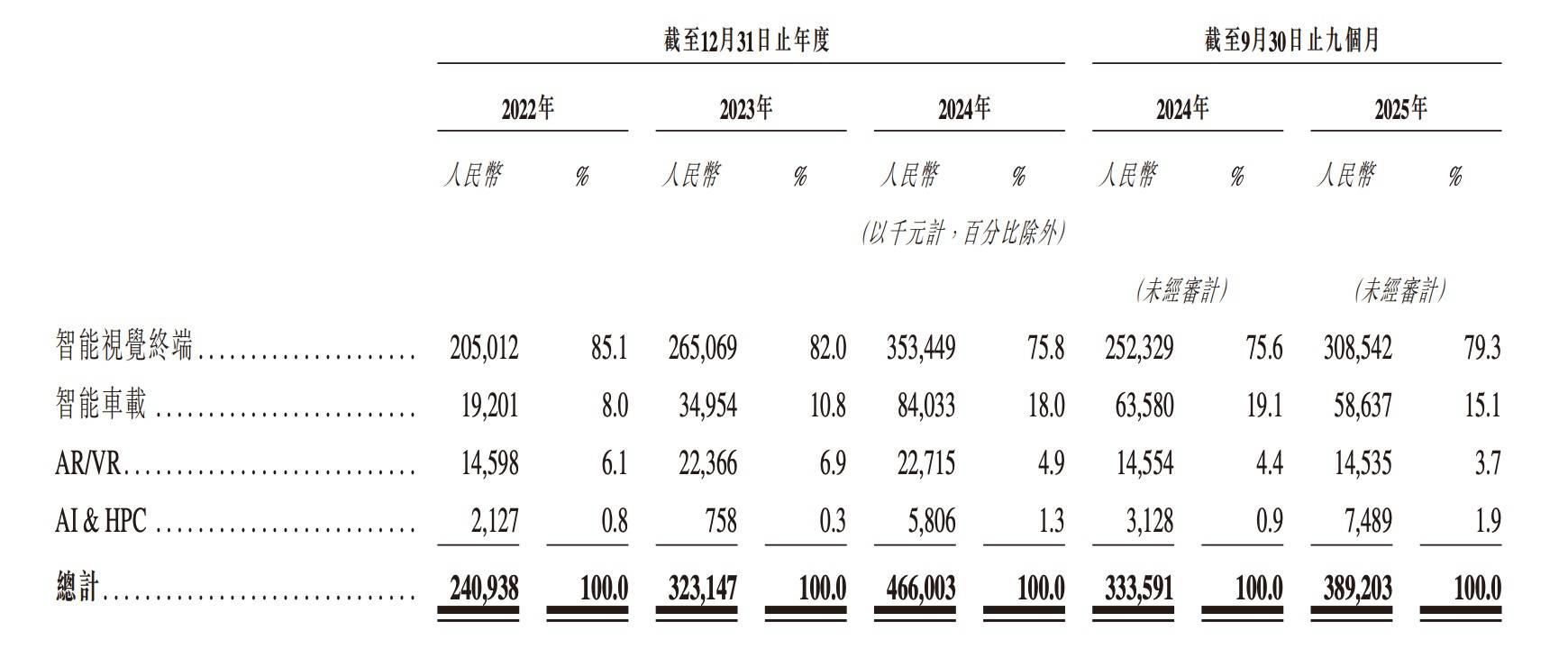
Group 1 - The core point of the article is that Longxun Co., which is already listed on the A-share Sci-Tech Innovation Board, has submitted a listing application to the Hong Kong Stock Exchange, highlighting the growing interest in technology stocks, particularly in the semiconductor sector [1] - Longxun Co. specializes in high-speed mixed-signal chips, with business coverage in popular sectors such as smart vision, automotive, AR/VR, and AI computing, showing impressive growth, especially in automotive business with a compound annual growth rate exceeding 100% [1] - The company’s revenue projections for 2022, 2023, and 2024 indicate significant growth across various segments, with total revenue expected to rise from RMB 240.94 million in 2022 to RMB 466.00 million in 2024 [3] Group 2 - The article discusses the anxiety of missing investment opportunities during bullish market trends, emphasizing that the fear of "missing out" can prevent investors from making timely decisions [4] - It highlights the importance of understanding market consensus and the role of institutional investors in driving stock price movements, suggesting that recognizing the true nature of market trends is crucial for avoiding missed opportunities [4] - The article explains that analyzing trading data can reveal the behavior of different capital groups, allowing investors to understand the underlying dynamics of market movements and make more informed decisions [5][10] Group 3 - Longxun Co.'s move to list in Hong Kong is seen as a positive signal for the entire chip design sector, but the actual impact on stock prices will depend on the attitude of institutional investors [13] - The article suggests that observing the trading behavior of institutional investors can help assess the quality of investment opportunities, distinguishing between short-term speculative trading and sustained institutional participation [13] - It emphasizes the need for investors to utilize quantitative tools to analyze market data, which can help filter out noise and enhance confidence in holding stocks amidst market volatility [13]


当全华尔街都看涨 美股危险了?
Xin Lang Cai Jing· 2025-12-22 13:21
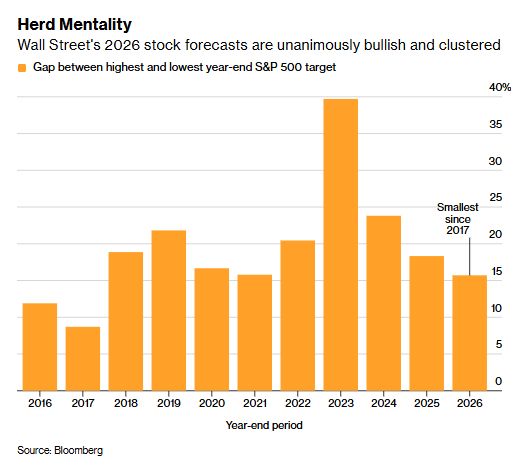
Group 1 - Wall Street analysts have a highly concentrated bullish outlook for the S&P 500 index for 2026, with predictions ranging from 7000 to 8100 points, reflecting the narrowest range in nearly a decade [1][4] - The consensus view is often seen as a contrarian indicator, suggesting that when all market participants bet in the same direction, it may lead to a self-correcting imbalance [1][4] - Despite the S&P 500 achieving double-digit gains for three consecutive years, strategists project an average increase of about 11% for 2026 [1] Group 2 - The optimistic outlook is based on expectations of economic growth driving corporate earnings, supported by anticipated tax cuts and regulatory relaxations, along with expectations of two 25 basis point rate cuts by the Federal Reserve [4] - Conversely, some analysts interpret the widespread optimism as a sign of complacency in the market, indicating potential vulnerability to negative developments [4][5] - The tradition of publishing S&P 500 index forecasts has been noted, with historical data showing that these predictions often lag behind actual market performance by about two months [5] Group 3 - Analysts express concern that a highly concentrated target for the S&P 500 indicates that market expectations are already reflected in current prices, making the market more sensitive to minor negative factors [5] - The current market optimism is seen as being built on the momentum of rising indices, which could amplify the impact of any external shocks [8] - There are ongoing concerns regarding the high concentration in the tech sector and the slower-than-expected commercialization of AI, despite recent positive developments such as rate cuts and tax proposals boosting investor sentiment [8]
30家A股分拆上市,机构早已布局完毕!
Sou Hu Cai Jing· 2025-12-07 00:13
Group 1 - The core viewpoint of the article highlights the trend of companies in the A-share market pursuing spin-off listings, with 30 companies currently in line for this process, indicating a significant shift towards independent financing for subsidiaries [2][5] - Spin-offs allow parent companies to focus on their core business while providing subsidiaries with independent financing channels, which has attracted institutional investors who are quick to capitalize on policy changes [2][5] - The article emphasizes the information asymmetry in the market, where institutional investors have the advantage of early access to signals and trends, leaving retail investors at a disadvantage [2][3] Group 2 - The biggest risk in a bull market is not a downturn but missing out on opportunities, as many investors become overly cautious after experiencing bear markets [3][5] - Market consensus plays a crucial role in bull markets, where the value of assets is often driven by the collective agreement among institutional investors [5][6] - Understanding institutional behavior is essential for retail investors, as true market intentions are often hidden behind superficial trading patterns [6][8] Group 3 - The article provides examples of specific stocks, such as Cambrian and Tibet Tianlu, to illustrate how institutional activity can signal potential price movements and the importance of monitoring these trends [8][10] - Quantitative data can help retail investors visualize capital flows, providing insights that traditional technical analysis may miss [11][13] - The relationship between spin-off announcements and institutional accumulation of shares is highlighted, suggesting that retail investors can benefit from observing these patterns [13][14] Group 4 - Recommendations for retail investors include focusing on who is buying rather than what to buy, establishing a personal observation system, and maintaining patience and emotional control in investment decisions [14]





牛市最大风险不是亏损,而是这个!
Sou Hu Cai Jing· 2025-11-14 16:50
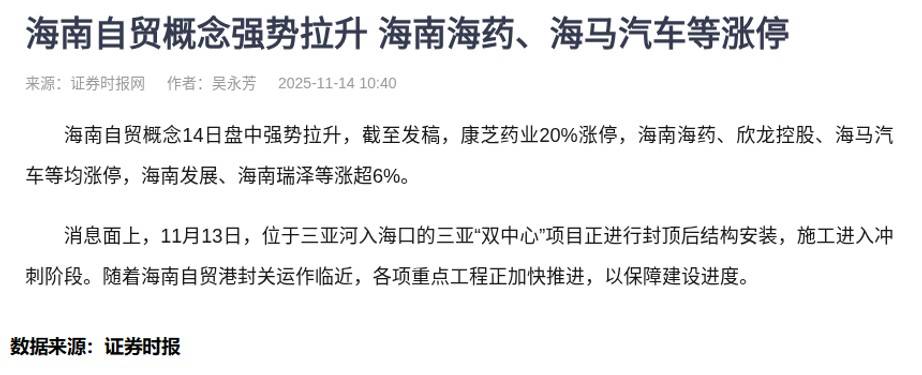
Group 1 - The core viewpoint of the article highlights the impact of policy announcements on stock prices, particularly in the Hainan sector, where stocks surged following the news of the Sanya "dual center" project completion [3] - The article discusses the phenomenon of missing investment opportunities during a bull market, emphasizing that the most frustrating experience is not losing money but rather watching good stocks rise without taking action [4] - It points out that many investors often rely on historical price trends to make decisions, which can lead to missed opportunities as current market sentiment drives stock prices [6] Group 2 - The article emphasizes the importance of understanding market behavior rather than focusing solely on price levels, suggesting that subjective perceptions of high or low prices can be misleading [7] - It illustrates how institutional investors often position themselves ahead of retail investors, highlighting the need for retail investors to be aware of institutional activity to avoid chasing prices [9] - The concept of market consensus is discussed, explaining that the belief in the value of assets like gold and Bitcoin drives their prices up, indicating that a bull market is characterized by strengthening consensus among investors [10][12] Group 3 - The article provides three keys to overcoming psychological barriers in investing: letting go of fear of heights, focusing on market behavior rather than news, and using data to inform decisions instead of relying on gut feelings [13] - It suggests that the future of the Hainan sector, driven by policies like duty-free and commercial aerospace, should be evaluated based on institutional inventory data to gauge market activity [14] - The article concludes by advocating for the use of quantitative tools to monitor market trends, emphasizing that following institutional investors can be more beneficial than relying on traditional analysis methods [15]