市场风险防控

Search documents
期货公司全力守护交易者“钱袋子”
Zheng Quan Ri Bao· 2026-02-23 16:43
Core Viewpoint - During the Spring Festival holiday, various futures companies are actively providing services and risk management to support clients, ensuring that trading activities and investor education continue despite the market closure [1][2][3]. Group 1: Risk Management and Investor Education - Futures companies are implementing comprehensive risk monitoring and investor education measures during the holiday, including multi-channel risk alerts and educational videos to guide investors in managing risks effectively [2]. - Companies like Zhong Grain Futures are enhancing risk control by sending detailed risk alerts to clients, clarifying margin adjustments, and analyzing potential risks in various sectors [1][2]. Group 2: Support for Real Economy - Several futures companies, such as Dongzheng Futures, are focusing on empowering real economy enterprises through tools like off-exchange derivatives and "insurance + futures" services, optimizing hedging strategies based on inventory and production plans [3]. - Companies are also conducting dynamic monitoring and scenario analysis of existing derivative products to ensure smooth transitions into the post-holiday market [3]. Group 3: Continuous Operations During Holiday - Despite the holiday, companies like Huishang Futures maintain operations to provide ongoing support, with staff available for risk alerts and market monitoring to assist clients in navigating market fluctuations [1][3]. - The technical departments of some firms are also working on finalizing the development of intelligent hedging models to enhance service precision for enterprises [3].
上期所再出手,调整白银套保持仓额度自动转化标准
Sou Hu Cai Jing· 2026-02-12 03:16
Core Viewpoint - The Shanghai Futures Exchange (SHFE) has implemented measures to mitigate market risks, particularly concerning silver futures, by adjusting the position limits for non-futures company members and certain foreign participants, effective from February 2026 [1][2]. Group 1: Regulatory Changes - SHFE announced that starting from the last trading day of February 2026, non-futures company members and certain foreign participants without the necessary position limits for the upcoming delivery month will have their position limits automatically adjusted to zero for that month [1][2]. - This adjustment aims to maintain stable operations of the silver market and prevent delivery risks, reflecting a proactive approach to market volatility [1][2]. Group 2: Market Conditions - The silver market is currently experiencing high volatility, leverage, and uncertainty, particularly with the upcoming Chinese New Year holiday, which poses additional risks due to differing trading schedules between domestic and international markets [3]. - As of February 11, silver prices saw significant fluctuations, with spot silver rising by 4.35% to $84.262 per ounce, while domestic futures also experienced gains [3]. Group 3: Investor Guidance - Analysts recommend that investors exercise caution during the holiday period, as various factors such as U.S. government shutdowns, policy changes, and geopolitical tensions could drive silver prices higher [4]. - It is advised that investors maintain a rational trading approach, control leverage, and consider reducing positions ahead of the holiday to mitigate potential risks associated with market volatility [5].
2月3日多家交易场所调整风控 白银涨跌停板调至19% 多品种保证金比例同步调整
Sou Hu Cai Jing· 2026-02-03 23:49
Group 1 - The core viewpoint of the news is the adjustment of risk control measures across multiple futures and precious metals trading venues in China, aimed at enhancing market risk prevention mechanisms [1][2] Group 2 - Shanghai Futures Exchange announced that starting from the settlement on February 4, 2026, the price fluctuation limit for silver futures will be adjusted to 19%, with margin requirements for hedging positions set at 20% and for general positions at 21% [1] - The Shanghai International Energy Exchange will adjust the price fluctuation limit for crude oil, low-sulfur fuel oil, and No. 20 rubber futures to 9%, with margin requirements for hedging positions at 10% and for general positions at 11%, effective from February 5, 2026 [1] - The Shanghai Gold Exchange will reduce the margin level for Ag(T+D) contracts from 26% to 23% and adjust the price fluctuation limit from 25% to 22% starting from February 3, 2026; for Au(T+D) and mAu(T+D) contracts, the margin will increase from 16% to 17% and the fluctuation limit from 15% to 16% starting from February 4, 2026 [1] - Guangzhou Futures Exchange will adjust the price fluctuation limit for platinum and palladium futures to 20% and the trading margin standard to 22%, effective from February 5, 2026 [2] - All trading venues require member units to strengthen risk prevention awareness and improve emergency response plans, urging investors to manage risks effectively and participate in market trading rationally to maintain market stability [2]
国际金价首次突破5200美元 多家机构采取措施防范市场过热风险
Xin Hua Cai Jing· 2026-01-28 03:47
Group 1 - International spot gold and COMEX gold futures have both surpassed $5200 per ounce, marking a historic high [1] - Silver futures have also seen a significant increase, with New York silver prices rising nearly 8% [1] - Market risks are accumulating, prompting institutions to enhance risk control measures [1] Group 2 - Guotou Ruijin Fund announced the suspension of subscriptions for its silver futures investment fund due to significant premium, with a premium rate of 46.02% as of January 27 [2] - Shenzhen's Luohu District reported on the operational issues of Shenzhen Jie Wo Rui Jewelry Co., emphasizing that the management is actively communicating with investors and addressing asset settlement [2] - The Shanghai Futures Exchange has implemented measures to curb excessive speculation and prevent market overheating [3] Group 3 - The Chicago Mercantile Exchange has adjusted margin requirements for certain silver, platinum, and palladium futures contracts, with new margin rates set at approximately 11% of nominal value [3] - The Bank of Thailand has limited daily online gold trading to 50 million Thai Baht and prohibited short selling to manage the Thai Baht's strength [3]
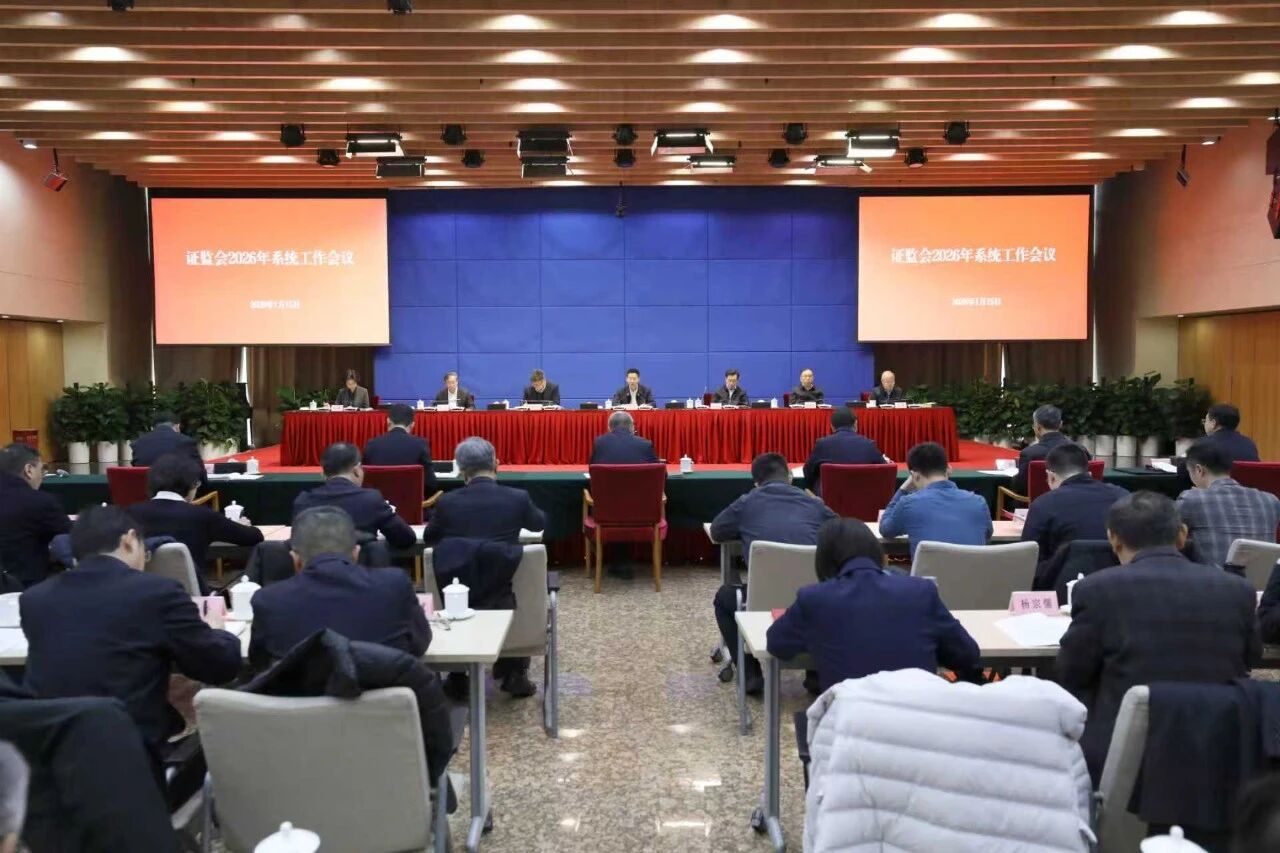
证监会工作会议部署2026:深化改革强监管 巩固市场向好态势
2 1 Shi Ji Jing Ji Bao Dao· 2026-01-17 04:03
Core Viewpoint - The China Securities Regulatory Commission (CSRC) held a meeting to summarize the past year and plan for 2026, focusing on enhancing the resilience of the capital market and addressing complex challenges to promote high-quality development in service of the national economy [1]. Review of 2025: Market Resilience and Regulatory Reforms - In 2025, the CSRC successfully promoted market development amidst multiple risks, enhancing market resilience and achieving significant breakthroughs in attracting medium- and long-term capital [4]. - The CSRC strengthened regulatory enforcement, addressing financial fraud and illegal activities in private equity funds, with 701 cases investigated and fines totaling 15.47 billion yuan [4]. - Market reforms included the introduction of the "1+6" policy for the Sci-Tech Innovation Board, the activation of a third set of standards for the Growth Enterprise Market, and the initiation of public fund reforms, with total cash dividends and buybacks reaching 2.68 trillion yuan [4]. - The IPO and refinancing totaled 1.26 trillion yuan, with bond issuance at 16.3 trillion yuan and the introduction of 18 new futures and options products [4]. Deployment for 2026: Five Key Tasks - The CSRC emphasized a focus on stability and quality improvement, outlining five key tasks for 2026 [5]. - The first task is to maintain market stability through enhanced monitoring and counter-cyclical adjustments, strict regulation of trading and information disclosure, and prevention of market volatility [6]. - The second task involves advancing reforms to improve the quality of services for high-quality development, including enhancing the inclusiveness of the multi-tiered equity market and promoting the integration of various market segments [6]. - The third task focuses on strict legal enforcement to deter serious violations such as financial fraud and insider trading, while improving regulatory capabilities through technology [6]. - The fourth task aims to strengthen the foundation for listed companies' value growth by implementing new governance standards and enhancing shareholder return mechanisms [7]. - The fifth task is to promote higher levels of openness in the market, optimizing foreign investor access and enhancing cross-border investment convenience [7].

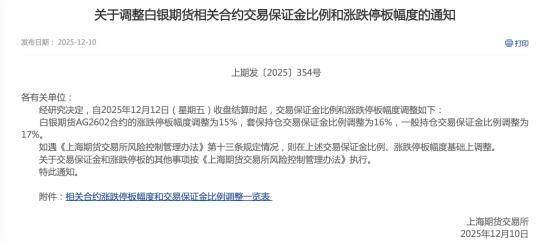
上期所上调白银期货合约保证金比例与涨跌停板幅度 防范市场过度波动
Sou Hu Cai Jing· 2025-12-11 06:51
Core Viewpoint - The Shanghai Futures Exchange has announced adjustments to silver futures contract margin ratios and price fluctuation limits to address recent market volatility and enhance risk management [1][2]. Group 1: Margin and Price Adjustments - Starting from the close on December 12, 2025, the price fluctuation limit for the silver futures AG2602 contract will increase from 14% to 15% [2]. - The margin ratio for hedging positions will rise from 15% to 16%, while the margin ratio for general positions will increase from 16% to 17% [2]. Group 2: Market Context and Price Movements - Recent international complexities have led to significant volatility in the precious metals market, prompting the exchange to advise investors to manage risks and participate in trading rationally [2]. - As of December 10, 2025, the domestic silver market reached a record high, with the main silver futures contract closing at 14,373 yuan per kilogram, reflecting a 5.44% increase [2]. Group 3: Inventory Levels and Market Risks - Global silver inventories are at historical lows, with the Shanghai Futures Exchange's silver inventory at 688 tons as of December 5, 2025, representing a more than 50% reduction for the year [3]. - The London Metal Exchange's silver inventory has decreased by approximately 75% from its peak in 2019, leading to increased liquidity risks [3]. - The New York COMEX inventory has not effectively alleviated the physical shortage issues due to cross-border transportation bottlenecks [3].
14年等待 纸白银投资者终于“解套”
Hua Xia Shi Bao· 2025-10-19 00:51
Core Insights - The silver market has experienced significant volatility, with silver prices reaching a high of $53.51 per ounce on October 16, marking an over 80% increase in 2023, surpassing gold's performance [1][3][4] - Many investors, like Mr. Wei, who have been "stuck" in paper silver investments for over a decade, are now seeing profits but still feel regret due to the opportunity cost compared to other investments like real estate [1][6][8] Market Performance - The current surge in silver prices is attributed to various factors, including the overall bullish trend in precious metals, with silver's year-to-date increase outpacing that of gold [3][4] - Historical context shows that silver prices were significantly influenced by the Federal Reserve's quantitative easing measures from 2009 to 2011, leading to a peak in 2011, followed by a prolonged bear market [4][8] Investor Sentiment - Many long-term paper silver investors are sharing their experiences on social media, highlighting the challenges they faced during the prolonged downturn and the recent price recovery [6][7] - Despite the current profits, investors like Mr. Wei express that the investment still feels like a loss when compared to other potential returns from different asset classes [1][6] Banking Sector Response - Banks have largely withdrawn from offering paper silver trading due to increased risk management measures following incidents like the "Oil Treasure" event, which highlighted the risks associated with leveraged trading [7][8] - The discontinuation of paper silver services is also attributed to the complexities of silver's supply and demand dynamics compared to gold, making it less suitable for stable investment offerings [8][9] Recommendations for Investors - Experts suggest that current paper silver holders should recognize the high volatility of silver investments and consider strategies such as gradual profit-taking to lock in gains [8][9] - Investors are advised to avoid using leverage in their trading strategies to mitigate risks associated with market fluctuations [8][9]

证监会:全力巩固市场回稳向好态势
财联社· 2025-07-25 09:04
Core Viewpoint - The China Securities Regulatory Commission (CSRC) emphasizes the need for stability and reform in the capital market amidst complex internal and external challenges, while highlighting the certainty of high-quality economic development and asset valuation recovery as foundations for a stable market [1][2]. Group 1: Market Stability and Reform - The CSRC aims to consolidate the market's recovery by enhancing market monitoring and risk response mechanisms, as well as improving expectation guidance [1]. - There is a focus on deepening reforms to stimulate the vitality of multi-level markets, including the implementation of reforms for the Sci-Tech Innovation Board and a comprehensive package of measures for the Growth Enterprise Market [1][2]. Group 2: Enhancing Corporate Value and Governance - The CSRC promotes the enhancement of investment value for listed companies, emphasizing the implementation of merger and acquisition guidelines and major asset restructuring management while preventing conflicts of interest and financial fraud [2]. - There is a push to cultivate long-term and patient capital, encouraging the entry of medium to long-term funds into the market and advancing public fund reforms [2]. Group 3: Regulatory Effectiveness and Risk Control - The CSRC aims to improve regulatory enforcement effectiveness by focusing on significant violations and enhancing collaborative regulation, while also increasing technological regulatory capabilities [2]. - Precise risk prevention measures are to be implemented in key areas of the capital market, including addressing real estate company bond defaults and illegal activities in private equity and securities [2]. Group 4: Open Capital Market - The CSRC plans to systematically research and improve the overall layout and implementation path for capital market openness, promoting coordinated development between onshore and offshore markets [2][3].