平台思维

Search documents
温江鱼凫成长营:让餐饮企业 “思维破局,行动落地”
Sou Hu Cai Jing· 2025-12-07 16:16
Core Insights - The article discusses the transformation of Chengdu Juding Longteng Catering Management Co., led by General Manager Zhou Tao, from facing challenges of heavy asset expansion and weak single-category growth to integrating resources and building a new dining ecosystem through a platform mindset [1][3]. Group 1: Challenges and Transformation - Zhou Tao, an entrepreneur with 23 years in the catering industry, faced significant challenges post-pandemic, particularly in the single hot pot sector [3]. - The training camp provided Zhou with a new understanding of the industry, emphasizing "6 redefinitions and 4 strategies" as pivotal turning points [3]. - A key breakthrough was the reconstruction of customer positioning, shifting focus from business banquets to targeting the 25-35 age group in open and naturally appealing environments [3][5]. Group 2: Business Model Innovation - The company expanded its offerings beyond hot pot to meet the all-day consumption needs of younger consumers, introducing convenient breakfast snacks, home-style dishes for lunch, barbecue and beer for night-time, and health-oriented mushroom soup hot pot [5]. - Zhou was inspired by the "lightweight strategy" to avoid heavy investments in opening new stores, opting instead to integrate resources and operate as a platform [6]. - The business adopted a revenue-sharing model with professional teams for non-core areas, reducing labor and management costs while allowing experts to handle specialized tasks [6]. Group 3: Growth Strategy and Ecosystem Development - The "13+1 business model innovation" course helped Zhou understand that expansion is about replicating successful systems rather than merely opening new locations [6]. - The company established a full-link customer acquisition system through live streaming, short videos, and private domain conversion, significantly lowering promotional costs [6]. - The diverse business model improved space utilization and mitigated operational risks associated with a single category [6]. Group 4: Collaborative and Community Approach - Zhou's team engaged in resource integration, collaborating with peers in the cultural tourism sector to leverage each other's strengths, leading to plans for opening three garden-style hot pot restaurants next year and expanding to 20 within five years at only one-fifth of traditional investment costs [8]. - The establishment of the "Longteng Catering Alliance" allowed for quick matching of dining services for cultural tourism projects, enhancing project efficiency and creating new opportunities for alliance members [8]. - The training camp instilled a culture of altruism within the company, with Zhou actively helping alliance partners improve operations, fostering stronger collaboration and ecosystem cohesion [9].


外卖大战,便宜了谁?
Tai Mei Ti A P P· 2025-12-02 02:30
Core Insights - The irrational competition in the food delivery sector is expected to transition to a more rational and mature phase, with platforms that possess deep industry insights, proven operational excellence, and sustainable high-quality growth becoming industry leaders [1] Group 1: Market Dynamics - The ongoing food delivery battle has led to significant financial losses for major players, with Meituan reporting a loss of 16 billion, Alibaba's profit dropping by 76%, and JD's net profit halving, resulting in over 77 billion burned in just one quarter [2][4][5] - The competition is characterized by a lack of unified victory standards, as the three major players (Meituan, Alibaba, and JD) are not competing on the same track, leading to a scenario where no clear winner emerges [9][14] Group 2: Company Strategies - JD initiated the competition but is now focusing on building its supply chain capabilities, with a projected loss of 34 billion in its instant retail business by 2025 [4][10] - Alibaba views food delivery as a high-frequency trigger to activate its broader e-commerce platform, aiming to enhance user engagement and overall consumption [11] - Meituan sees food delivery as a critical lifeline, emphasizing its foundational role in the company's ecosystem and its strategy to maintain market dominance [12][13] Group 3: Financial Performance - JD's net profit fell by 54.7% year-on-year to 5.3 billion, while its marketing expenses surged by 110.5% to 21.1 billion due to increased promotional activities [4] - Alibaba's adjusted EBITA dropped from 44.3 billion to 10.5 billion, primarily due to a significant reduction in flash sales [5] - Meituan's core local business revenue decreased by 2.8%, resulting in a loss of 14.1 billion, equating to a daily loss of 1.5 billion [6] Group 4: Future Outlook - The three companies have signaled a shift towards efficiency and strategic focus, with terms like "reduction," "unsustainable," and "strategic focus" being commonly used [15][17] - The future of the food delivery market will likely involve smarter subsidy strategies, with a shift from indiscriminate coupons to targeted promotions, and a focus on high-value user engagement [19][20]



京东要做灶王爷?
3 6 Ke· 2025-07-25 01:42
Group 1 - JD.com plans to open 10,000 "Seven Fresh Kitchen" stores nationwide, focusing on freshly cooked meals with a cash investment of 1 billion yuan and recruiting 1,000 signature dish partners [1][2] - The company aims to leverage its established supply chain capabilities to redefine the food delivery market, addressing issues such as high platform fees and food safety concerns [2][5] - By collaborating with major food companies for centralized sourcing and processing, JD.com intends to reduce food waste and lower costs, with waste rates potentially dropping below 5% [3][4] Group 2 - The introduction of robotic cooking aims to enhance efficiency and standardization in food preparation, although it raises questions about taste consistency and user satisfaction [5][6][7] - JD.com's "dish partner" model seeks to empower chefs while potentially shifting control of the cooking process to the platform, which may redefine the value of chefs in the industry [8][10] - The strategy involves a combination of centralized kitchens, community stores, and robotic cooking to gradually shift control from chefs and restaurant owners to JD.com [9][11] Group 3 - The scalability of this model across different regions is uncertain, as local tastes, supply chain logistics, and regulatory environments vary significantly [12][13] - Competitors like Meituan and Ele.me are also innovating in the food delivery space, utilizing local merchant flexibility and technology to respond to regional demands [14][15][16] - JD.com's ambitious plan may face challenges in execution speed and adaptability to regional differences, raising questions about its long-term viability in the food service industry [17]
超500亿元资金涌入债券ETF 公司债ETF易方达(511110)规模破80亿
Sou Hu Cai Jing· 2025-05-12 04:14
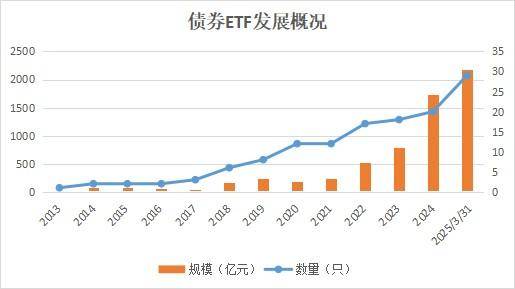
Core Insights - The bond ETF market in China has seen significant growth, with over 50 billion yuan in net inflows this year, bringing the total scale to over 250 billion yuan [1][2] - The number of bond ETFs has increased to 29, with a total scale of approximately 220 billion yuan, which is nine times the scale in 2021 [2][4] - Credit bond ETFs have become a prominent category, with their scale exceeding 110 billion yuan, accounting for 44% of the total bond ETF market [5][6] Group 1: Market Growth and Trends - The bond ETF market has experienced explosive growth since 2022, with new products like government bonds and corporate bonds emerging [2][4] - The development of bond ETFs is driven by policy support and market demand, making them an essential tool for asset allocation [4][6] - The introduction of benchmark corporate bond ETFs has attracted significant capital, with nearly 20 billion yuan in net inflows since their launch [6] Group 2: Investment Characteristics - Bond ETFs are characterized by high trading efficiency, low investment costs, high transparency, and good liquidity, making them attractive for investors [4][5] - The average turnover rate of benchmark corporate bonds is 2.5 times that of ordinary corporate bonds, indicating strong market activity [5] Group 3: Future Development Strategies - The development of bond ETFs requires an ecological approach and platform thinking, emphasizing the need for a diverse product system and mature investor base [7][8] - The industry is focusing on optimizing management efficiency and enhancing pricing accuracy for bond ETFs [8]