战略属性

Search documents
商品板块轮动 现在到哪个阶段了?
Qi Huo Ri Bao· 2026-02-12 00:20
Core Insights - The commodity market is transitioning from a "broad increase" to "structural differentiation," with funds shifting towards undervalued sectors with solid fundamentals [1][3] - The historical divergence between "green metals" (copper, lithium, nickel) and traditional energy (crude oil, coal) has become a defining feature of the current market [3][4] - The current commodity cycle is characterized by a unique combination of financial and strategic attributes, driven by structural narratives rather than traditional economic growth [7][12] Market Dynamics - The supply-demand relationship for green metals is tight due to rigid supply and explosive demand, while traditional energy faces relaxed supply and slowing demand [3][4] - The global supply chain is shifting from "efficiency-first" globalization to "security-first" regionalization, impacting commodity pricing and availability [4][20] - Recent price movements, such as a 30% increase in LME copper prices in January 2026, reflect the new characteristics of the market [4] Historical Context - The current commodity cycle shows similarities to the 1970s, with a focus on the restructuring of the global monetary system and ongoing supply chain disruptions [11][12] - The previous commodity supercycle was driven by China's industrialization and urbanization, while the current cycle is influenced by AI infrastructure and green transitions [7][12] Investment Opportunities - Investors are advised to focus on the fundamental differences among commodities to identify structural opportunities [4][13] - Key commodities to watch include zinc, wheat, iron ore, and platinum, which are expected to perform well in the current market environment [15][24] - The chemical sector is anticipated to see growth due to domestic policy changes and supply optimization, with specific attention to products with strong export expectations [14] Future Outlook - The commodity market is expected to continue exhibiting significant differentiation, with traditional rotation patterns being disrupted [13][24] - The focus on strategic resources like gold, silver, copper, and tin is likely to lead to a scenario where these commodities experience upward price pressure while others may lag [24]
白银腰斩后反弹30%,谁在抄底?
3 6 Ke· 2026-02-11 11:43
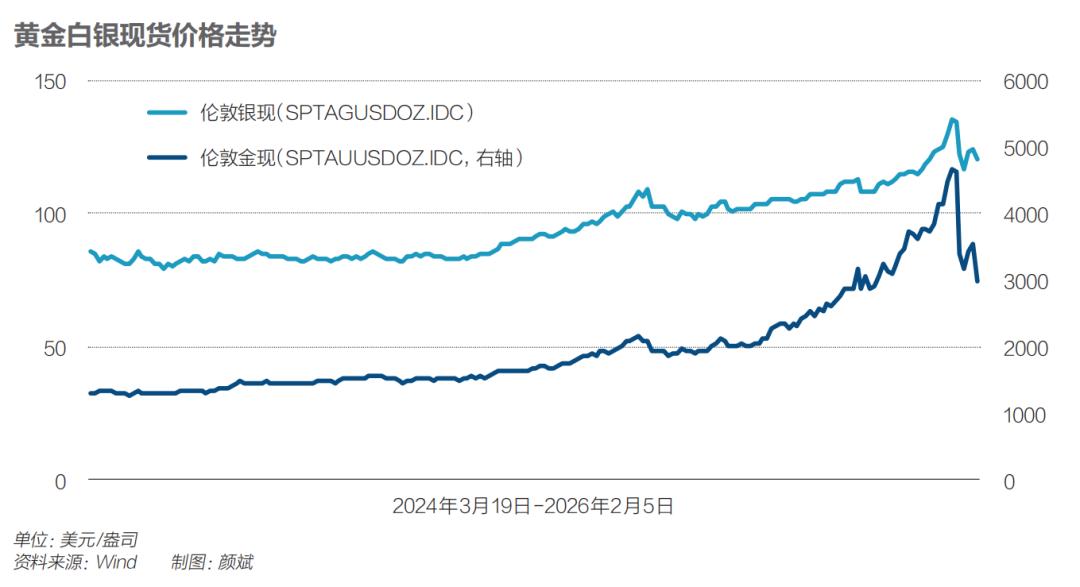
Core Viewpoint - The silver market experienced extreme volatility in early 2026, with prices soaring to a historical high of $121.65 per ounce before plummeting by over 36% in a single day, marking the largest daily drop in nearly 40 years. This volatility was driven by speculative trading and macroeconomic factors, particularly the nomination of Kevin Warsh as the next Federal Reserve Chair, which shifted market sentiment dramatically [1][9][10]. Group 1: Price Movements and Market Dynamics - On January 29, silver prices reached $121.65 per ounce, reflecting a more than 67% increase within a month, but subsequently fell to $64 by February 6, nearly halving from the peak [1][2]. - The National Investment Silver LOF (161226) saw a net value drop of 31.5% on February 2, the largest single-day decline for a domestic public fund [1][11]. - The silver market's liquidity issues and high leverage contributed to a rapid price decline, as programmatic trading exacerbated the situation when investor sentiment shifted [1][10]. Group 2: Supply and Demand Factors - Investment demand significantly reduced the available circulating silver, leading to a structural supply shortage that drove prices up sharply. Once investment funds withdrew, the market faced an oversupply, causing prices to crash [2][16]. - The silver market's supply is constrained by rigid short-term production capabilities and delayed recycling processes, which limits the elasticity of physical supply [2][16]. Group 3: Speculative Trading and Market Sentiment - The silver market was characterized by extreme speculative trading, with the silver-to-gold price ratio deviating significantly from historical norms, indicating overvaluation [3][10]. - Social media platforms played a crucial role in driving retail investor interest, with many new investors engaging in silver trading without fully understanding the associated risks [6][12]. Group 4: Historical Context and Future Outlook - The recent price collapse mirrors historical events, such as the 1980 silver crash, where speculative trading led to dramatic price corrections [3][10]. - Analysts suggest that the silver market may enter a phase of rebalancing, where industrial demand and strategic value will play a more significant role in price determination, moving away from speculative influences [21][22].