战略性资产配置

Search documents
国泰海通:市场波动加剧 建议2月超配AH股、美股、原油与工业商品
智通财经网· 2026-02-05 22:38
Core Viewpoint - The liquidity crisis is intensifying market volatility, accelerating the repricing of major asset classes, while global equities and commodities may still present performance opportunities. The recommendation is to overweight AH shares, US stocks, crude oil, and industrial commodities in February [1][2]. Group 1: Strategic Asset Allocation Framework - The company has developed an "all-weather" asset allocation framework consisting of Strategic Asset Allocation (SAA), Tactical Asset Allocation (TAA), and Major Event Review Adjustments to guide investment decisions [2]. - SAA aims to diversify macro risks and set long-term allocation benchmarks to ensure portfolio robustness, while TAA uses quantitative methods to identify assets with superior short-term risk-return characteristics and adjusts portfolio weights accordingly [2]. - The final step involves subjective review of major events to calibrate and supplement quantitative results [2]. Group 2: Equity Asset Recommendations - Multiple factors support the performance of Chinese equities, recommending an overweight in A/H shares. The upcoming economic work conference and the expectation of further expansion in the broad deficit suggest a more proactive economic policy [3]. - The Federal Reserve is expected to lower interest rates in December, and the stable appreciation of the RMB provides favorable conditions for monetary easing in early 2026, enhancing market risk appetite [3]. - The "Goldilocks" scenario is emerging, favoring US stock performance, with the US economy showing resilience despite marginal cooling, and corporate earnings expectations potentially supporting upward movement in US stock indices [3]. Group 3: Bond Asset Recommendations - The recommended bond allocation weight for February 2026 is 35.00%, including long-term and short-term government bonds [4]. - Structural monetary policy may strengthen the allocation to government bonds, as the imbalance between financing demand and credit supply remains a reality, but the trend of rising risk appetite may lead to a rebalancing of asset allocations [4]. - The US economy is cooling but not stalling, with a moderate decline in the labor market and favorable conditions for reducing inflationary pressures, suggesting a potential decline in US Treasury yields [4]. Group 4: Commodity Asset Recommendations - The recommended commodity allocation weight for February 2026 is 12.50%, with an overweight in crude oil and industrial commodities [5]. - The geopolitical situation in the Middle East is intensifying, suggesting an overweight in crude oil, as global demand remains relatively weak, and OPEC+ has decided to continue production cuts [5]. - Demand expectations for industrial commodities are being revised upward, with structural demand driven by construction, electric grids, and electric vehicles, indicating a potential supply-demand imbalance for industrial metals like copper [5].

国内金饰克价突破1600元
21世纪经济报道· 2026-01-28 01:59
Core Viewpoint - The article discusses the significant rise in gold prices, with spot gold surpassing $5,200 per ounce and reaching $5,220, marking an increase of over $880 this month, which is more than 20% [1]. Gold Price Trends - As of January 28, spot gold reached $5,221.810, with a daily increase of $40.062 or 0.77% from the previous close of $5,181.748 [2]. - The highest price recorded was $5,224.020, while the lowest was $5,156.570 [2]. Domestic Market Impact - The surge in international gold prices has led to domestic gold jewelry prices rising, with major brands quoting prices above ¥1,600 per gram. For instance, Chow Sang Sang reported ¥1,614 per gram, an increase of ¥37 from ¥1,577 on January 27 [2][3]. - Other brands like Lao Feng Xiang and Lao Miao quoted prices of ¥1,620 and ¥1,612 per gram, respectively [2]. Factors Driving Gold Prices - Analysts attribute the current surge in gold prices to strategic asset allocation by central banks, particularly as the Federal Reserve enters a rate-cutting cycle, reducing the attractiveness of dollar-denominated assets [3]. - Geopolitical risks, including tensions surrounding Greenland and the situation in Iran, are also contributing to increased demand for gold as a safe-haven asset [3]. Future Outlook - Goldman Sachs has raised its year-end gold price target from $4,900 to $5,400 per ounce, citing growing demand from private investors and central banks [4]. - Predictions for gold prices suggest a potential increase of 10% to 35% by 2026, with some forecasts reaching as high as $6,600 per ounce [4].





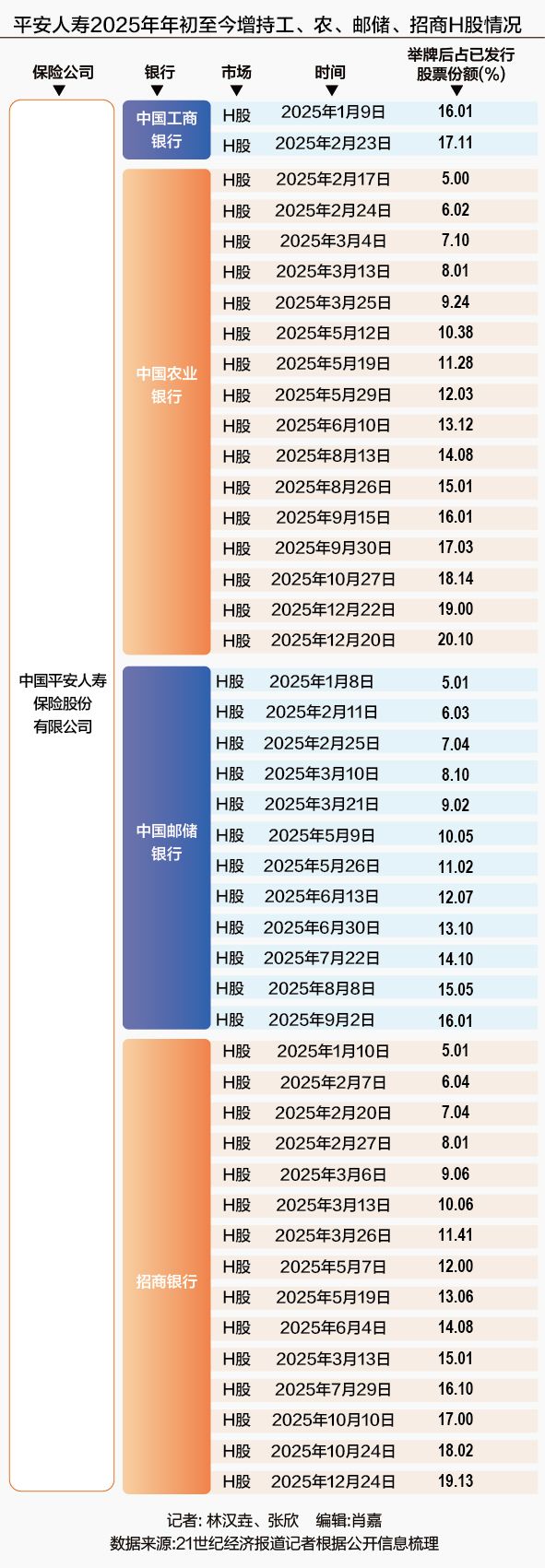
密集增持!平安人寿2025年大举“扫货”银行H股,最爱是农行
2 1 Shi Ji Jing Ji Bao Dao· 2026-01-06 07:36
Core Viewpoint - In 2025, Ping An Life Insurance Company significantly increased its holdings in major bank stocks, particularly Agricultural Bank of China (ABC), reflecting a strategic preference for high-dividend, undervalued financial assets in a declining interest rate environment [1][8]. Group 1: Investment Actions - Ping An Life conducted a total of 16 purchases of ABC H-shares throughout 2025, raising its stake from 5% to 20.10%, an increase of over 15 percentage points within a year [2][6]. - The company also made 2, 12, and 15 purchases of Industrial and Commercial Bank of China (ICBC), Postal Savings Bank, and China Merchants Bank H-shares respectively, indicating a concentrated investment strategy [1][2]. - Notably, on May 12, 2025, Ping An acquired approximately 147 million shares of ABC, pushing its holding to 10.38%, and on December 30, 2025, it added about 95.58 million shares, concluding the year with a total of approximately 4.618 billion shares [2][6]. Group 2: Strategic Rationale - Analysts suggest that Ping An's aggressive accumulation of state-owned bank H-shares reflects a broader trend among long-term investors favoring high-dividend, low-valuation financial assets [8][9]. - The preference for bank stocks is attributed to their low valuations and high dividend yields, aligning with the investment goals of insurance funds seeking stable long-term returns [8]. - Ping An's strategy is further supported by the observation that many bank stocks were trading below their net asset values, allowing for potential accounting gains when held above certain thresholds [9].



国泰海通|策略:10月超配权益与黄金,标配债券
国泰海通证券研究· 2025-10-15 13:11
Core Viewpoint - The report suggests that rising geopolitical uncertainties may temporarily increase volatility in global equity markets, while Chinese equity assets and gold may still present performance opportunities. It recommends increasing holdings in AH shares and gold in October, while maintaining a standard allocation to bonds [1]. Group 1: Strategic Asset Allocation (SAA) - The framework consists of Strategic Asset Allocation (SAA), Tactical Asset Allocation (TAA), and Major Event Review Adjustments, aimed at guiding investment decisions [1]. - SAA is designed to diversify macro risks and set long-term allocation benchmarks to ensure portfolio robustness [1]. Group 2: Tactical Asset Allocation (TAA) - The report is optimistic about Chinese equities, recommending an equity allocation weight of 41.25% for October, with overweight positions in A-shares and Hong Kong stocks [2]. - The report indicates that geopolitical uncertainties may create buying opportunities in the Chinese market, suggesting that the current market adjustments are not the end of the upward trend [2]. Group 3: Bond Allocation - The report maintains a neutral stance on bonds, recommending a bond allocation weight of 45% for October, with standard allocations to both long-term and short-term government bonds [3]. - It notes that the imbalance in credit supply and demand, along with stable liquidity, continues to support the bond market [3]. Group 4: Commodity Allocation - The report expresses a neutral to optimistic view on commodities, recommending a commodity allocation weight of 13.75% for October, with an overweight position in gold [3]. - It highlights that gold prices have recently surged past key resistance levels, supported by factors such as Federal Reserve rate cuts and ongoing geopolitical tensions [3].


“现在就像70年代!” 达利欧:买更多黄金
华尔街见闻· 2025-10-08 11:23
Group 1 - The core viewpoint is that investors should allocate up to 15% of their portfolios to gold, as it serves as a better hedge compared to the US dollar, especially in the current economic climate reminiscent of the 1970s [2][7][15] - Gold prices have surged over 50% this year, reaching approximately $4,000 per ounce, with futures hitting $4,071 [8][11] - The current economic environment is characterized by rising government debt, geopolitical tensions, and a weakening dollar, making gold a strong store of value [14][15] Group 2 - Dalio expresses skepticism about the speculative nature of AI investments, likening it to historical bubbles, but sees opportunities in companies leveraging AI for efficiency [4][17][18] - Despite concerns about valuations, Dalio will not short large tech companies, indicating a cautious but optimistic stance on the sector [19] - Analysts from Goldman Sachs and other firms are bullish on gold, with predictions for prices to rise to $4,900 by December 2026, suggesting a significant role for gold in investment portfolios [22]

国泰海通|策略:风险偏好改善支撑全球权益配置价值
国泰海通证券研究· 2025-08-11 14:15
Core Viewpoint - The article maintains a tactical overweight view on A-shares and US stocks for August, driven by improving market risk appetite and expectations of economic growth [1][2]. Group 1: Market Conditions - Recent improvements in market risk appetite have led to risk assets significantly outperforming safe-haven assets, with equities outperforming commodities and bonds [1]. - The expectation of continued economic growth and government support for capital markets is leading to a highly optimistic outlook for A-shares [1]. - The US stock market is viewed positively due to a reduced probability of recession and increasing chances of interest rate cuts [1]. Group 2: Asset Allocation Strategy - The current low-interest-rate environment necessitates higher demands for asset allocation research, with a long-term trend of increased institutional investment in capital markets [1]. - A strategic asset allocation (SAA) plan has been constructed based on macro factors, achieving an annualized return of 9.1% and a Sharpe ratio of 1.57 as of the end of July [1]. - The proposed strategic benchmark allocation is set at 45% for equities, 45% for bonds, and 10% for commodities, with a deviation limit of 10% [1]. Group 3: Tactical Asset Allocation (TAA) - The improvement in risk appetite is identified as a core factor influencing the current tactical asset allocation, with multiple factors expected to support continued strong performance in equity assets [2]. - The TAA plan projects an annualized return of 55% by 2025, with a high Sharpe ratio of 1.65 based on full sample backtesting [2]. Group 4: Specific Allocation Recommendations - For August, the recommended allocation is 55% in equities, 40% in bonds, and 5% in commodities [3]. - A positive outlook is maintained for A-shares and Hong Kong stocks due to stable economic growth expectations and government support [3]. - Caution is advised regarding government bonds due to pressures from market risk appetite and capital redemption [3]. - The outlook for commodities, particularly oil, remains cautious due to supply and demand pressures [3].