房地产市场供需失衡

Search documents
北大教授姚洋:不是老百姓没钱买房,是房价没跌到位不敢买
Sou Hu Cai Jing· 2026-02-18 10:17
Group 1 - The core argument presented by Professor Yao Yang is that the speed of housing price adjustments is too slow, leading to hesitation among the public regarding home purchases. He believes the fundamental issue is not a lack of funds among ordinary citizens, but rather that housing prices have not fallen to acceptable levels [1][3][5] - The continuous rise in housing prices has diminished the enthusiasm of the public for home buying, resulting in a market activity level that is far below expectations. Despite various government policies aimed at controlling prices, the root problems remain unaddressed, leading to a persistent supply-demand imbalance [5][12][14] - The soaring housing prices have contributed to social inequality, making home ownership increasingly unattainable for middle and low-income families. This situation has forced many families to rent long-term or face homelessness, causing significant distress [9][10][12] Group 2 - Professor Yao Yang challenges traditional economic theories by suggesting that the fluctuations in housing prices are the primary factor influencing buyers' decisions, rather than just their economic conditions. He posits that a decline in prices could stimulate market activity by changing buyer expectations [18][21][23] - The profitability of real estate investments has diminished as housing prices have surged, leading many investors to withdraw from the market. This has created a situation where even those needing housing are overwhelmed by high prices, resulting in increased pressure on families [26][28][30] - Government measures to control the housing market, such as increasing down payment ratios and tightening loan conditions, have had limited effectiveness and have not fundamentally resolved the supply-demand issues. The market is transitioning from a phase of prosperity to one of deep adjustment, presenting future challenges [30][32][35]



Redfin's Fairweather on Why Unsold Properties are Leaving the Housing Market
Youtube· 2025-11-30 21:15
Core Insights - The housing market is experiencing a stalemate where sellers are withdrawing listings due to high prices and mortgage rates, while buyers are unable to afford homes at these prices [2][3][15] Supply and Demand Dynamics - Sellers are taking homes off the market at the fastest pace in nearly a decade, primarily because they are unwilling to lower their asking prices [1][2] - Active listings are up, but true supply is tighter than it appears, as many homes are overpriced and sellers are not negotiating [8][9] - In markets like Florida and Texas, sellers are more likely to withdraw listings due to price competition, while in areas like New York, sellers are satisfied with offers and keep their homes on the market [6][7] Buyer Behavior - Buyers are increasingly opting to rent instead of purchasing homes due to affordability issues, leading to a decrease in demand [8][12] - The escrow period often leads to complications that can cause deals to fall apart, as buyers may discover additional costs that sellers are unwilling to cover [12][13] Interest Rates and Market Movement - A reduction in interest rates would likely help align the interests of buyers and sellers, as sellers are holding out for higher prices to offset the impact of high rates on their next home purchase [15][16] - Current interest rates are still too high to significantly stimulate market activity, with a need for rates around 5% for a meaningful change [16]


现在150万的房子,10年后还能值多少钱?马光远二句话说透
Sou Hu Cai Jing· 2025-10-27 20:38
Core Viewpoint - The era of real estate as the best investment has ended, and housing will return to its residential attribute, indicating potential downward pressure on housing prices to align with local residents' income levels [1] Group 1: Market Conditions - The Chinese real estate market faces a long-standing supply-demand imbalance, with a total of 600 million existing homes, theoretically capable of accommodating 3 billion people, while 96% of families own at least one property [4] - The phenomenon of "unfinished buildings" is causing a severe trust crisis, as tight financing and poor sales lead to project stoppages, further eroding buyer confidence and increasing the risk of price declines [3] Group 2: Demand Dynamics - Rigid housing demand is shrinking, with urbanization at 64% and an aging population that largely already owns homes, reducing the potential for new buyers [6] - The declining marriage rates among younger generations and a drop in newborns to 9.65 million last year are expected to significantly reduce the demand for new homes [6] Group 3: Affordability Issues - Residents' income levels are insufficient to support high housing prices, with average prices rising from 2,000 yuan per square meter in 1998 to a peak of 11,000 yuan per square meter, a 5.5-fold increase, while many families struggle with mortgage burdens [7] - As of September 2023, 99 cities have reported declines in second-hand housing prices, with over 90 cities experiencing price drops for four consecutive months, prompting government interventions to stimulate the market [8]
抛售潮迟迟一直没能出现?更令人心酸的是,有人已经开始断供了
Sou Hu Cai Jing· 2025-10-27 20:15
Core Insights - The current real estate market is facing significant challenges, with many homeowners opting to continue paying high mortgage rates rather than selling their properties at a loss [1][3][4] - Despite a continuous decline in second-hand housing prices, a large-scale selling wave has not materialized, leading to a phenomenon of "wait-and-see" among buyers and sellers [7][8] Market Data - As of August 2025, the second-hand housing price index in 70 major cities has dropped for 18 consecutive months, with an average decline of 9.6% [1] - The number of second-hand homes listed for sale increased by only 3.2% year-on-year in the first half of 2025, significantly below the expected growth of over 10% [1] Homeowner Behavior - Many homeowners prefer to endure high mortgage payments rather than sell at a loss, with some believing that the market will recover in the future [3][8] - A survey indicated that 87.3% of respondents feel that owning a home provides a sense of security, and 73.2% would not easily sell their homes even if prices drop [8] Mortgage Default Risks - The personal mortgage non-performing loan ratio has risen from 0.3% in 2023 to 0.9% in the second quarter of 2025, indicating increasing financial strain on homeowners [3] - Approximately 1.5% of the total personal housing loan balance of 38.5 trillion yuan is at risk of default, suggesting over 57 billion yuan in potential mortgage defaults [3] Regional Variations - The phenomenon of mortgage defaults is more pronounced in third- and fourth-tier cities, with some areas reporting default rates close to 5% [4][5] - Developers in these regions are offering solutions like "old-for-new" exchanges to alleviate the pressure on homeowners [5] Banking Sector Response - Banks are providing assistance to borrowers facing temporary repayment difficulties, including options for deferred payments and adjusted repayment plans [7] - Legal measures are being considered for those who maliciously default on their mortgages [7] Future Market Outlook - The real estate market is expected to shift from a focus on buying and selling to providing comprehensive living services, as indicated by industry experts [12] - The need for a return to the fundamental residential nature of housing, moving away from excessive financialization and speculation, is emphasized [12]
房价的迷思:那些被资本收割的中产与挣扎求存的刚需
Sou Hu Cai Jing· 2025-08-31 11:32
Group 1: Market Overview - The Chinese real estate market is undergoing a profound value reassessment, with significant disparities in property value appreciation and depreciation across different regions and timeframes [1][4][9] - In Chengdu, new housing supply has increased by 28% in recent years, indicating a clear trend of oversupply, although supply has decreased by 12% year-on-year in the first eight months of this year [2][4] - The vacancy rate in third and fourth-tier cities is as high as 21.3%, with inventory expected to take at least five years to be absorbed, contrasting with the relatively stable prices in core areas of first-tier and strong second-tier cities [4][9] Group 2: Economic and Policy Impacts - The high interest rates maintained by the central bank significantly increase repayment pressure on homebuyers, with a 100 million yuan mortgage resulting in monthly payments that are 1,200 yuan higher compared to lower interest periods [4][5] - The government is shifting its real estate policy from "stimulus" to "support," with various local policies aimed at easing purchasing conditions, such as the relaxation of purchase restrictions in Beijing and Shanghai [7][8] - The introduction of 6 million affordable housing units over the next five years is expected to divert demand from the commercial housing market, further pushing prices towards reasonable levels [11] Group 3: Changing Consumer Behavior - Economic uncertainties and income instability are major factors affecting homebuying decisions, with many high-position buyers facing monthly payments that exceed 70% of their income [5][9] - The changing demographic landscape, particularly the decline in the population of potential homebuyers, is reshaping market dynamics, with younger generations increasingly questioning the value of homeownership [9][11] - Market expectations are shifting, with recent policy changes boosting buyer confidence, leading to increased transaction volumes in certain areas while high-end property demand is declining [8][9]

美国6月成屋销售回落至近15年来最低水平,房价再创历史新高
Hua Er Jie Jian Wen· 2025-07-23 21:04
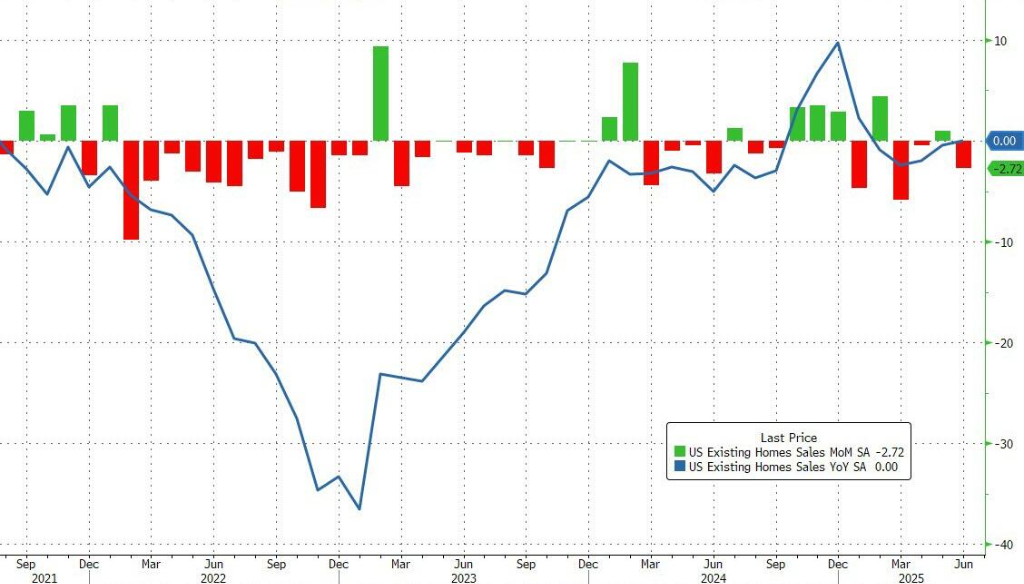
Core Insights - The U.S. real estate market is experiencing a significant disconnect, with home sales plummeting due to high borrowing costs and economic uncertainty, while home prices are reaching record highs [1][3] - The National Association of Realtors (NAR) reported a 2.7% year-over-year decline in existing home sales in June, totaling an annualized rate of 3.9 million units, the lowest since September of the previous year [1] - Despite the drop in sales, the median home price increased by 2% year-over-year to a record $435,300, indicating persistent high prices amid weak demand [1][3] Supply and Demand Dynamics - A fundamental reason for high home prices is the prolonged supply shortage, as residential construction has not kept pace with population growth [3] - Although the inventory of homes for sale has increased recently, the sales slowdown has resulted in a supply level of 4.7 months, the highest since July 2016, failing to alleviate the supply-demand imbalance [3] - Many homeowners who locked in low mortgage rates during the pandemic are reluctant to sell, further constraining the supply of existing homes [3] Impact of High Interest Rates - Persistently high mortgage rates are a key factor suppressing sales activity, with many potential buyers unable to afford the current prices [5] - A brief decline in rates earlier in the year did not sustain, as rates rose again following economic announcements [5] - If mortgage rates were to drop to 6%, an estimated 160,000 renters could transition to first-time homebuyers, highlighting the sensitivity of demand to interest rate changes [5] Market Outlook - Economists generally foresee a bleak outlook for a recovery in the U.S. real estate market within the year, with expectations of continued stagnation [6] - Additional macroeconomic factors, such as high mortgage rates, affordability issues, a weak labor market, and uncertainty about future financial conditions, are contributing to the demand slowdown [7] - Potential policy changes, including proposals to eliminate capital gains tax on home sales, add further uncertainty to the market [7]
买家观望,卖家惜售:澳洲楼市正卡在十字路口
Sou Hu Cai Jing· 2025-04-28 06:12
Core Viewpoint - The Australian real estate market is showing signs of cooling as the 2025 federal election approaches, with increasing cost of living pressures and a decline in auction clearance rates, which have dropped to 64.2%, the lowest since mid-December 2024 [1][3]. Auction Market Dynamics - Sydney's preliminary clearance rate has decreased to 66.2%, while Brisbane recorded a low of 47.1%, the lowest in two years. Melbourne's clearance rate is relatively stable at 67.6%, but still indicates reduced market activity compared to earlier in the year [3][5]. - The overall number of properties sent to auction has declined, with clearance rates falling across most cities except Melbourne, reflecting a growing wait-and-see attitude among buyers and sellers [1][3]. Buyer Sentiment Analysis - Despite a temporary boost from the Reserve Bank of Australia's (RBA) interest rate cut in February 2025, buyer confidence has weakened, as indicated by declining auction clearance rates [3][7]. - Factors affecting buyer sentiment include policy uncertainty due to the upcoming federal election, which typically leads to a 5%-10% short-term decline in buying activity [9]. - Rising living costs, with key expenses like food and energy increasing over 5.6% year-on-year, are further straining household budgets and suppressing purchasing power [11]. Price Resilience - Despite declining auction clearance rates, property prices in major Australian cities are still experiencing slight increases, with the national residential price index rising 0.6% in March 2025 [14]. - The ongoing structural supply-demand imbalance, characterized by a significant drop in new residential approvals (down 8.4% year-on-year), continues to support price levels [14][15]. - Low holding costs for homeowners, who have locked in low mortgage rates, contribute to reduced selling pressure, particularly in core urban areas [14][15]. Future Outlook - The trajectory of the Australian real estate market will largely depend on monetary policy and political developments, with expectations of another interest rate cut by the RBA in May 2025 [17]. - The outcome of the federal election could significantly influence market sentiment, with potential policy changes impacting supply and demand dynamics [17]. - Long-term fundamentals such as population growth and urbanization will continue to support the market, especially in major cities where quality housing remains scarce [18].