房地产政策利好

Search documents
房多多纳斯达克合规进展受关注,行业政策利好但竞争激烈
Xin Lang Cai Jing· 2026-02-16 18:20
Recent Events - Company is currently addressing compliance issues with Nasdaq regarding shareholder equity, which may impact its listing status and investor confidence [1] Industry Policy and Environment - National real estate policies since 2025, such as down payment ratios and mortgage interest rate reductions, could enhance transaction activity, indirectly benefiting platforms like the company, although competition remains intense [1] Performance and Volatility - In the first half of 2025, the company's revenue increased by 45.3% year-on-year, but it continues to face persistent losses and a high debt ratio, coupled with low liquidity leading to significant stock price volatility; future financial performance will require close monitoring [2]

2026年1月中国房企业绩分析报告
克而瑞地产研究· 2026-02-11 06:07
Core Viewpoint - The real estate market in core cities has shown signs of recovery, with the top 100 real estate companies achieving a sales amount of 165.45 billion yuan in January 2026 [1][14][16]. Group 1: Sales Performance - In January 2026, the top 100 real estate companies achieved a total sales amount of 165.45 billion yuan [14][16]. - The sales performance threshold for the top 100 real estate companies has decreased compared to January 2025 [17]. - Seven companies entered the top 100 list for the first time, with CITIC City Opening making it into the top 30 [21]. Group 2: Year-on-Year Growth - A total of 32 companies among the top 100 experienced year-on-year growth in January 2026, with 10 companies seeing growth rates exceeding 100% [25]. - Notable performers include Junyi Holdings with a growth rate of 757.4% and Haian Group with 488.2% [27]. Group 3: Market Trends - The new housing market showed weak performance in January, with a transaction area of approximately 8.1 million square meters in 50 key cities [27]. - The second-hand housing market, however, saw a recovery with a transaction area of approximately 8.1 million square meters, reflecting a 16% month-on-month increase and a 33% year-on-year increase [27]. Group 4: Policy Support - In January 2026, the central government released various policies focusing on urban renewal, financing optimization, and tax incentives to support the real estate market [28]. - Financial support measures include a reduction in the re-lending rate by 0.25 percentage points to 1.25% and a decrease in the minimum down payment ratio for commercial properties to 30% [28].





全国上市房企预亏超2000亿
Sou Hu Cai Jing· 2026-02-09 02:04
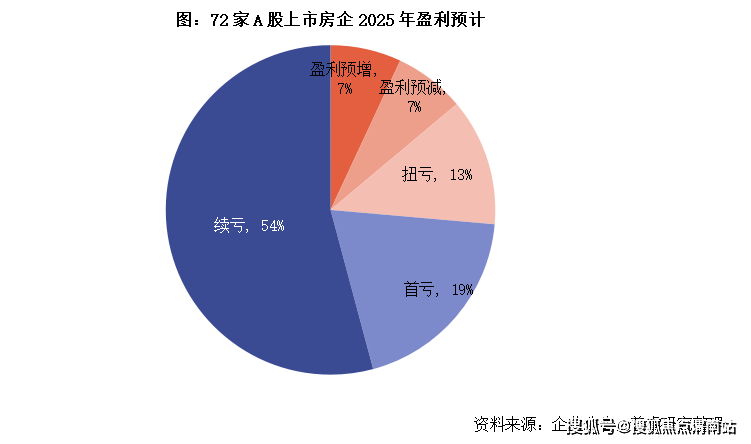
Group 1 - 73% of A-share real estate companies are expected to report losses for 2025, with 39 companies facing continuous losses [1][4] - Among the 72 companies that released performance forecasts, 53 are projected to incur losses, while only 19 are expected to be profitable, with 5 anticipating a decrease in net profit [1][4] - The overall performance of A-share listed real estate companies remains poor, with total net profit losses estimated at 1,471 billion yuan and total net profit losses excluding non-recurring items at 2,089 billion yuan for 2025 [10] Group 2 - The primary reasons for the decline in performance include reduced project profit recognition due to industry downturn, with nearly 83% of companies citing this as a factor, and 78% increasing asset impairment provisions [4] - Specific examples include China Merchants Shekou, which expects a significant drop in net profit due to reduced project deliveries and increased impairment provisions [8] - Kincor Holdings is notable for turning a profit due to debt restructuring, with expected net profit of 300-350 billion yuan, although its net profit excluding non-recurring items is still projected to be a loss of over 290 billion yuan [8][9] Group 3 - The market is currently in a bottoming phase, with January 2026 sales for the top 100 real estate companies reaching only 165.45 billion yuan, a significant decline in land transaction volume and value [14][17] - Despite the challenging market conditions, supportive policies are being implemented, including financial support measures and tax incentives aimed at revitalizing the real estate sector [17][18] - The ongoing debt restructuring of major real estate companies is seen as a positive development, potentially boosting industry confidence and paving the way for recovery [18]
北上深杭二手房成交集体回暖
21世纪经济报道· 2026-02-03 10:05
Core Viewpoint - The second-hand housing market in key cities in China showed signs of recovery in January, with significant year-on-year increases in transaction volumes, while the new housing market remained relatively subdued [1][4][6]. Group 1: Second-hand Housing Market Performance - In January, Beijing's second-hand housing transactions reached 15,082 units, a year-on-year increase of nearly 21%, despite being lower than December's over 17,000 units [5]. - Shanghai's second-hand housing transactions were 23,000 units, with a month-on-month increase of 1% and a year-on-year increase of 26% [6]. - Shenzhen recorded 5,000 second-hand housing transactions, with a month-on-month increase of 16% and a year-on-year increase of 7% [6]. - Hangzhou's second-hand housing transactions also saw growth, with 6,987 units sold, reflecting a month-on-month increase of 1.8% and a year-on-year increase of 15% [5][6]. Group 2: Factors Influencing Market Recovery - The recovery in the second-hand housing market is attributed to three main factors: a local market bottoming out, a significant drop in the number of listings, and families with educational needs advancing their purchasing plans due to the later timing of the Spring Festival [5][6]. - The number of second-hand listings in Beijing decreased to approximately 130,000, down from 150,000 last year, contributing to a more balanced supply-demand relationship [5]. - The confidence index among real estate agents rose by 12.39% in January, driven by the recovery in transaction volumes and clearer policy signals [6]. Group 3: New Housing Market Performance - The new housing market showed a decline, with Beijing's new housing transactions at 310,000 square meters, down 29% month-on-month and 20% year-on-year [7]. - In January, new housing transactions in Hangzhou fell by 64% month-on-month, with only 1,346 units sold [7]. - The new housing market is characterized by a lag in performance compared to the second-hand market, primarily driven by a more limited buyer demographic focused on improvement needs [7]. Group 4: Price Trends - The average price of new residential properties in 100 cities was 17,114 yuan per square meter, reflecting a month-on-month increase of 0.18% and a year-on-year increase of 2.52% [8]. - The average price of second-hand residential properties was 12,905 yuan per square meter, showing a month-on-month decrease of 0.85% but a narrowing decline compared to the previous month [8]. Group 5: Policy Impact and Future Outlook - The introduction of favorable real estate policies in January, including tax incentives and loan extensions, is expected to stabilize market expectations and boost buyer confidence [10][11]. - Despite a potential slowdown in transactions during February due to the Spring Festival, the market is anticipated to see a "small spring" recovery in March, driven by increased promotional activities from developers and the release of quality land parcels [11][12]. - The demand for high-end new housing is expected to remain strong, particularly in first and second-tier cities, as these properties are less affected by policy changes and have better value retention [11][12].
政策利好 北京1月份二手房住宅网签量达1.5万套
Sou Hu Cai Jing· 2026-02-02 15:36
Core Insights - In January, Beijing's second-hand residential property online signing volume reached 15,000 units, a year-on-year increase of 20.8%, marking the second consecutive month above 15,000 units since December of the previous year [1] Group 1: Policy Impact - The implementation of real estate policies on December 24 last year led to an 11% increase in online inquiries and a corresponding rise in offline viewings and transactions [3] - Adjustments to the value-added tax policy for personal sales of housing, reducing the tax rate from 5% to 3% for properties sold within two years, have lowered transaction costs for homebuyers [3] - The continuation of personal income tax incentives for home exchanges has also contributed to reducing costs for those upgrading their homes, stabilizing market expectations [3] Group 2: Seasonal Factors - The later timing of the Spring Festival this year has contributed to the over 20% year-on-year growth in second-hand home transactions in January, as some purchasing demand related to school admissions was released earlier than usual [4] - It is anticipated that February's transaction volume will be significantly affected by the Spring Festival, with a potential decrease compared to January, but a rebound is expected in March [4]

京沪深杭二手房成交回暖,“小阳春”要回归?
2 1 Shi Ji Jing Ji Bao Dao· 2026-02-02 13:02
Core Viewpoint - The second-hand housing market in key cities in China shows signs of recovery in January, with significant year-on-year increases in transaction volumes, while the new housing market remains relatively subdued [2][3][4]. Group 1: Second-hand Housing Market Performance - In January, Beijing's second-hand housing transactions reached 15,082 units, a year-on-year increase of nearly 21% [3]. - Shanghai's second-hand housing transactions were 23,000 units, with a year-on-year growth of 26% [4]. - Shenzhen's second-hand housing transactions totaled 5,000 units, reflecting a month-on-month increase of 16% and a year-on-year increase of 7% [4]. - Hangzhou's second-hand housing transactions reached 6,987 units, with a month-on-month growth of 1.8% and a year-on-year increase of 15% [4]. Group 2: Factors Influencing Market Recovery - The recovery in the second-hand housing market is attributed to three main factors: a local market bottoming out, a significant drop in the number of listings, and families with educational needs advancing their purchasing plans due to the later timing of the Spring Festival [3]. - The number of second-hand listings in Beijing has decreased to approximately 130,000, down from 150,000 last year, contributing to a more balanced supply-demand relationship [3]. Group 3: New Housing Market Performance - The new housing market remains in a repair phase, with Beijing's new housing transactions at 310,000 square meters, reflecting a month-on-month decline of 29% and a year-on-year decline of 20% [5]. - In Hangzhou, new housing transactions fell to 1,346 units, a 64% decrease from December, due to a significant reduction in new supply [5]. Group 4: Price Trends - The average price of new residential properties in 100 cities rose to 17,114 yuan per square meter, a month-on-month increase of 0.18% and a year-on-year increase of 2.52% [6]. - The average price of second-hand residential properties was 12,905 yuan per square meter, showing a month-on-month decline of 0.85% but a narrowing of the decline compared to the previous month [6]. Group 5: Policy Impact and Future Outlook - Recent favorable policies aimed at stabilizing the real estate market have been introduced, including tax incentives for home purchases and support for urban renewal projects [7]. - The expectation of a "small spring" in the housing market in March is supported by the anticipated release of quality land and increased promotional efforts from developers [8][9].
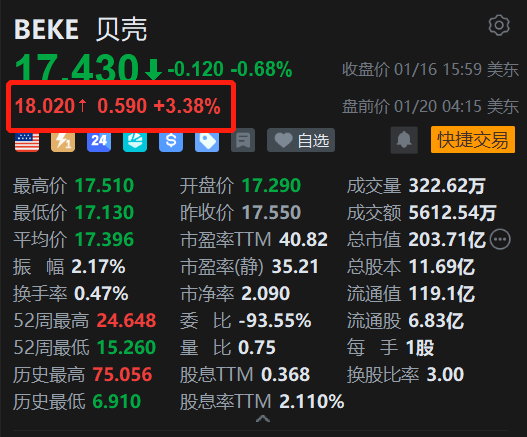
美股异动丨贝壳盘前涨超3% 持续回购+近期政策利好
Ge Long Hui· 2026-01-20 09:27
Group 1 - Beike (BEKE.US) stock rose by 3.38% to $18.02 in pre-market trading [1] - Beike announced a share repurchase plan to buy back 603,500 shares for $3.5 million on January 16, 2026 [1] - Recent financial measures in mainland China, such as a 25 basis point cut in the relending rate and a reduction of the minimum down payment for commercial real estate from 50% to 30%, are seen as direct benefits for Beike [1] Group 2 - The closing price of Beike on January 16 was $17.43, with a decrease of 0.68% [2] - The stock's highest price was $17.51, and the lowest was $17.13, with a trading volume of 3.2262 million shares [2] - Beike's total market capitalization is approximately $20.371 billion, with a price-to-earnings ratio of 40.82 [2]
房地产开发与服务26年第3周:政策利好持续,二手房基本面走强
GF SECURITIES· 2026-01-18 23:30
Core Insights - The report highlights a continuous improvement in the real estate sector, driven by favorable policies and a strengthening of the second-hand housing market [1] - The overall industry rating remains at "Buy," consistent with previous assessments [2] Group 1: Policy Developments - Central government policies are increasingly supportive, with the Ministry of Finance announcing an extension of the tax exemption policy for second-hand housing transactions until the end of 2027 [5][14] - The People's Bank of China has introduced measures including a 0.25 percentage point reduction in various structural monetary policy tool rates and a decrease in the minimum down payment for commercial properties from 50% to 30% [5][15] - The publication of multiple articles in "Qiushi" magazine indicates a heightened focus on real estate and urban development, suggesting a strong policy commitment [5][17] Group 2: Market Performance - The second-hand housing market has shown significant improvement, with a 40.3% year-on-year increase in transactions for the first 15 days of January, despite a 10% decline compared to the previous week [5][23] - New housing transactions remain low, with a 29.7% year-on-year decrease in sales volume, although there was a 9.9% week-on-week increase [5][23][26] - The average transaction price for second-hand homes in 33 cities increased by 0.6% week-on-week, indicating a stabilization in prices [5][25] Group 3: Land Market Dynamics - The total land transfer revenue remains low, with a 25.2% week-on-week decline and a 54.3% year-on-year decrease, reflecting weak market conditions [5][24] - There are localized instances of structural premiums in third and fourth-tier cities, suggesting potential opportunities despite overall market weakness [5][24] Group 4: Company Valuations and Financial Analysis - Key companies in the real estate sector, such as Vanke A and China Overseas Development, maintain a "Buy" rating with reasonable valuations projected for 2025 and 2026 [6] - The report includes detailed financial metrics for various companies, indicating expected earnings per share (EPS) and price-to-earnings (PE) ratios, which suggest potential for growth in the sector [6][30]



美股异动丨贝壳盘前涨1.6% 房地产行业再出政策利好
Ge Long Hui· 2026-01-15 09:28
Group 1 - The core point of the article is that Beike's stock is positively impacted by new policies in the real estate sector, leading to a pre-market increase of 1.6% for Beike (BEKE.US) [1] - The People's Bank of China announced that by December 2025, the weighted average interest rates for new corporate loans and new personal housing loans will be around 3.1%, a decrease of 2.5 percentage points and 2.6 percentage points respectively since the second half of 2018 [1] - The minimum down payment ratio for commercial property loans has been lowered to 30%, which is expected to stimulate transactions in the commercial real estate market, positively affecting Beike's core business [1]
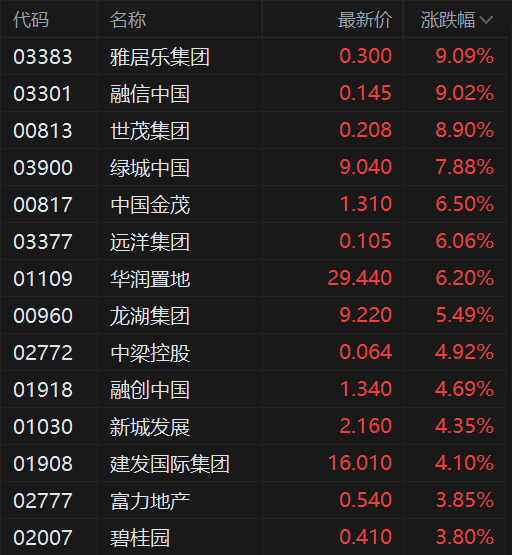
港股异动丨内房股拉升 世茂集团涨9% 中国金茂涨6.5% 行业政策利好催化
Ge Long Hui· 2026-01-05 03:40
Group 1 - The core viewpoint of the article highlights a collective rise in Hong Kong property stocks, driven by recent policy adjustments that are expected to enhance market activity [1] - Key property stocks such as Agile Group, Shimao Group, and Ronshine China saw increases of 9%, while Greentown China rose nearly 8% and China Jinmao increased by 6.5% [2] - The latest report from CICC indicates that the Ministry of Finance announced a new policy on the value-added tax for personal housing sales, and Beijing adjusted its purchase and loan restrictions, which are seen as positive developments for the market [1] Group 2 - Despite the recent policy improvements, the fundamental trends in the real estate market remain weak, necessitating ongoing observation of the interaction between policy and market fundamentals [1] - CICC suggests a cautious approach towards the real estate development sector in the short to medium term, while prioritizing investment in core assets within the commercial real estate sector that offer absolute returns [1] - If policy measures exceed expectations, there may be a more positive outlook for the real estate development sector, particularly for companies with high profit certainty and strong operational trends [1]