技术实力

Search documents
中国造船业新接订单快速回暖
日经中文网· 2026-03-25 06:18
Core Viewpoint - The Chinese shipbuilding industry is experiencing a recovery in new orders, particularly in the high-value liquefied natural gas (LNG) transport sector, following the postponement of U.S. regulatory measures that previously hindered growth [2][4][8]. Group 1: Order Trends and Market Dynamics - New orders in the Chinese shipbuilding industry are rebounding rapidly, with a significant increase in LNG transport vessels, showcasing China's strong global market presence [2][4]. - In 2025, the U.S. Trade Representative's office announced a port fee for ships built in China, which was initially set to take effect in the fall of 2025, leading to a temporary decline in orders [4][6]. - Despite a projected 35% year-on-year decline in Chinese shipbuilding orders in 2025, monthly data showed a contrasting trend, with a substantial increase in orders towards the end of the year, reaching approximately 1,300 million deadweight tons in November, 1.8 times the average for the first ten months [6][9]. Group 2: Competitive Advantages - China's shipbuilding industry benefits from lower labor and steel procurement costs, with labor costs being about half of those in Japan and South Korea, contributing to its competitive edge [10]. - The industry is not solely reliant on low prices; it is also making strides in technology, particularly in the LNG transport sector, where it has historically lagged behind South Korea [10]. - The core enterprise of China Shipbuilding Group, Hudong-Zhonghua Shipbuilding, has successfully delivered 60 LNG transport vessels and reduced construction time from 36 months to 16 months through domestic production of key components [10]. Group 3: Future Outlook - The momentum in new orders is expected to continue into 2026, with China's share of global shipbuilding orders rising from 67% in January to 80% in February [10]. - The CEO of Yangzijiang Shipbuilding indicated that the positive trend in orders is likely to persist, reflecting a recovery in shipowner confidence [9][10].



BCN综研:“中国系”厂商将掌握6成日本电视市场
Sou Hu Cai Jing· 2026-02-06 03:54
Group 1 - The core viewpoint of the articles indicates that Chinese companies are significantly increasing their market share in the Japanese television market, projected to reach 60% by 2025, highlighting the need for Japanese companies to adapt their business models [1][4] - Chinese companies are outperforming Japanese firms in pricing, with TCL's 43-inch 4K LCD TV priced at approximately 50,000 yen (around 2,211 RMB), compared to Sony's price of about 100,000 yen (around 4,422 RMB) [1] - According to BCN Research, REGZA is expected to lead the Japanese TV market, while the combined market share of Hisense and TCL will account for 50%, potentially increasing to 60% if Sony's brand shifts to a TCL-led joint venture [1] Group 2 - Global television market data from Euromonitor International shows that Samsung Electronics is the leading company, with LG Electronics, Hisense, and TCL collectively holding over 50% of the global market share [3] - Chinese companies are not only enhancing their cost competitiveness but also improving their technological capabilities, moving away from the perception that "cheap products are of low quality" [3] - The earlier announcement by Sony Group regarding the spin-off of its television business into a joint venture with TCL represents a significant restructuring of its home entertainment segment [4]


2025资本市场年度人物盘点:老将承压,新生代突围
Nan Fang Du Shi Bao· 2026-01-07 04:17
Group 1 - The core trend in the 2025 Chinese capital market indicates a shift from scale expansion to value return, emphasizing hard-core strength over conceptual speculation [2] - The experiences of industry veterans and new generation entrepreneurs reflect the necessity of risk awareness, essence adherence, and innovation embrace to navigate market changes [2] Group 2 - The resignation of Vanke's former CEO, Zhu Jiusheng, marks a significant event in the real estate sector, highlighting the vulnerabilities of high-leverage models amid industry downturns [4] - Xiaomi's CEO Lei Jun faces challenges in the automotive sector, where safety concerns and brand reputation are critical as consumer expectations evolve from mere production to quality [6] - BYD's Wang Chuanfu celebrates record sales of 4.6024 million electric vehicles globally, yet faces declining domestic revenue and profit, indicating the need for technological depth and operational excellence [8] Group 3 - The emergence of new entrepreneurs like Liu Jingkang, who launched a drone brand to compete with DJI, illustrates the survival imperative of differentiation in a competitive landscape [11] - Peng Zhihui's transition from Huawei employee to entrepreneur showcases the capital market's recognition of technical talent, but the challenge remains in converting technical prowess into sustainable profits [13] - Wang Xingxing's company, Yushutech, aims for an IPO, representing the maturation of the embodied intelligence sector, where commercialization and market expectations will dictate future success [15] Group 4 - Bubble Mart's founder Wang Ning experiences a volatile year, with significant revenue growth followed by a sharp decline in stock price, emphasizing the need to shift from reliance on hit products to ecosystem building [20] - Cambricon's Chen Tian Shi sees a turnaround with consecutive profitable quarters, driven by AI computing demand, highlighting the importance of technological barriers and ecosystem development in hard tech [22] - Liang Wenfeng's low-profile yet impactful contributions in AI through DeepSeek demonstrate that sustained innovation is crucial for success in the artificial intelligence era [24][25]

2025年车企销量排名出炉:比亚迪、吉利、奇瑞稳居前三,造车新势力分化加剧,零跑、小鹏、小米完成目标
Feng Huang Wang Cai Jing· 2026-01-02 14:45
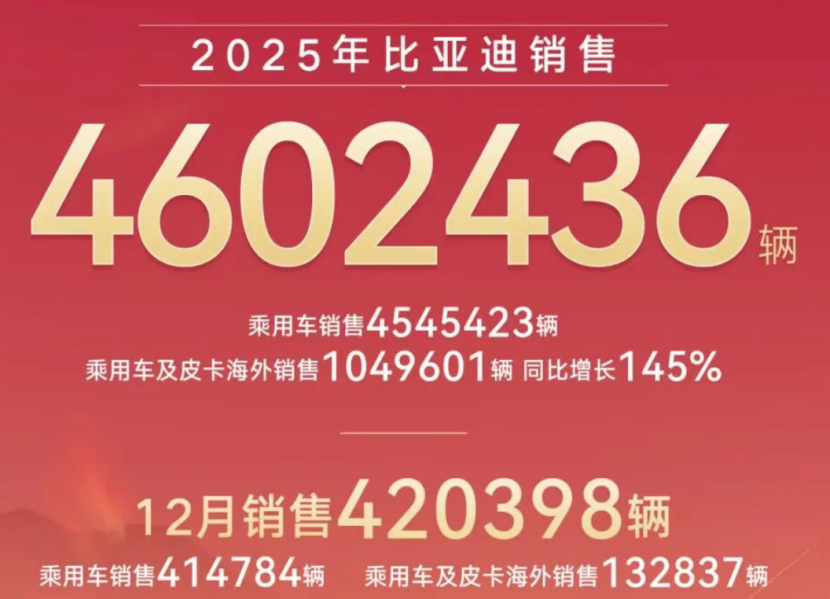
Core Insights - The Chinese automotive industry is experiencing a significant transformation, with traditional giants expanding rapidly while new energy vehicle startups face intense competition and market reshuffling [1] Traditional Giants' Performance - BYD continues to lead the market with total sales exceeding 4.6 million units in 2025, marking a nearly 8% year-on-year increase. Pure electric vehicle sales reached 2.2567 million units, up 27.86% [2] - BYD's overseas sales surpassed 1 million units for the first time, achieving 1.0496 million units, a staggering 145% increase year-on-year [2] - Geely Automotive achieved over 3.02 million units in sales, exceeding its target of 3 million units with a 39% year-on-year growth, driven by a 90% increase in new energy vehicle sales [3] - Chery Automotive sold over 2.8 million units, a 7.8% increase, and maintained its position as the top exporter of Chinese passenger cars for 23 consecutive years [5] - Great Wall Motors sold over 1.32 million units, a 7.33% increase, with new energy vehicle sales reaching 403,700 units, up 25.44% [7] New Energy Vehicle Startups' Struggles - The new energy vehicle sector shows significant differentiation, with only Leap Motor, Xiaomi, and XPeng meeting their annual sales targets [8] - Leap Motor emerged as a surprise leader with nearly 600,000 units sold, achieving a target completion rate of over 119% [8] - Homtruck followed closely with 589,100 units sold, but fell short of its 1 million target, achieving only 59% of its goal [8] - XPeng sold 429,400 units, surpassing Li Auto, with a year-on-year growth of 125.94% and a target completion rate of over 113% [10] - Li Auto faced a decline, selling 406,300 units, down 18.81% year-on-year, and only achieving 58.05% of its target [10] Market Dynamics and Future Outlook - The competitive landscape is shifting, with traditional automakers gaining strength while new entrants like Leap Motor and Xiaomi are rising [11] - The upcoming subsidy policies for 2026 are expected to intensify competition, focusing on product strength, technological capabilities, and brand value [12] - The automotive industry is poised for further transformation as market dynamics evolve, indicating that no company's position is guaranteed [12]