
汇市干预

Search documents
日本借力美国支持、以策略性沉默对抗日元空头
Xin Lang Cai Jing· 2026-01-29 08:54
Core Viewpoint - The Japanese monetary authorities are leveraging rare support measures from the U.S. to combat yen depreciation, employing strategic silence and cautious communication to promote significant yen appreciation without large-scale market interventions [1][4]. Group 1: Strategy and Execution - The strategy is primarily executed by Jun Mimura, Japan's Chief Foreign Exchange Diplomat, whose limited public statements serve as a policy signal [1][4]. - Mimura's approach involves controlling the rhythm of his statements, leading speculators to continuously speculate on potential market interventions by the Japanese government [1][4]. - The strategy has reportedly led to a decline in the USD/JPY exchange rate by approximately 7 yen, demonstrating remarkable efficiency [1][4]. Group 2: Market Reactions and U.S. Involvement - Since the weekend, the yen has experienced three significant appreciations, with the most notable fluctuations occurring after news of unusual interest rate checks by the New York Federal Reserve, raising investor awareness of a potential joint market intervention by the U.S. and Japan for the first time in 15 years [1][4]. - Despite U.S. Treasury Secretary Scott Bessenet denying any intervention to support the yen, former Japanese monetary officials view U.S. involvement in interest rate checks as a significant breakthrough, reinforcing the perception of a unified stance between the U.S. and Japan against yen depreciation [5][6]. Group 3: Communication and Market Perception - The Japanese government maintains deliberate silence regarding daily market fluctuations, only stating that it is closely coordinating with U.S. authorities, which fuels market speculation and uncertainty [2][5]. - Jun Mimura, set to become Japan's Vice Minister of International Affairs in 2024, has acknowledged that both silence and direct statements are valid communication strategies [2][5]. Group 4: Economic Factors and Limitations - The sustainability of yen appreciation ultimately depends on fundamental factors, particularly the Bank of Japan's policy direction and the fiscal trajectory of the new government post-February elections [3][6]. - The Bank of Japan raised interest rates to 0.75%, a 30-year high, but this has not effectively curbed yen depreciation, as the market perceives the central bank's actions as lagging in addressing inflation [3][6]. - Analysts suggest that if Prime Minister Fumio Kishida wins the upcoming elections, it may embolden inflationist advisors, potentially intensifying opposition to interest rate hikes [7].
贝森特称美国政府“绝对没有”干预美元
Xin Lang Cai Jing· 2026-01-28 15:21
Core Viewpoint - The U.S. Treasury Secretary, Mnuchin, stated that the Trump administration is not intervening in the foreign exchange market, particularly regarding the Japanese yen [1] Group 1 - Mnuchin's response to inquiries about potential intervention in the currency market was a clear denial, emphasizing "absolutely not" [1]
美元跌至四年低点 多重不利因素叠加
Xin Lang Cai Jing· 2026-01-27 14:37
Core Viewpoint - The Bloomberg Dollar Index has fallen to its lowest level in nearly four years, driven by a resurgence of the yen and investor caution regarding U.S. policies [1][2] Group 1: Dollar Index Performance - The Bloomberg Dollar Index dropped by 0.4%, marking its lowest point since March 2022, and has declined for four consecutive trading days [1][2] - The dollar's performance over the past week was the worst since May [1][2] Group 2: Factors Influencing Dollar Weakness - Signs indicate that the U.S. may intervene to support the yen, sparking discussions about potential coordinated interventions by major economies to lower the dollar against key trading partner currencies [2] - Investor caution is reflected in the dollar's weakness, influenced by erratic U.S. policies, including President Trump's threats regarding Greenland [2] - Long-term concerns about the independence of the Federal Reserve, rising budget deficits, fiscal irresponsibility, and increasing political polarization are contributing to the dollar's decline [2] Group 3: Market Sentiment - Concerns about a potential partial government shutdown are causing apprehension among those bullish on the dollar [2] - The performance of the U.S. economy is expected to influence the extent of the Federal Reserve's easing measures, which will, in turn, affect the dollar's strength [2]
日元危局难解?高市早苗“政治豪赌”拉响财政警报
Jin Shi Shu Ju· 2026-01-27 13:28
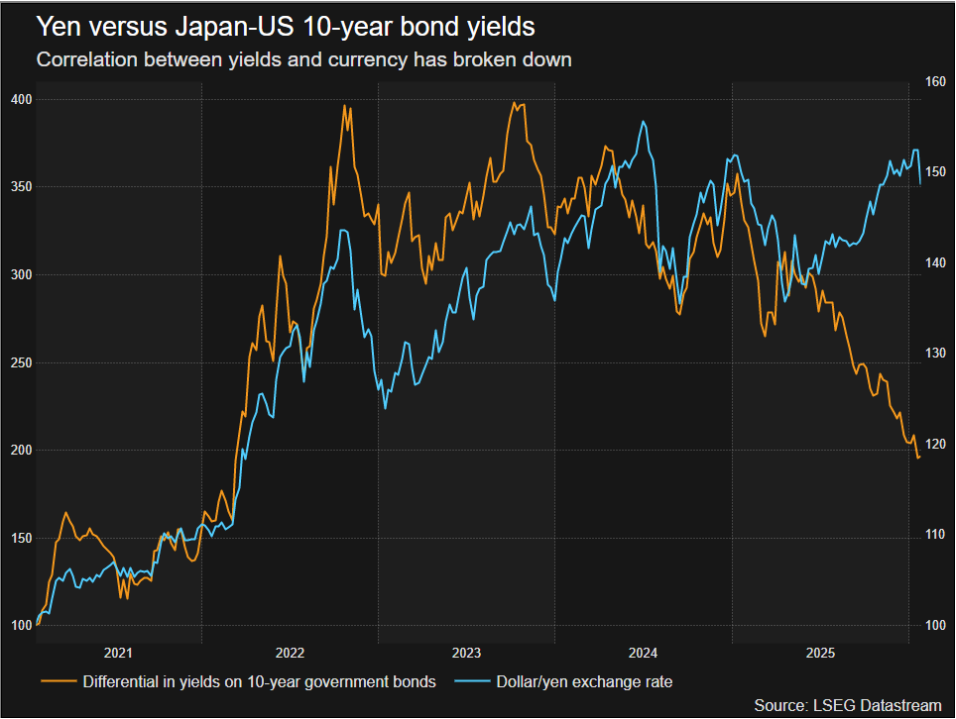
Core Viewpoint - The Japanese yen is under significant pressure due to concerns over Japan's fiscal health, despite expectations of coordinated buying by the US and Japan to support the currency. The upcoming elections and the government's economic stimulus plans further complicate the situation [1][5]. Group 1: Economic Context - The Japanese government debt now accounts for approximately 230% of GDP, the highest among developed countries [5]. - Prime Minister Sanae Takaichi's campaign for early elections is based on expanding economic stimulus measures, which may weaken the effectiveness of any currency intervention [1][5]. - The market's concern over Japan's fiscal management has intensified, leading to a significant sell-off in the stock market and a decline in the yen against the euro and Swiss franc [5]. Group 2: Currency Intervention - Historical experience suggests that actual market interventions may have limited impact, especially in the context of Japan's fiscal crisis concerns [1][6]. - The yen's depreciation has prompted discussions of potential intervention, with expectations that a breach of the 160 yen per dollar mark could trigger the first round of intervention [4]. - Despite the potential for US-Japan coordinated intervention, the effectiveness is expected to be limited, primarily due to a lack of investor confidence in Japan's fiscal management capabilities [4][6]. Group 3: Market Reactions - Fund manager Toshinobu Chiba indicated that if Takaichi wins decisively and pushes for more stimulus, the yen could fall to 180 per dollar, a level not seen since 1986 [3]. - The recent spike in Japanese government bond yields has not supported the yen as expected, indicating a disconnect between bond yields and currency value [2][5]. - The upcoming elections are seen as a critical moment for Takaichi's economic agenda, with the potential for significant market reactions based on the election outcome [1][5].

交易员周一紧盯屏幕:日元又突涨近1% 黄金突破5000美元 干预警报全市场拉响
智通财经网· 2026-01-25 23:53
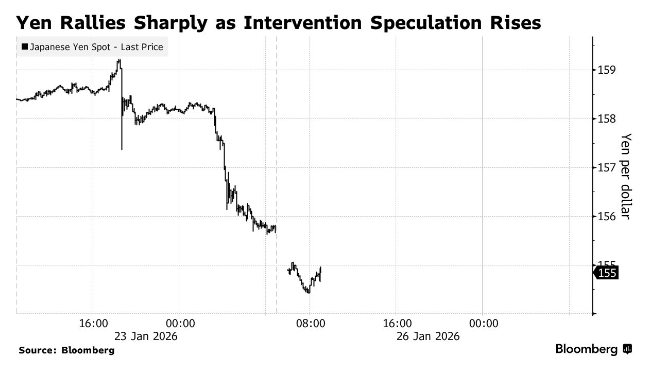
Core Viewpoint - The Japanese yen has experienced a significant rise, prompting traders to remain vigilant regarding potential government intervention in the currency market due to recent volatility and speculation about coordinated actions with the U.S. [1][2] Group 1: Yen Movement and Market Reactions - The yen appreciated nearly 1% against the dollar, reaching 154.23, the highest level in over a month, following warnings from Prime Minister Fumio Kishida and signals of possible U.S. support [1] - On the previous Friday, the yen saw its largest single-day increase since August 1, rising by 1.75% [2] - The New York Federal Reserve's currency checks and communications between Japanese Finance Minister Shunichi Suzuki and U.S. Treasury Secretary Janet Yellen have led traders to believe in the possibility of joint intervention [2] Group 2: Government Statements and Market Sentiment - Prime Minister Kishida stated that the government would take all necessary measures to address speculative and extreme market fluctuations, although he refrained from commenting directly on the yen [1] - The current administration under Kishida has a lower tolerance for speculative currency fluctuations compared to previous governments, as noted by analysts [3] - Traders are expected to exercise caution in their trading behavior due to the official verbal interventions, despite a prevailing willingness to short the yen [5] Group 3: Historical Context and Future Implications - Speculation about coordinated intervention between Japan and the U.S. has drawn parallels to the 1985 Plaza Accord, which successfully devalued the dollar [5] - The Japanese government has invested nearly $100 billion in currency support measures in 2024, with intervention occurring whenever the yen approaches the 160 mark against the dollar [5] - Analysts suggest that if Japan genuinely aims to stabilize the yen, actual intervention is necessary, especially in light of upcoming elections and rising bond yields [6][8]
日本迎“闪电大选”预期!日债收益率飙升,对冲基金疯狂做空日元
Jin Shi Shu Ju· 2026-01-19 10:26
Core Viewpoint - The Japanese government bond yields have surged to their highest levels in nearly 27 years, driven by market speculation that Prime Minister Fumio Kishida will leverage a promise to cut food taxes as a bargaining chip for an early election [2] Group 1: Bond Market Reaction - The 10-year Japanese government bond yield rose to 2.275%, the highest since February 1999, while yields on 5-year, 20-year, and 30-year bonds also reached historical highs [2] - This surge in bond yields coincides with Kishida's plans to announce an early election, which is expected to provide a clear mandate for large-scale stimulus spending [2] Group 2: Tax Policy Considerations - The ruling Liberal Democratic Party is considering suspending the current 8% value-added tax on food and beverages, which could result in an additional annual loss of 5 trillion yen (approximately $31.7 billion) for the Japanese government [2] - Kishida enjoys a support rate of up to 75% in some polls, and she is expected to clarify her reasons for calling the election earlier than most analysts anticipated [2] Group 3: Investor Sentiment and Currency Impact - Investors are concerned that Kishida's policies may worsen public finances, with analysts noting that there is little evidence of real pressure on the Japanese government bond market despite rising yields [3] - Hedge funds have significantly increased their bearish bets on the yen, with net short positions rising by 35,624 contracts, the largest increase since May 2015 [3] - The yen has fallen to its lowest level since July 2024, as traders speculate on Kishida's potential victory and subsequent stimulus measures, raising concerns about an expanding fiscal deficit [3]
日元未现加速贬值 央行政策路径关键数据指引方向
Jin Tou Wang· 2026-01-07 12:19
Group 1 - The core factors influencing the Japanese yen include concerns over Japan's fiscal situation, rising risk appetite, and uncertainty regarding the timing of the next interest rate hike by the Bank of Japan, which continues to exert pressure on the yen's exchange rate [1] - The Japanese Cabinet recently approved a record annual budget of 122.3 trillion yen, raising concerns about fiscal sustainability and impacting market sentiment towards the yen [1] - Market risk appetite remains relatively high, diminishing the yen's appeal as a traditional safe-haven currency, while there is significant disagreement among investors regarding the timing of the Bank of Japan's next interest rate hike [1] Group 2 - The Bank of Japan's policy direction has not fundamentally changed, with the Governor indicating that as long as economic and inflation trends align with expectations, the central bank will continue to pursue interest rate hikes [2] - The hawkish stance from the Bank of Japan has led to a rise in Japanese government bond yields, narrowing the interest rate differential between Japan and other major economies, which has made market participants more cautious about aggressive short positions on the yen [2] Group 3 - The US dollar's upward momentum is limited by ongoing expectations for future interest rate cuts by the Federal Reserve, leading to a more conservative approach among dollar bulls [3] - Investors are awaiting key macroeconomic data from the US, including ADP private sector employment data and the non-farm payroll report, which will be crucial for assessing the dollar's future trajectory [3] Group 4 - Technically, the USD/JPY pair is showing a strong oscillating pattern, with key support at 156.15, which corresponds to the 100-period moving average on the 4-hour chart [4] - The MACD indicator shows a gradual decrease in bearish momentum, while the RSI is in a neutral zone, indicating a current state of consolidation in the market [4] - Key price levels include 156.10 as a critical support level, with potential for a new downward trend if breached, while resistance is focused around 157.15, which could open further upward movement if surpassed [4]
日元年末逼近155关口 2026年或向160挺近
Jin Tou Wang· 2025-12-30 02:28
Core Viewpoint - The USD/JPY exchange rate remains strong, trading around 154.85 as of December 30, 2025, with expectations for it to break the 160 mark in 2026 despite a nearly 10% decline in the USD index throughout the year [1][2]. Group 1: Currency Policy Divergence - The strength of the USD/JPY is primarily due to the structural divergence in monetary policies between the US and Japan, with the Federal Reserve expected to slow its rate cuts in 2026 after a cumulative reduction of 75 basis points to 3.50%-3.75% in 2025 [2]. - The Bank of Japan raised rates to 0.75% in December but is proceeding cautiously, with market expectations for the next rate hike not fully priced in until September 2026, maintaining a negative real interest rate that diminishes the yen's attractiveness [2]. Group 2: Additional Factors Influencing the Yen - Increased carry trade activity is evident, with leveraged funds showing the highest short position against the yen since July 2024, as investors borrow low-yielding yen to invest in higher-yielding currencies [2]. - There is ongoing capital outflow pressure from Japan, with retail investors significantly buying overseas stocks and corporate mergers and acquisitions reaching multi-year highs [2]. - Persistent inflation in the US may limit the Fed's ability to cut rates further, while increasing pressure on Japanese government bonds could weaken the yen's safe-haven appeal [2]. Group 3: Market Intervention and Future Outlook - The yen is approaching the 160 level, which could trigger official intervention, as Japanese officials express concerns over speculative volatility in the exchange rate [3]. - Analysts believe that mere intervention may not reverse the yen's long-term weakness, emphasizing the need for a comprehensive fiscal strategy from the Japanese government [3]. - Most international investment banks maintain a bullish outlook on USD/JPY for 2026, with forecasts ranging from 160 to 165, driven by the slow pace of rate hikes from the Bank of Japan, ongoing capital outflows, and a deceleration in Fed rate cuts [3].
日元承压下探 日银政策转向预期
Jin Tou Wang· 2025-12-12 02:38
Core Viewpoint - The USD/JPY exchange rate is experiencing a slight decline, trading around 155.62, following a recent peak at 156.50, with market focus shifting towards the Bank of Japan's policy direction and potential currency market interventions by the Japanese Ministry of Finance [1][2]. Group 1: Currency Market Dynamics - The divergence in monetary policy remains the primary driver of the USD/JPY exchange rate, with recent market expectations showing subtle changes. The Federal Reserve's recent rate cuts have not signaled an overly dovish stance, leading to a relatively stable dollar interest rate advantage, which still supports the exchange rate in the short term [1]. - Expectations for a shift in the Bank of Japan's policy are rising, which is a key factor suppressing the USD/JPY rate. Japan's November core CPI remains above the 2% target, indicating persistent inflation, while the labor market remains tight with an unemployment rate of 2.4% [1][2]. Group 2: Technical Analysis - The USD/JPY is currently showing a clear bearish trend, having broken below the 156.00 level and the 100-hour moving average. Key support is now focused around 155.30; if this level is breached, the exchange rate could further decline towards 155.00 or even 154.50 [2]. - Resistance is concentrated at the 156.00 level; if the rate can regain this position, it may attempt to challenge the 156.60-157.00 range [2]. Group 3: Upcoming Events - Two critical events to monitor include the Bank of Japan's monetary policy meeting in December, where any hawkish signals could lead to a significant rebound in the yen, and the Federal Reserve's communications and U.S. economic data, which could strengthen the dollar if they indicate a delay in rate cuts or strong economic performance [3]. - Continuous tracking of the Japanese Ministry of Finance's potential currency market interventions is essential to mitigate short-term volatility risks [3].
日本经济与政策面 多重矛盾发酵
Jin Tou Wang· 2025-11-28 02:26
Core Viewpoint - The USD/JPY exchange rate continues to show a strong oscillating pattern, influenced by both internal economic pressures in Japan and external factors such as U.S. Federal Reserve policy expectations [1][2]. Internal Factors - Japan's economic fundamentals are under pressure, with Q3 GDP declining at an annualized rate of 1.8%, marking a return to negative growth after six quarters. Key contributors to this decline include shrinking exports and a significant drop in private residential investment [1]. - The Japanese government's economic stimulus plan of 21.3 trillion yen raises concerns about potential fiscal deterioration, leading to a "sell Japan" trade sentiment that pressures both the yen and Japanese government bonds [1]. - The Bank of Japan's cautious approach to normalizing monetary policy is evident, with ongoing political pressures causing market concerns about the pace of interest rate hikes [1]. External Factors - Market expectations indicate an 84.7% probability of a 25 basis point rate cut by the Federal Reserve in December, contributing to a relatively stable USD/JPY interest rate differential [2]. - Morgan Stanley suggests that if the Fed initiates a series of rate cuts, the USD/JPY could depreciate by nearly 10% over the next few months, potentially reaching the 140 level by Q1 2026 [2]. - The recent weakness of the yen has drawn significant attention from Japanese authorities, with Finance Minister Shunichi Suzuki mentioning the possibility of intervention, and the Economic and Fiscal Policy Minister emphasizing close monitoring of speculative currency behavior [2]. Technical Analysis - The USD/JPY is currently trading within a critical range of 156-157, with resistance near the 160 intervention level and support around 155.80 [3]. - The Relative Strength Index (RSI) is at approximately 58, indicating that there is still potential for upward movement, although momentum appears to be waning [3]. - Key signals to watch include potential currency market intervention by Japanese authorities and the outcomes of the Federal Reserve's December policy decision and the Bank of Japan's rate meeting on December 19 [3].