
政策保障

Search documents
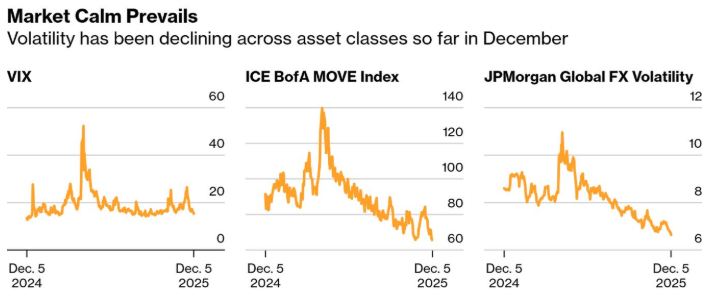
美国股债波动率指数齐跌至低位 市场“静待”美联储决议
智通财经网· 2025-12-06 06:34
Core Viewpoint - The current market calmness is fragile, with potential volatility looming due to diverging views among Federal Reserve officials and concerns over a weakening labor market [2][4]. Group 1: Market Indicators - The VIX index, a measure of market fear, is hovering near its lowest level since the beginning of the year, while the MOVE index has reached its lowest point since early 2021 [1]. - Recent economic data, including a consumer inflation report that met expectations, has led traders to anticipate a rate cut by the Federal Reserve next week [2][4]. Group 2: Economic Conditions - The latest inflation indicator favored by the Federal Reserve rose by 0.2%, keeping year-over-year data below 3%, indicating persistent inflationary pressures [4]. - Concerns about a weakening labor market are growing, with the highest number of layoffs reported since early 2023, according to ADP Research [4]. Group 3: Investor Behavior - The S&P 500 index rose by 0.3% this week, nearing historical highs, while the Nasdaq 100 index increased by 1% [7]. - Investors are increasingly moving into equity markets, with U.S. stock funds experiencing inflows for twelve consecutive weeks [7]. Group 4: Risk Management - Despite the current low volatility, there are signs of caution, as the amount of money flowing into money market funds reached a record high for a single week [8]. - Tail risk hedging products have shown some strength in 2025, but their significant gains have not been maintained through recent market turbulence [8].

中经评论:以动态思维看待制造业合理比重
Jing Ji Ri Bao· 2025-11-28 00:09
Core Viewpoint - The article emphasizes the importance of maintaining a reasonable proportion of the manufacturing industry in China's economy, highlighting that it is essential for national stability, technological innovation, and employment support [1][2]. Group 1: Manufacturing Industry's Role - Manufacturing is the foundation of the nation and the basis for strength, requiring a dynamic balance for qualitative improvement and reasonable growth [1]. - The manufacturing sector absorbs over 100 million jobs and is crucial for employment stability, serving as a "reservoir" for job opportunities [2]. - In 2024, China's manufacturing value added is projected to reach 33.6 trillion yuan, accounting for 24.9% of GDP, indicating a relatively high global standing despite existing issues of being "large but not strong" [2]. Group 2: Quality and Structure of Manufacturing - The term "reasonable" focuses on "stable quantity and improved quality," suggesting that a slight decrease in quantity can lead to a significant increase in quality, enhancing the sector's contribution to the economy [2]. - The manufacturing industry should not pursue blind expansion but must maintain a baseline scale to prevent hollowing out while optimizing and upgrading its structure towards high-end, intelligent, and green development [2][3]. Group 3: Regional Considerations - The concept of "reasonable proportion" varies by region, necessitating differentiated implementation based on local resources, development stages, and functional positioning [3]. - Eastern coastal regions may focus on knowledge-intensive high-end manufacturing, while central and western regions can leverage industrial transfer and develop specialized industries [3]. Group 4: Innovation and Policy Support - Continuous R&D investment is essential to overcome key technological bottlenecks, such as high-end chips and industrial software, to enhance innovation capabilities [3][4]. - A stable resource allocation mechanism is needed to guide funds, talent, and land towards manufacturing, alongside tax reductions and improved business environments to lower overall costs [4]. Group 5: Market Orientation - The development of the manufacturing sector ultimately relies on market validation, leveraging China's vast market to drive innovation and application [4]. - Expanding openness and integrating deeply into global supply chains will enhance the core competitiveness of the manufacturing industry [4].
以动态思维看待制造业合理比重
Jing Ji Ri Bao· 2025-11-27 21:42
Core Viewpoint - The article emphasizes the importance of maintaining a reasonable proportion of the manufacturing industry in China's economy, highlighting the need for a dynamic balance between quality and quantity in alignment with national modernization strategies [1][2]. Group 1: Manufacturing Industry's Role - Manufacturing is fundamental to the nation, serving as a foundation for economic stability and growth, and is crucial for employment, technological innovation, and resilience against international challenges [2][3]. - In 2024, China's manufacturing value added is projected to reach 33.6 trillion yuan, accounting for 24.9% of GDP, indicating a relatively high global standing despite existing issues of being "large but not strong" and "complete but not excellent" [2]. Group 2: Dynamic Adaptation - The proportion of manufacturing is closely linked to the economic development stage, with a need for gradual and controllable adjustments rather than rapid declines, as seen in historical examples of premature deindustrialization in developed countries [1][2]. - The concept of "reasonable" emphasizes stabilizing quantity while enhancing quality, suggesting that a slight reduction in scale could lead to significant improvements in value and contribution to the economy [2]. Group 3: Regional Considerations - The "reasonable proportion" varies by region, necessitating tailored approaches based on local resources, development stages, and functional roles, with eastern coastal areas focusing on high-end manufacturing and central/western regions leveraging unique advantages [3]. Group 4: Innovation and Policy Support - Continuous investment in R&D is essential for overcoming key technological bottlenecks, with a focus on integrating artificial intelligence into manufacturing to enhance productivity [3][4]. - A stable resource allocation mechanism is needed to attract funds, talent, and land to the manufacturing sector, alongside policies that reduce costs and improve the business environment [4]. Group 5: Market Orientation - The development of manufacturing must ultimately be validated by market demand, leveraging China's large market size to drive innovation and application, while also promoting deeper integration into global supply chains [4].
引得进 用得好 留得住
Jing Ji Ri Bao· 2025-10-15 22:15
Core Insights - Hunan is actively promoting its talent attraction initiatives through the "Wisdom Gathering Hunan" series, showcasing its commitment to creating a favorable environment for high-quality development and entrepreneurship [1] Group 1: Talent Attraction and Retention - Attracting talent is just the first step; the focus must also be on effective utilization, retention, and long-term engagement of talent [1] - A stable and predictable policy environment is essential for talent development, allowing individuals to establish long-term roots in the region [1] Group 2: Support for Talent - Initial challenges in employment and entrepreneurship require targeted support to address talent needs and concerns, including assistance in platforms, return channels, financing needs, and welfare [1] - Implementing flexible rewards and shared success mechanisms can create predictable returns, while fostering a culture that respects talent and encourages innovation is crucial for integration [1]