新能源非电利用

Search documents
中金 | 绿色甲醇行业:起于航运减碳,短看政策和订单,降本和生产稳定性决定长期空间
中金点睛· 2026-03-12 23:34
Core Viewpoint - The investment in green methanol in China is accelerating, with expectations of continued supply-demand imbalance in the next 1-2 years, while also testing project order locking and production stability [1][2]. Group 1: Policy and Market Dynamics - The EU has included shipping in its carbon emissions trading system starting in 2024, with penalties for non-compliant vessels from 2025 [4]. - The EU FuelEU Maritime regulation aims to reduce the greenhouse gas intensity of shipping fuels by 2% from a 2020 baseline, with further reductions every five years, targeting an 80% reduction by 2050 [5]. - The International Maritime Organization (IMO) has proposed a global carbon pricing mechanism, with a goal to reduce greenhouse gas emissions from international shipping by at least 20% by 2030 compared to 2008 levels [8][9]. Group 2: Green Methanol Development in China - China's green methanol production capacity is projected to exceed 60 million tons by the end of 2025, but only about 1% of this capacity is currently operational [2][39]. - The short-term focus for green methanol in China is on securing overseas customer orders, as the global supply is expected to remain tight [40]. - The development of green methanol aligns with China's "14th Five-Year Plan" for non-electric renewable energy utilization, contributing to energy security [33][35]. Group 3: Production and Cost Challenges - Current green methanol production projects face challenges in production stability due to factors like renewable energy output fluctuations and biomass supply consistency [42]. - The production costs of green methanol remain high, and reducing these costs is critical for the industry's long-term viability [43]. - The price of green methanol is currently elevated, with domestic prices around 7,000 yuan per ton for green methanol compared to 2,000-2,500 yuan per ton for conventional methanol [32][40]. Group 4: Future Demand and Opportunities - By 2030, global demand for green methanol is expected to increase significantly, potentially reaching five times the demand in 2025 [16][18]. - The establishment of long-term supply contracts for green methanol with international shipping companies is a key strategy for securing market position [40].


广发证券:高景气+结构通胀共振 两海驱动风电盈利反转
智通财经网· 2026-01-05 04:08
Core Viewpoint - The wind power sector is entering a new cycle of multiple prosperity starting in 2026, driven by domestic policies and global demand growth, particularly in offshore wind energy [1][2]. Group 1: Domestic Wind Power Installation Forecast - It is projected that from 2025 to 2027, the annual new installation capacity for onshore wind in China will be approximately 100-105 GW, while offshore wind capacity will increase from 9.0 GW to 15.0 GW, with a CAGR of about 29.1% [1]. - The global wind power demand is expected to grow, with a projected CAGR of about 8.8% for new installations from 2025 to 2030, with China and Europe contributing 73% of the new capacity [1]. Group 2: Pricing and Profitability Trends - Since Q4 2024, domestic onshore wind bidding prices have significantly rebounded, expected to maintain in the range of 1600-1700 RMB/kW (excluding towers) in 2025, reflecting a year-on-year increase of 10% [2]. - The industry is entering a profitability uptrend characterized by dual recovery in pricing and structure, alongside a decrease in expense ratios [2]. Group 3: New Growth Trends - The trend of large-scale wind turbine production is slowing, which is expected to reduce risks and provide long-term benefits to cost structures [3]. - There is a significant increase in overseas wind power demand, transitioning from merely exporting products to exporting capabilities and production capacity [3]. - The inclusion of renewable energy non-electric consumption in national assessments is accelerating the layout of hydrogen and ammonia production by wind turbine manufacturers [3].

华能调增高效光伏组件采购占比,光热发电规模发展意见发布
Ping An Securities· 2025-12-29 04:55
Investment Rating - The report maintains an "Outperform" rating for the industry [1] Core Insights - The report highlights the increasing procurement ratio of high-efficiency photovoltaic components by Huaneng Group, indicating a shift towards higher efficiency in solar energy production [6] - The development of concentrated solar power (CSP) is emphasized, with a target of reaching 15GW of installed capacity by 2030, aiming for cost parity with coal power [7] - The report notes significant growth in the wind power index, outperforming the broader market, and provides insights into the performance of various renewable energy sectors [4][11] Summary by Sections Wind Power - The wind power index increased by 5.97%, outperforming the CSI 300 index by 4.02 percentage points, with a current PE_TTM valuation of approximately 26.26 times [4][11] - The delivery of the world's first methanol dual-fuel super-large oil tanker indicates a growing demand for hydrogen and methanol applications in the shipping sector, which is seen as a promising direction for renewable energy [10][26] Photovoltaics - Huaneng Group has adjusted its procurement framework for photovoltaic components, increasing the expected procurement capacity for high-efficiency components from 2.5GW to 3.5GW, while reducing the capacity for medium-efficiency components [6][7] - The report suggests that the shift towards high-efficiency components aligns with the government's push for quality and responsible pricing in the photovoltaic sector [6] Energy Storage & Hydrogen - The National Development and Reform Commission and the National Energy Administration have released opinions promoting the large-scale development of CSP, targeting a total installed capacity of 15GW by 2030 [7] - The report recommends investments in energy storage companies and highlights the potential for growth in distributed energy storage markets, particularly in residential and commercial sectors [7] Investment Recommendations - The report suggests focusing on companies with strong competitive positions in energy storage and wind power, including Yangguang Electric and Mingyang Smart Energy, while also recommending attention to leading photovoltaic companies like Longi Green Energy and Trina Solar [7]




氢能周度观察:氢氨醇政策逐步形成“制度建设-资金扶持-产业规划等”体系-20251208
Changjiang Securities· 2025-12-08 04:33
Investment Rating - The report indicates a positive outlook on the green hydrogen and methanol industry, emphasizing its investment value during the "14th Five-Year Plan" period, particularly in non-electric applications [9]. Core Insights - Recent policies from key government departments, including the National Development and Reform Commission and the National Energy Administration, have established a comprehensive framework for the hydrogen and methanol industry, covering institutional construction, funding support, and industrial planning [3][6]. - The transition from demonstration projects to large-scale commercial operations is marked by significant project launches and technology validations, indicating a new phase for green hydrogen and methanol [9]. - The report highlights the establishment of a minimum renewable energy consumption target for non-electric sectors, which positions green hydrogen and methanol as essential pathways to meet these targets [9]. - Financial support mechanisms have been introduced, such as a 20% funding support for green methanol projects, aimed at alleviating initial investment burdens [9]. - The report identifies specific application scenarios for green hydrogen and methanol, focusing on industrial sectors like coal chemical and metallurgy, as well as green fuel for shipping [9]. Summary by Sections Policy Developments - A series of recent policies have been issued to support the hydrogen and methanol industry, transitioning from a focus on demonstration projects to a more structured approach that includes funding and planning [6][9]. - The National Development and Reform Commission's recent guidelines emphasize the importance of green hydrogen and methanol in achieving renewable energy consumption targets [9]. Project Developments - Major projects have commenced, such as the launch of the zero-carbon hydrogen ammonia project in Inner Mongolia, which aims for an annual production of 320,000 tons of green synthetic ammonia [9]. - Other projects include the successful verification of green hydrogen production processes and the ongoing development of integrated hydrogen and methanol production facilities [9]. Price Trends - Current prices for green methanol remain high due to supply constraints, with domestic prices reported at approximately 6,504 RMB/ton for offshore prices in North China [13]. - Future price projections suggest a potential decrease as production scales up, with contracts indicating prices around 4,713 RMB/ton starting in 2028, representing a 27.5% decrease from current levels [9][13].
专家解读丨推动新能源供给与消费侧深度集成融合
Zhong Guo Dian Li Bao· 2025-12-01 03:52
Core Viewpoint - The "Guiding Opinions on Promoting the Integrated Development of New Energy" outlines a systematic approach to the development of new energy, emphasizing the integration of supply and consumption sides to enhance high-quality development and support a green transition in the economy and society [1] Group 1: Current Challenges in New Energy Development - The development mode of new energy needs urgent transformation due to increasing issues with grid integration and consumption autonomy [2] - As of September 2025, total installed capacity of wind and solar power exceeded 1.7 billion kilowatts, surpassing thermal power as the largest energy source [2] - New energy utilization rate fell below 95% in the first three quarters of the year, a decrease of 2 percentage points year-on-year, with curtailment issues spreading beyond the "Three North" regions [2] Group 2: Marketization and Revenue Models - The national unified electricity market is accelerating, marking a new phase of marketization for new energy [3] - Negative electricity prices have emerged in regions like Shandong and Inner Mongolia during peak generation periods, with the average clearing price in the Mengxi region dropping over 40% compared to the same period last year [3] - New energy must move beyond the traditional "grid-connected power generation + guaranteed pricing" model to develop a composite revenue system that includes green environmental value and value-added services [3] Group 3: Green Low-Carbon Transition on the Consumption Side - The internal and external environment demands a higher level of green low-carbon transition in consumption, with industrial, construction, and transportation sectors accounting for over half of carbon emissions [4] - The government has imposed strict constraints on energy-intensive industries, mandating minimum green electricity consumption ratios in sectors like data centers and electrolytic aluminum [4] - Technological advancements in multi-energy conversion are creating new opportunities for green energy substitution on the consumption side [4] Group 4: Integrated Development Blueprint - The "Guiding Opinions" signal a shift in focus from scale expansion to quality improvement and supply-demand coordination in new energy development [5] - It proposes multiple tasks for the integrated development of distributed new energy, collaboration with traditional industries, and non-electric utilization of new energy [5] - Close coordination between new energy supply and consumption is essential for improving resource allocation efficiency [5] Group 5: Regulation and Technical Innovations - The release of regulatory capabilities, particularly through load-side participation, is crucial for the integrated development of new energy [6][7] - The "Guiding Opinions" encourage traditional industries to optimize production processes and upgrade self-supplied power plants to enhance their flexibility and participation in energy systems [7] - Non-electric utilization, particularly in sectors like transportation and chemicals, is identified as a key breakthrough area for deep decarbonization [8] Group 6: Policy Implementation and Local Adaptation - The integrated development of new energy and consumption sides is still in its early stages, requiring exploration in key technologies and business models [9] - The "Guiding Opinions" propose measures for project investment management, electricity dispatch mechanisms, and market transaction frameworks to support integration [9] - Localized strategies should be developed based on regional resources and industrial foundations to promote project construction effectively [9]
IDC 权威认证!中能拾贝持续领跑电力大数据赛道,连续两年稳居第一梯队领航席
Cai Fu Zai Xian· 2025-11-26 05:09
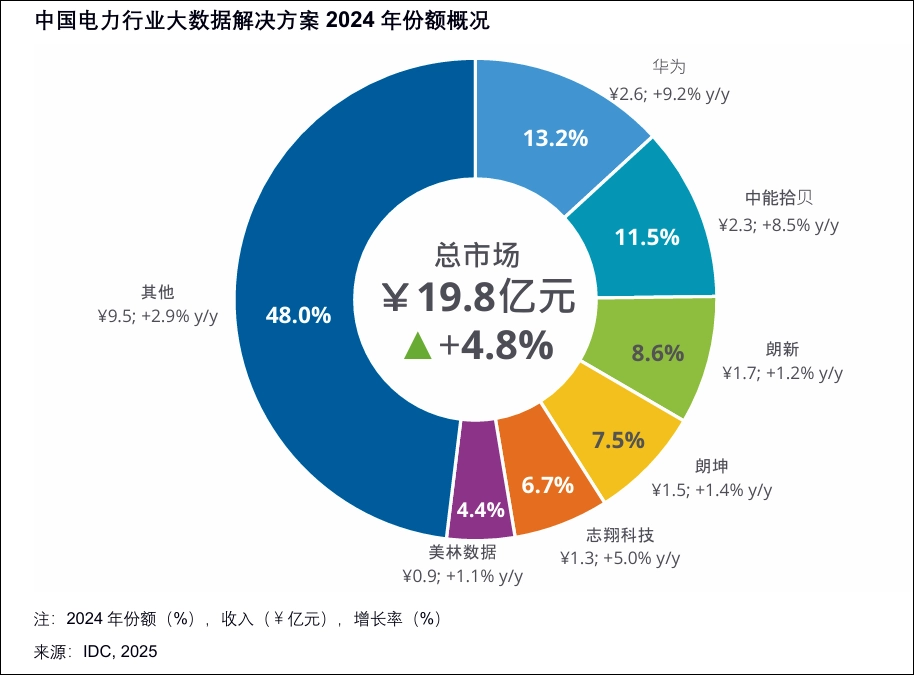
Core Insights - The report by IDC highlights the strong market position of Zhongneng Shibei in the Chinese power industry big data solutions market, with a market share of 11.2% in 2023 and an expected increase to 11.5% in 2024, showcasing a growth rate of 8.2% and 8.5% respectively [1][3] Market Overview - The Chinese power industry big data solutions market is projected to reach approximately 1.98 billion RMB in 2024, reflecting a year-on-year growth of 4.8%, indicating robust industry momentum [3] - The market structure has evolved into a dual framework of "comprehensive cloud vendors + specialized technology vendors," with leading companies dominating the development direction due to their technological depth and resource integration capabilities [3] Company Positioning - Zhongneng Shibei is recognized as a core representative of specialized technology vendors, leveraging its "technical depth + scene adaptability" to lead the market alongside major players like Huawei [3][4] - The company has established a comprehensive core technology system covering industrial intelligence operating systems, IoT, big data, and AI, adhering to principles of "independence, controllability, safety, and reliability" [3][4] Client Engagement - Zhongneng Shibei has served over 1,000 enterprise-level clients nationwide, including major power groups such as State Grid, Southern Power Grid, and Huaneng Group, and has contributed to over 20 national and industry standards in smart energy [4] Industry Trends - IDC predicts that the Chinese power industry will enter a sustained high-growth "super cycle" over the next decade, driven by factors such as AI data center expansion, export structure transformation, accelerated electrification, and new energy utilization [5] - The dual impact of policy incentives and market demand is expected to create a significant demand for high-quality power big data services, particularly in areas like smart grid and energy efficiency management [5] Strategic Initiatives - Zhongneng Shibei is strategically positioned to capitalize on industry opportunities by integrating cutting-edge technology with core mechanisms of the power sector, enhancing the stability of renewable energy integration through multi-energy complementarity solutions [6] - The company aims to continue its leadership in the industrial intelligence sector, focusing on technological innovation and customer value to support the construction of a new power system in China [6]
国家能源局:“十五五”时期加快推动新能源“立起来”“靠得住”
Zheng Quan Ri Bao Wang· 2025-10-31 12:54
Core Insights - Energy investment in China has shown robust growth, with key projects completing investments of 1.97 trillion yuan in the first eight months of the year, marking an 18.2% year-on-year increase [1] - The National Energy Administration has set ambitious targets for renewable energy capacity, aiming for wind and solar power to reach over 3.6 billion kilowatts by 2035, which is six times the capacity of 2020 [1] Group 1: Investment Growth - Energy investment in the first eight months reached 1.97 trillion yuan, a growth of 18.2% year-on-year [1] - Six provinces, including Shandong, Jiangsu, Guangdong, Xinjiang, Yunnan, and Inner Mongolia, each exceeded 100 billion yuan in investment by the end of August [1] Group 2: Renewable Energy Development Goals - The "14th Five-Year Plan" aims to significantly increase renewable energy capacity, targeting over 3.6 billion kilowatts by 2035 [1] - The focus is on expanding renewable energy supply and enhancing the integration of various energy sources [2] Group 3: Policy and Market Mechanisms - Policies will be developed to promote the integrated development of renewable energy with traditional industries and emerging sectors [2] - Efforts will be made to enhance the market and pricing mechanisms to support high proportions of renewable energy [3]
绿电直连及新能源非电利用培训火热报名中丨系列培训
中国能源报· 2025-10-27 08:04
Core Viewpoint - The article emphasizes the importance of developing renewable energy to improve energy structure, ensure energy security, and promote ecological civilization, with a target of reaching 3.6 billion kilowatts of installed wind and solar power capacity by 2035 in China [2]. Group 1: Training Announcement - A training session on green electricity direct connection and non-electric utilization of renewable energy is organized to help enterprises understand the latest policies and pathways [2]. - The training will take place from October 30 to 31 in Beijing [3]. Group 2: Target Audience - The training is aimed at various stakeholders including provincial power companies, renewable energy enterprises (wind, solar, storage), energy service companies, and research institutions [4]. Group 3: Course Modules - The training will cover multiple modules including: - Outlook on the 14th Five-Year Plan for electricity and renewable energy development - Discussion on green electricity direct connection policies - Differences in provincial green electricity direct connection policies - Application scenarios for green electricity direct connection - Investment and construction models for green electricity direct connection projects - Planning paths for green electricity parks - Approval processes for green electricity direct connection projects - Development status and prospects of non-electric utilization of renewable energy [4]. Group 4: Training Fees - The training fee is set at 3,900 yuan per person, which includes the training cost, while transportation and accommodation are self-managed [5].

绿电直连及新能源非电利用培训火热报名中丨系列培训
中国能源报· 2025-10-26 06:31
Core Viewpoint - The article emphasizes the importance of developing renewable energy to improve energy structure, ensure energy security, and promote ecological civilization, with a target of reaching 3.6 billion kilowatts of installed wind and solar power capacity by 2035 in China [2]. Group 1: Training Overview - The training on green electricity direct connection and non-electric utilization of renewable energy is organized by China Energy News and aims to help enterprises understand the latest policies and pathways for renewable energy utilization [2][3]. - The training will take place from October 30 to 31 in Beijing [3]. Group 2: Target Audience - The training is aimed at various stakeholders including provincial power companies, renewable energy enterprises (wind, solar, storage), energy service companies, and research institutions [4]. Group 3: Course Modules - The training will cover multiple modules including: - Outlook on the 14th Five-Year Plan for electricity and renewable energy development - Discussion on green electricity direct connection policies - Differences in provincial green electricity direct connection policies - Application scenarios for green electricity direct connection - Investment and construction models for green electricity direct connection projects - Planning paths for green electricity parks - Approval processes for green electricity direct connection projects - Development status and prospects of non-electric utilization of renewable energy [4]. Group 4: Training Fees - The training fee is set at 3,900 yuan per person, which includes the training cost, while transportation and accommodation are self-managed [5].

绿电直连及新能源非电利用培训火热报名中丨系列培训
中国能源报· 2025-10-26 00:40
Core Viewpoint - The article emphasizes the importance of developing renewable energy to improve energy structure, ensure energy security, and promote ecological civilization, with a target of reaching 3.6 billion kilowatts of installed wind and solar power capacity by 2035 in China [2]. Group 1: Training Announcement - A training session on green electricity direct connection and non-electric utilization of renewable energy is organized to help enterprises understand the latest policies and pathways [2]. - The training will take place from October 30 to 31 in Beijing [3]. Group 2: Target Audience - The training is aimed at various stakeholders including provincial power companies, renewable energy enterprises (wind, solar, storage), energy service companies, and research institutions [4]. Group 3: Course Modules - The training will cover multiple modules including: - Outlook on the 14th Five-Year Plan for electricity and renewable energy development - Discussion on green electricity direct connection policies - Differences in provincial green electricity direct connection policies - Application scenarios for green electricity direct connection - Investment and construction models for green electricity direct connection projects - Planning paths for green electricity parks - Approval processes for green electricity direct connection projects - Development status and prospects of non-electric utilization of renewable energy [4]. Group 4: Training Fees - The training fee is set at 3,900 yuan per person, which includes the training cost, while transportation and accommodation are self-managed [5].