智能制造2.0

Search documents
中国工程院院士周济:智能制造2.0成为第四次工业革命核心技术
2 1 Shi Ji Jing Ji Bao Dao· 2025-12-13 15:06
Group 1 - The core viewpoint of the article is that artificial intelligence has become the core technology of the fourth industrial revolution, driving the development of intelligent manufacturing 2.0, which is essential for building a strong manufacturing nation [1] - The historical innovation in manufacturing has two main pathways: gradual innovation in manufacturing technology and the integration of common enabling technologies, which leads to revolutionary upgrades in the industry [1] - Intelligent manufacturing 2.0 is formed through the deep integration of advanced manufacturing technologies and artificial intelligence, marking a new industrial peak and reshaping the technological system, production models, and industrial forms [1] Group 2 - The next decade is critical for China's manufacturing industry, transitioning from digital transformation to intelligent upgrading, with a focus on two phases: the first phase aims for digitalization of large-scale enterprises during the 14th Five-Year Plan, while accelerating the R&D and pilot testing of intelligent manufacturing 2.0 [2] - The second phase will focus on comprehensive intelligent upgrading during the 16th Five-Year Plan, with the goal of achieving high-quality development in manufacturing by 2035, where large-scale enterprises will have largely completed their intelligent upgrades [2]


从世界智能制造大会展望下一个十年
Nan Jing Ri Bao· 2025-12-01 01:57
Group 1 - The 2025 World Intelligent Manufacturing Conference concluded in Nanjing, showcasing over 2,000 cutting-edge achievements in intelligent manufacturing from 456 companies across 21 countries and regions [1][3] - The conference has been held for 10 consecutive years since its inception in 2016, establishing itself as a leading global event in the field of intelligent manufacturing [1][3] - The event emphasized the importance of intelligent manufacturing 2.0, which integrates advanced AI technologies with manufacturing processes, marking a significant transition from digital transformation to intelligent upgrading in China's manufacturing sector [3][4] Group 2 - The conference featured the release of the 2025 Intelligent Manufacturing Blue Paper and the "Double Ten" technological advancements, providing intellectual support and direction for the future development of global intelligent manufacturing [3][4] - The penetration rate of AI technology in intelligent factory production scenarios has significantly increased, with over 70% in leading intelligent factories and over 45% in excellent-level factories [7] - Nanjing is focusing on the integration of digital technology and manufacturing, having developed a number of well-known intelligent manufacturing benchmark enterprises, including 12 national-level intelligent factories [7][8] Group 3 - The conference included 41 events such as exhibitions, roadshows, and seminars, addressing key topics like digital transformation paths and the construction of industrial intelligent ecosystems [5][6] - The intelligent factory is identified as the core carrier of intelligent manufacturing, with ongoing efforts to enhance flexibility, intelligence, and sustainability in future developments [7] - The robot industry in Nanjing has formed a comprehensive ecosystem, with nearly 200 related enterprises and a revenue scale of approximately 33 billion yuan, reflecting a year-on-year growth of about 20% [10][11] Group 4 - The conference attracted nearly 70,000 attendees from around 50 countries and regions, highlighting the global interest in intelligent manufacturing innovations [11] - The event serves as a high-end platform for China's participation in global intelligent manufacturing cooperation and showcases the achievements of Jiangsu's manufacturing sector [11][12] - Future conferences will continue to promote technological innovation, industrial upgrading, and international cooperation, supporting the construction of a modern industrial system [12]
首批15家领航级智能工厂亮相 勾勒中国智能制造新图景
Shang Hai Zheng Quan Bao· 2025-11-28 18:47
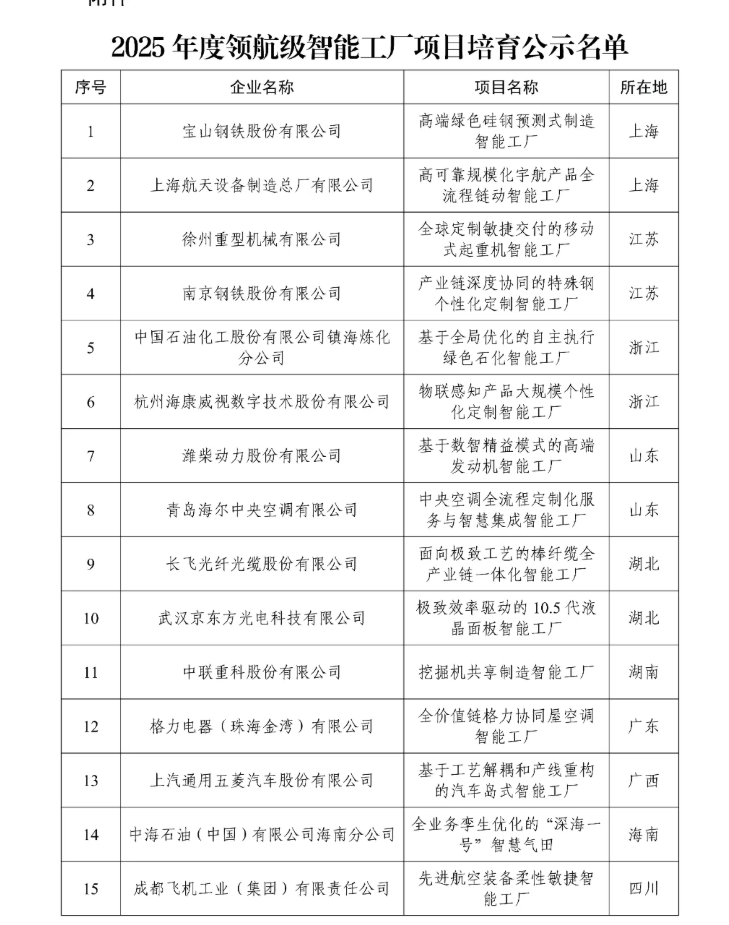
Core Insights - The 10th World Intelligent Manufacturing Conference was held in Nanjing, China, from November 26 to 29, where the first batch of 15 "Leading Intelligent Factories" was announced, aiming to accelerate the construction of a globally influential intelligent manufacturing model [1][2] - The conference gathered practitioners, suppliers, and experts in intelligent manufacturing to discuss its development and future, highlighting the importance of enabling technologies in driving industrial transformation [1][3] - The "Leading Intelligent Factory" standard is considered equivalent to the international "Lighthouse Factory" standard, focusing on digital transformation, network collaboration, and intelligent change [2] Group 1: Leading Intelligent Factories - The 15 selected "Leading Intelligent Factories" span key industries such as equipment manufacturing, raw materials, electronic information, and consumer goods, showcasing the breadth and depth of China's intelligent manufacturing [2] - Notable examples include Weichai Power, which improved production efficiency by 10.6% through a digital lean model, and Hikvision, which reduced production line changeover time by 50% using self-developed IoT, AI, and big data technologies [2] Group 2: Future of Intelligent Manufacturing - The next decade of intelligent manufacturing in China is expected to unfold in two phases: the first phase involves large enterprises achieving basic digital transformation, while the second phase sees the widespread adoption of Intelligent Manufacturing 2.0 [1][3] - The concept of "Intelligent Manufacturing 2.0" is anticipated to reshape the manufacturing technology system, production modes, and industry forms, leading to the realization of Industry 4.0 [3][4] - The "Leading Action Plan" was jointly advocated by leaders of the selected factories, emphasizing the need for open collaboration to build a new ecosystem for industrial synergy [3]


去世界智能制造大会 看见“未来”
Shang Hai Zheng Quan Bao· 2025-11-28 09:26
Core Insights - The 10th World Intelligent Manufacturing Conference opened in Nanjing, showcasing advancements in intelligent manufacturing and robotics [1][3] - The first batch of 15 "Leading Intelligent Factories" was announced, highlighting the focus on digital transformation and intelligent upgrades in manufacturing [2][4] Group 1: Intelligent Manufacturing Developments - Intelligent manufacturing is significantly reducing order delivery cycles by 55% and new product development cycles by 50% [3] - The "Leading Intelligent Factories" initiative aims to create a global benchmark for manufacturing, focusing on digital transformation and networked collaboration [4][6] Group 2: Leading Intelligent Factories - The 15 selected factories span key industries such as equipment manufacturing, raw materials, electronics, and consumer goods [5] - Notable companies include Baosteel, Shanghai Aerospace Equipment, and Xuzhou Heavy Machinery, each with specific innovative projects [5] Group 3: Robotics Industry Growth - China's industrial robot shipments are projected to reach 294,000 units in 2024, with Nanjing being a leader in production and R&D [7][8] - Nanjing has developed a complete industrial chain for robotics, with over 200 companies contributing to a market that represents 10% of the national scale [8] Group 4: Future of Intelligent Manufacturing - The concept of Intelligent Manufacturing 2.0 is emerging, integrating AI with advanced manufacturing technologies to drive the next industrial revolution [10] - The development of intelligent manufacturing in China is expected to progress in two phases, with significant advancements by 2035 [10]
AI 驱动 智链未来炸裂登陆 CPCA 展会,带你沉浸式解锁产业智能化革命
半导体行业观察· 2025-10-25 03:19
Core Viewpoint - The article highlights the upcoming "AI-Driven Smart Chain Future - 2025 Electronic Circuit and Semiconductor Industry Innovation Forum," which will take place on October 28, 2025, in Shenzhen. This forum aims to explore the integration of AI with the electronic circuit and semiconductor industries, presenting opportunities for innovation and growth in these sectors [1][17]. Agenda Overview - The forum will feature seven key topics that cover various aspects of AI's impact on industry, from technology implementation to global strategies [2][3]. - The first session will discuss the "Made in China" sentiment in overseas cloud computing and AI applications, focusing on the technological strengths and market strategies of Chinese companies [3][19]. - The second session will address the transformation in smart manufacturing, emphasizing AI's role in enhancing decision-making capabilities and operational efficiency [4][20]. - The third session will explore future storage technologies under AI-native architectures, identifying emerging trends in the storage sector [5][21]. - The fourth session will focus on AI-driven R&D innovations and collaborative design processes, highlighting efficiency improvements in research and development [6][21]. - The fifth session will delve into millimeter-wave wireless isolation technology, discussing its potential to solve signal issues in electronic circuits and its implications for the industry [7][21]. - The sixth session will cover advanced packaging EDA flows and their role in enhancing computing power for AI chips, providing insights for industry professionals [9][21]. - The final session will address legal risks and compliance strategies for PCB enterprises operating globally, offering guidance on navigating legal challenges [10][21]. Organizers and Significance - The forum is organized by the China Electronic Circuit Industry Association (CPCA) and Semiconductor Industry Observation (Semi-insights), combining industry authority and innovative insights to provide a platform for understanding AI trends and seizing industry opportunities [12][23].