服务即增长

Search documents
2026年,淘宝天猫优化营商环境“放大招”!商家的增长红利来了!
Xin Lang Cai Jing· 2026-01-23 13:10
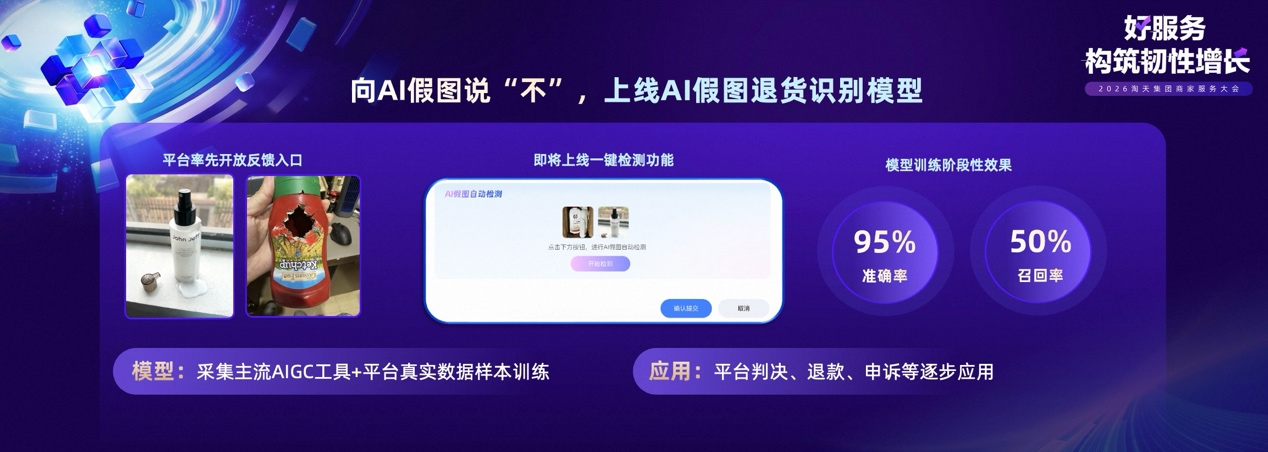
Core Insights - Taobao Tmall is enhancing its business environment in 2026 with new initiatives aimed at supporting merchants and driving growth [2][4][24] Group 1: Business Environment Optimization - In 2026, Taobao Tmall will implement ten new measures to optimize the business environment, including an AI fake image recognition model and a return mismatch mutual trust mechanism [4][35] - The AI fake image governance will help detect fraudulent return requests using AI-generated images, protecting merchants from losses [4][35] - The return mismatch mutual trust mechanism aims to address common malicious refund behaviors, expanding the number of merchants involved and providing them with exclusive rights [7][37] Group 2: Service as a Growth Driver - The focus of competition in the e-commerce sector is shifting from mere traffic and price wars to deeper competition based on product quality and service [40][41] - Taobao Tmall is promoting a "service equals growth" strategy, providing merchants with a clear path to achieve sustainable growth through improved service offerings [39][40] - The platform will enhance the real experience score system, rewarding merchants for good service across various dimensions such as product quality and logistics speed [45][46] Group 3: Merchant Support and Recognition - High-scoring merchants (above 4.8) will be invited to participate in a "good service" list, increasing their visibility and potential customer engagement [47] - A new customer service certification system will be introduced, allowing specialized customer service representatives to gain recognition and improve customer satisfaction [49] - Increased investment in AI services will enable merchants to better understand customer needs and enhance operational efficiency [21][50] Group 4: Performance Metrics - In 2025, merchants with high service levels saw user repurchase rates and net GMV double compared to those with lower service levels [52] - The introduction of the real experience score has significantly accelerated growth for high-scoring merchants, with sales growth rates for those scoring above 4.8 being 2.2 times higher than average [52][53]



电商的下一步转型,是要让好人赚钱
3 6 Ke· 2026-01-23 04:28
Core Viewpoint - The e-commerce industry in China is facing significant challenges as it transitions from a "low-price for volume" model to one focused on service growth, which is essential for survival in a competitive market [2][19]. Group 1: Current Challenges - E-commerce is experiencing three main dilemmas: traffic, supply, and trust [3][4]. - The growth logic of e-commerce, previously based on "lower prices, increased traffic, and growth," is no longer effective, with online retail growth rates declining from 14.75% in 2021 to nearly zero in 2024 [4]. - Customer acquisition costs have surged from tens of yuan to 800-1000 yuan, with some platforms exceeding four-digit costs [4]. - The excessive price wars have created a "lemon market," where quality products are pushed out, leaving only inferior goods available [5]. Group 2: Trust Issues - Trust between merchants and consumers is deteriorating, with over 60% of merchant complaints during the 2024 Double Eleven shopping festival related to "only refunds" [6]. - Merchants face operational pressures and must deal with issues like malicious refund requests and AI-generated false images, leading to a lack of confidence in the market [6][10]. Group 3: Service as a Solution - The solution to the industry's challenges lies in improving service and rebuilding connections with consumers [8]. - However, merchants are reluctant to invest in service improvements due to the existing e-commerce mechanisms that prioritize immediate results over long-term service benefits [9]. - The current financial models treat service as a cost center, making it difficult for merchants to justify service investments [9]. Group 4: Need for Structural Change - A fundamental shift in the e-commerce paradigm is necessary, moving from a focus on single transactions to fostering repeat purchases [17][18]. - The industry must address the distribution of benefits and change algorithms, models, and rules to encourage service-oriented practices [11][12]. - Initiatives like the introduction of a real experience score by Taobao and Tmall aim to link service quality directly to traffic distribution, promoting a more service-oriented ecosystem [14]. Group 5: Future Outlook - The e-commerce sector must overcome its current challenges to avoid becoming a marketplace for low-quality goods [21][22]. - A successful transition to a service-oriented model could serve as a reference for other industries facing similar structural issues [20].
淘宝天猫加码营商环境优化,账号诚信体系累计为商家挽回40亿损失
Jin Rong Jie· 2026-01-22 05:12
Core Insights - Taobao Tmall is enhancing its business environment with new measures aimed at reducing costs and increasing efficiency for merchants, including the introduction of an AI-based fake image recognition model and a return mismatch trust mechanism [1][4][6] Group 1: New Initiatives - The launch of an AI fake image recognition model to combat fraudulent claims in the after-sales process, providing merchants with a one-click detection feature [1][2] - Establishment of a return mismatch trust mechanism to reduce merchant losses, expanding the pilot program to more brands and offering exclusive rights such as key evidence recognition and user purchase limits [4] - Introduction of industry-specific dispute resolution rules to decrease the rate of disputes, with a notable 40% reduction in disputes in the electric vehicle sector [6] Group 2: Enhancements to Existing Systems - The account integrity system has recovered over 4 billion yuan for merchants, with ongoing improvements to address issues like false returns and refund fraud [8] - The real experience score system has shown that high-scoring merchants (4.8 and above) have a transaction growth rate 2.2 times higher than average merchants, with plans to further enhance the scoring system [10] - Implementation of a risk management mechanism to alert merchants about pricing errors and stock shortages, projected to save over 200 million yuan in losses [11] Group 3: Operational Support - A reduction in logistics compensation rates is expected to save merchants over 1 billion yuan annually, alongside enhanced pre-warning systems for logistics anomalies [12] - The introduction of an intelligent after-sales ecosystem, with tools that have helped recover over 840 million yuan in refunds for merchants [13] - Upgrades to the store manager hotline to address various operational issues, achieving a problem resolution rate of over 85% since its launch [14]
淘宝明确服务即增长!2026电商转向价值竞争
Sou Hu Cai Jing· 2026-01-21 19:17
Core Insights - The Chinese e-commerce industry is entering a deep adjustment period in 2025, with unsustainable competition based on price cuts and subsidies leading to a focus on user retention and service quality [2][11] - Major e-commerce platforms, particularly Taobao and Tmall, are shifting their strategies to support high-quality merchants, emphasizing service experience as a key growth driver [4][11] Industry Trends - User demographics are changing, with the 80s and Z generations accounting for nearly 50% of consumption, leading to higher expectations for service quality and emotional value in shopping experiences [5][12] - The "real experience score" system launched by Taobao Tmall in 2025 has become an industry benchmark, promoting a shift from price competition to service and experience-oriented operations [2][10] New Initiatives - Taobao Tmall has introduced four major initiatives to enhance the "service equals growth" concept: 1. Upgrading the real experience score system to make service operational [6][8] 2. Launching a "good service" leaderboard to increase visibility for high-quality service providers [7][9] 3. Providing tiered customer service certifications to encourage specialized service offerings [8][10] 4. Leveraging AI tools to improve service efficiency and experience [10][19] Merchant Strategies - Merchants are encouraged to understand the new rules of service scoring and optimize their service offerings to gain immediate benefits in terms of traffic and customer acquisition [16][20] - A shift in organizational structure is necessary, with a focus on building a service-oriented culture that positions service as a key differentiator [17][20] - Merchants should adopt a productized approach to service, ensuring that services are measurable and deliverable, thus enhancing customer satisfaction and loyalty [18][20] Future Outlook - The e-commerce industry is expected to transition from scale-driven growth to quality-driven growth, with service becoming a core metric for assessing business health [23][24] - The integration of online and offline experiences will blur the lines between e-commerce and traditional retail, enhancing customer engagement and service delivery [24]