
期货保证金

Search documents
金银价继续重挫,CME今年第三次上调金银期货保证金比例
Xin Lang Cai Jing· 2026-02-06 00:22
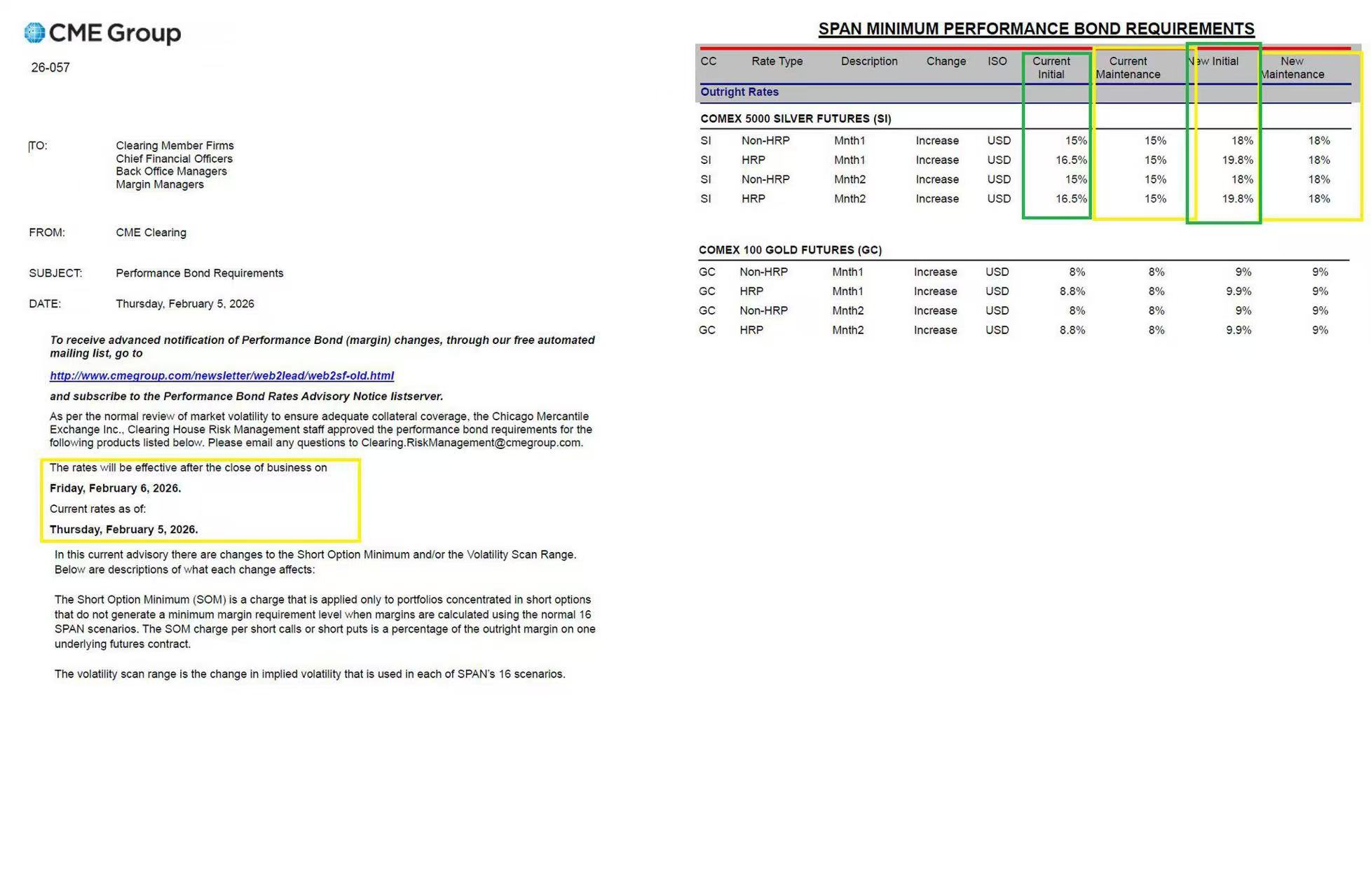
Core Viewpoint - The Chicago Mercantile Exchange (CME) has announced an increase in margin requirements for gold and silver futures, reflecting heightened volatility and price fluctuations in precious metals markets. Group 1: Margin Requirement Changes - CME raised the initial margin for COMEX 100 gold futures from 8% to 9% and for COMEX 5000 silver futures from 15% to 18%, effective after the close on February 6 [1] - This marks the third increase in margin requirements by CME since 2026, indicating ongoing adjustments in response to market conditions [4] - On January 12, CME shifted to a percentage-based margin calculation for gold, silver, platinum, and palladium futures, moving away from a fixed amount method [4] Group 2: Recent Price Movements - International silver prices experienced a significant drop after a brief rebound, with silver falling to $66.55 per ounce, down 5.86% on the day, while gold fell below $4,700 per ounce, down 1.56% [1][5] - Silver prices had previously surged to a high of $92 per ounce before the recent decline, highlighting the volatility in the market [5] - The adjustments in margin requirements come amid these dramatic price movements, particularly following substantial declines in gold and silver prices observed on January 31 [4]


银价大跳水!盘中、盘后,交易所接连出手“降温”;特朗普称将提高对韩国关税,美军航母打击群正部署中东
Qi Huo Ri Bao· 2026-01-27 00:37
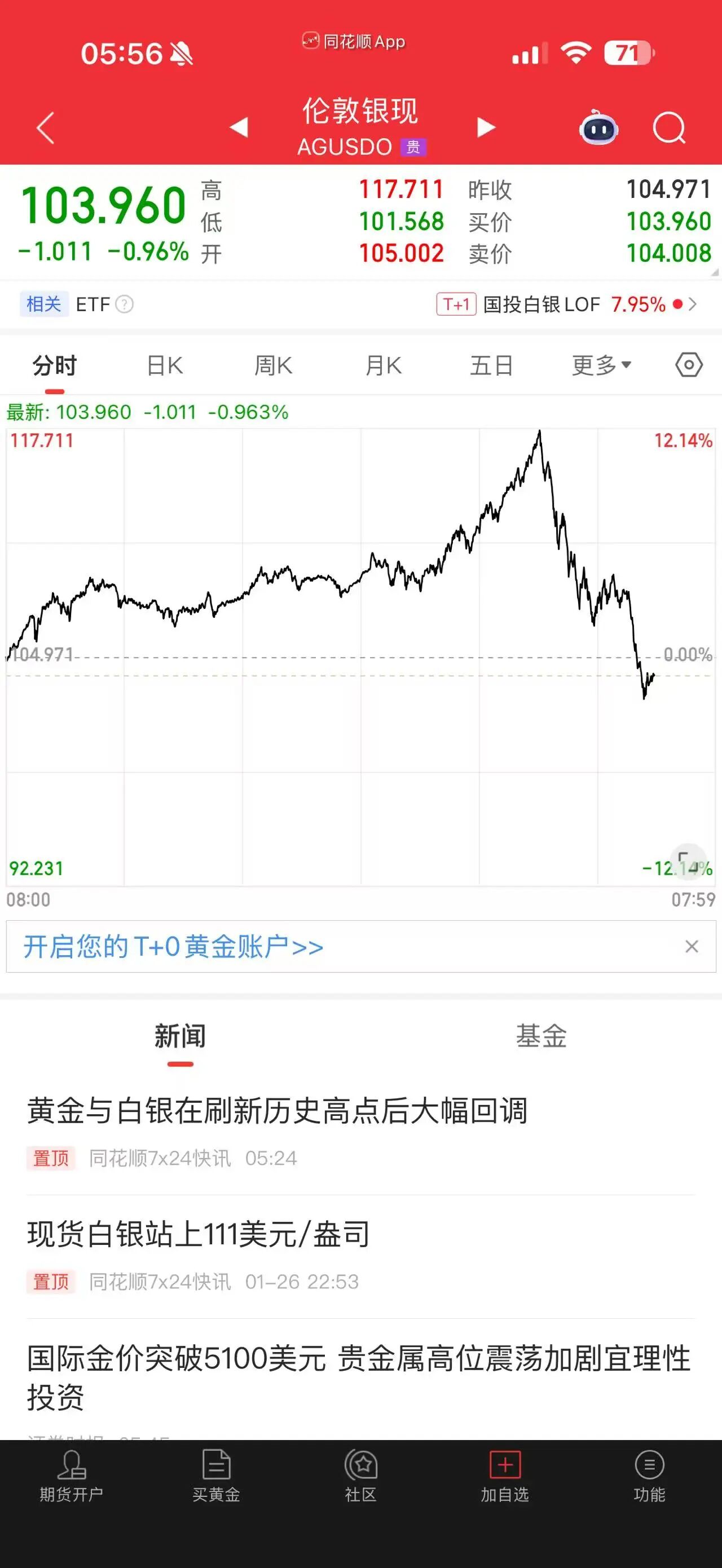
Group 1 - Silver prices accelerated, with London silver spot prices increasing by 12% and New York silver futures rising over 16% on January 26 [1] - However, both gold and silver prices experienced a significant pullback, with London silver spot prices dropping to approximately $103 per ounce from a high of $117 per ounce, and London gold spot prices falling below $5000 per ounce from around $5100 per ounce [1][11] - The London gold spot price closed down 0.77% at $5000.2 per ounce, while London silver spot price decreased by 1.54% to $103.3 per ounce, reflecting a drop of nearly $14 from its intraday high [11] Group 2 - Analysts noted that the recent surge in silver prices is driven by a combination of macroeconomic policies, industrial demand expectations, and market sentiment [17] - The core drivers for the rise in silver prices include increased risk aversion and a weakening dollar, with funds rotating into "high beta" assets like silver following strong gold price movements [17] - The supply-demand structure for silver indicates a long-term structural imbalance, with a projected supply gap of around 3000 tons in 2026, marking the fifth consecutive year of supply shortages [18][19] Group 3 - The recent volatility in silver prices is exacerbated by adjustments in trading limits by exchanges, with the Shanghai Futures Exchange making multiple changes to silver futures trading limits over the past month [13] - The increase in geopolitical risks, such as tensions between the U.S. and Iran, and concerns over key metal supplies are contributing to the bullish outlook for silver prices [17][19] - Market participants are advised to approach trading with caution, emphasizing risk management and structured trading strategies due to the potential for significant price fluctuations [19]
黄金又跌价了,26年1月22日金条降价,国内黄金、金条新价格
Sou Hu Cai Jing· 2026-01-23 18:39
Core Viewpoint - International gold prices have experienced a pullback after reaching a high in mid-January, leading to a cooling effect in the domestic market, with noticeable pricing discrepancies across different channels [1][2]. Group 1: International and Domestic Pricing - International gold prices peaked at $4,636 per ounce on January 14, then retreated to around $4,595, with a brief spike to $4,690 around January 19 [2]. - In the Shanghai market, as of January 22, 2026, spot gold prices fell to 1,084 RMB per gram, with futures around 1,090 RMB per gram and base gold prices at approximately 1,093 RMB per gram [2]. - Retail gold prices in major stores ranged from 1,247 to 1,506 RMB per gram, with mainstream brands priced around 1,493 to 1,498 RMB per gram [2]. Group 2: Factors Influencing Price Movements - The recent price pullback is attributed to multiple factors, including profit-taking at historical highs and programmed trading mechanisms that trigger sell orders at key price levels [4]. - Macro factors exerting pressure on gold prices include the Federal Reserve's signals of not rushing to cut interest rates, which strengthens the dollar and suppresses gold prices, while geopolitical risks provide support for safe-haven demand [4]. Group 3: Domestic Market Pricing Discrepancies - Domestic gold price reductions do not equate to uniform consumer costs due to three main reasons: differences in processing fees, brand premiums, and regional price variations [6]. - Processing fees for complex designs can add 300 to 500 RMB per gram, significantly impacting total costs even when gold prices decline [6]. - Regional price differences can be as high as 300 RMB per gram, influenced by logistics, policies, and competition [6]. Group 4: Technical Signals and Central Bank Purchases - Key technical levels to monitor include support around $4,575 per ounce and the psychological barrier at $4,600, with potential for amplified volatility due to leveraged funds adjusting positions [8]. - The People's Bank of China has been increasing its gold reserves, with a reported total of 74.15 million ounces as of December 2025, indicating a continued strategy to enhance financial security amid uncertainty [8]. Group 5: Strategies for Investors - Investors are advised to separate investment decisions from consumption, focusing on gold bars or ETFs to minimize costs associated with processing fees and brand premiums [10]. - For those looking to purchase for personal use, it is recommended to buy during price corrections and to compare prices across different stores and channels [10]. - When planning to liquidate gold, it is crucial to understand weighing methods, discount rules, and quality assessment processes to avoid unexpected costs [10].
周二白银价格反弹
Xin Lang Cai Jing· 2025-12-30 16:01
Group 1 - Silver prices have rebounded after record highs and sharp declines, influenced by traders considering margin increases from the Chicago Mercantile Exchange (CME) and industry demand [1][2] - Tesla CEO Elon Musk warned that soaring silver prices could impact vehicle manufacturing for Tesla (TSLA) [1][2] - The CME has raised margin requirements for futures contracts, which is a significant factor in the current market dynamics [1][2]