模拟计算

Search documents
能效比提升超228倍 我国科学家研制出新型芯片
Ke Ji Ri Bao· 2026-01-23 00:55
Core Insights - The research team from Peking University has developed a new analog computing chip for non-negative matrix factorization, significantly improving processing speed and energy efficiency compared to current digital chips [1][2] Group 1: Technology Overview - Non-negative matrix factorization (NMF) is a powerful data dimensionality reduction technique used in various fields such as recommendation systems, bioinformatics, and image processing [1] - Traditional digital hardware struggles with real-time processing demands due to computational complexity and memory bottlenecks when handling large-scale datasets [1] Group 2: Chip Performance - The new chip, based on resistive random-access memory (RRAM), achieves approximately 12 times faster computation speed and over 228 times better energy efficiency compared to advanced digital chips [1][2] - In image compression tasks, the chip maintains image quality while reducing storage space by half, and in recommendation system applications, it shows prediction error rates comparable to digital chip results [2] - In the MovieLens 100k dataset training task, the analog calculator achieved a speed improvement of 212 times and an energy efficiency improvement of 46,000 times compared to mainstream programmable digital hardware [2] Group 3: Implications for Industry - This research opens new pathways for real-time solutions to constrained optimization problems like non-negative matrix factorization, showcasing the potential of analog computing in handling complex real-world data [2] - The advancements could lead to innovations in real-time recommendation systems, high-definition image processing, and genetic data analysis, contributing to more efficient and lower-power artificial intelligence applications [2]
国产芯片上新!能效比提升超228倍
Xin Lang Cai Jing· 2026-01-22 11:00
Core Insights - The research team from Peking University has developed a new analog computing chip for non-negative matrix factorization, significantly improving processing speed and energy efficiency compared to current digital chips [1][2]. Group 1: Technology Overview - Non-negative matrix factorization (NMF) is a powerful data dimensionality reduction technique used in various fields such as recommendation systems, bioinformatics, and image processing [1]. - Traditional digital hardware struggles with real-time processing of large datasets due to computational complexity and memory limitations [1]. - The new chip utilizes resistive random-access memory (RRAM) and features a reconfigurable compact generalized inverse circuit, optimizing the core computation steps of NMF [1]. Group 2: Performance Validation - The research team built a testing platform to validate the chip's performance in typical scenarios, achieving minimal image quality loss in image compression while saving 50% of storage space [2]. - In recommendation system applications, the chip demonstrated a 212-fold speed increase and a 46,000-fold energy efficiency improvement compared to mainstream programmable digital hardware on the MovieLens 100k dataset [2]. - For the Netflix dataset, the chip achieved a speed improvement of approximately 12 times and an energy efficiency increase of over 228 times compared to advanced digital chips [2]. Group 3: Implications for Industry - This research opens new pathways for real-time solutions to constrained optimization problems like NMF, showcasing the potential of analog computing in handling complex real-world data [2]. - The advancements could lead to innovations in real-time recommendation systems, high-definition image processing, and genetic data analysis, contributing to more efficient and lower-power artificial intelligence applications [2].
能效比提升超228倍 我国科学家研制出新芯片
Ke Ji Ri Bao· 2026-01-22 06:27
Core Insights - The research team from Peking University has developed a new analog computing chip for non-negative matrix factorization, significantly improving computational speed and energy efficiency compared to current digital chips [1][2]. Group 1: Technology Overview - Non-negative matrix factorization (NMF) is a powerful data dimensionality reduction technique used in various fields such as recommendation systems, bioinformatics, and image processing [1]. - Traditional digital hardware struggles with real-time processing demands due to computational complexity and memory bottlenecks when handling large-scale datasets [1]. Group 2: Chip Performance - The new analog computing chip demonstrates a speed increase of approximately 12 times and an energy efficiency improvement of over 228 times compared to advanced digital chips in Netflix dataset applications [2]. - In the MovieLens 100k dataset recommendation system training task, the analog computing solution achieved a speed enhancement of 212 times and an energy efficiency boost of 46,000 times compared to mainstream programmable digital hardware [2]. Group 3: Applications and Implications - This research opens new pathways for real-time solutions to constrained optimization problems like non-negative matrix factorization, showcasing the potential of analog computing in handling complex real-world data [2]. - The advancements could lead to innovations in real-time recommendation systems, high-definition image processing, and genetic data analysis, contributing to more efficient and lower-power artificial intelligence applications [2].
新型专用计算芯片成功研发
Huan Qiu Wang Zi Xun· 2026-01-22 01:12
Core Insights - The article discusses a breakthrough in computing technology by a research team at Peking University, which has developed a new type of specialized computing chip that significantly enhances computational speed and energy efficiency compared to traditional digital chips [1][2]. Group 1: Technological Advancements - The new chip architecture provides a dedicated hardware acceleration solution for complex computational tasks, achieving approximately 12 times faster computation speed and over 228 times better energy efficiency compared to advanced digital chips [1][2]. - The research focuses on a core task in machine learning known as non-negative matrix factorization, which is essential for extracting patterns from large datasets in various applications such as image analysis and personalized recommendations [1]. Group 2: Innovation in Computing - The team has innovatively shifted towards analog computing, creating a non-negative matrix factorization solver based on resistive switching memory, which is likened to a highly customized "smart key" for specific tasks [2]. - The prototype system successfully demonstrated high-quality decomposition of color images and efficiently processed training tasks for movie recommendation datasets, achieving performance nearly equivalent to digital chips [2]. Group 3: Future Implications - This advancement opens new pathways for real-time solutions to constrained optimization problems, showcasing the potential of analog computing in handling complex real-world data [2]. - The high-efficiency specialized chips are expected to significantly enhance the real-time responsiveness of personalized recommendations and provide faster, more energy-efficient computational support for generative AI training [2].
绕开光刻机“卡脖子” 中国新型芯片问世!专访北大孙仲:支撑AI训练和具身智能 可在28纳米及以上成熟工艺量产
Mei Ri Jing Ji Xin Wen· 2025-12-30 00:36
Core Viewpoint - A Chinese research team has developed a novel high-precision, scalable analog matrix computing chip based on resistive random-access memory (RRAM), achieving 24-bit fixed-point precision for the first time globally, which allows for reduced computational card usage for similar tasks [1][12]. Group 1: Technology and Innovation - The new chip represents a significant leap in precision, reducing the relative error from 1% to one part in ten million (10^-7), thus addressing the historical precision bottleneck of analog computing [7][15]. - The chip can support advanced applications such as 6G, embodied intelligence, and AI model training, and can be produced using mature processes of 28nm and above, circumventing the bottleneck of photolithography [1][12]. - The research team has introduced a new feedback circuit and utilized classic iterative optimization algorithms to enhance precision without sacrificing energy efficiency or speed [11][15]. Group 2: Market and Application Potential - The chip is particularly suited for applications requiring large-scale matrix operations, such as AI model training, 6G communications, and supercomputing tasks, which are fundamentally based on matrix calculations [10][20]. - The team aims to scale the matrix size from 16x16 to 128x128 within two years, with a long-term goal of reaching 512x512, which would enable practical applications in medium-scale scenarios [24][25]. - The technology provides a potential alternative to reliance on advanced processes and NVIDIA GPUs, positioning the team at the forefront of modern analog computing [10][26]. Group 3: Strategic Importance - This development offers a "detour" for China's computing capabilities, potentially reducing dependence on advanced manufacturing processes and foreign technology [10][26]. - The successful demonstration of this new path confirms its potential, although significant investment and collaboration across the technology and industry sectors will be necessary to fully realize its capabilities [10][26].

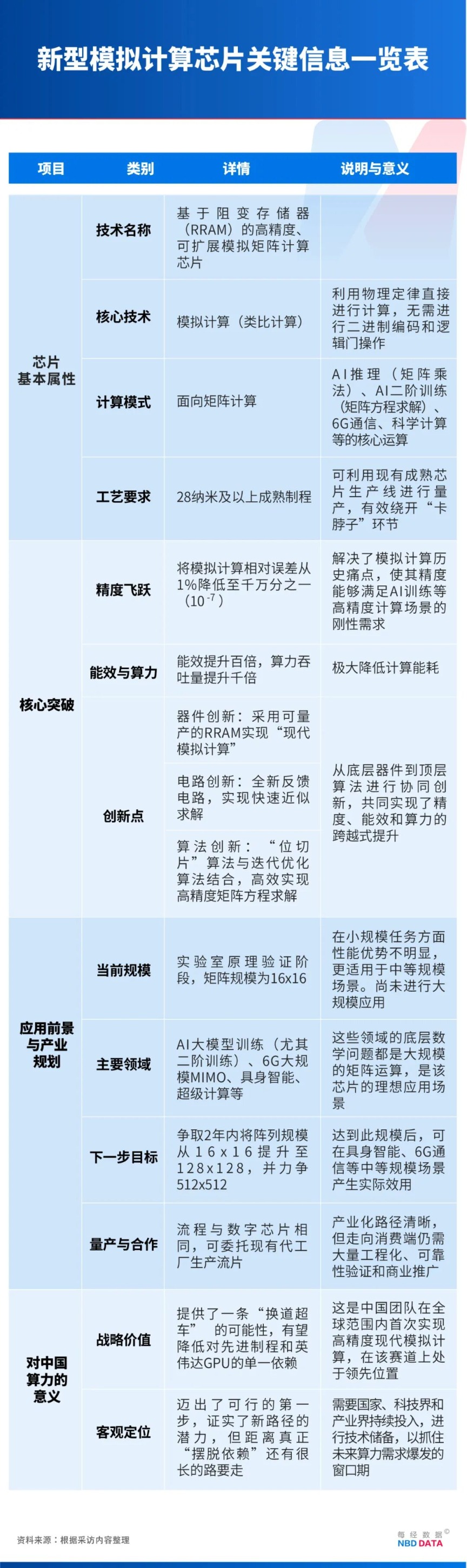
绕开光刻机“卡脖子”,中国新型芯片问世!专访北大孙仲:支撑AI训练和具身智能,可在28纳米及以上成熟工艺量产
Mei Ri Jing Ji Xin Wen· 2025-12-29 10:20
Core Insights - A Chinese research team has developed a new type of chip based on resistive random-access memory (RRAM) that achieves a precision of 24-bit fixed-point accuracy in analog matrix computations, marking a significant advancement in computational efficiency and energy consumption for AI applications [2][12][15] - This chip can support various cutting-edge applications, including 6G communication, embodied intelligence, and AI model training, while being produced using mature 28nm technology, thus avoiding reliance on advanced lithography processes [2][4][10] Technology Overview - The new chip represents a departure from traditional digital computing paradigms, which rely on binary logic and silicon-based transistors, to a more efficient analog computing approach that directly utilizes physical laws for calculations [4][6][15] - The precision of analog computing has been significantly improved, reducing relative error from 1% to one part in ten million (10⁻⁷), which is crucial for large-scale computations where errors can accumulate exponentially [8][12][15] Innovation Highlights - The chip's innovations include the use of RRAM as a core component, a novel feedback circuit design that minimizes energy consumption while enhancing accuracy, and the implementation of classic iterative optimization algorithms for efficient matrix equation solving [15][16] - The chip's architecture allows for high-speed, low-power solutions to matrix equations, making it suitable for applications that require rapid computations, such as second-order training methods in AI [19][21] Application Potential - The chip is particularly well-suited for medium-scale applications, such as AI model training and 6G MIMO systems, where it can outperform traditional digital chips [18][25] - Future plans include scaling the chip's matrix size from 16x16 to 128x128 within two years, with aspirations to reach 512x512, which would enhance its applicability in various computational scenarios [25][26] Strategic Value - This development provides China with a potential alternative to reliance on advanced processes and NVIDIA GPUs, positioning the country favorably in the global computational landscape [10][11] - The successful demonstration of this new computing paradigm is seen as a critical step towards addressing future computational demands, emphasizing the need for ongoing investment in technology and infrastructure [11][26]

【科技日报】2025国内十大科技新闻解读
Ke Ji Ri Bao· 2025-12-25 06:46
Group 1: DeepSeek AI Model - The Chinese AI company DeepSeek launched its open-source model DeepSeek-R1, which has gained global attention due to its low training costs and high performance in tasks like mathematical reasoning and code generation [2][3] - DeepSeek-R1's core competitiveness lies in its systematic innovation in computational efficiency, demonstrating that top-tier reasoning capabilities can be achieved without massive labeled data, significantly reducing training costs [2][3] - The model's open-source approach breaks technological monopolies, allowing developers worldwide to participate in its ecosystem, which has attracted hundreds of thousands of developers [2] Group 2: Nuclear Fusion and Quantum Computing - China's "artificial sun," the EAST device, achieved a world record by maintaining a plasma temperature of 100 million degrees Celsius for 1000 seconds, marking a significant step towards practical nuclear fusion energy [4] - The superconducting quantum computing prototype "Zuchongzhi 3" was developed, showcasing a computational speed that is a trillion times faster than the current fastest supercomputers, indicating a major advancement in quantum computing capabilities [5][6] Group 3: Advanced Materials and Brain-Computer Interfaces - A research team successfully created large-area two-dimensional metallic materials, marking a significant breakthrough in the field of two-dimensional materials [7] - China initiated its first invasive brain-computer interface clinical trial, allowing participants to control devices through thought, utilizing advanced flexible neural electrodes that minimize brain tissue damage [8][9] Group 4: Lunar Exploration and Plant Biology - The Chang'e 6 mission revealed the evolutionary history of the moon's far side, providing insights into volcanic activity and magnetic fields, which are crucial for understanding lunar geology [11][12] - A research team uncovered the molecular mechanisms behind how a single plant cell can develop into a complete plant, addressing a long-standing scientific question in plant biology [13] Group 5: Technological Innovations in Computing - Researchers developed a high-precision, scalable analog matrix computing chip, achieving digital-level precision in analog computing, which could revolutionize computational tasks in AI and communications [14][15] Group 6: National Strategic Initiatives - The 20th Central Committee of the Communist Party of China emphasized the importance of technological innovation in its strategic planning for the next five years, aiming to enhance China's technological self-reliance and drive new productive forces [16][17] Group 7: Military Advancements - China's first electromagnetic catapult aircraft carrier, Fujian, was commissioned, representing a leap in naval technology by utilizing advanced electromagnetic launch systems, enhancing operational capabilities [18]
2025国内十大科技新闻解读
Ke Ji Ri Bao· 2025-12-25 01:00
Group 1: Artificial Intelligence Developments - The Chinese AI company DeepSeek launched the open-source model DeepSeek-R1, which has gained global attention due to its low training costs and high performance in tasks like mathematical reasoning and code generation [2] - DeepSeek-R1's core competitiveness lies in its systematic innovation in computational efficiency, achieving top-tier reasoning capabilities without the need for massive labeled data [2][3] - The model's open-source approach aims to break technological monopolies, allowing developers worldwide to participate in its ecosystem [2] Group 2: Nuclear Fusion Research - China's "artificial sun," the EAST device, achieved a world record by maintaining a plasma temperature of 100 million degrees Celsius for 1000 seconds, marking a significant step towards practical nuclear fusion [4] - The high-confinement operation mode is crucial for future fusion reactors, indicating that the experiment has successfully simulated the necessary conditions for sustained fusion [4] Group 3: Quantum Computing Advancements - The "Zu Chongzhi No. 3" superconducting quantum computing prototype was developed, demonstrating a computational speed that surpasses the fastest supercomputers by trillions of times [5][6] - This prototype achieved the highest level of quantum computing superiority, showcasing its potential for various applications in quantum error correction and simulation [6] Group 4: Material Science Innovations - A research team successfully created large-area two-dimensional metallic materials, marking a significant advancement in the field of material science [7] - This breakthrough allows for the production of ultra-thin metals, potentially opening new avenues for research in two-dimensional materials [7] Group 5: Brain-Computer Interface Trials - China initiated its first invasive brain-computer interface clinical trial, positioning itself as the second country globally to enter this phase of technology [8][9] - The trial utilizes flexible neural electrodes that minimize damage to brain tissue, enhancing the safety and effectiveness of the procedure [8] Group 6: Lunar Exploration Findings - The Chang'e 6 mission revealed the evolutionary history of the moon's far side, providing insights into volcanic activity and the moon's magnetic field [11][12] - This research fills a significant gap in lunar studies, highlighting the moon's geological history and the impact of large-scale collisions on its evolution [11][12] Group 7: Agricultural Biotechnology Breakthroughs - A research team unveiled the molecular mechanisms behind how a single plant cell can develop into a complete plant, addressing a long-standing scientific challenge [13] - This discovery could pave the way for advancements in agricultural biotechnology, particularly in overcoming regeneration bottlenecks [13] Group 8: Computing Architecture Innovations - Researchers developed a high-precision, scalable analog matrix computing chip, achieving precision comparable to digital computing systems [14][15] - This innovation addresses the challenges of computational efficiency in AI and 6G communications, marking a significant breakthrough in computing paradigms [15] Group 9: National Strategic Initiatives - The 20th Central Committee of the Communist Party of China emphasized the role of technological innovation in driving economic development in its 14th Five-Year Plan [16][17] - The plan outlines specific strategies to enhance original innovation and integrate technological advancements with industrial development [16][17] Group 10: Military Advancements - China's first electromagnetic catapult aircraft carrier, the Fujian, was commissioned, representing a leap in naval technology with its advanced launch capabilities [18] - This carrier enhances operational capabilities and signifies a transition to a new era in the Chinese navy, showcasing advancements in military technology [18]
成立仅2月,这家AI初创公司种子轮融资33亿,贝索斯也出手了
Sou Hu Cai Jing· 2025-12-13 10:20
Core Insights - Unconventional AI, a startup founded by Naveen Rao, raised $475 million in seed funding, achieving a post-money valuation of $4.5 billion, marking one of the largest early-stage funding rounds in the AI chip sector [2][3] - The company aims to develop energy-efficient neuromorphic computing chips, challenging the current digital computing paradigm dominated by GPUs [11][12] Company Overview - Unconventional AI was established just two months prior to its funding announcement, with a founding team that includes experts from MIT, Stanford, and former Google engineers, providing a strong foundation in hardware, software, and neuroscience [3] - Rao's previous entrepreneurial successes include Nervana Systems, which was acquired by Intel for approximately $400 million, and MosaicML, which was sold to Databricks for $1.3 billion [8][9] Technology and Innovation - The company seeks to redefine AI computing hardware by developing chips optimized for AI workloads, leveraging insights from neuroscience to achieve higher energy efficiency [11][12] - Unconventional AI's approach contrasts with the prevailing "scaling laws" in AI, which rely on increasing computational power and data size, by focusing on the inherent physical properties of semiconductors for more efficient computation [12][13] Market Context - The AI industry has seen significant investment in "Neo-Labs," which prioritize long-term foundational research over immediate product commercialization, with Unconventional AI being a notable example [17][18] - The recent funding round reflects a shift in investor focus from short-term financial metrics to the potential of visionary founders and their ability to address fundamental challenges in AI infrastructure [20]

成立仅2月,这家AI初创公司种子轮融资33亿,贝索斯也出手了
创业邦· 2025-12-13 03:05
Core Insights - Unconventional AI, a startup founded by Naveen Rao, raised $475 million in seed funding, achieving a post-money valuation of $4.5 billion, marking a record in early-stage financing within the AI hardware sector [3][4]. - The company aims to develop next-generation digital computing by designing simulation chips inspired by neuroscience principles, addressing the energy consumption challenges faced by traditional AI computing [15][19]. Company Overview - Unconventional AI was established just two months prior to its significant funding round, with a founding team that includes experts from MIT, Stanford, and former Google engineers, providing a comprehensive capability chain from theory to application [5][7]. - Rao's previous entrepreneurial successes include Nervana Systems, which was acquired by Intel for approximately $400 million, and MosaicML, which was sold to Databricks for $1.3 billion [12][14]. Technological Vision - The company seeks to redefine AI computing hardware architecture by creating high-efficiency simulation chips tailored for AI workloads, diverging from the traditional reliance on GPUs [17][20]. - Unconventional AI's approach contrasts with the prevailing "scaling laws" in AI development, which emphasize increasing computational power and data size, by focusing on energy efficiency and the probabilistic nature of AI tasks [18][24]. Industry Context - The rise of "Neo-Lab" startups, like Unconventional AI, reflects a shift in the AI landscape where founders with proven track records are attracting significant investment for long-term foundational research rather than immediate product commercialization [25][26]. - The funding environment is increasingly favoring companies that challenge existing paradigms in AI development, as evidenced by the substantial valuations of similar startups [28].