比特币现货ETF

Search documents
美伊和谈今日开启,加密市场小幅上涨,比特币现货etf本周大额流入,币安人生暴涨,交易所老板们嘴炮持续【Vic TALK第1631期】
Vic TALK· 2026-04-11 04:43
okx dex钱包折扣注册链接:https://web3.okx.com/ul/joindex?ref=VIC666 币安钱包手续费折扣码:https://web3.binance.com/referral?ref=JO8ZTLYX 推特:https://x.com/victalk6886 币安链接:https://www.binance.com/activity/referral-entry/CPA?ref=CPA_00AJKYPKEA 电报群:https://t.me/joinchat/EN6OG4vXZLw4MDg1 Telegram :victalk2021 #web3 #binance #eth #btc #crypto #币安 # #meme #川普 #比特币 #trump #$TRUMP #川普币 #马斯克 #gork ...


比特币暴跌警示风险重重
Jing Ji Ri Bao· 2026-02-26 22:01
Core Viewpoint - The recent sharp decline in Bitcoin prices is primarily attributed to the weakening of the US tech sector and a decrease in risk appetite in international financial markets, with a heightened dependence on institutional funds in the crypto asset market [1][2] Group 1: Market Dynamics - Bitcoin's price has recently plummeted below $70,000, reaching a low of around $60,000, marking a 16-month low and resulting in over $2 billion in liquidations across the crypto market within 24 hours [1] - Compared to its historical peak of $126,000 in October 2025, Bitcoin has erased half of its market value [1] - The volatility of Bitcoin is not surprising to industry insiders, as significant price fluctuations are inherent to highly financialized crypto assets [1][2] Group 2: Institutional Involvement - The current crypto market is characterized by deep institutional involvement, which has led to rapid growth in stablecoins and Real World Assets (RWA), replacing the previous speculative model dominated by small-cap tokens [3] - Institutional investment strategies are expected to evolve beyond passive holding of mainstream assets, focusing on high-performance public chains, blockchain infrastructure, and exploring non-financial applications of blockchain technology [3] Group 3: Risk Factors - The primary risks affecting Bitcoin's future price movements include macroeconomic factors such as interest rate expectations, dollar liquidity, and changes in risk appetite, which directly impact the valuation of high-volatility assets [4] - The potential for a "hard landing" in the US economy or a global recession could exert further downward pressure on Bitcoin's valuation [4] - Regulatory developments and geopolitical tensions are also significant external risk factors that may continue to suppress market risk appetite and induce volatility [4] Group 4: Regulatory Environment - China maintains a prohibitive stance on cryptocurrency-related activities, with recent notifications from the People's Bank of China and other departments reinforcing the illegality of virtual currency exchanges and token issuance within the country [4][5] - Investors in China are advised to avoid any form of cryptocurrency trading or illegal tokenization activities to safeguard their financial security [5]
比特币暴跌59万人爆仓,中国8部门停虚拟币,坚决不跟美国疯
Sou Hu Cai Jing· 2026-02-10 19:12
Group 1 - Bitcoin experienced a dramatic decline, dropping over 10% in a single day to around $60,000, down from a peak of $126,000 in October, resulting in a market capitalization halving and significant losses for investors [1] - Over 590,000 investor accounts were forcibly liquidated within 24 hours, leading to a total loss of $2.705 billion, with Bitcoin-related liquidations accounting for more than half of this amount [1] - The largest single loss reported was $12.02 million, highlighting the severe impact of the market crash on individual investors [1] Group 2 - On February 6, Chinese regulatory authorities, including the People's Bank of China and the China Securities Regulatory Commission, issued a significant document declaring all virtual currency-related activities as illegal financial activities within China [3] - The notification explicitly prohibits any trading, promotion, or technical support related to virtual currencies, tightening regulatory measures to an unprecedented level [3][5] - Financial institutions are banned from providing account opening and fund transfer services for virtual currency activities, and internet companies are prohibited from offering platforms for such activities [3] Group 3 - The contrasting approaches between China and the U.S. regarding virtual currencies stem from fundamentally different perceptions and risk assessments of cryptocurrencies [4] - The U.S. is exploring a conditional integration of Bitcoin into the mainstream financial system, aiming to maintain control over pricing and regulatory frameworks, while China prioritizes risk prevention [4][5] - China's regulatory stance is driven by concerns over the speculative nature of virtual currencies, which are seen as tools for money laundering and financial fraud [5] Group 4 - The recent regulatory notification expands the scope of illegal financial activities to include the tokenization of real-world assets (RWA) and prohibits foreign entities from issuing stablecoins pegged to the Chinese yuan [7] - This measure aims to prevent the integration of traditional assets into the blockchain and to safeguard the legal status of the yuan against potential challenges from digital currencies [7] Group 5 - The volatility and high leverage characteristic of the cryptocurrency market have led to a rapid sell-off, exacerbated by macroeconomic factors such as rising interest rate expectations from the Federal Reserve [8] - The combination of these factors has created a precarious environment for investors, with the potential for cascading liquidations as prices decline [8] Group 6 - China's strict regulatory measures are viewed as protective, aimed at safeguarding the financial stability and security of its citizens, preventing the emergence of a high-risk speculative bubble [10] - The government's clear stance is to maintain control over its financial sovereignty and ensure that virtual currencies do not gain a foothold in the domestic market [10]
Bitcoin Price Liquidity Gap Widening: Big Boys Bought $1.2Bn But Retailers Sold
Yahoo Finance· 2026-01-23 07:03
Core Insights - The approval of the first nine spot Bitcoin ETFs by the SEC in January 2024 marks a significant turning point for Bitcoin and the broader cryptocurrency industry [1] - Institutional investors, managing substantial funds, are now able to invest in Bitcoin through regulated ETFs, reducing the influence of retail traders [2] - The immediate market reaction saw Bitcoin prices rise towards the $70,000 level, with institutions rapidly acquiring Bitcoin, contributing billions to the market [3] Market Dynamics - The total cryptocurrency market capitalization has surged to over $3 trillion, with Bitcoin trading at nearly $90,000, significantly above previous highs [4] - Institutional investors have become the primary drivers of Bitcoin price movements, overshadowing retail traders [4][6] - The liquidity in Bitcoin trading has improved, allowing for easier accumulation of Bitcoin without causing significant price volatility [5] Institutional Investment - Spot Bitcoin ETF issuers currently manage over $115 billion in Bitcoin for various institutions, a figure expected to grow as adoption increases [7] - The structure of spot Bitcoin ETFs simplifies the investment process for institutions, eliminating the need for wallets and private key management [7]
交易员2025年“最后一搏” 比特币连续第二天冲击9万关口失败
Zhi Tong Cai Jing· 2025-12-30 22:23
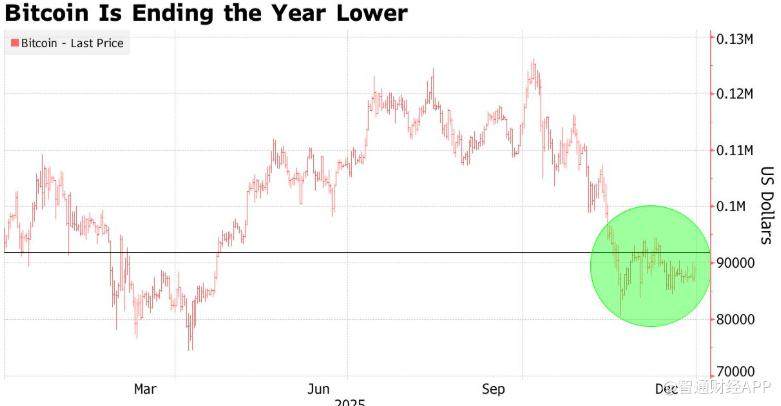
Group 1 - Bitcoin traders are attempting a "last-ditch effort" to recover year-to-date losses before the end of the year, but their efforts have been thwarted again as Bitcoin struggles to break the $90,000 mark [1] - Since experiencing a significant pullback in October, Bitcoin has remained in a trading range of approximately $85,000 to $95,000, with a year-to-date decline of about 5%, potentially marking its first annual drop in three years [3] - The market liquidity is low during the year-end period, which may amplify price volatility, and it is advised to avoid over-interpreting short-term signals until liquidity normalizes [3] Group 2 - The demand for Bitcoin spot ETFs has cooled, contributing to price suppression, with a net outflow of $6 billion in the fourth quarter as institutional investors adopt a cautious stance while Bitcoin remains below $90,000 [3] - Overall, Bitcoin's year-end performance is under pressure due to low liquidity, continuous capital outflows, and ongoing macroeconomic uncertainties, making it difficult to escape the current trading range in the short term [4]
12 月 26 日比特币现货 ETF 总净流出 2.76 亿美元
Xin Lang Cai Jing· 2025-12-28 06:02
Core Insights - The total net outflow of Bitcoin spot ETFs reached $276 million as of December 26, marking a continuous outflow for six days [1] - The Blackrock ETF IBIT experienced the highest single-day net outflow of $193 million on December 26, while its historical total net inflow stands at $62.056 billion [1] Summary by Category - **Market Performance** - Bitcoin spot ETFs have seen a total net outflow of $276 million over the last six days [1] - The Blackrock ETF IBIT had a significant single-day net outflow of $193 million on December 26 [1] - **Historical Data** - The historical total net inflow for the Blackrock ETF IBIT is recorded at $62.056 billion [1]
比特币为何涨不动了?
Guo Ji Jin Rong Bao· 2025-11-17 15:48
Core Viewpoint - Bitcoin has fallen below the $100,000 mark, erasing over 30% of its gains for the year, with a recent low of $93,778.6, indicating a significant market correction driven by various macroeconomic factors and changes in investor sentiment [1][2]. Market Dynamics - The recent decline in Bitcoin's price is attributed to a shift in market expectations regarding the Federal Reserve's interest rate policies, leading to a synchronized pressure on global risk assets [2]. - The liquidity in the market has decreased, exacerbating the downward trend, as many exchange-traded funds (ETFs) have seen capital outflows, and long-term holders are cashing out profits [2][5]. - The psychological barrier of $100,000 has led to increased selling pressure, with institutional funds withdrawing and a lack of new liquidity entering the market [2][5]. Historical Context - Bitcoin has experienced multiple corrections since first surpassing $100,000, with significant drops occurring in early 2025, influenced by geopolitical concerns and security incidents [3]. - The current downturn is seen as a result of compounded factors, including macroeconomic risks, market structure issues, and investor psychology, similar to past market corrections [3][4]. Long-term Outlook - Despite short-term pressures, Bitcoin's long-term potential remains, supported by increasing institutional participation and a healthier market structure [7]. - Analysts suggest that once a substantial interest rate cut cycle begins, Bitcoin could see renewed upward momentum as funds are reallocated across asset classes [7]. - The current liquidity constraints are viewed as a temporary effect from recent market shocks, with the potential for Bitcoin to find a new equilibrium and open up upward price movement in the future [7].
比特币24小时跌至9.3万美元、回吐年内全部涨幅,长期逻辑仍待验证
Di Yi Cai Jing· 2025-11-17 13:08
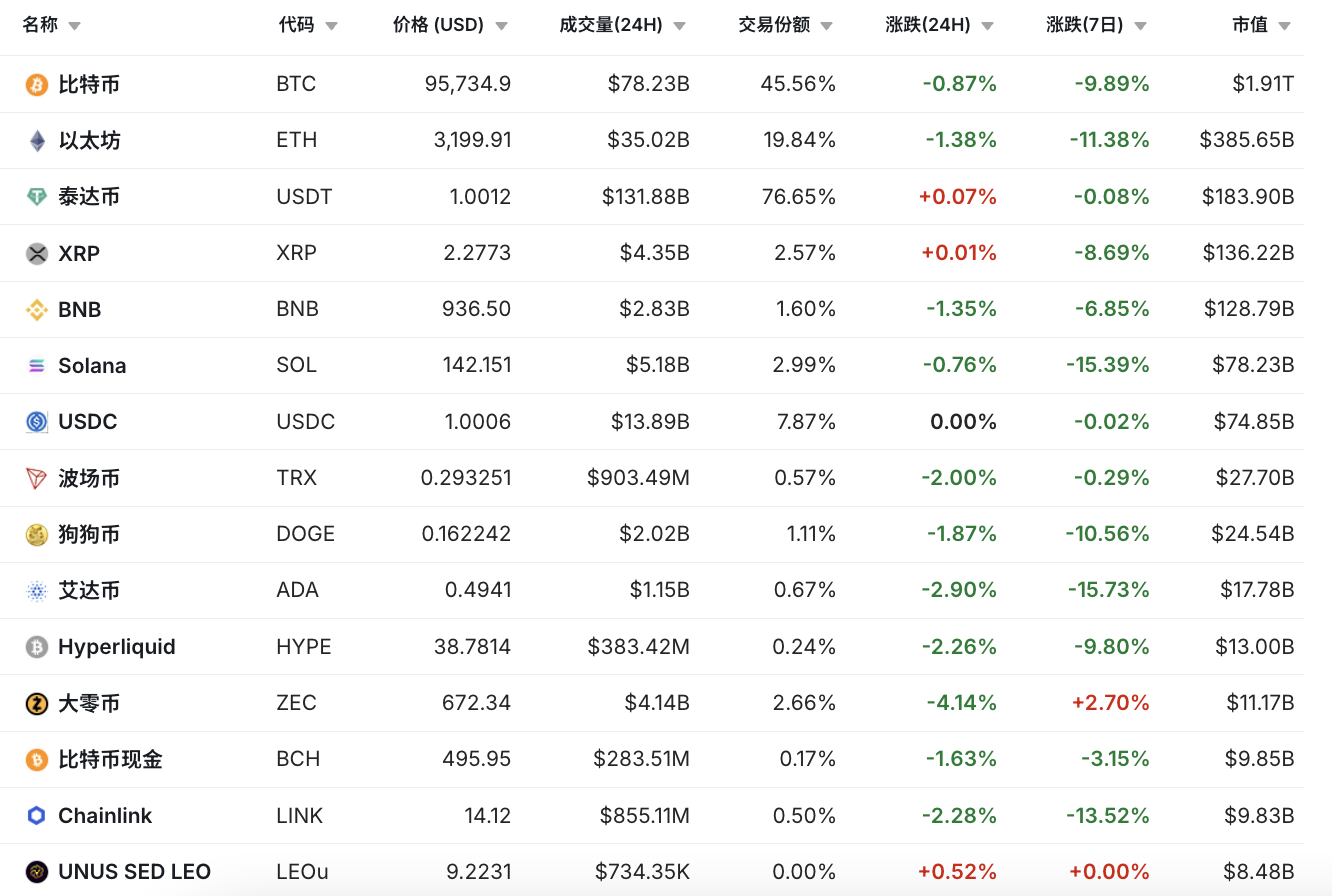
Core Viewpoint - The recent decline in major cryptocurrencies, including Bitcoin and Ethereum, is attributed to multiple pressures from macroeconomic expectations, funding conditions, and trading sentiment, leading to a significant drop in risk appetite among investors [4][5][6]. Market Performance - On November 17, Bitcoin's price fell to a low of $93,714, erasing all gains made in 2023, with a market capitalization loss of approximately $600 billion since its peak in October [1][3]. - Ethereum also experienced a decline, dropping below $3,200, with a 7-day decrease of 11.38% [3][4]. - Other cryptocurrencies, such as XRP, BNB, and Solana, also faced varying degrees of decline [3][4]. Market Pressures - The decline is not due to a single event but rather a combination of macroeconomic uncertainties, funding pressures, and weakened trading sentiment [4][5]. - There is a lack of consensus regarding the Federal Reserve's policy direction, leading to fluctuating expectations for interest rate cuts, which has negatively impacted risk assets [4]. - The Bitcoin spot ETF, which had previously shown strong performance, has seen continuous net outflows since September, contributing to the decline in market liquidity [4][5]. Trading Environment - The market is experiencing heightened vulnerability due to a significant liquidation event on October 11, which has left investors cautious [5][6]. - High leverage levels and fluctuating investor sentiment have made the market more susceptible to liquidity shocks [5][6]. - Recent data indicates that over 230,000 trading accounts were liquidated in a 24-hour period, amounting to over $1 billion, primarily affecting Bitcoin and major altcoin contracts [6]. Long-term Outlook - Despite the short-term volatility, the long-term narrative for Bitcoin as a hedge against inflation and geopolitical risks remains intact, but it requires time to establish itself as a mature asset class [8]. - Key variables influencing future market direction include the improvement of ETF channels, clarity in global regulatory environments, and sustained demand for on-chain finance and cross-border payments [8]. - Analysts suggest that while recent declines may correct excessive risk appetite and valuation deviations, the structural vulnerabilities of the crypto market compared to traditional financial assets still pose significant risks [8].
2025年11月10日比特币与以太坊行情分析
Sou Hu Cai Jing· 2025-11-10 11:53
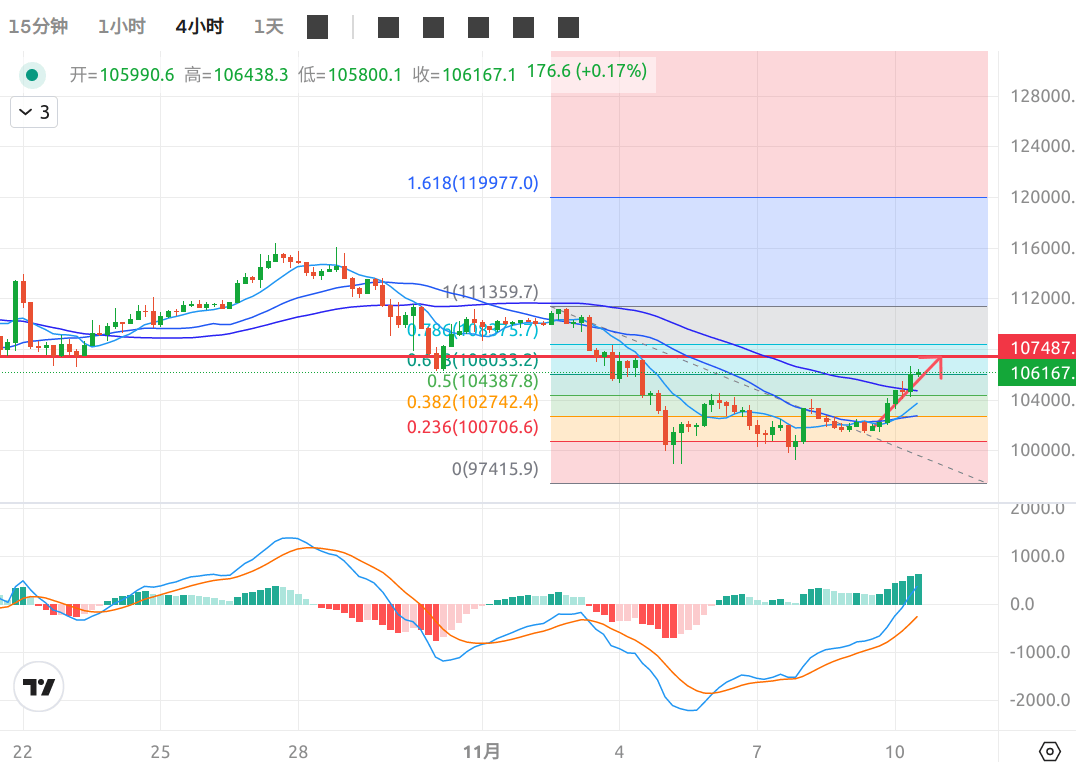
Group 1: Bitcoin - Bitcoin experienced a narrow fluctuation between $102,000 and $105,000, breaking through key resistance with a peak at $105,000 [1] - The current price is stable above $104,000, with limited short-term pullback potential and an upward channel intact, targeting $106,500 to $110,000 [1] - Institutional funds continue to flow in, with Bitcoin spot ETF management scale surpassing $60 billion, and long-term holders' supply ratio reaching 78% [1] Group 2: Ethereum - Ethereum followed Bitcoin's upward trend, breaking $3,600 with a daily increase of over 6%, targeting $3,670 to $3,700 [3] - Whale investors accumulated over 1.6 million ETH in October, indicating a potential accumulation phase, with historical data showing an average November increase of nearly 7% [3] - The number of active addresses on the Ethereum network has risen, suggesting increased user participation, while stable Gas fees indicate manageable network congestion [3]
比特币“减半后必跌”规律失效了?
日经中文网· 2025-10-31 07:51
Core Viewpoint - Bitcoin is currently experiencing a high price range despite historical trends suggesting a downturn after halving events, attributed to the increasing influence of institutional investors [2][6][10]. Group 1: Bitcoin Halving and Market Trends - Bitcoin's issuance is designed to halve approximately every four years, with the latest halving occurring in April 2024, leading to a significant price increase of 70% over the following year and a half [4][6]. - Historical patterns indicate that after previous halvings, Bitcoin prices typically entered a prolonged decline within 1.5 years, but this trend has not materialized in the current cycle [6][11]. - The current market volatility for Bitcoin is notably low, with a volatility rate below 2%, contrasting sharply with previous halving periods where volatility exceeded 5% [6][10]. Group 2: Institutional Investor Influence - The rise of institutional investors is reshaping the Bitcoin market, with notable entities like Harvard University and UAE sovereign wealth funds increasing their Bitcoin holdings [7]. - The number of individual accounts holding between 0.01 BTC and 1 BTC has decreased by 2% over the past year, indicating a shift away from retail investors [7][8]. - Conversely, accounts holding between 100 BTC and 1000 BTC have increased by over 20%, reflecting a growing presence of institutional and corporate investors [8]. Group 3: Market Sentiment and Future Outlook - Daily Bitcoin issuance is approximately 450 BTC, while the daily inflow from Bitcoin ETFs is around $140 million, suggesting a strong demand from institutional investors [10]. - Options trading data indicates a bullish sentiment among investors, with a significant number of call options at strike prices of $120,000 and $140,000 [10]. - Despite the optimistic outlook, concerns remain regarding the potential impact of declining stock prices of companies heavily invested in Bitcoin, which could lead to reduced buying activity [10].