
汽车行业价格合规

Search documents
车企定价得按新规!市场监管总局出手,汽车价格合规指南来了
Nan Fang Du Shi Bao· 2026-02-13 07:27
Core Viewpoint - The National Market Supervision Administration has released the "Guidelines for Price Behavior Compliance in the Automotive Industry," which outlines compliance requirements for price behavior of automotive manufacturers and sales enterprises, emphasizing principles such as legality, transparency, equality, and integrity [1]. Group 1: Price Behavior of Automotive Manufacturers - The guidelines specify that automotive manufacturers must establish pricing strategies based on production costs and market supply and demand, implementing comprehensive price management across all sales and financial service channels [3]. - Manufacturers are required to create clear rebate policies, which must be agreed upon in contracts with dealers, and respect the dealers' autonomy in pricing [3]. - The guidelines prohibit price discrimination among operators under the same trading conditions and forbid collusion on prices between manufacturers and component suppliers [3][4]. Group 2: Price Behavior of Automotive Sales Enterprises - The guidelines detail the requirements for sales enterprises to clearly display pricing information in physical and online locations, prohibiting any hidden charges [3]. - Sales promotions must be transparently communicated, including the rules, duration, and limitations, along with accurate information about any gifts offered [3]. Group 3: Prohibited Pricing Practices - The guidelines explicitly ban practices that lead to "disguised price reductions," such as selling vehicles below production costs or using deceptive methods to lower effective prices [4]. - Specific prohibited actions include offering discounts or subsidies that result in prices below production costs, and engaging in non-equivalent exchanges that lower effective prices [4].

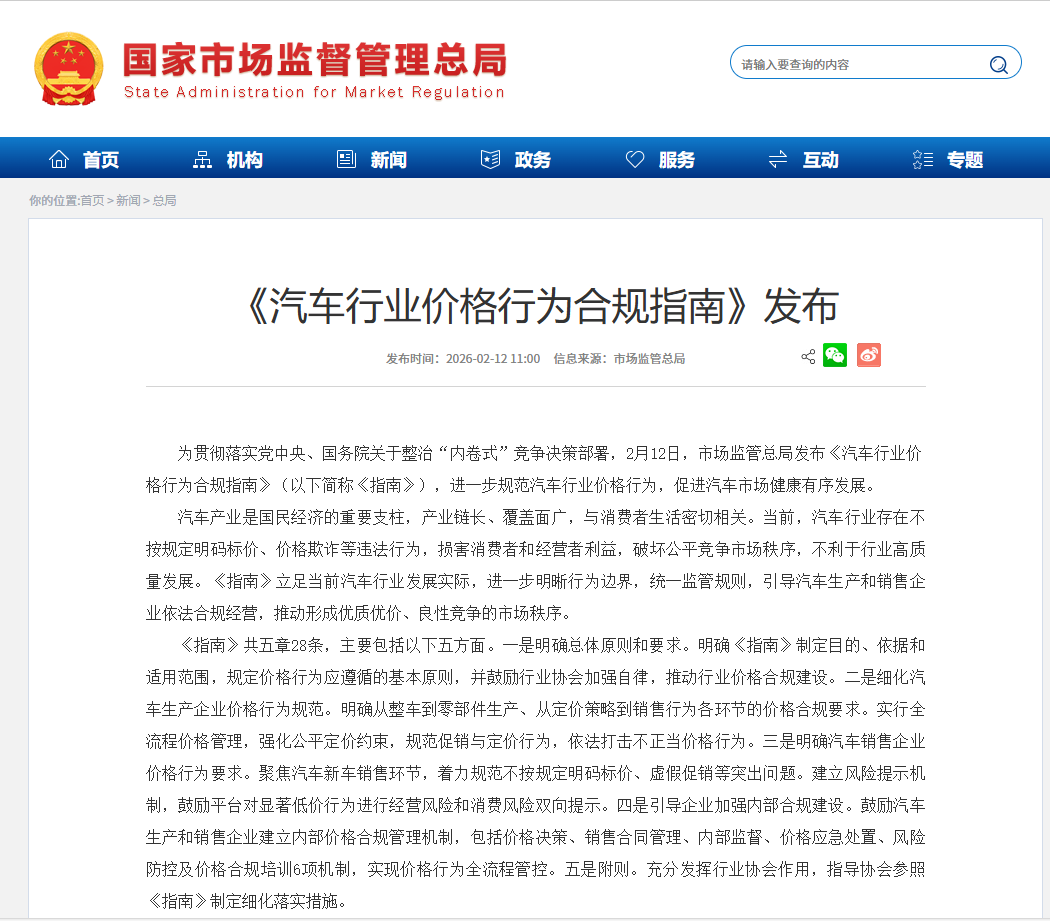
小米汽车发声明
Guan Cha Zhe Wang· 2026-02-13 00:02
Core Viewpoint - The release of the "Automotive Industry Price Behavior Compliance Guidelines" by the State Administration for Market Regulation is a significant measure to standardize competition in the automotive industry, protect consumer rights, and promote high-quality development in the sector [1][12]. Group 1: Guidelines Overview - The guidelines aim to clarify behavioral boundaries, unify regulatory rules, and guide automotive production and sales enterprises to operate in compliance with the law, fostering a market order characterized by quality and fair pricing [2][12]. - The guidelines consist of five chapters and 28 articles, focusing on various aspects of price behavior in the automotive industry [3][13]. Group 2: Key Principles and Requirements - The guidelines outline the overall principles and requirements, including the purpose, basis, and scope of application, while encouraging industry associations to enhance self-discipline and promote price compliance [4][15]. - They specify price behavior norms for automotive manufacturers, detailing compliance requirements from vehicle production to pricing strategies and sales practices, emphasizing full-process price management and fair pricing constraints [5][16]. Group 3: Sales and Internal Compliance - The guidelines address price behavior requirements for automotive sales enterprises, focusing on issues like failure to display prices clearly and false promotions, and establishing a risk warning mechanism for significantly low pricing [6][16]. - They encourage automotive manufacturers and sales enterprises to establish internal price compliance management mechanisms, covering price decision-making, sales contract management, internal supervision, emergency response, risk prevention, and compliance training [8][16]. Group 4: Role of Industry Associations - The guidelines emphasize the importance of industry associations in guiding the development of detailed implementation measures based on the guidelines [9][17].
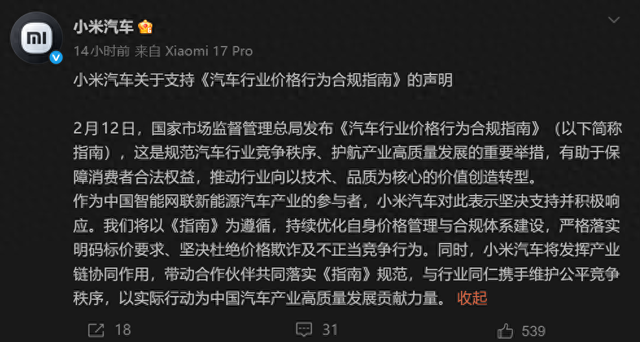
市场监管总局发布指南 28条措施规范汽车行业价格行为
Zhong Guo Zheng Quan Bao· 2026-02-12 20:38
Core Viewpoint - The National Market Supervision Administration has released the "Guidelines for Compliance in Pricing Behavior in the Automotive Industry" to standardize pricing practices and promote healthy market development in the automotive sector [1]. Group 1: Overview of the Guidelines - The automotive industry is a crucial pillar of the national economy, with a long supply chain and wide coverage, closely related to consumer life [1]. - Current issues in the automotive sector include non-compliance with clear pricing regulations and price fraud, which harm consumer and operator interests and disrupt fair competition [1]. - The guidelines aim to clarify behavioral boundaries, unify regulatory rules, and guide automotive manufacturers and sales enterprises to operate legally and compliantly [1]. Group 2: Key Contents of the Guidelines - The guidelines consist of five chapters and 28 articles, outlining overall principles and requirements, including the purpose, basis, and scope of application [1]. - They specify pricing behavior norms for automotive manufacturers, detailing compliance requirements from vehicle production to pricing strategies and sales actions [1]. - The guidelines emphasize full-process price management, reinforcing fair pricing constraints, and regulating promotional and pricing behaviors while legally combating improper pricing practices [1]. Group 3: Focus on Automotive Sales Enterprises - The guidelines specifically address pricing behavior requirements for automotive sales enterprises, focusing on new car sales and regulating issues like non-compliance with clear pricing and false promotions [1]. - A risk warning mechanism is established to encourage platforms to provide dual warnings regarding significant low pricing behaviors, addressing both operational and consumer risks [1]. Group 4: Internal Compliance Mechanisms - Enterprises are encouraged to strengthen internal compliance by establishing mechanisms for price decision-making, sales contract management, internal supervision, emergency price handling, risk prevention, and price compliance training [2]. - This aims to achieve full-process control over pricing behaviors within automotive production and sales enterprises [2].
剑指“内卷式”竞争 规范定价和促销
Xin Lang Cai Jing· 2026-02-12 17:28
Core Viewpoint - The Market Regulation Administration has released the "Automotive Industry Pricing Behavior Compliance Guidelines" to address "involution-style" competition and to standardize pricing and promotional practices in the automotive sector [1][2]. Group 1: Pricing Behavior Compliance - The guidelines specify compliance requirements for pricing behavior across all stages, from vehicle manufacturing to parts production, and from pricing strategies to sales practices [1][4]. - The guidelines aim to implement comprehensive price management, strengthen fair pricing constraints, and regulate promotional and pricing behaviors while legally combating improper pricing practices [1][4]. Group 2: Sales Practices Regulation - The guidelines focus on the new car sales segment, addressing issues such as non-compliance with clear pricing regulations and false promotions [2][4]. - Automotive sales enterprises are required to clearly display pricing information in physical locations and online platforms, prohibiting additional charges beyond the stated price [4][5]. Group 3: Consumer Protection Measures - The guidelines detail forms of price fraud, explicitly prohibiting misleading pricing, false comparisons, and failure to fulfill pricing commitments [5]. - The guidelines encourage platforms to provide dual risk warnings for significantly low-priced offerings, ensuring transparency in service charges and prohibiting practices such as charging without service or duplicate charges [5].
市场监管总局:促进汽车市场健康有序发展
Qi Huo Ri Bao Wang· 2026-02-12 16:21
Core Viewpoint - The release of the "Automotive Industry Price Behavior Compliance Guidelines" by the State Administration for Market Regulation aims to standardize pricing behavior in the automotive industry, promoting healthy and orderly market development [1]. Group 1: Overall Principles and Requirements - The guidelines clarify their purpose, basis, and scope of application, establishing basic principles for pricing behavior and encouraging industry associations to enhance self-discipline and promote price compliance within the industry [2]. Group 2: Pricing Behavior Norms for Automotive Manufacturers - The guidelines detail pricing behavior norms for automotive manufacturers, covering all aspects from vehicle to component production, pricing strategies, and sales behaviors. It emphasizes full-process price management, fair pricing constraints, and the regulation of promotional and pricing behaviors, while legally combating improper pricing practices [2]. Group 3: Pricing Behavior Requirements for Automotive Sales Enterprises - The guidelines focus on the new car sales segment, addressing issues such as failure to display prices as required and false promotions. A risk warning mechanism is established to encourage platforms to provide dual warnings regarding significant low-price behaviors, covering both operational and consumer risks [2]. Group 4: Internal Compliance Construction for Enterprises - The guidelines encourage automotive manufacturers and sales enterprises to establish internal price compliance management mechanisms, which include price decision-making, sales contract management, internal supervision, emergency price handling, risk prevention, and price compliance training, ensuring comprehensive control over pricing behaviors [2]. Group 5: Supplementary Provisions - The guidelines propose leveraging the role of industry associations to guide them in formulating detailed implementation measures based on the guidelines [3].
明码标价、整治虚假促销、规范付费解锁 市场监管总局发布《汽车行业价格行为合规指南》
Xin Lang Cai Jing· 2026-02-12 15:27
Core Viewpoint - The "Guidelines for Compliance with Pricing Behavior in the Automotive Industry" aims to regulate market pricing order, curb vicious competition, and protect the legitimate rights and interests of consumers and operators, promoting high-quality development in the automotive sector [3][4]. Group 1: Pricing Strategies and Compliance - Automotive manufacturers are required to establish pricing strategies based on production costs and market supply and demand, ensuring compliance across the entire pricing behavior chain [3][4]. - Clear rebate policies must be formulated and agreed upon with dealers in advance, respecting their autonomy in pricing and adhering to principles of fair trade and equal negotiation [3][4]. Group 2: Legal Risks in Pricing Behavior - Significant legal risks arise from price collusion among automotive manufacturers, including fixing or changing vehicle and component prices, and agreeing on uniform pricing standards [3][4]. - Manufacturers face legal risks if they implement pricing behaviors aimed at eliminating competition or monopolizing the market, such as selling below production costs or using deceptive practices to lower prices [4][7]. Group 3: Sales Practices and Consumer Protection - Automotive sales enterprises must clearly display vehicle information and actual prices, prohibiting additional charges not disclosed upfront [5][6]. - Misleading pricing tactics, such as using deceptive language or false comparisons, are subject to legal risks, emphasizing the need for transparency in promotional activities [6][7]. Group 4: Responsibilities of Sales Platforms - Automotive trading platforms are required to respect the pricing autonomy of operators and must not impose unreasonable restrictions or conditions on pricing [7][8]. - Platforms should provide timely risk warnings regarding unusually low pricing behaviors and cooperate with regulatory inspections [7]. Group 5: Internal Compliance Mechanisms - Automotive production and sales enterprises are encouraged to establish internal pricing compliance management mechanisms to coordinate and supervise pricing compliance efforts [8].
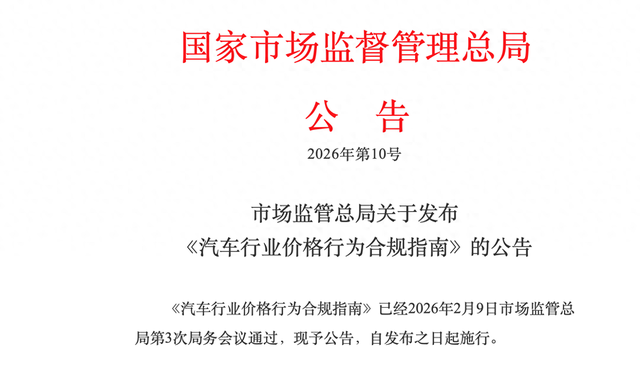
多项操作存重大法律风险!市场监管总局发布《汽车行业价格行为合规指南》
经济观察报· 2026-02-12 10:42
Core Viewpoint - The article discusses the release of the "Automobile Industry Pricing Behavior Compliance Guidelines" by the State Administration for Market Regulation, marking the first systematic regulatory framework for pricing behavior in the automotive industry at the national level [2]. Group 1: Overview of the Guidelines - The guidelines consist of five chapters and twenty-eight articles, covering manufacturers, authorized dealers, automotive sales companies, and emerging automotive trading platforms [2]. - The guidelines aim to unify regulatory standards and clarify legal boundaries to guide enterprises in compliant operations [2]. Group 2: Prohibitions and Regulations for Manufacturers - Manufacturers are prohibited from selling vehicles and parts below production costs to eliminate competition [2]. - Practices such as disguised loss sales through discounts, subsidies, or other means are classified as "significant legal risks" [2]. - Price collusion between manufacturers and parts suppliers is explicitly banned [2]. Group 3: Pricing and Transparency for Sales Enterprises - Sales enterprises must clearly display pricing information, including model, configuration, standard parameters, and optional parts [4]. - The sales price should be determined by dealers independently, not based on manufacturer suggested retail prices, to avoid misleading consumers [4]. - Additional fees beyond the displayed price are prohibited, and delivery timelines must be communicated if vehicles cannot be delivered on-site [4]. Group 4: Promotions and Gifts - The guidelines require that promotional gifts must be accurately represented with real samples or images, including details on quantity and specifications [4]. - Any promotional claims, such as "limited-time discounts," must be substantiated and cannot mislead consumers [4]. Group 5: New Business Models and Compliance - The guidelines address new business models like direct sales and live-streaming car sales, prohibiting platforms from coercing sellers into price promotions [5]. - Platforms must take immediate action against pricing violations and encourage compliance reminders for significantly underpriced goods [5]. - A dedicated section on compliance encourages companies to establish internal mechanisms for pricing decisions and risk management [5]. Group 6: Context and Implications - Prior to these guidelines, the automotive industry's pricing behavior was primarily governed by general laws, lacking a comprehensive regulatory framework [5]. - The introduction of these guidelines is expected to provide clearer enforcement for regulators and delineate boundaries for companies, potentially shifting the industry from irrational competition to high-quality development [5].

直通部委|去年前11个月6.6万人侵害未成年人被诉 网信办整治“数字泔水”等垃圾信息
Xin Lang Cai Jing· 2026-02-12 10:19
Group 1 - The Supreme People's Procuratorate reported that 66,000 cases of crimes against minors were prosecuted in the first 11 months of 2025, with over 1,000 cases of supervision and correction of missed captures and prosecutions [1] - The majority of public interest litigation cases related to the protection of minors involved areas such as hotel stays, entertainment venues, and school safety, accounting for over half of the total cases filed [1] Group 2 - The National Healthcare Security Administration issued a guideline for the establishment of price projects for general medical services, consolidating existing price projects into 63 items [2] - The guideline aims to standardize medical service pricing across provinces, allowing for adjustments based on a unified provincial price benchmark [2] Group 3 - The Ministry of Natural Resources supports the establishment of a cross-regional construction land coordination mechanism in the Beijing-Tianjin-Hebei region, emphasizing spatial coordination in urban planning [4][5] - The initiative aims to manage construction land according to regional planning rather than annual quotas, providing local governments with greater flexibility [4][5] Group 4 - The National Medical Insurance Administration published a list of pharmaceutical companies rated as "seriously untrustworthy," with penalties based on the severity of misconduct, including bribery and price manipulation [6] - Companies rated as "seriously untrustworthy" face restrictions on their products' market access and distribution [6] Group 5 - The Ministry of Commerce announced measures to promote the trade-in of consumer goods during the 2026 Spring Festival, ensuring adequate supply and participation from rural areas [7] - The initiative aims to enhance consumer engagement and support local economies during the holiday season [7] Group 6 - The National Immigration Administration predicts that the average daily inbound and outbound travelers during the Spring Festival will exceed 2.05 million, a 14.1% increase from the previous year [8] - Major airports are expected to see significant increases in passenger flow, particularly around key dates during the holiday [8] Group 7 - The Ministry of Education outlined five major tasks for vocational education reform, including dynamic adjustment of professional settings and optimization of curriculum design [9] - The reform aims to enhance the quality of vocational education and align it with industry needs [9] Group 8 - The Ministry of Ecology and Environment, along with the State Administration for Market Regulation, is seeking public input on improving vehicle emission inspection quality [10] - The proposed measures include stricter regulations on inspection practices to reduce vehicle emissions [10] Group 9 - The National Energy Administration reported a 25% year-on-year increase in wind and solar power generation in 2025, accounting for 22% of total electricity generation [11] - The cumulative installed capacity of renewable energy has increased significantly, supporting China's carbon peak and neutrality goals [11] Group 10 - The State Administration for Market Regulation released a compliance guideline for pricing behavior in the automotive industry, aiming to promote healthy market development [12][13] - The guideline includes measures to regulate pricing practices and encourage internal compliance mechanisms within automotive companies [12][13] Group 11 - The National Health Commission reported that over 8,400 medical institutions can provide dialysis services, with a focus on increasing accessibility in rural areas [12] - The initiative aims to improve healthcare services for patients requiring dialysis, reducing their travel and associated costs [12]

中国官方出台汽车行业价格新规:“实际出厂价格低于其生产成本”存在重大法律风险
Hua Er Jie Jian Wen· 2026-02-12 09:17
Core Viewpoint - The National Market Supervision Administration has released the "Guidelines for Compliance in Pricing Behavior in the Automotive Industry," emphasizing that setting actual factory prices below production costs poses significant legal risks [1][4]. Group 1: Overview of the Guidelines - The guidelines consist of five chapters and 28 articles, outlining the purpose, basis, and scope of application, while encouraging industry associations to enhance self-regulation [2]. - The guidelines specify pricing behavior norms for automotive manufacturers, detailing compliance requirements from vehicle production to sales, and enforcing fair pricing constraints [2]. - Automotive sales enterprises are required to adhere to pricing behavior standards, focusing on issues like failure to display prices clearly and false promotions [2]. Group 2: Internal Compliance and Risk Management - The guidelines encourage automotive companies to establish internal compliance management mechanisms, including price decision-making, sales contract management, and risk prevention [8]. - Companies must conduct regular reviews of pricing behaviors and assess potential compliance risks, with preemptive measures for actions that could lead to public complaints [8]. Group 3: Legal Risks and Pricing Practices - The guidelines identify nine pricing behaviors that carry significant legal risks, including setting factory prices below production costs and using deceptive discounting methods [4][6]. - The definition of "production costs" is strictly outlined, encompassing manufacturing costs and various operational expenses [4]. - The guidelines promote full-chain pricing management for automotive manufacturers, ensuring clear rebate policies and respect for dealers' pricing autonomy [5]. Group 4: Platform Responsibilities and Consumer Protection - Automotive trading platforms are encouraged to monitor pricing anomalies and inform both operators and consumers of potential transaction risks when prices are significantly lower than market levels [7]. - The guidelines mandate that automotive manufacturers clearly communicate any fees associated with "paid unlock" features, ensuring transparency with consumers [7].
市场监管总局发布!进一步规范汽车行业价格行为
Zhong Guo Zheng Quan Bao· 2026-02-12 08:33
Core Viewpoint - The State Administration for Market Regulation has released the "Guidelines for Compliance of Pricing Behavior in the Automotive Industry" to further standardize pricing behavior in the automotive sector and promote healthy market development [1]. Group 1: Overall Principles and Requirements - The guidelines clarify the purpose, basis, and scope of application, establishing basic principles for pricing behavior and encouraging industry associations to enhance self-discipline [2]. Group 2: Pricing Behavior Norms for Automotive Manufacturers - The guidelines detail pricing compliance requirements for automotive manufacturers, covering all aspects from vehicle to component production, pricing strategies, and sales behaviors. It emphasizes full-process price management, fair pricing constraints, and the regulation of promotional and pricing behaviors, while legally combating improper pricing practices [2]. Group 3: Pricing Behavior Requirements for Automotive Sales Enterprises - The guidelines focus on the new car sales segment, addressing issues such as failure to display prices as required and false promotions. A risk warning mechanism is established to encourage platforms to provide dual warnings regarding significant low-price behaviors [2]. Group 4: Internal Compliance Construction for Enterprises - The guidelines encourage automotive manufacturers and sales enterprises to establish internal pricing compliance management mechanisms, including price decision-making, sales contract management, internal supervision, emergency price handling, risk prevention, and pricing compliance training, to achieve full-process control of pricing behavior [2]. Group 5: Supplementary Provisions - The guidelines propose leveraging the role of industry associations to guide them in formulating detailed implementation measures based on the guidelines [3].