海外流动性宽松预期

Search documents
港股周观点 | 港股或迎三因素共振上行
Xin Lang Cai Jing· 2026-01-11 16:16
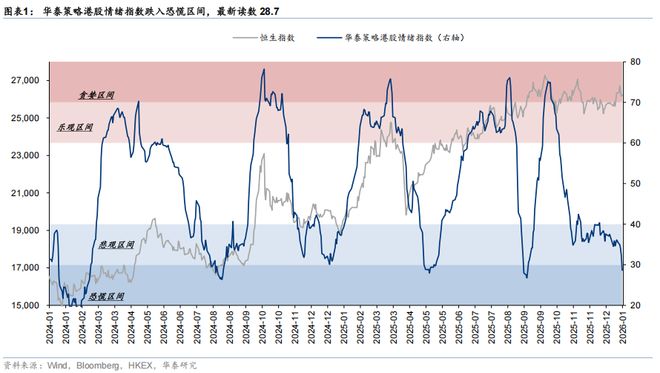
Core Viewpoint - The Hong Kong stock market sentiment index has entered a panic zone, historically indicating a high probability of price increases in the following month, with current factors such as overseas liquidity easing, accelerated capital inflows, and upward revisions in profit expectations contributing to a potential rally in the market [1][2][4]. Group 1: Market Sentiment and Performance - The Hong Kong stock sentiment index fell to 28.6, marking its return to the panic zone for the first time in four months, with a historical average increase probability of 76% for the Hang Seng Index (HSI) 30 days after entering this zone [2][4]. - Since October 2023, there have been seven signals indicating a 100% success rate, with an average HSI increase of 4% expected in the next month [2][4]. - The current implied probabilities for the HSI reaching 27,000 points by the end of January and February are only 25% and 39%, respectively, indicating a positive expectation gap [2]. Group 2: Liquidity and Capital Inflows - Expectations for overseas liquidity easing are rising, with U.S. Treasury Secretary indicating potential announcements regarding the next Federal Reserve chair around the World Economic Forum [4]. - Foreign capital inflows into Hong Kong stocks accelerated, with a record inflow of $1.54 billion in a week, the highest since February 1998, alongside significant southbound capital inflows of nearly 30 billion RMB [4]. - January typically sees a seasonal increase in southbound capital inflows, historically accounting for about 13% of the annual total [4]. Group 3: Profit Expectations and Sector Performance - The MSCI China Bloomberg profit expectations have been revised upward by 0.9% over the past four weeks, with expectations for major economic data in January and February lacking strong anchors due to seasonal effects [4][6]. - Sectors such as upstream resources, public industries, TMT, and essential consumer goods have shown significant improvements in sentiment over the past three months, while sectors like steel and real estate have seen downward revisions in profit expectations [6][40]. - The AH premium index has risen to a peak of 122.7, indicating that Hong Kong stocks may enter a relative yield period as A-shares have outperformed recently [5].

有色金属ETF(512400.SH)涨1.14%,中金黄金涨3.49%
Sou Hu Cai Jing· 2025-12-12 02:49
Group 1 - The core viewpoint of the articles highlights the impact of the Federal Reserve's recent interest rate cut on various sectors, particularly in the context of the metals market and economic conditions [1][2] Group 2 - The Federal Reserve lowered the federal funds rate by 25 basis points to a target range of 3.50%–3.75%, marking the third rate cut of the year [1] - Economic indicators show moderate expansion, with slowing job growth and a slight increase in unemployment, while inflation remains high [1] - The Fed's dot plot indicates expectations for two additional 25 basis point cuts in 2026 and 2027, suggesting ongoing global liquidity easing [1] Group 3 - In the industrial metals sector, supply-demand imbalances for copper and aluminum are evident, with short-term disruptions and insufficient long-term capital expenditure limiting supply [2] - Demand resilience from sectors like new energy and infrastructure supports price increases for industrial metals [2] - For precious metals, rising expectations of Fed rate cuts and geopolitical risks are benefiting silver, which is driven by both financial attributes and industrial demand [2] Group 4 - Domestic policies supporting rare earth and new energy metals, along with high demand from sectors like electric vehicles and energy storage, are stabilizing prices for materials like praseodymium-neodymium and lithium carbonate [2] - The overall outlook for the metals industry is strengthened by the combination of overseas liquidity easing and domestic economic recovery, reinforcing the logic of "resource scarcity + demand growth" [2] - The performance of the non-ferrous metal ETF (512400.SH) is expected to benefit from the improved sector dynamics and significant investment value [2]

原料供应偏紧 沪锡创半年新高【10月9日SHFE市场收盘评论】
Wen Hua Cai Jing· 2025-10-09 07:38
Core Viewpoint - The overall performance of risk assets, particularly in the metals sector, has been strong during the National Day holiday, driven by expectations of overseas liquidity easing and supply concerns in the tin market [1][2]. Group 1: Market Performance - During the holiday, LME tin prices rose by 2.95%, while domestic Shanghai tin futures increased by 2.99%, reaching a six-month high of 287,090 yuan/ton [1]. - The tightening supply of tin, exacerbated by Indonesia's crackdown on illegal mining, has contributed to the upward price movement [1]. Group 2: Supply Dynamics - Indonesia's strict enforcement against illegal mining is aimed at better controlling its tin industry, with the closure of many small illegal mining operations. Major tin smelting companies in Indonesia are expected to remain unaffected due to their stable supply channels [1]. - The Indonesian Tin Exporters Association (ITEA) projects that refined tin exports will rise from 45,000 tons in 2024 to approximately 53,000 tons, indicating that the recent regulatory actions will not significantly impact exports [1]. Group 3: Domestic Supply and Demand - Domestic tin production is set to resume as Yunnan Tin ends maintenance, and most smelting plants maintained normal operations during the holiday. Additionally, transportation of tin from Myanmar is gradually recovering, suggesting a slight increase in overall supply [1]. - Post-holiday, the operating rate of downstream tin processing enterprises is expected to remain stable, although colder weather and lower-than-usual Christmas order volumes may keep the operating rates steady in the fourth quarter [1]. Group 4: Future Market Outlook - The expectation of high interest rate cuts by the Federal Reserve is favorable for risk assets, while new regulations in Indonesia to shorten mining quota validity from three years to one year will effectively control tin supply [2]. - The LME inventory has decreased again, and fluctuations in the 0-3 structure indicate ongoing liquidity concerns, which may further stimulate tin prices [2].
矿端脆弱性担忧笼罩 LME铜重心上移【十一外盘综述】
Wen Hua Cai Jing· 2025-10-09 01:54
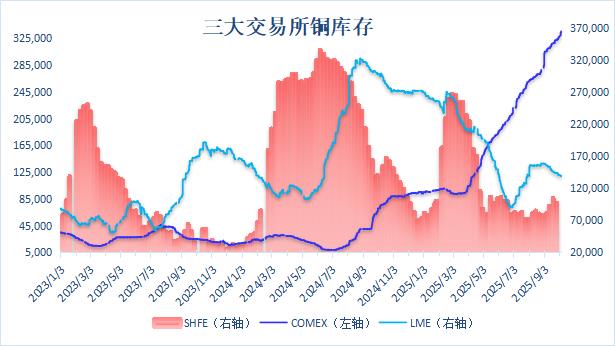
Group 1 - During the National Day holiday, overseas liquidity easing expectations boosted risk assets, with copper prices reaching around $108,000, the highest since May 2022 [1] - The U.S. government shutdown has led to a decline in ADP employment data, with a decrease of 32,000 jobs in September, raising expectations for two rate cuts by the Federal Reserve this year [1] - Chile's copper production fell by 9.9% year-on-year in August, marking the largest decline in over two years, primarily due to an accident at Codelco's El Teniente mine [1] Group 2 - Global copper mine vulnerabilities have been increasingly exposed this year, complicating negotiations between domestic smelters and overseas miners, leading to concerns about supply tightness [2] - Freeport's Grasberg mine in Indonesia faced force majeure, further escalating supply concerns and contributing to rising copper prices [2] - LME copper inventory has slightly decreased, while COMEX copper inventory has accumulated to over 330,000 tons, indicating a potential shift in market dynamics [2]