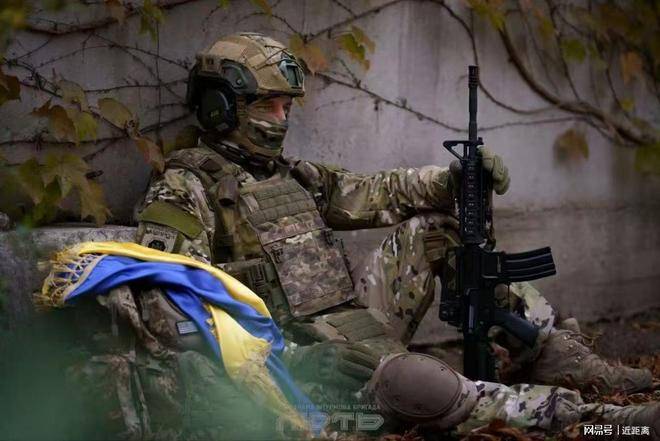
混合战争

Search documents
内塔尼亚胡:若伊朗遭美打击袭击以色列,将以伊无法想象的力度回击!伊朗副外长:战争后果将“波及整个地区”
Mei Ri Jing Ji Xin Wen· 2026-02-24 07:13
Group 1 - Israeli Prime Minister Netanyahu stated that if Iran attacks Israel in response to a U.S. military strike, it would be Iran's "most serious mistake," and Israel would retaliate with "unimaginable force" [1] - Netanyahu emphasized the unprecedented closeness of the partnership between Israel and the U.S., particularly highlighting the "tight connections" between their military and security agencies [1] - Iran's Deputy Foreign Minister, Karibabadi, warned that any war against Iran would have consequences beyond the immediate conflict, affecting the entire region [4] Group 2 - Iranian military commander Hatami asserted that Iran's armed forces would "fight to the last moment" to defend the country's sovereignty and territorial integrity, indicating readiness for a broader hybrid warfare [5] - Hatami cited examples of failed military interventions by external forces in other countries, suggesting that threats and intimidation against Iran would ultimately fail [6] - The U.S. and Iran are set to engage in a new round of negotiations in Geneva, with previous talks showing some progress despite ongoing differences [6]

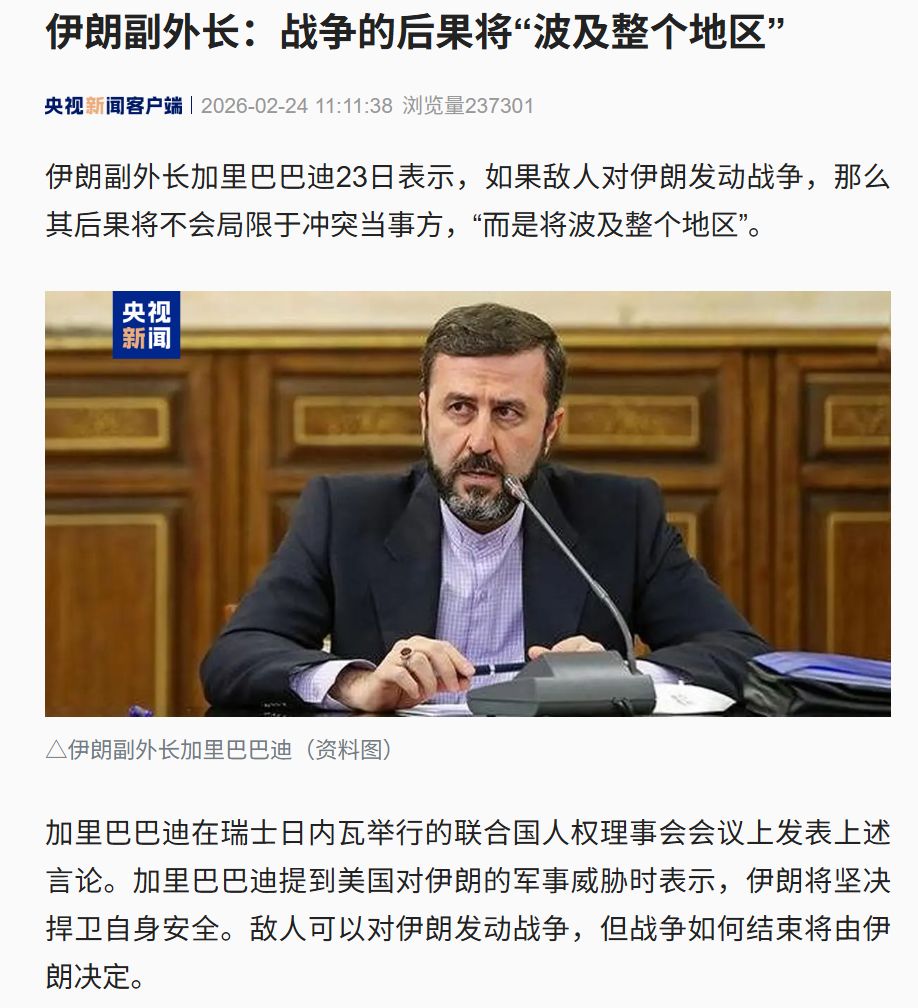
伊朗副外长:战争的后果将“波及整个地区”
Xin Lang Cai Jing· 2026-02-24 04:55
Group 1 - Iranian Deputy Foreign Minister Garibabadi stated that any war initiated by enemies against Iran would have consequences that extend beyond the immediate conflict, affecting the entire region [2] - Garibabadi emphasized Iran's commitment to defending its security and asserted that the outcome of any conflict would be determined by Iran [2] - Iranian Army Chief Hatami mentioned that external forces are attempting to weaken Iran through various strategic means, and the armed forces are prepared to fight to the last moment to defend national sovereignty and territorial integrity [2] Group 2 - The Iranian armed forces are preparing for a broader hybrid warfare that encompasses political, economic, social, military, and psychological threats [2] - Hatami cited examples of failed military interventions by U.S. forces in other countries, suggesting that external threats to Iran will ultimately end in failure [2] - Oman's Foreign Minister Badr confirmed that new negotiations between the U.S. and Iran are scheduled for the 26th in Geneva, following a previous round of indirect talks that showed some progress despite ongoing differences [3]
子思:进入“推土机政治”时代,中国的定力意味着什么?
Xin Lang Cai Jing· 2026-02-17 00:43
Core Viewpoint - The article discusses the evolving geopolitical landscape, particularly the shift in U.S. foreign policy under the Biden administration and its implications for global competition, especially with China and Russia. It highlights the transition from a "Decisive Decade" to a more chaotic and uncertain international order, marked by the U.S. abandoning its global leadership role and the resulting confusion among Western allies [1][6][10]. Group 1: U.S. Foreign Policy and Global Competition - The Biden administration has defined the 2020s as a "Decisive Decade," emphasizing the importance of this period in shaping the future international order, with a focus on competition against China and Russia [1][2]. - The U.S. aims to rebuild Western alliances, categorizing China as a significant competitor and Russia as a major threat, thereby attempting to create a unified Western front [1][2]. - The shift in U.S. policy under Trump 2.0 marks a departure from the global competition strategy, with a focus on national interests over ideological battles, leading to a significant change in how the U.S. perceives its role in global affairs [6][8]. Group 2: Responses from Other Nations - The UK, Germany, and Japan have echoed the U.S. sentiments, introducing concepts like "Era of Competition" and "Systemic Competition," indicating a long-term strategic rivalry with China [2][3]. - France, however, has taken a more cautious approach, emphasizing "strategic autonomy" and recognizing the end of Western dominance without fully aligning with the competitive narrative [3][6]. Group 3: Implications for China - The changing U.S. stance has led to a re-evaluation of China's role, with the U.S. now seeking a stable and mutually respectful relationship rather than viewing China solely as a threat [8][10]. - China's strategic consistency and refusal to alter its policies in response to external pressures have been highlighted as key strengths, suggesting that its approach may lead to a more favorable position in the evolving global landscape [11][12]. Group 4: Future Outlook - The article suggests that while the immediate phase of U.S.-China competition may be temporarily subdued, the potential for renewed conflict remains, particularly as the U.S. continues to grapple with internal chaos and shifting foreign policy [12][14]. - China's role as a stabilizing force in a tumultuous world is emphasized, indicating that its strategic determination will be crucial in navigating future challenges [14].
特朗普施压伊朗:美军派遣舰队规模,“比在委内瑞拉的还大”,伊朗胆敢暗杀,将被美国“从地球上抹去”
Xin Lang Cai Jing· 2026-01-27 03:02
Core Viewpoint - The situation regarding Iran is still "changing," with President Trump stating that a larger fleet has been deployed to the Middle East compared to the U.S. military presence near Venezuela, while also suggesting that Iran is interested in reaching an agreement [1][14]. Military Deployment - A significant naval presence, including the USS Abraham Lincoln carrier strike group, has been deployed to the Middle East, which consists of three guided-missile destroyers and various advanced aircraft such as F-35C stealth fighters and F/A-18E/F fighter jets [3][16]. - The U.S. Central Command confirmed the deployment of the carrier strike group to the region, indicating readiness for potential military action within "one or two days" if ordered by the White House [6][18]. Iran's Response - Iranian officials, including Foreign Ministry spokesman Baghaei, emphasized that Iran is more capable than ever and will respond strongly to any acts of aggression, viewing the U.S. military presence as a violation of international principles [6][11]. - Baghaei also noted that the insecurity in the region is not limited to Iran and that Iran is prepared to defend its sovereignty and territorial integrity if war breaks out [20][22]. Regional Implications - The potential for conflict between the U.S. and Iran could have severe implications for maritime security and the international energy market, with Iran's retaliation likely targeting U.S. military bases in the region and Israel [13][24]. - There is a call for restraint from multiple regional countries, emphasizing the need for dialogue to alleviate tensions and avoid strategic miscalculations that could escalate into a broader crisis [24].
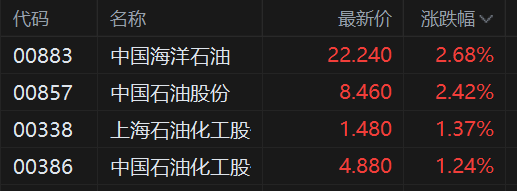
港股异动丨三桶油拉升 中海油涨近3% 中石化创阶段新高
Ge Long Hui· 2026-01-15 02:04
Group 1 - The three major oil companies in Hong Kong, namely CNOOC, PetroChina, and Sinopec, experienced significant stock price increases, with CNOOC rising nearly 3%, PetroChina up 2.5%, and Sinopec gaining over 1%, reaching new highs in the current phase [1] - Recent fluctuations in oil prices were noted, with WTI and Brent crude oil prices initially rising over 2% before dropping by 2% within a short time frame, influenced by statements from former President Trump regarding Iran [1] - The International Energy Agency (IEA) indicated that Venezuela's oil industry, after years of neglect, will require time to restore production, with current output only a small fraction of its capacity due to mismanagement, lack of investment, and sanctions [1] Group 2 - The latest stock prices and percentage changes for the major oil companies are as follows: CNOOC at 22.240 with a 2.68% increase, PetroChina at 8.460 with a 2.42% increase, Shanghai Petrochemical at 1.480 with a 1.37% increase, and Sinopec at 4.880 with a 1.24% increase [2]



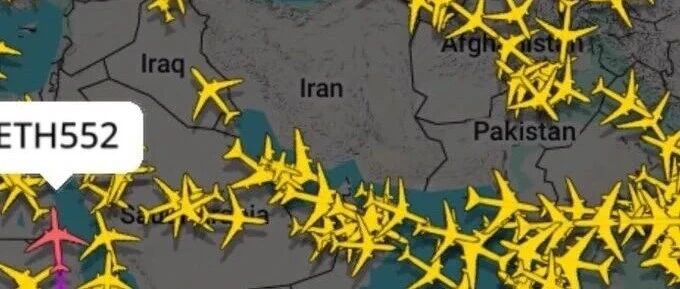
突发!美军,异动!伊朗,关闭领空!
券商中国· 2026-01-15 00:55
Core Viewpoint - The article discusses the escalating tensions in the Middle East, particularly focusing on the U.S. military's movements and the implications for regional stability, especially concerning Iran and its airspace restrictions [1][3][4]. Group 1: U.S. Military Actions - The U.S. is deploying the "Abraham Lincoln" aircraft carrier strike group to the Central Command area, which includes the Middle East and Central Asia, expected to take about a week [3]. - Some personnel from the U.S. military base in Qatar are being evacuated in response to the current regional tensions [3]. - U.S. officials indicate that military intervention could occur within the next 24 hours, although the specifics remain unclear [3]. Group 2: Iran's Response and Airspace Control - Iran has temporarily closed its airspace, allowing only approved international flights, with the closure expected to last over two hours [1]. - The Tehran Flight Information Region (FIR) was closed for all flights except those pre-approved by the Iranian Civil Aviation Authority, indicating potential military or security activities [6]. - The closure of airspace is occurring amid increasing domestic unrest and concerns about regional security, with many commercial flights rerouting to avoid Iranian airspace [6]. Group 3: Regional Diplomatic Reactions - Various countries, including Spain, Italy, and Poland, have issued advisories for their citizens to leave Iran due to the unstable situation [4]. - The U.S. State Department has also urged American citizens to leave Iran immediately, suggesting land routes to neighboring countries [4]. Group 4: Iran's Military Perspective - Iranian military experts claim that the U.S. and Israel are conducting a "hybrid war" against Iran, utilizing military strikes, economic sanctions, and other means to destabilize the country [7]. - The risk of war is perceived to be increasing as tensions rise between Iran and the U.S.-Israel alliance [7].
伊朗军事专家:美国和以色列正对伊朗发动“混合战争”
Yang Shi Xin Wen· 2026-01-15 00:18
Group 1 - The Iranian government has urged the US and Israel to cease actions that destabilize Iran, with military expert Mughadam stating that a "hybrid war" is being waged against Iran [1] - Mughadam claims that the US and Israel are using military strikes, economic sanctions, and terrorism to undermine Iran's economic and social stability, increasing the risk of war [1] - Iran is preparing for a preemptive strike if intelligence indicates an imminent attack from the US or Israel, with a stockpile of approximately 2,000 missiles capable of reaching Israel and US military bases in the region [1] Group 2 - Analysis indicates that the US and Israel's plan to weaken Iran consists of two phases: the first phase involves military strikes, while the second phase focuses on psychological and media warfare to test Iran's societal resilience [2] - In light of these external threats, Iran is advised to implement practical policies to stabilize its economy and improve living conditions [2]
寒冬中的能源绞杀战!俄军隐身战机撕碎乌克兰防空网,百万民众在黑暗中期盼光明
Sou Hu Cai Jing· 2026-01-14 18:00
Group 1 - The article highlights the severe humanitarian crisis in Ukraine during the winter of 2025, exacerbated by Russian military attacks on the energy infrastructure, leading to widespread suffering among civilians [1] - Russian forces have employed a strategy of targeting critical energy facilities, including high-voltage substations and thermal power plants, using advanced missile systems like the Iskander-K and Kh-101, resulting in significant disruptions to electricity and water supply [1][3] - The coordinated attacks on civilian infrastructure reflect a new form of hybrid warfare, where the destruction of essential services is used as a tactical advantage [1] Group 2 - The effectiveness of Russian stealth technology, particularly the Su-57 fighter jets, has allowed them to conduct strikes with minimal detection, complicating Ukrainian defense efforts [3][5] - The disparity in technological capabilities is evident, as Ukrainian air defense systems struggle to intercept advanced missiles, with interception rates for hypersonic missiles dropping to as low as 7% [5][7] - A recent assessment indicates that over 54% of Ukraine's regions have experienced power outages lasting more than 48 hours, with repair efforts hampered by ongoing military actions [8] Group 3 - The article emphasizes the importance of tactical innovation, as Ukrainian electronic warfare units have successfully disrupted missile guidance systems, demonstrating that even in a high-tech warfare environment, strategic creativity remains crucial [10] - The ongoing conflict has led to dire humanitarian conditions, with reports of casualties from power outages and contaminated water sources, highlighting the indirect impacts of warfare on civilian populations [7][8]
美国再扣委内瑞拉油轮,学者:美军若入侵或陷“第二场越战”
Xin Lang Cai Jing· 2025-12-21 14:33
Core Viewpoint - The U.S. government, under the Trump administration, is intensifying pressure on Venezuela through military actions and sanctions, aiming for regime change while using the pretext of a "war on drugs" to justify its actions [1][3][9]. Group 1: Military Actions and Sanctions - The U.S. Coast Guard seized a Panama-flagged oil tanker near Venezuela, marking the second such seizure in ten days, which Venezuela condemned as a serious act of piracy violating international law [1]. - Since September, U.S. military operations in the Caribbean and Eastern Pacific have resulted in hundreds of deaths, with multiple naval vessels deployed near Venezuela [1]. - The Trump administration has threatened to impose a "complete and total blockade" on all oil tankers entering or leaving Venezuela, indicating a strategy to tighten sanctions on Venezuela's oil trade [3][4]. Group 2: Political Objectives - The Trump administration's actions are aimed at destabilizing the Venezuelan government, which has been at odds with the U.S. since it came to power in 1999, with sanctions imposed since 2006 [3][4]. - The ultimate goal is to reinforce U.S. influence in Latin America by undermining leftist movements and reasserting Monroe Doctrine principles [3][9]. Group 3: Military Readiness and Challenges - The U.S. has amassed 15,000 troops and deployed the USS Ford aircraft carrier near Venezuela, marking one of the largest military deployments in the Caribbean in decades [4]. - However, there is significant public and political resistance within the U.S. against initiating a new ground war, complicating the feasibility of a large-scale military invasion [4][6]. - Venezuela's military capabilities include 63,000 army personnel, 25,500 navy personnel, and 11,500 air force personnel, indicating a robust defense against potential U.S. military actions [6]. Group 4: Regional and International Reactions - Several countries, including Brazil and Mexico, have expressed concerns over U.S. military actions, with Mexico's president offering to mediate between the U.S. and Venezuela [6]. - Russia has warned the U.S. against making "fatal mistakes" regarding Venezuela, indicating international opposition to U.S. military threats [6]. Group 5: Broader Implications - The U.S. strategy of using drug trafficking as a justification for military intervention is not new, as similar threats have been made towards Mexico and Colombia [7][9]. - The overarching aim is to strengthen U.S. control over the Western Hemisphere and counteract China's influence in the region [9].
Putin痛骂欧洲政客为猪猡,乌克兰获得新年大礼包
Sou Hu Cai Jing· 2025-12-19 06:40
Group 1 - The article discusses the psychological impact on Ukrainian soldiers and their families regarding the fluctuating peace negotiations between the US and Russia, highlighting the uncertainty and fear of prolonged conflict [1][3] - It emphasizes the disappointment among Ukrainians towards President Zelensky's team for not achieving peace, and the growing discontent among EU citizens regarding financial support to Ukraine, which is perceived as a drain on their resources [3][5] - The article outlines the mixed warfare strategy employed by both Trump and Putin, where Trump uses diplomatic pressure while Putin resorts to military threats, aiming to undermine Ukrainian morale and European unity [3][5] Group 2 - The article details the significant military and financial aid pledged to Ukraine by various countries, including Germany's €11.5 billion and other contributions from the UK, Canada, and the EU, totaling approximately $45 billion in commitments [6][8] - It notes the potential for a funding gap of around $50 billion for Ukraine, but suggests that aid countries are capable of addressing this shortfall, indicating a sustained commitment to support Ukraine in the ongoing conflict [8] - The article highlights the shift in leadership within Europe, with Germany emerging as a central figure in supporting Ukraine, contrasting with the previous US-led efforts, and emphasizes the emotional appeal made by German leaders regarding the importance of Ukraine's fate to Europe [8]