
港股芯片

Search documents
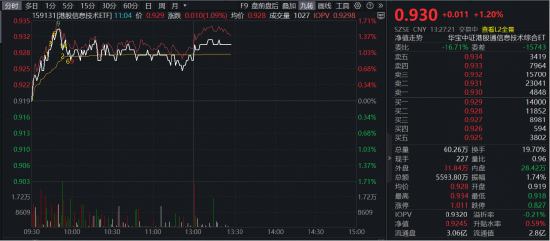
冲击三连涨!港股硬科技拐点出现?港股信息技术ETF(159131)劲涨1.2%,小米集团大涨超5%
Xin Lang Cai Jing· 2026-02-11 05:47
Core Viewpoint - The Hong Kong stock market's hard technology sector is showing strong performance, with significant gains in stocks like Kintor Pharmaceutical and Kingsoft Cloud, alongside the launch of the first ETF focused on the Hong Kong chip industry, indicating potential investment opportunities in this sector [1][6]. Group 1: Market Performance - Kintor Pharmaceutical's stock rose over 13%, while Kingsoft Cloud increased by more than 9%, and both Kintor Group and Xiaomi Group saw gains exceeding 5% [1][6]. - The newly launched Hong Kong Information Technology ETF (159131), which focuses on the chip industry, has seen a price increase of 1.2% and a trading volume exceeding 55.93 million CNY [1][6]. Group 2: ETF Details - The ETF is the first in the market to focus on the Hong Kong chip industry, with its index composed of 70% hardware and 30% software, covering 42 hard technology companies [3][8]. - Major holdings in the ETF include Semiconductor Manufacturing International Corporation (15.21% weight), Xiaomi Group (12.08% weight), and Hua Hong Semiconductor (8.68% weight), excluding large internet companies like Alibaba and Tencent [3][8]. Group 3: Market Analysis - According to recent research from China Merchants Securities, the current market volatility presents a significant allocation value, suggesting that recent fluctuations are primarily due to liquidity shocks [2][8]. - The report indicates that the current market conditions are not fundamentally different from those observed in November 2025, with positive factors accumulating for future outlook [2][8].


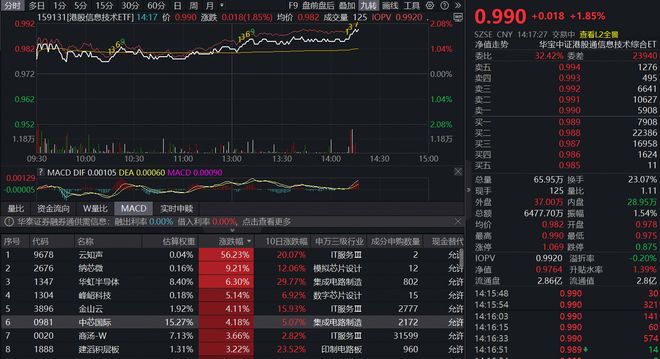
ETF盘中资讯|港股芯片午后急涨!华虹半导体、中芯国际双双大涨,港股信息技术ETF(159131)劲涨1.85%
Jin Rong Jie· 2026-01-28 07:04
Core Viewpoint - The Hong Kong stock market is experiencing a surge in the hard technology sector, particularly in the semiconductor industry, with significant gains in stocks like Yunzhisheng and Naxinwei, and the launch of the first ETF focused on the Hong Kong chip industry [1][3]. Group 1: Market Performance - Yunzhisheng's stock price surged by 56%, while Naxinwei increased by over 9%, Huahong Semiconductor rose by over 6%, and SMIC gained over 4% [1]. - The newly launched Hong Kong Information Technology ETF (159131) saw a price increase of 1.85%, with a real-time transaction volume exceeding 64.77 million CNY [1][2]. Group 2: ETF Details - The Hong Kong Information Technology ETF (159131) is the first ETF focusing on the "Hong Kong chip" industry chain, with a composition of 70% hardware and 30% software, covering 42 hard technology companies [3]. - Key holdings in the ETF include SMIC with a weight of 15.26%, Xiaomi Group-W at 11.95%, and Huahong Semiconductor at 8.40% [3]. Group 3: Semiconductor Market Insights - According to SIA data, global semiconductor sales are projected to reach 75.28 billion USD by November 2025, marking 25 consecutive months of year-on-year growth [1]. - China's semiconductor sales are expected to be 20.23 billion USD, reflecting a year-on-year increase of 22.9% and a month-on-month increase of 3.9% [1].

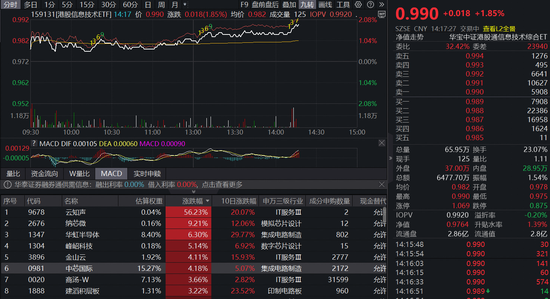
港股芯片午后急涨!华虹半导体、中芯国际双双大涨,港股信息技术ETF(159131)劲涨1.85%
Xin Lang Cai Jing· 2026-01-28 06:46
Core Viewpoint - The Hong Kong stock market's hard technology sector is experiencing a significant rally, with notable increases in stock prices for companies like Yunzhisheng and Naxinwei, alongside the launch of the first ETF focused on the Hong Kong chip industry [1][5]. Group 1: Market Performance - Yunzhisheng's stock surged by 56%, Naxinwei increased by over 9%, Huahong Semiconductor rose by over 6%, and SMIC gained over 4% [1][5]. - The Hong Kong Information Technology ETF (159131), which focuses on the chip industry, saw its price rise by 1.85%, with a trading volume exceeding 64.77 million yuan [1][5]. Group 2: ETF Details - The ETF is the first in the market to focus on the Hong Kong chip industry, with a composition of 70% hardware and 30% software, covering 42 hard technology companies [3][7]. - Key holdings in the ETF include SMIC with a weight of 15.26%, Xiaomi Group-W at 11.95%, and Huahong Semiconductor at 8.40% [3][7]. - The ETF excludes major internet companies like Alibaba, Tencent, and Meituan, allowing for a sharper focus on the AI hard technology sector [3][7]. Group 3: Semiconductor Market Insights - According to SIA data, global semiconductor sales are projected to reach $75.28 billion by November 2025, marking 25 consecutive months of year-on-year growth [6][8]. - China's semiconductor sales are expected to be $20.23 billion, reflecting a year-on-year increase of 22.9% and a month-on-month increase of 3.9% [6][8]. - In the storage segment, both DRAM and NAND Flash contract prices rose in November, with DRAM spot prices continuing to increase in December [6][8].
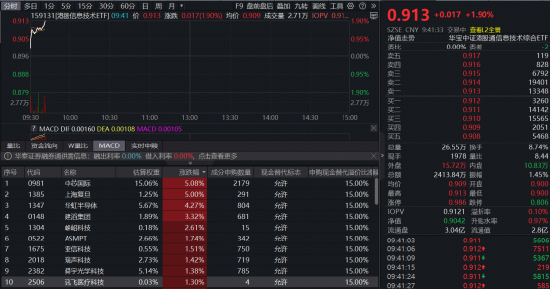
部分产能涨价10%?中芯国际飙涨5%,首只“港股芯片链”ETF开盘涨近2%
Xin Lang Cai Jing· 2025-12-24 02:00
Core Viewpoint - The Hong Kong stock market is experiencing a strong surge in the semiconductor sector, with notable increases in stock prices for companies like SMIC and Hua Hong Semiconductor, alongside the launch of the first ETF focused on the Hong Kong semiconductor industry [1][7]. Group 1: Market Performance - On December 24, the Hong Kong stock market saw significant gains in semiconductor stocks, with SMIC and Shanghai Fudan rising by 5% and Hua Hong Semiconductor increasing by over 4% [1][7]. - The first ETF focusing on the Hong Kong semiconductor industry (159131) recorded a price increase of 1.9%, with a real-time transaction volume exceeding 24 million CNY [1][7]. Group 2: Price Increases and Demand - SMIC has implemented price increases on some of its production capacities, with an approximate rise of 10% expected to be executed soon [8][9]. - The demand for semiconductor products is driven by the continuous growth in mobile applications and AI, leading to increased wafer demand [9]. - The capacity utilization rates for SMIC and Hua Hong are nearing or exceeding full capacity due to strong demand [9]. Group 3: ETF Composition and Strategy - The ETF's index is composed of 70% hardware and 30% software, heavily investing in Hong Kong's semiconductor, electronics, and computer software sectors, covering 42 hard-tech companies [9]. - SMIC holds a weight of 20.48% in the ETF, while Xiaomi Group-W and Hua Hong Semiconductor have weights of 9.53% and 5.80%, respectively [9].
【早盘三分钟】12月15日ETF早知道
Xin Lang Cai Jing· 2025-12-15 01:17
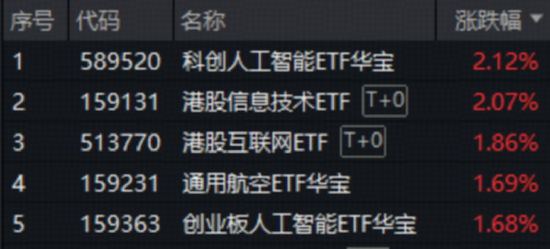
Core Insights - The article highlights the performance of various ETFs, particularly focusing on the surge in AI-related investments and the interest in the Hong Kong chip industry [16][17]. ETF Performance - The newly launched Hong Kong Medical ETF (华宝159137) has been introduced [1]. - The Shanghai Composite Index, Shenzhen Component Index, and ChiNext Index have respective 10-year PE ratios of 90%, 79.09%, and 39.96% as of December 12, 2025 [1]. - The top-performing sectors include Electronics (+1.50%), Non-ferrous Metals (+1.46%), and Power Equipment (+1.42%) [2][13]. Fund Flows - The top three inflow sectors are Machinery (+1.42 billion), Non-ferrous Metals (+463 million), and Public Utilities (+455 million) [2][13]. - The top three outflow sectors are Computer (-2.506 billion), Electronics (-1.913 billion), and Power Equipment (-1.434 billion) [2][13]. Specific ETF Highlights - The Science and Technology Innovation Artificial Intelligence ETF (589520) rose by 2.12% with a trading volume of 47.29 million, marking a 92% increase from the previous period [16]. - The Hong Kong Information Technology ETF (159131), focusing on the Hong Kong chip industry, increased by 2.07%, recovering its 5-day and 10-day moving averages [17]. - The Hong Kong Internet ETF (513770) and the General Aviation ETF (159231) also showed positive performance, with increases of 1.86% and 1.69%, respectively [4][14]. Market Outlook - The market sentiment remains optimistic, with a focus on AI and technology sectors as key growth areas for the future [16][17].

A股放量上攻!国产AI王者归来,科创人工智能ETF(589520)劲涨2.12%!国际机构坚定看好中国经济
Xin Lang Cai Jing· 2025-12-12 11:54
Market Overview - The three major A-share indices collectively rose on December 12, with the Shanghai Composite Index up 0.41%, the Shenzhen Component Index up 0.84%, and the ChiNext Index up 0.97. The total trading volume in the Shanghai and Shenzhen markets reached 2.09 trillion yuan, an increase of over 230 billion yuan compared to the previous day [1][22]. AI Industry - The AI industry chain regained momentum, with the Sci-Tech Innovation Artificial Intelligence ETF (589520) and the ChiNext Artificial Intelligence ETF (159363) both rising over 2% during the session. The focus on domestic AI industry chains is evident as these ETFs saw significant trading activity [1][22]. - The Sci-Tech Innovation Artificial Intelligence ETF (589520) experienced a strong increase of 2.12%, with a trading volume of 47.29 million yuan, marking a 92% increase compared to the previous day. This ETF is heavily invested in the domestic AI industry chain, indicating strong buying interest [4][25]. Defense and Aerospace Sector - The high-profile defense and aerospace sector saw the National Defense and Military Industry ETF (512810) reach a new high, driven by themes such as commercial aerospace, controllable nuclear fusion, and superconductivity. This ETF has shown a continuous upward trend over the past three weeks [15][19]. - The National Defense and Military Industry ETF (512810) has outperformed the Shanghai Composite Index and the CSI 300 Index, with a weekly increase of 2.59% and a total trading volume of 4.09 billion yuan [19][16]. Hong Kong Market - In the Hong Kong market, technology stocks surged, with the first ETF focusing on the "Hong Kong chip" industry chain (159131) rising 2.07% and recovering its 5-day and 10-day moving averages. The trading volume for this ETF reached 82.28 million yuan [8][15]. Economic Outlook - The World Bank and the International Monetary Fund have raised their economic growth forecasts for China in 2026, emphasizing the country's potential for long-term growth through technological innovation and improved resource allocation efficiency [3][23]. - The Chinese government is expected to continue implementing proactive fiscal policies and moderately loose monetary policies in 2026, focusing on stabilizing employment, enterprises, and market expectations [3][24]. Investment Opportunities - Analysts suggest focusing on technology growth, dividends, and cyclical resources, particularly in undervalued and policy-sensitive sectors. The emphasis on "domestic demand-driven" and "innovation-driven" strategies aligns with the upcoming 14th Five-Year Plan [3][24]. - The AI sector is anticipated to see significant growth, with a shift in investment logic from hardware and infrastructure to practical applications and commercialization [6][27].
2025年半导体营收将站上8000亿美元!首只聚焦“港股芯片”产业链的港股信息技术ETF(15...
Xin Lang Cai Jing· 2025-12-12 05:47
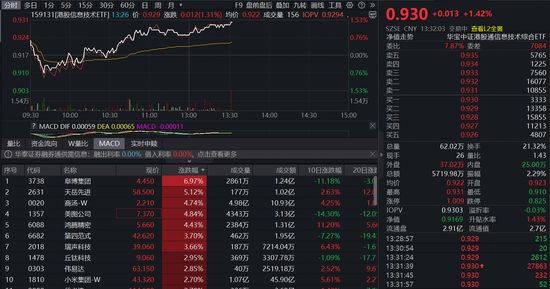
Group 1 - The Hong Kong stock market's chip industry chain showed strong performance, with notable gains from companies such as Fubo Group (+6%), Tianyue Advanced (+5%), SenseTime-W, Meitu, and Hong Teng Precision (+4%) [1] - The first ETF focusing on the Hong Kong chip industry chain (159131) experienced a price increase of 1.42%, with real-time transaction volume exceeding 57 million yuan [1][2] - According to Omdia's latest research, the semiconductor industry is projected to reach revenues of $216.3 billion in Q3 2025, marking a 14.5% quarter-over-quarter growth, with annual revenues expected to surpass $800 billion [1][3] Group 2 - The newly launched Hong Kong Information Technology ETF (159131) tracks an index composed of 70% hardware and 30% software, heavily investing in semiconductor, electronics, and computer software sectors, including major companies like SMIC (20.48% weight) and Xiaomi Group-W (9.53% weight) [3] - The ETF excludes large-cap internet companies such as Alibaba, Tencent, and Meituan, allowing for a sharper focus on the AI hard technology sector in Hong Kong [3]
盘中ETF资讯 | 备战2026!“港股芯片”深蹲回调,南向资金逆向加仓!机构:短线调整为2026年赢得空间
Jin Rong Jie· 2025-12-03 06:45
Core Viewpoint - The Hong Kong stock market, particularly the technology sector represented by the Hang Seng Tech Index, has experienced a significant decline of over 15% in the past two months, prompting investors to reconsider their investment strategies as the year-end approaches [1]. Group 1: Market Performance - The Hang Seng Tech Index has seen a low of 5536.51 and a high of 5600.88, with a trading volume of 247.53 billion [1]. - The year-to-date performance of the index shows a return of 23.94%, despite the recent downturn [1]. - The index's 52-week high and low are 6715.46 and 4168.04, respectively, indicating a substantial range of price movement [1]. Group 2: Capital Flows - In November, southbound capital inflows reached 117.2 billion, demonstrating a strong willingness among Chinese investors to increase their positions in Hong Kong stocks despite market declines [2]. - The sectors attracting the most net buying from southbound funds include consumer discretionary, financials, and information technology [4]. Group 3: Investment Opportunities - The Hong Kong Information Technology ETF (159131), which focuses on the "Hong Kong chip" sector, has seen a recent influx of 29.5 million in capital over the past ten trading days, suggesting potential for a rebound in the market [6]. - The ETF's underlying index has a price-to-earnings ratio of 34.25, which is favorable compared to other major technology indices, indicating a strong investment value [7][9]. - The ETF is designed to capture the performance of the semiconductor and electronic sectors, with significant weights in companies like SMIC (20.27%) and Xiaomi (9.11%) [9].

【早盘三分钟】11月26日ETF早知道
Xin Lang Ji Jin· 2025-11-26 01:27
Core Viewpoint - The article discusses the performance of various ETFs and sectors in the market, highlighting significant movements in the artificial intelligence and semiconductor sectors, as well as the overall market trends as of November 25, 2025 [5][6]. Sector Performance - The top-performing sectors on November 25, 2025, included Media (+3.54%), Communication (+2.42%), and Non-ferrous Metals (+2.85%), while sectors like Transportation (-0.11%) and Defense (-0.32%) saw declines [3]. - The net inflow of capital was highest in the Communication sector with 38.30 billion, followed by Electric Equipment (37.85 billion) and Electronics (36.77 billion). Conversely, the Defense sector experienced the largest outflow at -28.88 billion [3]. ETF Highlights - The "Entrepreneurship AI ETF" (159363) saw a strong performance with a daily increase of 3.45%, recovering key moving averages and achieving a trading volume of 8.73 billion [5][6]. - The "Hong Kong Chip ETF" (159131) recorded a significant price increase of nearly 4% during the day, closing with a 1.10% gain, marking a record trading volume of 1.36 billion since its launch [6]. Investment Insights - Fund managers indicated that the U.S. stock market is showing signs of a significant rebound, suggesting that the main downtrend may have ended, making technology ETFs attractive for investment [6]. - The article emphasizes the valuation advantages of Hong Kong chip stocks, with a PE ratio percentile of around 38%, significantly lower than that of the ChiNext Index (83%) and Nasdaq 100 (67%) [6][8].

第一大权重股“中芯国际”业绩暴增!净利劲增43%,国内首只港股信息技术ETF(159131)上市聚焦“港股芯片”
Mei Ri Jing Ji Xin Wen· 2025-11-14 02:29
Group 1 - Semiconductor leader SMIC reported strong Q3 performance with total revenue of 17.162 billion yuan, a quarter-on-quarter increase of 6.9% and a year-on-year increase of 9.9%, marking a record high for quarterly revenue [1] - The net profit attributable to shareholders for Q3 reached 1.517 billion yuan, representing a year-on-year growth of 43.1% and a quarter-on-quarter increase of 60.64% [1] - The "14th Five-Year Plan" is expected to significantly boost the growth potential of China's chip industry to a "decisive breakthrough" level [1] Group 2 - The newly launched Hong Kong ETF (159131) focuses on the semiconductor industry chain and tracks the CSI Hong Kong Stock Connect Information Technology Composite Index, which excludes large-cap internet companies and emphasizes the Hong Kong semiconductor sector [1] - The index consists of 70% hardware and 30% software, heavily weighted towards semiconductor, electronics, and computer software sectors [2] - As of October 31, 2025, the index includes 42 Hong Kong hard tech companies, with SMIC holding a weight of 20.27%, Xiaomi at 9.11%, and Hua Hong Semiconductor at 5.64% [2] Group 3 - The CSI Hong Kong Stock Connect Information Technology Composite Index has achieved a cumulative increase of 89.60% from December 30, 2022, to October 31, 2025, outperforming other Hong Kong tech indices [2] - The index's maximum drawdown during the same period was -36.31%, which is better than the maximum drawdowns of other Hong Kong tech indices [2] - As of November 10, 2025, the index's price-to-earnings ratio stands at 39.85, significantly lower than major global tech indices, indicating potential growth opportunities for investors [3]