
努比亚M153工程样机

Search documents
中兴通讯(000063):算力转型顺利 AI再造中兴
Xin Lang Cai Jing· 2026-02-01 00:32
Core Insights - The company has made significant progress in its "Connection + Computing Power" business transformation, focusing on three main sectors: operator networks, government and enterprise business, and consumer business [1][4] - The company's revenue for the first three quarters of 2025 reached 100.52 billion yuan, a year-on-year increase of 11.6%, primarily driven by the rapid growth of its computing power business, which saw a revenue increase of 180% [1] - The net profit attributable to shareholders was 5.322 billion yuan, a year-on-year decrease of 33%, mainly due to a slowdown in capital expenditure from operators, impacting the high-margin operator network business [1] Computing Power Business - The company has made major breakthroughs in self-developed chips, including CPU, DPU, and switching chips, benefiting from the development of domestic super node solutions [2] - The computing power business has become the core driver of revenue growth, with server and storage revenue increasing by 250% year-on-year and data center product revenue growing by 120% [1][2] - The company has launched a super node server solution featuring Baidu's Kunlun Heart P800, achieving GPU intercommunication bandwidth of 400GB/S to 1.6TB/S [2] Connection Business - The company maintains a leading position in the global telecommunications market, with an estimated market share of about 11% in 2024 [3] - The construction and user adoption of 5G networks are nearing completion, with 4.598 million 5G base stations built in China by July 2025, resulting in a 79% penetration rate [3] - Capital expenditure from domestic operators is expected to decline by 9.7% year-on-year in 2024, while 5G-A and 6G are emerging as new directions in the telecommunications market [3] Consumer Business - The consumer business encompasses a wide range of AI terminal products, including home terminals, mobile terminals, and cloud computers, with a revenue of 17.235 billion yuan in the first half of 2025, a year-on-year increase of 7.6% [4] - The company is collaborating with ByteDance's Doubao to launch a smartphone assistant, marking a significant step towards creating an "AI-native smartphone" [4] - The strategic transformation of "Connection + Computing Power" is showing initial success, with the server and storage business becoming a key growth engine [4]

被马化腾指责外挂方式“不负责任”后,豆包手机助手回应安全隐私问题
Xin Lang Cai Jing· 2026-01-27 02:12
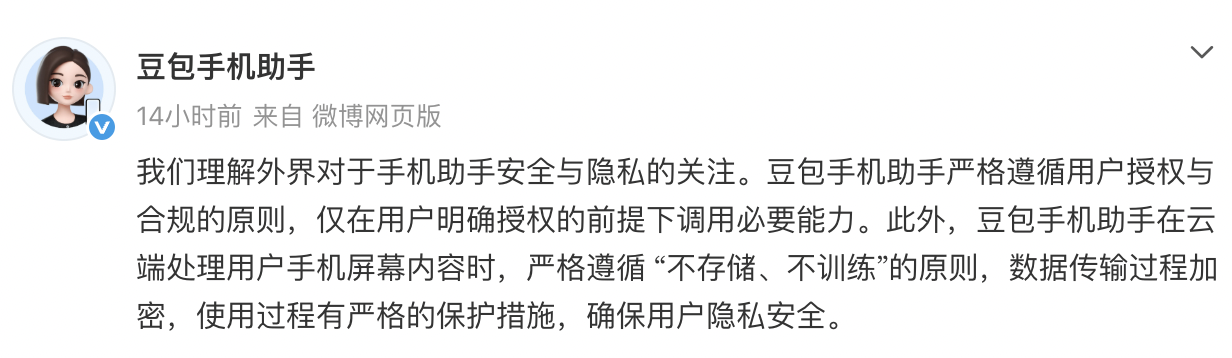
Group 1 - Tencent's founder Ma Huateng expressed concerns about Doubao Phone's method of integrating with user devices, labeling it as "extremely unsafe and irresponsible" [2][6] - Doubao Phone Assistant responded to privacy concerns by stating it adheres to user authorization and compliance principles, ensuring data is not stored or trained on, and that data transmission is encrypted [1][5] - The Doubao Phone, launched in collaboration with ZTE, is aimed at developers and tech enthusiasts, priced at 3499 yuan, and sold out immediately upon release [2][6] Group 2 - Following user complaints about account security issues when using Doubao Phone Assistant, the company clarified that it does not engage in unauthorized access and only operates with user consent [2][6] - Doubao Phone Assistant announced adjustments to its AI capabilities, including restrictions on certain financial applications and gaming scenarios, in response to ongoing criticism [3][6] - Industry insiders noted that the controversy surrounding Doubao Phone reflects a conflict between AI integration and existing app ecosystems, highlighting the need for a balance between system permissions and application security [4][8]


实测豆包手机助手 AI操作均需用户授权
Xin Hua Cai Jing· 2025-12-26 10:00
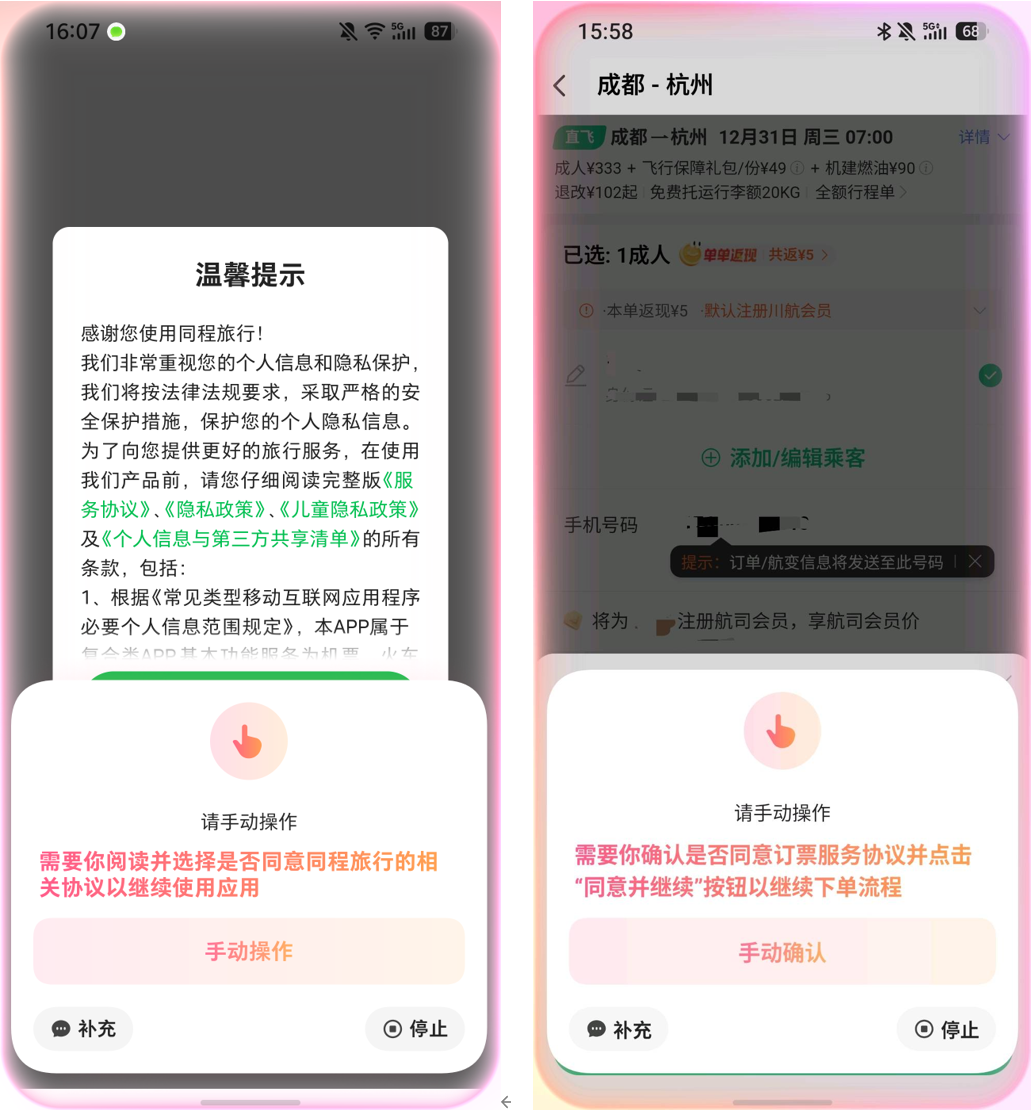
Core Insights - ByteDance's Doubao team has launched a technical preview of the Doubao mobile assistant, which aims to transform mobile assistants from "auxiliary tools" to "smart housekeepers" by enabling complex tasks across applications [1][8] - The assistant demonstrates advanced capabilities, surpassing traditional voice assistants, by executing commands such as searching and playing videos or finding the cheapest flight tickets with minimal user intervention [1][3] Functionality and User Interaction - The Doubao mobile assistant requires user commands and authorization through pop-up prompts to perform tasks, showcasing its ability to handle both information retrieval and transaction processing [3][8] - During testing, the assistant successfully executed commands like searching for videos and booking flights, although it faced limitations in completing transactions on certain shopping apps due to login barriers [3][8] Authorization and Security Mechanisms - A three-tier authorization system has been established to address user concerns regarding AI operations, including pre-authorization, in-process management, and post-task review [4][5] - Users are prompted for permissions at various stages, with options for single-use or ongoing permissions, and must authenticate through facial recognition, voiceprint, or passwords when accessing the assistant in locked mode [5][7] User Control and Decision-Making - Users maintain ultimate decision-making authority throughout the interaction, with the assistant providing real-time updates on task progress and allowing for manual intervention if necessary [7][8] - The assistant's design emphasizes user privacy and data protection, with a commitment to transparency regarding data usage and ongoing product optimization [9] Industry Trends and Collaborations - The collaboration between mobile manufacturers and AI model developers is becoming a trend, as seen in partnerships like Google Gemini with Samsung, indicating a shift in industry dynamics [8] - Doubao has no plans for self-developed phones and aims to engage in ecological cooperation with various mobile manufacturers and third-party apps [8]
【早盘三分钟】12月15日ETF早知道
Xin Lang Cai Jing· 2025-12-15 01:17
Core Insights - The article highlights the performance of various ETFs, particularly focusing on the surge in AI-related investments and the interest in the Hong Kong chip industry [16][17]. ETF Performance - The newly launched Hong Kong Medical ETF (华宝159137) has been introduced [1]. - The Shanghai Composite Index, Shenzhen Component Index, and ChiNext Index have respective 10-year PE ratios of 90%, 79.09%, and 39.96% as of December 12, 2025 [1]. - The top-performing sectors include Electronics (+1.50%), Non-ferrous Metals (+1.46%), and Power Equipment (+1.42%) [2][13]. Fund Flows - The top three inflow sectors are Machinery (+1.42 billion), Non-ferrous Metals (+463 million), and Public Utilities (+455 million) [2][13]. - The top three outflow sectors are Computer (-2.506 billion), Electronics (-1.913 billion), and Power Equipment (-1.434 billion) [2][13]. Specific ETF Highlights - The Science and Technology Innovation Artificial Intelligence ETF (589520) rose by 2.12% with a trading volume of 47.29 million, marking a 92% increase from the previous period [16]. - The Hong Kong Information Technology ETF (159131), focusing on the Hong Kong chip industry, increased by 2.07%, recovering its 5-day and 10-day moving averages [17]. - The Hong Kong Internet ETF (513770) and the General Aviation ETF (159231) also showed positive performance, with increases of 1.86% and 1.69%, respectively [4][14]. Market Outlook - The market sentiment remains optimistic, with a focus on AI and technology sectors as key growth areas for the future [16][17].

AI投资逻辑迭代!应用端潜力更大?重仓端侧AI的——科创人工智能ETF(589520)放量劲涨2.12%
Xin Lang Cai Jing· 2025-12-14 11:43
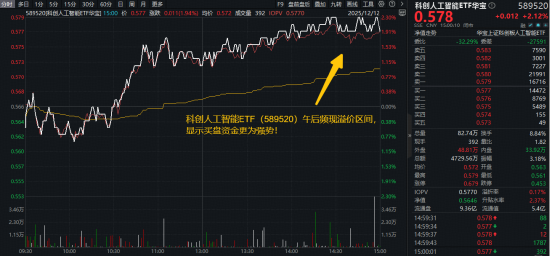
Core Viewpoint - The domestic AI industry chain is gaining momentum, as evidenced by the performance of the Science and Technology Innovation Artificial Intelligence ETF (589520), which saw a significant increase in trading volume and price appreciation, indicating strong buying interest [1][7]. Market Performance - The Science and Technology Innovation Artificial Intelligence ETF (589520) rose by 2.12%, with a peak increase of 2.3%, and a total trading volume of 47.29 million yuan, reflecting a 92% increase compared to the previous period [1][7]. - Among the 30 constituent stocks of the ETF, 28 stocks experienced price increases, with over 60% rising by more than 2%. Notable performers included Hehe Information, which surged by 13.8%, and Chip Origin, which rose by 7.22% [4][9]. Industry Developments - The end-side AI sector is witnessing new advancements, such as ByteDance's Doubao mobile assistant and Alibaba's Quark AI glasses, which integrate advanced AI capabilities for consumer applications [11]. - The State Council has issued guidelines aiming for over 70% penetration of new intelligent terminals and smart entities by 2027, and over 90% by 2030, indicating strong governmental support for AI development [3][11]. Investment Trends - Analysts suggest that the AI investment logic is evolving from focusing on hardware and infrastructure ("selling shovels") to emphasizing practical applications and commercialization ("mining for gold") [3][11]. - The ETF's index is balanced across four key segments: application software, terminal applications, terminal chips, and cloud chips, reflecting a shift in the AI industry from cloud-based solutions to edge computing and self-sufficiency [12][13]. Strategic Focus - The Science and Technology Innovation Artificial Intelligence ETF (589520) and its associated funds are strategically positioned to capitalize on the domestic AI industry, with over 70% of the top ten holdings concentrated in the semiconductor sector, highlighting a strong focus on domestic alternatives [5][13].
从“卖铲子”到“挖金子”:AI应用迎来大机会!重仓端侧AI的——科创人工智能ETF(589520)放量劲涨2.12%
Xin Lang Cai Jing· 2025-12-12 11:54
Core Viewpoint - The domestic AI sector is experiencing a resurgence, with the focus on the domestic AI industry chain through the Science and Technology Innovation Artificial Intelligence ETF (589520), which saw a significant increase in trading volume and price [1][7]. Market Performance - The Science and Technology Innovation Artificial Intelligence ETF (589520) rose by 2.12%, with a peak increase of 2.3%, and a total trading volume of 47.29 million yuan, marking a 92% increase compared to the previous period [1][7]. - Among the 30 constituent stocks of the ETF, 28 stocks closed higher, with over 60% of them rising by more than 2%. Notable performers included Hehe Information, which surged by 13.8%, and Chip Original Co., which increased by 7.22% [4][9]. Industry Developments - The edge AI sector is witnessing new advancements, such as ByteDance's Doubao mobile assistant and Alibaba's Quark AI glasses, indicating a growing market for consumer-grade smart wearable devices [11]. - The State Council has issued opinions to promote AI applications, aiming for over 70% penetration of new intelligent terminals and entities by 2027, and over 90% by 2030 [3][11]. Investment Trends - The investment logic in AI is shifting from hardware and infrastructure ("selling shovels") to actual applications and commercialization ("mining for gold"), highlighting the potential for explosive growth in AI applications [3][11]. - The ETF's index is balanced across four key segments: application software, terminal applications, terminal chips, and cloud chips, reflecting a shift from cloud-based to edge-based AI development [12]. Strategic Focus - The Science and Technology Innovation Artificial Intelligence ETF (589520) emphasizes the domestic AI industry chain, with over 70% of its top ten holdings concentrated in semiconductor-related sectors, indicating a strong focus on domestic alternatives [5][13].
应用端暖风频吹 机构AI投资策略悄然转向
Zhong Guo Zheng Quan Bao· 2025-12-11 22:23
Core Insights - The AI application sector currently presents more narrative appeal and growth potential compared to the computing power layer, which has established a solid "value base" and clearer valuation logic [1] - Investment strategies are shifting towards AI applications, with fund managers increasingly focusing on companies that can translate technology into profits [2][3] Investment Trends - Fund managers are adjusting their AI investment strategies, maintaining a strong position in computing power while increasing focus on AI applications, particularly with the emergence of edge AI products [2] - Notable funds have begun to accumulate semiconductor stocks and reduce holdings in certain sectors, indicating a strategic shift towards AI-related investments [2][3] Market Developments - The edge AI field is witnessing significant advancements, with new products like ByteDance's Doubao mobile assistant and Alibaba's Quark AI glasses entering the market [4] - Major funding rounds are occurring in the edge AI hardware sector, with companies like Thunder Innovation and Hangzhou Guangli Technology securing substantial investments [4] Policy Support - The Chinese government has set ambitious targets for AI application penetration, aiming for over 70% by 2027 and over 90% by 2030, which is expected to drive growth in the consumer electronics sector [5] - Recent policies emphasize the development of trillion-level consumption fields, including consumer electronics and smart wearable products, further supporting the growth of AI applications [5] Future Outlook - The investment focus is expected to shift from infrastructure to application-driven opportunities, with edge AI products likely to become a significant investment theme by 2026 [6] - The integration of computing power and applications is anticipated to drive rapid ecosystem expansion, positioning 2026 as a potential "big year" for edge AI [6]
机构AI投资策略悄然转向
Zhong Guo Zheng Quan Bao· 2025-12-11 20:17
Core Insights - The AI application sector currently presents more narrative appeal and growth potential compared to the computing power layer, which has established a solid "value base" and clearer valuation logic [1] - Investment strategies are shifting towards AI applications, with fund managers increasing their focus on companies that can translate technology into profits, particularly in sectors like AI smartphones and AR glasses [1][2] - The end-side AI market is expected to see significant advancements, with new products emerging and a growing investment interest in hardware companies [2][3] Investment Trends - Fund managers are adjusting their portfolios to capitalize on the growth of AI applications, with notable increases in holdings of semiconductor stocks and consumer electronics [1][2] - Specific funds, such as Dongwu Fund, have significantly increased their positions in semiconductor companies while reducing exposure to certain optical module and PCB stocks [1] - The trend of investing in end-side AI applications is gaining momentum, with funds focusing on opportunities in areas like foldable screens, 3D printing, AI glasses, and robotics [2] Market Developments - Recent product launches in the end-side AI space include ByteDance's Doubao mobile assistant and Alibaba's Quark AI glasses, indicating a strong push into consumer-grade smart wearable devices [2] - Significant funding rounds have been reported in the end-side AI hardware sector, with companies like Thunder Innovation and Guangli Technology securing substantial investments [2] - Government initiatives, such as the State Council's plan for AI application proliferation by 2027, are expected to drive market growth and consumer adoption of smart devices [2][3] Future Outlook - The penetration of end-side AI devices is anticipated to increase, leading to performance growth for companies in the consumer electronics supply chain [3][4] - The investment focus is shifting from infrastructure (computing power) to applications, with a belief that AI applications will become a key investment theme by 2026 [3][4] - The integration of computing power and applications is expected to drive rapid ecosystem expansion, positioning 2026 as a pivotal year for end-side AI [4]
从“卖铲子”转向“挖金子”,谁已提前下注?
Zhong Guo Zheng Quan Bao· 2025-12-11 14:33
Core Insights - The investment logic is shifting from focusing on hardware and infrastructure ("selling shovels") to prioritizing actual applications and commercialization ("mining gold") in the AI sector [1][7] - The AI application layer is seen as having greater potential for growth and innovation compared to the more stable and predictable computing power layer [1][2] Market Trends - In the primary market, venture capital is heavily investing in next-generation AI hardware companies, while in the secondary market, fund managers are positioning themselves to benefit from emerging AI products [1][2] - Fund managers are increasingly optimistic about AI applications, particularly with the rise of edge AI products, leading to a gradual increase in investments in this area [2][4] Fund Manager Strategies - For example, Dongwu Fund's manager significantly increased investments in semiconductors while reducing holdings in AI optical modules and PCBs, indicating a strategic shift towards hardware that supports AI applications [3] - Managers are focusing on mid-term opportunities in AI terminal applications, including foldable screens, 3D printing, AI glasses, and robotics [3][4] Primary Market Activity - The edge AI market is witnessing new developments, such as the launch of the Doubao mobile assistant and the Quark AI glasses, indicating a growing consumer interest in AI-integrated devices [5] - Significant funding rounds have been completed in the edge AI hardware sector, with record investments in companies like Thunderbird Innovation and Guangli Technology [5] Consumer Electronics Outlook - The Ministry of Industry and Information Technology has outlined plans for significant growth in consumer electronics, with expectations for AI devices to drive performance in related companies [6] - The investment focus for 2026 is anticipated to be on the consumer electronics chain driven by edge AI innovations, as the industry shifts towards application-based value creation [7]
概念研究所-什么是AI端侧?
Xin Lang Cai Jing· 2025-12-10 07:48
Group 1 - The core concept of edge AI is to deploy artificial intelligence algorithms and models on local devices, enabling local data processing, analysis, and decision-making, which enhances speed, privacy, and efficiency [1] - Edge AI significantly reduces latency from hundreds of milliseconds to around ten milliseconds, meeting the real-time feedback requirements for interactive applications [2] - The stability and reliability of edge AI are improved as it operates independently of network conditions, maintaining functionality in low or no connectivity environments [2] Group 2 - Major companies are actively launching products related to edge AI, with notable releases including Quark AI glasses by Alibaba and a collaboration between ByteDance and ZTE for a new smartphone [3] - Predictions indicate that the global penetration rate of AI smartphones could reach 43% by 2027, a 32% increase from 2024, while China's rate may reach 52%, a 39% increase [3] - The focus on edge AI is seen as a key direction for scalable expansion and application, addressing issues of energy consumption, cost, reliability, and data security associated with cloud-based AI [3] Group 3 - Investors interested in edge AI opportunities can consider specific ETF products, such as the E Fund CSI Consumer Electronics Theme ETF, which tracks companies involved in consumer electronics [4] - Another option is the Artificial Intelligence ETF, which covers leading companies in the AI industry chain, with a significant focus on computer, electronics, and communication sectors [4]