游戏防沉迷

Search documents
国内游戏年收入3507亿元;上海发布游戏“沪十条”丨游戏周报
2 1 Shi Ji Jing Ji Bao Dao· 2025-12-21 10:57
Industry Overview - The annual game industry conference in Shanghai revealed that the domestic game market is projected to achieve actual sales revenue of 350.79 billion yuan by 2025, representing a year-on-year growth of 7.68% [3] - The user base is expected to reach 683 million, with a growth rate of 1.35% [3] - The report also highlighted that the revenue from self-developed games in the domestic market is anticipated to be 291.1 billion yuan, growing by 11.64% [3] Policy Developments - Shanghai announced the "Game Hu Ten Measures" to support the development of the gaming and esports industry, focusing on resource allocation to key areas [6] - Guangzhou's Tianhe District introduced two policies aimed at promoting high-quality development in the digital cultural industry, providing financial support to cultural enterprises [7] Company Updates - NetEase's game "Where Winds Meet" achieved over 15 million players in its first month of overseas release [8] - The 2D game "New Moon Journey" announced it will stop content updates but will keep its servers operational [9] Legal and Acquisition News - Sony and Tencent reached a settlement in the infringement case regarding the game "Wild Horizon," with Sony withdrawing its lawsuit [10] - Ubisoft acquired a free-to-play 4V4 MOBA game titled "March of Giants" from Amazon Game Studios [11] Financial Performance - CyberAgent's game division reported a full-year sales revenue of 216.7 billion yen (approximately 9.67 billion yuan), with a year-on-year increase of 10.6% [13] - The operating profit surged by 96.5% to 60 billion yen (approximately 2.68 billion yuan), with Cygames contributing significantly to this growth [13]
家长或成防沉迷短板,监管意识及监护能力亟待提升
Mei Ri Jing Ji Xin Wen· 2025-12-19 14:25
Core Insights - The report presented at the China Game Industry Annual Conference indicates significant progress in protecting minors in the gaming industry, with 71% of minors expected to limit their gaming time to under 3 hours per week by 2025 [3][10] - The report highlights the need for improved family supervision, as 73.4% of minors exceeding gaming limits are using accounts of parents or relatives to bypass restrictions [3][9] Regulatory Framework - The legal framework for protecting minors in gaming has evolved, with the 2021 revision of the Minor Protection Law introducing a dedicated chapter on online protection, mandating service providers to implement time and permission management features [6] - The "830 New Regulations" issued in August 2021 further specified that online gaming companies can only provide services to minors during limited hours on weekends and holidays, aiming to curb gaming addiction [6] - The upcoming 2024 revision emphasizes parental responsibility in guiding and supervising minors' online behavior, reinforcing the role of families in the protection framework [6] Industry Implementation - Companies like Tencent have made significant strides in implementing identity verification measures, including support for various identification documents and facial recognition technology to ensure accurate user identification [7] - Monitoring data indicates that the proportion of minors gaming for less than 3 hours per week has remained stable over the past four years, and the share of minors in overall gaming revenue continues to decline [7][9] Family Supervision Challenges - The report reveals that family supervision is a critical shortcoming, with 3.4% of minors circumventing regulations by borrowing accounts from parents or relatives, and nearly 40% using this method to lift spending limits [9][10] - A significant number of parents have registered accounts for their children using their own identification, indicating a lack of awareness or active participation in monitoring their children's gaming habits [9] Call to Action - The gaming industry is entering a "family offensive" phase, where enhancing parental supervision is deemed essential for effective gaming addiction prevention [10][14] - Companies are providing tools and resources to assist parents in monitoring their children's gaming, but the success of these initiatives relies on parents' willingness to engage and utilize these resources effectively [12][14]



2025游戏工委未保报告:游戏防沉迷进入“家庭攻坚”阶段
Zheng Quan Ri Bao Wang· 2025-12-19 13:10
Group 1 - The report indicates that by 2025, 71% of minors will have their gaming time limited to 3 hours per week, a figure that has remained stable for four consecutive years [1] - A significant issue is the lack of family supervision, with 73.4% of minors exceeding gaming limits using parents' or guardians' accounts to bypass restrictions [1] - The report highlights that parents, instead of fulfilling their supervisory roles, are often assisting children in circumventing anti-addiction measures, with 44.84% of parents having registered accounts using their IDs [1] Group 2 - Game companies are actively exploring ways to empower family supervision, with Tencent introducing tools to facilitate parental management of gaming time [2] - Tencent's new tools include a "temporary game switch" for flexible time settings and a "parental self-service facial recognition" feature to prevent children from misusing parents' accounts [2] - The integration of technology and services aims to help parents learn effective supervision methods, with initiatives like AI assistants and visual behavior insight reports [2] Group 3 - The report also shows a shift in minors' online entertainment preferences, with gaming accounting for less than 20% of their online time by 2025, indicating a need for parental oversight [3] - The collaboration of government, enterprises, and families is essential to create a comprehensive governance framework to ensure the healthy development of minors [3]
中国音数协游戏工委报告:游戏防沉迷进入“家庭攻坚”阶段
Zhong Zheng Wang· 2025-12-18 12:06
Core Insights - The 2025 China Game Industry Annual Conference was held in Shanghai, where a report on the progress of minor protection in the gaming industry was released [1] Group 1: Industry Developments - The report indicates that the long-term effectiveness of anti-addiction policies has led to 71% of minors playing games for no more than 3 hours a week in 2025, maintaining stability for four consecutive years [1] - However, there are loopholes in family supervision, with 73.4% of users exceeding the time limit using accounts or identity information of parents or elders to bypass restrictions [1] Group 2: Recommendations and Future Directions - The report emphasizes the need for enhanced family education, particularly addressing the issue of parents assisting children in exceeding gaming time limits [1]
游戏工委报告:73.4%超时用户用父母或长辈账号、信息规避防沉迷
Xin Lang Cai Jing· 2025-12-18 06:51
Core Insights - The report titled "2025 China Game Industry Minor Protection Progress Report" was released at the China Game Industry Annual Conference, highlighting the effectiveness of anti-addiction policies in controlling minors' gaming time [1] - In 2025, 71% of minors are expected to have their gaming time limited to under 3 hours, maintaining stability over the past four years [1] - A significant issue identified is the loophole in family supervision, with 73.4% of excessive users bypassing restrictions by using accounts of parents or elders, indicating a shift towards addressing family involvement in gaming addiction [1] Summary by Categories Policy Effectiveness - Anti-addiction policies have shown long-term effectiveness, with a stable percentage of minors gaming for less than 3 hours [1] Family Supervision Issues - There are notable gaps in family supervision, as a large portion of minors circumvent gaming restrictions by using family accounts [1] Recommendations - Emphasis on the need for enhanced family education to address the issue of parents inadvertently enabling excessive gaming among children [2]
腾讯网易发布游戏暑期限玩日历:未成年人每周限玩3小时
Bei Jing Ri Bao Ke Hu Duan· 2025-07-03 02:52
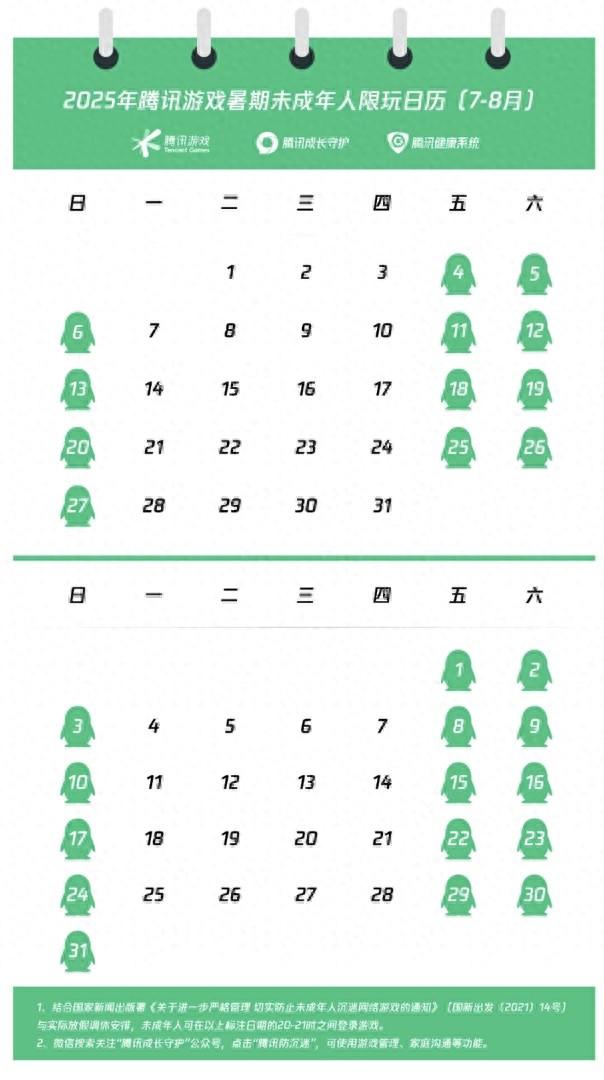
Core Points - The article discusses the implementation of strict gaming restrictions for minors by NetEase and Tencent during the summer of 2025 to prevent gaming addiction [1][4] - Both companies have established a gaming calendar that limits minors to play only on Friday, Saturday, and Sunday evenings from 8 PM to 9 PM, totaling a maximum of 27 hours for the entire summer [1][6] Company Measures - Tencent has introduced a comprehensive account management tool to address issues of account misuse by minors, including a "temporary game switch" feature that allows parents to set specific gaming durations [4] - The "face recognition verification" feature is also being implemented to prevent unauthorized access to gaming accounts during restricted hours [4] - NetEase has launched the "NetEase Minor Protection Platform," enabling parents to monitor their children's gaming time and spending, along with features like "one-click ban" and "one-click disable charging" for precise control [4] Industry Initiatives - NetEase announced a special initiative to combat black and gray market activities related to gaming, expanding its protective strategies beyond in-game restrictions to include measures against account rental and social platform scams [5]

初中生借《元梦之心》公屏聊天“组cp”;游戏社交安全亟待加强 | 20款手游未保测评2025①
2 1 Shi Ji Jing Ji Bao Dao· 2025-05-28 09:51
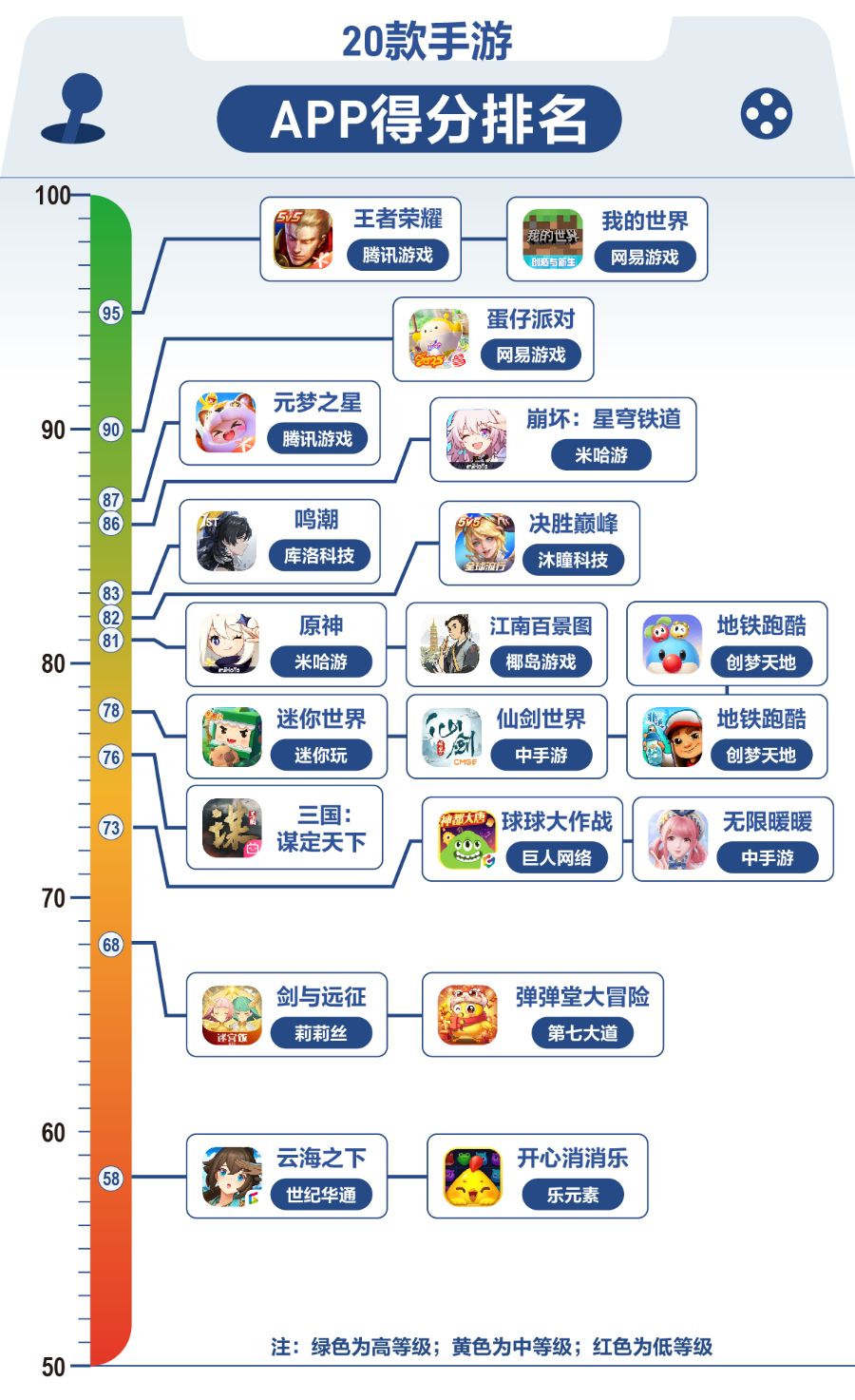
Core Viewpoint - The report evaluates the minor protection mechanisms in 20 mobile games, highlighting improvements in anti-addiction systems and the introduction of social protection measures for minors [1][4][9]. Group 1: Overview of Evaluation - The average score for the 20 evaluated mobile games is 78.30, with the highest scores being 95 for "Honor of Kings" and "Minecraft," and the lowest being 68 for "Under the Cloud" and "Happy Elimination" [4][9]. - The evaluation process involved simulating the actual gaming experience of minors, assessing the anti-addiction mechanisms at different stages: before, during, and after gameplay [4][9]. Group 2: Implementation of Anti-Addiction Measures - All 20 games implemented real-name authentication and age-appropriate restrictions, with 100% compliance in displaying user agreements and age warnings before gameplay [10][11]. - The games enforce time limits for minors, ensuring they can only play during designated hours, and restrict in-game purchases based on age [21][22]. Group 3: Social Protection Mechanisms - The evaluation introduced a focus on social protection mechanisms, addressing the risks minors face in online interactions, such as exposure to harmful content and privacy breaches [2][3][30]. - Most games provide features to block specific users and strangers, but less than half offer options to hide personal game information from unknown players [34]. Group 4: Customer Support Accessibility - The majority of the evaluated games (19 out of 20) have easily accessible customer support, allowing players to reach out for help within five steps [23][25]. - Improvements were noted in the handling of minor refund requests, with only 2 games requiring external channels for processing, down from 9 in the previous evaluation [28].