澳元升值

Search documents
学者:澳大利亚央行淡化澳元升值是在冒险
Sou Hu Cai Jing· 2026-02-17 06:42
Core Viewpoint - The Reserve Bank of Australia's policy meeting minutes downplay the role of the rising exchange rate in curbing inflation, according to Luci Ellis, Chief Economist at Westpac Banking Corporation [1] Group 1: Exchange Rate Impact - The recent appreciation of the Australian dollar largely reflects changes in interest rate expectations, which is expected to have a slight impact on inflation slowdown [1] - The recent sell-off of the US dollar is an independent factor that the Reserve Bank of Australia seems to have insufficiently considered [1] Group 2: Inflation Risks - Although the effects of the exchange rate changes may not be immediately apparent, they indicate some downside risks to imported goods inflation [1]
澳元强势攀升 加息落地支撑汇率走强
Jin Tou Wang· 2026-02-04 02:59
Core Viewpoint - The Australian dollar (AUD) has strengthened against the US dollar (USD) due to the Reserve Bank of Australia's (RBA) interest rate hike and the weakness of the USD, with expectations of continued upward momentum in the AUD exchange rate. Group 1: Economic Indicators - As of February 4, 2026, the AUD/USD exchange rate is 0.7031, showing a slight increase of 0.1282% within a daily range of 0.7011 to 0.7036 [1] - The RBA raised the cash rate by 25 basis points to 3.85% on February 2, 2026, marking it as the first major developed economy to implement tightening measures in 2026, driven by rising inflation pressures [1] - Australia's Consumer Price Index (CPI) rose to 3.8% in December 2025, exceeding market expectations, alongside strong private demand and a tight labor market [1] Group 2: Market Dynamics - The USD index fell by 0.22% to 97.39 on February 3, 2026, amid concerns over the long-term credit and policy easing of the USD, leading to capital outflows from USD assets and indirectly boosting non-USD currencies like the AUD [1] - The RBA's stance on inflation suggests that further rate hikes may be possible, maintaining a tight monetary policy that supports the AUD, contrasting with the Federal Reserve's recent rate cuts and easing measures [2] Group 3: Technical Analysis - The AUD/USD shows strong bullish momentum, with the weekly chart indicating a breakout from previous ranges and a clear bullish alignment in MACD indicators, suggesting sufficient upward momentum for the medium to long term [3] - Key resistance is identified at the 0.7050 level, with potential for further gains towards the 0.7100 mark if this level is breached, while 0.7000 serves as a critical support level [3]
澳元走高澳洲联储 政策立场成关键
Jin Tou Wang· 2025-12-11 02:53
Core Viewpoint - The Australian dollar (AUD) is experiencing fluctuations against the US dollar (USD) due to divergent monetary policies between the Federal Reserve and the Reserve Bank of Australia, alongside domestic inflation data and China's economic recovery [1][2][3] Group 1: Monetary Policy Divergence - The Federal Reserve announced a 25 basis point rate cut on December 11, lowering the federal funds rate target range to 3.50%-3.75%, marking the third consecutive cut this year [2] - In contrast, the Reserve Bank of Australia maintained its cash rate at 3.6% during its recent meeting, indicating a potential shift towards a more hawkish stance [2] - This "loose US, stable Australia" policy divergence has been a significant driver for the strengthening of the AUD against the USD [2] Group 2: Domestic Economic Indicators - Australia's consumer price index (CPI) rose by 3.8% year-on-year in October, marking the fourth consecutive month of increases, which is above the RBA's target range of 2-3% [2] - Analysts suggest that this inflation data nearly eliminates the possibility of a rate cut by the RBA in December, with some predicting a rate hike could occur as early as Q4 2026 [2] - There are signs of economic recovery in Australia, with consumer sentiment regarding future economic conditions showing significant improvement [2] Group 3: External Economic Factors - China's steady economic growth is providing potential support for the AUD, as Australia relies heavily on exports of commodities like iron ore to China [3] - The current global market sentiment is relatively stable, reducing the appeal of the USD as a safe haven, which offers slight upward movement for the AUD [3] - However, Australia faces challenges such as an expanding budget deficit and rising net debt, with projections indicating a decline in commodity exports exceeding 100 billion AUD over the next four years, which may constrain the AUD's long-term performance [3] Group 4: Future Outlook - Investors should monitor three key signals: the RBA's future policy statements, the Federal Reserve's anticipated policy path for 2026, and ongoing inflation data from Australia alongside China's economic recovery [3] - Changes in global trade dynamics and fluctuations in commodity demand could also lead to significant movements in the AUD/USD exchange rate, necessitating risk management strategies [3]
【财经分析】澳大利亚通胀涨势降低降息可能 澳元保有升值潜力
Xin Hua Cai Jing· 2025-11-26 14:41
Core Viewpoint - Australia's inflation rate has risen for the fourth consecutive month, reaching 3.8% in October, which strengthens expectations that the Reserve Bank of Australia (RBA) will maintain the benchmark interest rate in December and may consider raising rates in the coming years [1][2][3]. Inflation Data Summary - The overall inflation rate in Australia increased from 3.6% in September to 3.8% in October, with previous months showing rates of 1.9%, 3%, and 3.2% [1]. - The trimmed mean inflation rate, an important reference for the RBA, rose from 3.2% in September to 3.3% in October, with prior months at 2.8%, 3%, and 3% [1]. - The RBA's inflation target is set between 2-3%, indicating that current inflation levels exceed this target, making further rate cuts unlikely [1]. Economic Analyst Insights - Analysts are shifting focus from potential rate cuts to predicting the timing of rate hikes, with some suggesting that the RBA is unlikely to cut rates in December [2][3]. - The possibility of rate hikes is increasing, with forecasts suggesting that if inflation continues to rise, the RBA may raise rates as early as 2026 [3]. - Some analysts believe that the rise in October's inflation may be influenced by temporary factors, leading to only a slight adjustment in their annual inflation expectations [4]. Currency and Economic Outlook - Following the inflation data release, the Australian dollar strengthened, reflecting market expectations for the RBA to maintain rates [5]. - Reports indicate a stabilization in Australia's economic recovery, with significant increases in consumer confidence regarding future economic conditions [5]. - The relationship between the Australian dollar and China's economic performance suggests further appreciation potential for the Australian dollar [5].
大行晨:澳元有望再上年高位-2025年11月20日
光大新鸿基· 2025-11-20 04:42
Core Insights - The report indicates that the Australian dollar (AUD) is expected to test its highest levels within the year, driven by various economic factors [1] Group 1: Economic Factors - The Australian dollar's potential rise is attributed to strong commodity prices, particularly in iron ore and coal, which are significant exports for Australia [1] - The report highlights that the Reserve Bank of Australia (RBA) may maintain a hawkish stance, supporting the currency's strength [1] Group 2: Market Trends - There is an observed increase in foreign investment in Australia, which is likely to bolster demand for the Australian dollar [1] - The report notes that global economic recovery post-pandemic is contributing to a favorable environment for the Australian dollar [1]
澳元汇率持续飙升 对冲基金乘胜追击加大看涨押注
Zhi Tong Cai Jing· 2025-09-15 03:25
Core Viewpoint - Macro hedge funds are increasing their bets on the appreciation potential of the Australian dollar (AUD) as its exchange rate continues to strengthen, with a notable rise in demand for AUD call options [1][3] Group 1: Market Activity - Several hedge funds have recently increased their holdings of AUD call options, which will yield profits if the AUD strengthens against major currencies [1] - The US Depository Trust & Clearing Corporation (DTCC) reported that the AUD/USD options saw the most active trading days since late July, with call option volumes reaching three times that of put options [1] - Single trades exceeding 150 million AUD (approximately 100 million USD) have become frequent during these active trading days [1] Group 2: Economic Factors - The Australian dollar was the second-best performing major currency in September, following the Norwegian krone, driven by resilient domestic household spending, better-than-expected economic growth, rising commodity prices, and hawkish signals from the Reserve Bank of Australia [1] - The RBA Governor, Michele Bullock, indicated that strong consumer demand may limit the scope for interest rate cuts [1] Group 3: Broader Currency Trends - The bullish sentiment on the AUD is not limited to the USD; the AUD has also risen against other G10 currencies, reaching multi-month highs against the Canadian dollar (CAD) and Swiss franc (CHF) [3] - The AUD/CAD exchange rate has reached its highest level since November of the previous year, influenced by weak Canadian economic growth and labor data [3] - Following signals from the Swiss National Bank's President regarding potential interest rate cuts, the AUD/CHF exchange rate has also hit a new high since mid-June [3] - Hedge funds are increasingly using AUD call options to express their bullish views on the AUD against both the USD and other currencies like CAD and CHF [3]

突然疯涨!澳元,彻底站起来了!
Sou Hu Cai Jing· 2025-05-08 21:45
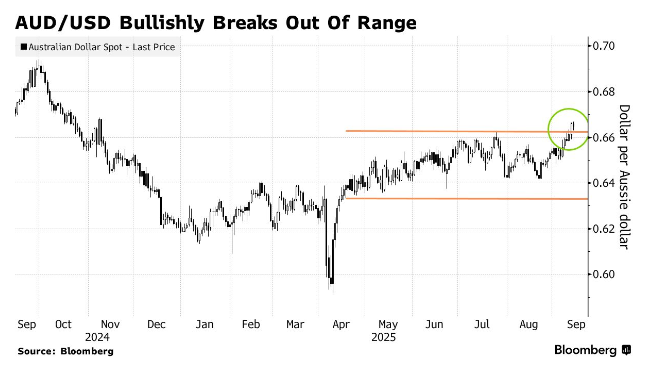
Group 1 - The Australian dollar (AUD) has surged to over 65 cents against the US dollar, marking a five-month high and the first time since early December last year [2] - The recent Australian election resulted in a significant victory for Albanese's Labor Party, securing 87 parliamentary seats and indicating strong public trust in the party [3][4] - The election outcome signals the end of political uncertainty in Australia, providing policy support for the AUD [5] Group 2 - Economic data supports the strength of the AUD, with the TD-MI inflation index rising 0.6% month-on-month in April, marking the second consecutive month of increase [7] - The annual inflation index increased to 3.3%, up from 2.8% previously [8] - The Judo Bank composite PMI for April stood at 51.0, indicating economic expansion for the seventh consecutive month [9] Group 3 - The ongoing trade tensions between the US and China have created market volatility, but recent indications of trade negotiations have improved market sentiment [11][14] - Any positive developments in US-China trade relations are likely to bolster the AUD due to Australia's close trade ties with China [17][22] - China's recent economic stimulus measures, including a 0.5 percentage point cut in the reserve requirement ratio, are expected to enhance demand for Australian exports, further supporting the AUD [19][20] Group 4 - The Federal Reserve's decision to maintain interest rates without changes reflects growing economic risks in the US, which may lead to a decline in the US dollar [23][26] - Concerns over the US economic outlook and potential political issues could trigger a sell-off of the US dollar, making the AUD more attractive to investors [28][30] - The strong Australian consumer inflation data has led to expectations of a potential interest rate cut by the Reserve Bank of Australia, but it also supports the AUD by reducing expectations for aggressive rate cuts [31][32] Group 5 - The political stability and economic recovery in Australia, combined with supportive external factors, suggest a positive outlook for the AUD [33][34] - The AUD is expected to continue its upward trajectory, driven by optimism regarding US-China trade relations and increased demand from China for Australian commodities [36][37]