
生态系统保护修复

Search documents
中央财政优化资金奖补政策 促进生态系统保护修复
Sou Hu Cai Jing· 2026-01-17 16:02
Group 1 - The central government will optimize funding subsidy policies during the "14th Five-Year Plan" period to promote ecosystem protection and restoration [1] - The subsidy ratio for "mountain-water projects" will be increased, with support for cross-provincial joint application projects, offering a maximum subsidy of 80%, not exceeding 2.5 billion [1] - For historical abandoned mine ecological restoration projects, the subsidy amount for each project will not exceed 300 million [1]
当好自然资源“大管家”和美丽中国“守护者”
Ren Min Ri Bao· 2025-11-29 01:05
Core Viewpoint - The construction of a beautiful China is a crucial goal for the comprehensive modernization of the socialist nation, emphasizing the harmonious coexistence of humans and nature [1] Group 1: Regional Economic Layout and Land Space System - The natural resources department aims to optimize the land space development pattern by balancing population, resources, and environmental factors [2] - Policies will be refined to enhance the implementation of the main functional area strategy, promoting differentiated development based on local advantages [2][3] - The department will maintain stability in urbanization areas, agricultural production zones, and key ecological function areas while optimizing specific functional areas [2] Group 2: Land Space Planning and Protection - The focus will be on dynamic assessment and optimization of land space planning, integrating major projects into a unified management system [3] - Strict adherence to the three control lines: farmland protection, ecological protection red lines, and urban development boundaries will be enforced [3] - The goal is to ensure the preservation of 1.865 billion acres of arable land and 1.546 billion acres of permanent basic farmland [3] Group 3: Resource Allocation and Support - The department will enhance the quality and efficiency of natural resource allocation, promoting comprehensive land supply and redevelopment of inefficient land [4] - Provincial governments will be granted greater autonomy in land use management, with a focus on integrated approval processes for various land uses [4] Group 4: Marine Economy and Ecological Protection - The "14th Five-Year" plan emphasizes strengthening marine development and protection, with a focus on high-quality marine economic growth [5] - The department will promote innovation in marine technology and establish platforms for marine research and development [6] - Collaborative efforts will be made to balance marine resource utilization with ecological protection, including the development of marine ecosystems [6] Group 5: Resource Security and National Safety - The natural resources sector is integral to national security, focusing on food, energy, and supply chain security [7] - Emphasis will be placed on protecting farmland and enhancing the quality of agricultural land through strategic planning [7] - The department will implement a new round of mineral exploration strategies to ensure resource security [7] Group 6: Geographic Information and Disaster Management - A new national spatial reference system will be established to support digital China initiatives and enhance disaster monitoring and response capabilities [8] - The department will focus on geological disaster prevention and response, particularly in high-risk areas [8] Group 7: Ecological Protection and Restoration - The department will prioritize the establishment of a natural protection area system, focusing on national parks and ecological restoration [9] - Efforts will be made to enhance the quality of forests and grasslands through large-scale greening initiatives [10] - The development of a market mechanism for ecological compensation and resource rights will be explored to promote sustainable resource management [10]
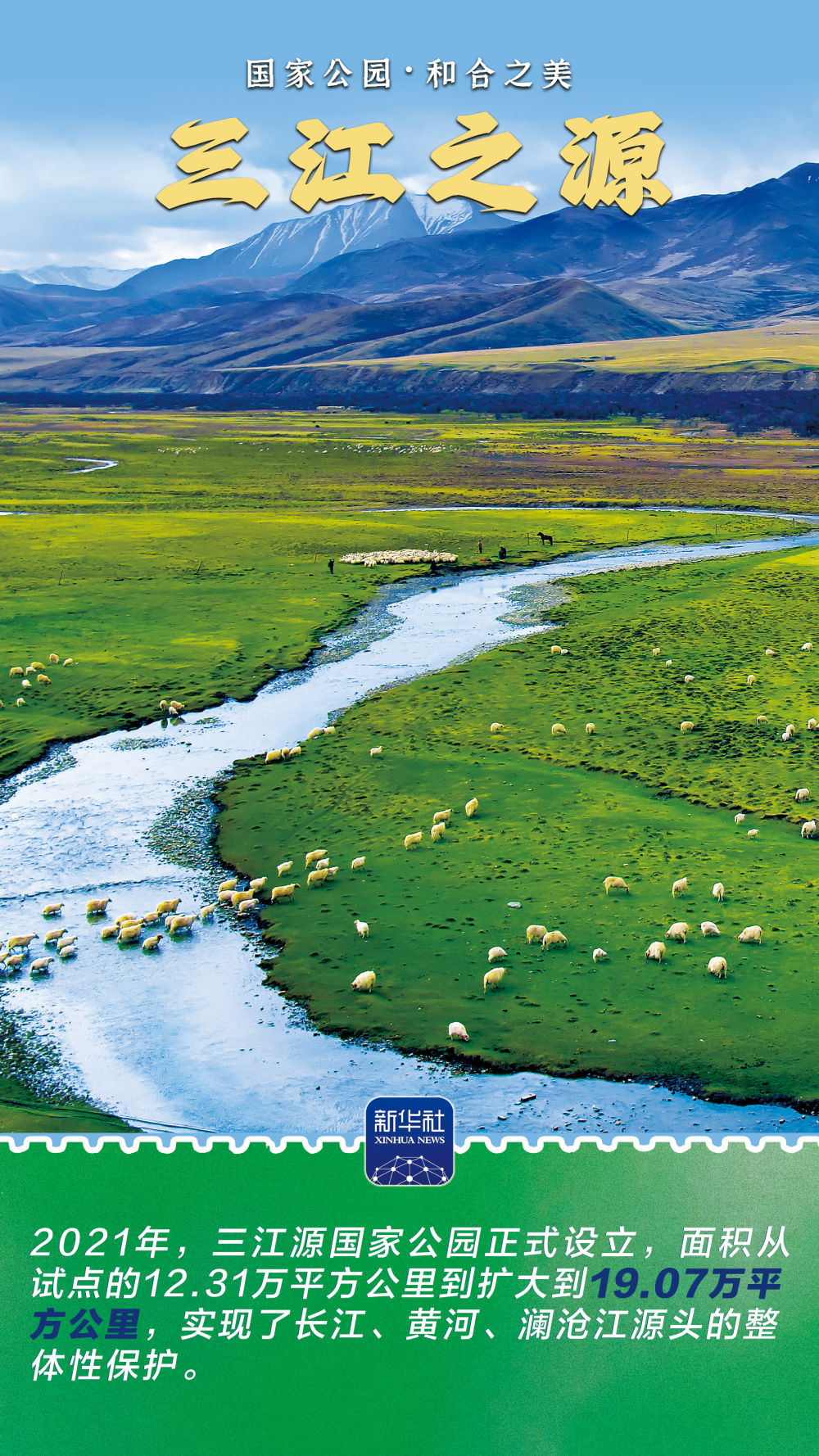
三江源国家公园:中华水塔、稳固丰盈
Xin Hua She· 2025-10-21 04:02
Core Viewpoint - The establishment of Sanjiangyuan National Park has significantly improved the ecological environment and biodiversity in the region, marking the 10th anniversary of China's national park system reform [1][3]. Group 1: Park Establishment and Area - Sanjiangyuan National Park was officially established in 2021, expanding from an initial area of 123,100 square kilometers to 190,700 square kilometers, achieving comprehensive protection of the sources of the Yangtze, Yellow, and Lancang Rivers [3]. Group 2: Ecological Improvements - The ecological environment in the Sanjiangyuan region has continuously improved under the national park system, with significant increases in the populations of wildlife such as Tibetan antelope, Tibetan gazelle, and Tibetan wild donkey [11][13]. - The number of Tibetan antelope has recovered from fewer than 20,000 to over 100,000 [13]. Group 3: Biodiversity and Species - As of September 2024, the park is home to 30 species of wild terrestrial vertebrates, including key protected species such as Tibetan antelope and wild yak [18]. - The park contains 832 species of seed plants and 200 species of wild vascular plants, making it a core distribution area for seed plants in the Sanjiangyuan region [21]. Group 4: Local Community Involvement - The park has implemented a public welfare job hiring system for ecological protection, transforming local herders into ecological protectors, which has led to an average annual income increase of 12,700 yuan for ecological caretakers [24].

高质量完成“十四五”规划 我国持续开展调查监测,自然资源家底更厚
Ren Min Ri Bao· 2025-09-12 00:40
Core Insights - The article highlights the significant progress made in China's natural resource management during the "14th Five-Year Plan" period, emphasizing achievements in land, mineral, and marine resources, as well as ecological conservation efforts [1][2][3]. Group 1: Agricultural and Land Resources - The total arable land area in China reached 1.94 billion acres, with a commitment to protect this land [1] - By the end of 2024, the arable land area is expected to increase by 28 million acres compared to 2020, establishing a three-dimensional protection framework for quantity, quality, and ecology [2] - Over 10 million acres have been rehabilitated through comprehensive land management efforts [4] Group 2: Mineral Resources - Major breakthroughs in mineral exploration have been achieved, including the discovery of 10 large oil fields and 19 large gas fields during the "14th Five-Year Plan" [2] - Significant progress in the exploration of strategic minerals such as oil, gas, copper, and lithium has been reported, supporting stable production levels of 200 million tons of oil and over 240 billion cubic meters of natural gas [2] - New resource bases are emerging, with notable discoveries in lithium across four provinces, forming a 2,800-kilometer "Asian lithium belt" [3] Group 3: Marine Resources - The marine economy has shown strong growth, with the marine production value reaching 10.5 trillion yuan, an increase of 2.7 trillion yuan since 2020 [1] - China has maintained its position as the world's largest producer of marine products for 36 consecutive years, with marine oil and gas becoming key contributors to domestic production increases [3] Group 4: Ecological Conservation - The forest coverage rate has reached 25.09%, making China one of the fastest-growing countries in terms of green coverage [1] - The area of national parks has expanded significantly, with five national parks established, integrating over 120 existing natural reserves [5][6] - The "Three North" project has successfully implemented 415 projects, restoring 16.4 million acres of land [4] Group 5: Digital and Technological Advancements - The construction of a unified management platform for natural resource management has improved governance efficiency [7] - The establishment of a national satellite navigation network and the implementation of international scientific projects highlight China's commitment to technological innovation in resource management [7]
全国耕地面积达19.4亿亩 较2020年增加2800万亩
Ren Min Ri Bao Hai Wai Ban· 2025-09-12 00:14
Core Viewpoint - The news highlights the achievements of China's natural resources management during the "14th Five-Year Plan" period, emphasizing the effective support for high-quality economic and social development through comprehensive resource management and protection strategies [1][2][3][4][5] Group 1: Agricultural Land and Resource Management - By the end of 2024, the total cultivated land area in China is projected to reach 19.4 billion mu, an increase of 28 million mu compared to 2020, effectively maintaining the cultivated land protection red line [1] - The Ministry of Natural Resources has established a comprehensive national land spatial planning framework, optimizing urban, agricultural, and ecological spatial patterns to ensure food security and control urban sprawl [2] Group 2: Resource Exploration and Environmental Protection - China has clarified the quantity, distribution, and utilization status of 163 types of mineral resources, discovering 534 new large and medium-sized oil and gas fields and mineral sites, with significant breakthroughs in the exploration and development of strategic minerals [3] - The country has achieved a marine production value of 10.5 trillion yuan, an increase of 2.7 trillion yuan since 2020, while maintaining over 35% of the natural coastline [3] Group 3: Ecosystem Restoration and Land Management - The Ministry has completed the restoration of over 10 million mu of land and has implemented integrated protection and governance of ecosystems, including the restoration of 240 million mu of abandoned mines and 820 kilometers of coastlines [4] - The "Three North" project has successfully completed the construction of 164 million mu, reinforcing ecological safety barriers [4] Group 4: Resource Utilization and Policy Support - The Ministry has issued over 80 resource allocation policies to promote industrial structure adjustment and green transformation, with over 5 million mu of idle land disposed of and 1.71 million mu of low-efficiency land redeveloped [5] - The Ministry has improved the convenience of real estate registration, enabling cross-province processing of mortgage registrations and achieving full online services for high-frequency registration matters in key regions [5]
福建主要流域国控断面优良水质比例首次达到100%
Zhong Guo Chan Ye Jing Ji Xin Xi Wang· 2025-06-05 23:14
Core Viewpoint - The ecological environment quality in Fujian Province is stable and improving, maintaining a leading position nationally in 2024, with significant progress in air, water, and ecological quality [1][2][3]. Air Quality - In 2024, the proportion of good air quality days in nine cities reached 98.3%, with PM10 and PM2.5 annual average concentrations decreasing year-on-year. Fuzhou and Xiamen ranked 5th and 3rd respectively among 168 key cities in China [1][2]. Water Quality - The proportion of good water quality (Class I-III) at national control sections reached 100% for the first time, with Class I-II water quality at 77.1%. The quality of the Min River and the Jiulong River also showed significant improvements [1][2]. Marine Quality - Nearshore seawater quality improved, with 92.6% of the area classified as good (Class I-II), marking the first time it exceeded 90% [2]. Ecological Quality - The Ecological Quality Index (EQI) stood at 75.06, showing a year-on-year increase of 0.04. The forest coverage rate reached 65.12%, maintaining the top position in the country for 46 consecutive years [2][3]. Pollution Prevention - Continuous efforts in pollution prevention have led to excellent assessments for five consecutive years. Initiatives include air quality improvement plans and comprehensive management of key river basins [3][4]. Ecosystem Protection - The province is advancing integrated protection and management of ecosystems, with a focus on creating a comprehensive protection framework from mountains to oceans [4][5]. Environmental Governance - Fujian has established a robust mechanism for monitoring and regulating environmental issues, achieving top rankings in national assessments for ecological enforcement [4][5]. Green Development - The province is accelerating its transition to a green and low-carbon economy, implementing various measures to enhance energy efficiency and promote sustainable practices [3][5].