生物制造等

Search documents
我国将建一批具全球竞争力产业集群
Zhong Guo Zi Ran Zi Yuan Bao· 2026-01-30 07:24
Group 1 - The core viewpoint of the articles highlights the progress and strategic direction of central enterprises in China towards high-quality development by 2025, focusing on major national technological projects and advancements in various industries [1][2] - By 2025, central enterprises are expected to lead or participate in all 22 major national technological projects, achieving breakthroughs in 121 leading technologies, including the development of the first electromagnetic catapult aircraft carrier [1] - The construction of a modern industrial system is emphasized as a crucial support for advancing Chinese-style modernization, with significant progress in actions related to industrial renewal, future industries, and "AI+" initiatives [1] Group 2 - The State-owned Assets Supervision and Administration Commission (SASAC) will guide central enterprises to focus on intelligent, green, and integrated development, enhancing their advantages to build a modern industrial system that is self-controlled, safe, reliable, and competitive [2] - The key focus areas include "three concentrations," which involve adjusting existing structures and optimizing new investments to enhance the integrity, advancement, and safety of China's industrial system [2] - The main goal is to create a number of emerging pillar industries by establishing market-oriented and specialized state capital operation platforms, with a focus on sectors such as new energy, new energy vehicles, aerospace, and quantum technology, among others [2]
央企2025“成绩单”:资产超95万亿元 利润2.5万亿元
Xin Lang Cai Jing· 2026-01-28 21:00
Core Insights - By the end of 2025, state-owned enterprises (SOEs) are projected to have total assets exceeding 95 trillion yuan and achieve a total profit of 2.5 trillion yuan, with fixed asset investments reaching 5.1 trillion yuan and tax contributions of 2.5 trillion yuan [1][2] - R&D investment is expected to reach 1.1 trillion yuan, maintaining over 1 trillion yuan for four consecutive years, with significant advancements in various cutting-edge fields through the participation of over 100 innovative entities in 23 innovation alliances [1][2] - Investments in strategic emerging industries are projected to total 2.5 trillion yuan, accounting for 41.8% of total investments, with revenue from these industries exceeding 12 trillion yuan, marking a consistent annual growth of 1 trillion yuan for three years [1][2] Investment and Development - SOEs are expected to have over 70% of their revenue coming from sectors critical to national security, the economy, and public welfare by 2025 [2] - Cumulative investments and support funds are anticipated to reach 16.03 billion yuan and 11.41 billion yuan respectively, with training for 1.487 million personnel and procurement of agricultural products from poverty-stricken areas amounting to 19.83 billion yuan [2] - New enterprises such as China Yajiang Group and China Chang'an Automobile are being established, while existing companies like China FAW and China Tourism Group are integrating resources in sectors like power batteries and cruise operations [2] Future Directions - The State-owned Assets Supervision and Administration Commission (SASAC) aims to create new pillar industries by establishing market-oriented and specialized platforms for state capital operations, focusing on sectors such as new energy, new energy vehicles, new materials, aerospace, low-altitude economy, quantum technology, and 6G [2]
利好来了!上海,重磅发布!事关商业航天、机器人……
证券时报· 2026-01-10 08:15
Core Viewpoint - The Shanghai Municipal Government has released a three-year action plan (2026-2028) to support the transformation and upgrading of advanced manufacturing, focusing on structural optimization, innovation, quality improvement, and resource support [1][3]. Group 1: Action Plan Overview - The action plan aims to add 100 manufacturing enterprises with an annual output value exceeding 1 billion yuan by 2028, totaling over 600, and to drive the addition of 500 large-scale industrial enterprises in the supply chain [3]. - It emphasizes the development of new-generation electronic information, smart connected vehicles, high-end equipment, advanced materials, green low-carbon products, and fashion consumer goods [3][4]. Group 2: Investment in Emerging Fields - The plan encourages investment in emerging sectors such as low-altitude economy, commercial aerospace, embodied intelligence, biomanufacturing, and smart terminals, aiming to accelerate the development of innovative products like eVTOLs, commercial rockets, and humanoid robots [1][4]. Group 3: Innovation and Research Support - The action plan proposes financial incentives for companies increasing their basic research investments, with one-time subsidies ranging from 200,000 to 1 million yuan based on the level of investment [6]. - It focuses on core technology breakthroughs in areas like laser manufacturing, quantum technology, and new functional materials, supporting key industries such as integrated circuits and high-end equipment [6]. Group 4: Quality and Efficiency Enhancement - The plan includes an "AI + manufacturing" initiative to enhance digitalization in manufacturing, aiming for full coverage of smart factory applications by 2028 and increasing robot density to 600 units per 10,000 people [7]. - It promotes green transformation by encouraging the development of low-carbon products and supporting energy-saving upgrades with financial rewards [7]. Group 5: Financial Support Mechanisms - The action plan outlines financial support for key industrial chains, including lower interest rates and higher loan limits for manufacturing loans, with interest subsidies ranging from 0.8% to 1.3% [8]. - It also encourages the issuance of technology innovation bonds and customized insurance services for major technological equipment [8].


中芯国际港股获南向资金连续7日净买入!千亿ETF大厂热推国内首只港股信息技术ETF(159131)全网发售
Xin Lang Ji Jin· 2025-10-31 02:03
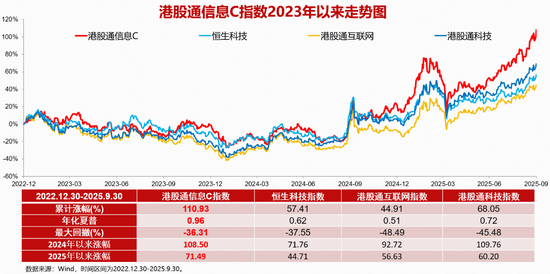
Core Insights - The article highlights the positive momentum in the semiconductor and AI computing sectors following the unexpected outcomes of the US-China summit on October 30, which has led to a continuous net buying of SMIC shares in the Hong Kong market for seven consecutive days, totaling HKD 30.44 billion [1][6] - The launch of the first Hong Kong information technology ETF (159131) is gaining attention as it tracks the CSI Hong Kong Stock Connect Information Technology Composite Index, which focuses on semiconductor, electronics, and software sectors [1][2] Group 1: Market Trends - The Hong Kong Stock Connect Information Technology Composite Index consists of 41 hard technology companies, with a composition of 70% hardware and 30% software, emphasizing a strong focus on semiconductor and electronic sectors [3][5] - The index has shown significant performance, with a cumulative increase of 110.93% from December 30, 2022, to September 30, 2025, outperforming other Hong Kong technology indices [5][8] Group 2: Investment Opportunities - The ETF provides a tool for investors to capitalize on the growth of hard technology assets in Hong Kong, particularly in the semiconductor sector, where SMIC holds a weight of 19.41% in the index [5][6] - The index's high concentration in leading companies aligns with the objective of capturing long-term growth opportunities in the technology sector [5][6] Group 3: Future Outlook - The article indicates a strong demand for quality hard technology companies in Hong Kong, with expectations for more listings in the future, driven by the increasing participation of international long-term funds in the IPO market [6][8] - The current price-to-earnings ratio of the index stands at 42.68, significantly lower than other major global technology indices, suggesting potential growth opportunities for investors [6][8]