
新材料等

Search documents
沪深交易所发布!主板科技型企业利好!
证券时报· 2026-03-27 10:25
Core Viewpoint - The Shanghai and Shenzhen Stock Exchanges have revised the "Light Asset, High R&D Investment" recognition standards, expanding their applicability to main board companies, allowing for more flexible refinancing for R&D investments [1][4][8]. Group 1: Recognition Standards - The recognition standards for "light asset" require that physical assets account for no more than 20% of total assets [7][8]. - The "high R&D investment" standard mandates that the average R&D investment over the last three years must be at least 15% of operating income, or the cumulative R&D investment over the last three years must be no less than 300 million yuan, with an average R&D investment ratio of at least 5% [7][8]. Group 2: Policy Implications - The revision aims to enhance the inclusivity and adaptability of the refinancing system, responding to market demands and supporting technology-driven companies [4][9]. - The policy is expected to facilitate the transformation and upgrading of traditional industries while fostering the development of new productive forces [9]. Group 3: Historical Context and Implementation - The "light asset, high R&D investment" standards were previously piloted in the Sci-Tech Innovation Board and the Growth Enterprise Market, with the main board now included in this framework [10][11]. - As of now, 14 companies on the Sci-Tech Innovation Board have utilized these standards for refinancing, with a total intended financing of 35.12 billion yuan, representing 37% of the number of companies and 76% of the intended financing amount for 2025 [10].


香港生产力局:香港将因地制宜发展新质生产力 建设国际创新科技中心
智通财经网· 2026-03-12 12:16
Core Viewpoint - The Hong Kong Productivity Council welcomes the central government's work report, emphasizing the integration of technology and industrial innovation to support the development of the Greater Bay Area as an international innovation and technology hub [1][2] Group 1: Government Initiatives - The central government report highlights the acceleration of technological self-reliance and the development of a modern industrial system, focusing on artificial intelligence and the optimization of traditional industries [1] - The report includes a dedicated section for Hong Kong, indicating the importance of the region's international advantages and the support from the central government [1] Group 2: Strategic Focus Areas - The Productivity Council aims to enhance autonomous innovation and provide technological support, focusing on strategic industries such as new generation information technology, new energy, new materials, and intelligent connected vehicles [1] - Future industries like quantum technology and hydrogen energy will also be prioritized, along with the development of marine and low-altitude economies [1] Group 3: Service Industry Development - The Productivity Council plans to improve the productive service industry system, enhancing capabilities in technology services, intellectual property, and certification [2] - The council will assist enterprises in expanding their manufacturing and service networks internationally through initiatives like The Cradle outbound service center [2] Group 4: Future Outlook - The Productivity Council sees the current year as a golden opportunity for Hong Kong to align with national strategies, focusing on future manufacturing, AI innovation, and empowering small and medium enterprises [2] - The goal is to establish Hong Kong as a world-class source of innovation and technology, contributing to high-quality national development and expanding overseas market opportunities [2]
科创板指数3月13日盘后进行一季度调样 总市值覆盖率将达63%
Shang Hai Zheng Quan Bao· 2026-02-27 19:03
Core Viewpoint - The adjustment of the STAR Market indices will enhance the representativeness of the indices in the STAR Market, with a total market capitalization coverage of 63% after the changes [2]. Group 1: Index Adjustments - The STAR 50 Index will include Guodun Quantum, Zhongke Feimeng, and Zhongke Xingtou, while 10 other securities will be added to the STAR 100 Index, including Rejing Bio, Sry New Materials, and Junshi Biosciences [1]. - After the adjustments, the total market capitalization of the STAR 50 Index will reach 4.5 trillion yuan, with a coverage rate of 39%, and the STAR 100 Index will have a total market capitalization of 2.7 trillion yuan, with a coverage rate of 24% [2]. Group 2: Market Representation - The combined market capitalization coverage of the STAR 50 and STAR 100 indices will increase by 1.1 percentage points, effectively representing the performance of large and medium-sized securities in the STAR Market [2]. - The STAR 50 and STAR 100 indices will achieve orderly sample interchange, with samples entering and exiting between the two indices, thereby enhancing their collaborative representation of the STAR Market [2]. Group 3: Future Developments - The Shanghai Stock Exchange aims to continue improving the index system to support the development of new productive forces and facilitate long-term capital inflow into the market [2]. - By 2025, a comprehensive index representing new productive forces will be launched, providing investors with a balanced tool to observe the overall performance of the STAR Market [3]. - The STAR Comprehensive Index has seen a 68% increase since its launch, making it one of the best-performing comprehensive indices in the domestic market [3].
四大重点项目落户浑南科技城
Xin Lang Cai Jing· 2026-02-25 22:06
Core Insights - The conference emphasized the integration of technological and industrial innovation in the Hunnan Science and Technology City, aiming to lead industrial innovation through technological advancements and cultivate new productive forces [1] Group 1: Achievements and Innovations - The "Top Ten Innovations of Hunnan Science and Technology City for 2025" were announced, showcasing significant contributions from leading institutions such as the Liaoning Materials Laboratory and the Chinese Academy of Sciences [2] - These innovations span critical fields including advanced materials, high-end equipment, precision instruments, heavy-duty power, and intelligent systems, with several published in top international journals and recognized with national awards [2] Group 2: New Projects and Initiatives - Four major projects were officially signed to settle in Hunnan Science and Technology City, including the Northeast Asia Intelligent Innovation Center and the Shenyang National Data Annotation Base, enhancing the region's innovative resources [3] - The "Innovation Coffee Gathering" platform was launched, focusing on key industries such as integrated circuits, high-end equipment, artificial intelligence, and new materials [3] Group 3: Discussions on Business and Innovation - The conference featured discussions on building a favorable business environment and nurturing new productive forces, with insights from entrepreneurs, scientists, and financial experts on the challenges and opportunities in technology commercialization [4] - Hunnan district leaders highlighted the importance of transitioning from construction to innovation-driven development, focusing on enhancing innovation supply quality and building a modern industrial system [4]
“296X”产业岗位率先“抢人” 春节后首场人才招聘会明日启幕
Mei Ri Shang Bao· 2026-02-24 14:17
Group 1 - The first offline job fair after the Spring Festival will take place in Hangzhou, aiming to connect enterprises with job seekers and support the talent needs of key industries such as the "296X" advanced manufacturing cluster [1][2] - This event is strategically timed to coincide with the peak job-seeking period after the holiday, providing job seekers with an opportunity to connect with quality employers and avoid later competition [2] - The job fair focuses on the "296X" advanced manufacturing development strategy, targeting key sectors like artificial intelligence, high-end general equipment, biomedicine, and new materials, offering high-tech and high-growth positions [3] Group 2 - The recruitment event marks the beginning of the 2026 "Spring Talent Recruitment Month" in Hangzhou, with a series of specialized job fairs planned for various industries and demographics over the next month [3] - An annual recruitment conference, the 2026 "Spring Start" Youth Talent Exchange Conference, will be held on March 14, featuring over 1,200 participating organizations to support economic recovery and growth [4] - The job fair is scheduled for February 25 from 9:00 AM to 4:00 PM, encouraging job seekers to participate and contribute to a successful start to the job market [4]
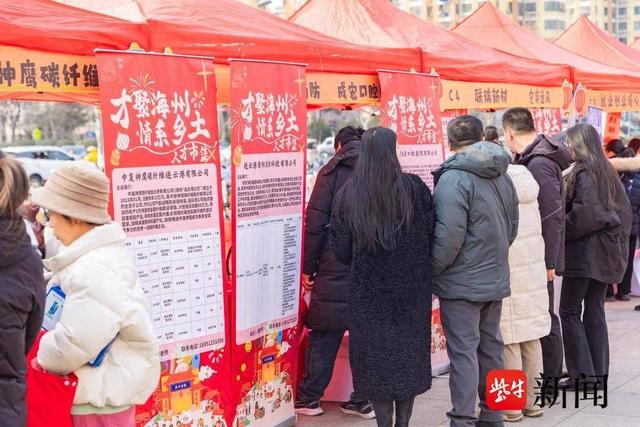
年味里飘出就业香 海州乡土人才市集767个岗位引才聚智
Xin Lang Cai Jing· 2026-02-17 12:11
Core Insights - The event "Talent Gathering in Haizhou" aimed to attract talents back to their hometown for development, providing 767 quality job opportunities and integrating cultural elements into the recruitment process [2][3][8] Group 1: Event Overview - The talent market featured 767 job opportunities and combined job recruitment with cultural showcases, creating an immersive job-seeking experience [2] - The event targeted "returning to hometown for entrepreneurship," inviting 15 reputable companies to recruit talents on-site [3] - A dual approach of offline and online recruitment was employed, attracting over 1,000 job seekers in person and over 10,000 online viewers [4] Group 2: Job Opportunities - The participating companies offered 74 diverse job positions across various fields, including R&D, manufacturing, brand operation, and modern services [3] - Job positions were tailored to different demographics, including roles for recent graduates, experienced professionals, and skilled workers [3] Group 3: Cultural Integration - The event incorporated local cultural heritage and non-material cultural elements, featuring skill demonstrations and product exhibitions [6][7] - Traditional crafts such as calligraphy and paper-cutting were showcased, enhancing the cultural atmosphere of the event [6] Group 4: Support Services - A "Warm Service Zone" was established to provide one-stop services for job seekers, including employment internships, living subsidies, and housing vouchers [8] - The event also promoted a vocational skills enhancement program specifically for young talents, simplifying the registration process [8] Group 5: Future Plans - The Haizhou district aims to continue developing diverse, high-quality events to enhance talent exchange and optimize the talent development ecosystem [8] - The district is committed to creating an attractive environment for returning talents and vibrant young professionals to settle and thrive in Haizhou [8]
上市公司再融资更加灵活
Xin Lang Cai Jing· 2026-02-12 22:41
Core Viewpoint - The Shanghai and Shenzhen Stock Exchanges have announced a package of measures to optimize refinancing, enhancing convenience and flexibility to better serve technological innovation and new productivity development [1] Group 1: Support for Quality Listed Companies - The exchanges will optimize refinancing reviews for quality listed companies that demonstrate good governance and information disclosure, aiming to improve refinancing efficiency [1] - Quality listed companies will be supported in using raised funds for new industries, new business formats, and new technologies that align with their main business, targeting second growth curve businesses [1] - The focus will be on the necessity of fundraising projects and the rationality of financing scale, which will enhance review precision and respond quickly to refinancing needs, especially for technology innovation companies [2] Group 2: Adaptation to Technology Innovation Enterprises - The exchanges have introduced a "light asset, high R&D investment" recognition standard for main board listed companies, optimizing the refinancing interval requirements [2] - For technology companies that are unprofitable and have nearly exhausted previous fundraising, the refinancing interval is adjusted to no less than 6 months [2] - Companies facing share price declines can reasonably finance through private placements or convertible bonds, with raised funds directed towards their main business [2] Group 3: Enhancing Flexibility and Convenience - When disclosing refinancing plans, listed companies must briefly disclose the usage of previous raised funds and the progress of future usage, with a principle that previous funds should be nearly fully utilized [2] - The exchanges will improve the announcement requirements for refinancing plans, particularly for lock-up private placements aimed at acquiring control of listed companies, ensuring that issuers commit to completing the issuance within the validity period of the approval [2] Group 4: Strengthening Regulatory Oversight - There will be increased regulatory scrutiny during and after the refinancing process, with strict penalties for violations [2] - The exchanges are seeking public opinion on the "light asset, high R&D investment" recognition standard, allowing qualifying companies to use over 30% of raised funds for R&D related to their main business [2] Group 5: Industry Trends - Main board companies are actively engaging in cutting-edge technology research and industry transformation, with a focus on strategic emerging industries such as new generation information technology, high-end equipment manufacturing, biomedicine, and new materials [3] - These companies typically have a low proportion of fixed assets and a high proportion of intangible assets, requiring stable funding support for ongoing R&D to meet innovation demands [3] - The expansion of the "light asset, high R&D investment" recognition standard is a key measure to enhance refinancing flexibility, encouraging main board companies to strengthen and improve through refinancing for high-quality development [3]
聚焦重点 抢抓机遇 攻坚突破 真抓实干
Xin Lang Cai Jing· 2026-01-31 23:41
Group 1 - The successful convening of the provincial two sessions signals a call to action for revitalizing and accelerating the construction of a modern socialist strong province [1] - The focus will be on enhancing the level of openness, aiming to become a leader in China's northern opening-up strategy, with initiatives to boost foreign trade and develop cross-border e-commerce [1] - Key infrastructure projects include the construction of the Mudanjiang-Dunhua Railway and the expansion of Hailang Airport, aimed at creating a comprehensive transportation network [1] Group 2 - The strategy includes enhancing technological innovation capabilities and optimizing the innovation ecosystem around universities and research institutions, particularly in key sectors like biomedicine and new materials [2] - There is a commitment to upgrading traditional industries and promoting digital transformation among small and medium-sized enterprises, focusing on sectors such as green food and equipment manufacturing [2] - The development of cultural tourism is emphasized, with plans to integrate tourism resources and create a comprehensive product system that includes unique travel experiences [2]
央企2025“成绩单”:资产超95万亿元 利润2.5万亿元
Xin Lang Cai Jing· 2026-01-28 21:00
Core Insights - By the end of 2025, state-owned enterprises (SOEs) are projected to have total assets exceeding 95 trillion yuan and achieve a total profit of 2.5 trillion yuan, with fixed asset investments reaching 5.1 trillion yuan and tax contributions of 2.5 trillion yuan [1][2] - R&D investment is expected to reach 1.1 trillion yuan, maintaining over 1 trillion yuan for four consecutive years, with significant advancements in various cutting-edge fields through the participation of over 100 innovative entities in 23 innovation alliances [1][2] - Investments in strategic emerging industries are projected to total 2.5 trillion yuan, accounting for 41.8% of total investments, with revenue from these industries exceeding 12 trillion yuan, marking a consistent annual growth of 1 trillion yuan for three years [1][2] Investment and Development - SOEs are expected to have over 70% of their revenue coming from sectors critical to national security, the economy, and public welfare by 2025 [2] - Cumulative investments and support funds are anticipated to reach 16.03 billion yuan and 11.41 billion yuan respectively, with training for 1.487 million personnel and procurement of agricultural products from poverty-stricken areas amounting to 19.83 billion yuan [2] - New enterprises such as China Yajiang Group and China Chang'an Automobile are being established, while existing companies like China FAW and China Tourism Group are integrating resources in sectors like power batteries and cruise operations [2] Future Directions - The State-owned Assets Supervision and Administration Commission (SASAC) aims to create new pillar industries by establishing market-oriented and specialized platforms for state capital operations, focusing on sectors such as new energy, new energy vehicles, new materials, aerospace, low-altitude economy, quantum technology, and 6G [2]
国务院国资委:去年央企资产总额突破95万亿元
Qi Huo Ri Bao Wang· 2026-01-28 18:44
Core Viewpoint - The State-owned Assets Supervision and Administration Commission (SASAC) outlines ambitious targets for central enterprises by 2025, including total assets exceeding 95 trillion yuan and profit reaching 2.5 trillion yuan, emphasizing the role of these enterprises in supporting national economic goals [1][2]. Group 1: Financial Performance and Investment - By the end of 2025, central enterprises are expected to achieve total assets of over 95 trillion yuan and profits of 2.5 trillion yuan, with fixed asset investments of 5.1 trillion yuan and tax contributions of 2.5 trillion yuan [1]. - During the "14th Five-Year Plan" period, central enterprises' total assets increased from 70 trillion yuan to 90 trillion yuan, with an average annual growth rate of 6.9% [1]. - The total profit of central enterprises reached 12.7 trillion yuan, marking a 56.2% increase compared to the previous five-year period [1]. Group 2: Research and Development - Central enterprises' R&D investment is projected to reach 1.1 trillion yuan in 2025, maintaining over 1 trillion yuan for four consecutive years, with 23 innovation alliances involving over 100 entities [1]. - Cumulatively, R&D investment during the "14th Five-Year Plan" exceeded 5 trillion yuan, with an increase in R&D intensity by 0.27 percentage points and a nearly 50% rise in the number of technology talents [2]. Group 3: Strategic Initiatives and Reforms - SASAC plans to focus on the "three concentrations" of state capital, emphasizing restructuring and integration to optimize the layout and structure of state-owned enterprises [2]. - Future initiatives include promoting high-quality mergers and acquisitions to acquire core resources and enhance technological capabilities, while reducing industry competition [2]. - The central enterprises' 2026 work plan emphasizes five key areas: improving quality and efficiency, enhancing technological innovation, optimizing layout, advancing reforms, and strengthening risk prevention [3].